
An attorney client agreement in a disability case is a written contract that defines the terms of legal representation, including the scope of services, fee structure, and payment conditions between you and your disability attorney. The Social Security Administration (SSA) governs how these contracts work for Social Security Disability Insurance (SSDI) and Supplemental Security Income (SSI) claims, which makes disability attorney contracts different from standard legal agreements. Understanding what your client lawyer agreement contains before you sign protects you from unexpected costs and sets clear expectations for your disability case representation. This guide covers every component you need to know, from SSA fee caps to fee petitions.
What are the essential components of an attorney client agreement for a disability case?
A disability attorney contract must cover six core areas: scope of representation, fee structure, payment terms, expense handling, communication expectations, and termination conditions. Each element directly affects what you pay and what your attorney is obligated to do.
Scope of representation defines exactly which services your attorney will provide. This includes filing your initial SSDI application, gathering medical evidence, representing you at hearings before an Administrative Law Judge (ALJ), and handling appeals to the Appeals Council or federal court. If your attorney's scope excludes federal court appeals, that must be stated in writing.

Fee structure in disability cases almost always follows a contingency model. You pay nothing unless you win. The fee agreement process governs about 95% of disability cases, with SSA approving the capped fee before any payment is made. That statistic reflects how standardized and regulated this process is compared to other areas of law.
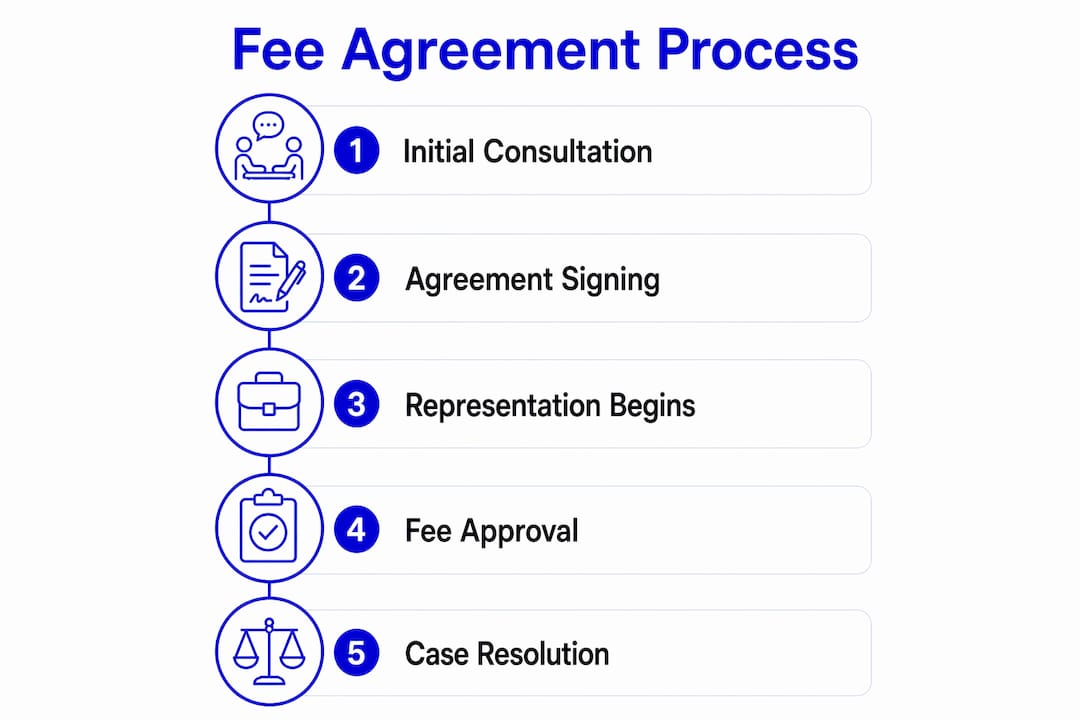
Payment terms are tied directly to SSA approval. Your attorney cannot collect a fee until the SSA reviews and authorizes it. SSA Form SSA-1696, the Appointment of Representative form, formally registers your attorney with the SSA and authorizes direct payment from your back pay.
Here are the key contract elements to confirm before signing:
- Scope of services: initial application, appeals, ALJ hearings, and federal court coverage
- Fee type: contingency, hourly, or flat fee (contingency is standard for SSDI)
- Fee cap acknowledgment: the lesser of 25% of past-due benefits or $9,200
- Expense clause: which out-of-pocket costs you owe separately from the capped fee
- Communication terms: response time expectations and case update frequency
- Termination policy: conditions under which either party can end the agreement
Pro Tip: Ask your attorney to walk you through the expense clause line by line. Costs like medical record retrieval, expert evaluations, and copying fees are often billed separately from the attorney fee cap and can add up to several hundred dollars.
How does the attorney fee agreement process work in Social Security disability claims?
The fee agreement process follows a defined sequence that the SSA controls from start to finish. Here is how it works:
- Sign the fee agreement before a favorable decision. The fee agreement must be signed by both you and your attorney before the SSA issues a favorable ruling. Agreements signed after the decision are not eligible for the standard fee agreement process.
- SSA reviews the agreement. After a favorable decision, the SSA examines the fee agreement to confirm it meets regulatory requirements, including the fee cap.
- SSA approves the fee. The approved fee is the lesser of 25% of your past-due benefits or $9,200 (updated cap effective November 30, 2024). This cap protects claimants from excessive charges regardless of how large the back pay award is.
- SSA withholds and pays the attorney directly. The SSA deducts the approved fee from your withheld back pay and sends it directly to your attorney. You receive the remainder. This direct payment system means you never write a check to your attorney out of pocket.
- SSA deducts an administrative user fee. The SSA also deducts a processing fee of 6.3% up to $123 from the attorney's payment to cover administrative costs. This reduces the net amount your attorney receives, not your benefit.
The table below compares the two main fee authorization methods:
| Feature | Fee Agreement | Fee Petition |
|---|---|---|
| When used | Standard cases with past-due benefits | No past-due benefits, disapproved agreement, or federal court appeals |
| Fee cap | Lesser of 25% or $9,200 | No automatic cap; SSA determines reasonable fee |
| SSA approval timing | Before favorable decision | After services are rendered |
| Payment source | Withheld back pay, paid directly to attorney | Claimant may be directly responsible |
| Form required | SSA-1696 | SSA-1560-U4 |
What are fee petitions and when are they used instead of fee agreements?
Fee petitions apply in specific situations where the standard fee agreement process cannot be used. Fee petitions are required when no fee agreement exists, when the SSA disapproves the fee agreement, when no past-due benefits result from the case, or when the case is appealed to federal district court.
The fee petition process works differently from the fee agreement process in several important ways:
- Detailed time accounting: Your attorney must submit SSA Form SSA-1560-U4, which itemizes every hour worked and every service performed. The SSA scrutinizes this record to determine what constitutes a reasonable fee.
- No automatic fee cap: Unlike the fee agreement process, fee petitions carry no fixed ceiling. The SSA evaluates the fee based on the complexity of the case, the time invested, and the results achieved. Fees can exceed $9,200 in complex or prolonged cases.
- Claimant responsibility: If no past-due benefits exist, the SSA cannot withhold and pay the attorney directly. In that scenario, you may be personally responsible for paying the approved fee.
- Filing timeline: Attorneys must file the fee petition within a specific period after the case concludes. Missing this window can complicate or forfeit the fee request.
Pro Tip: If your case involves a federal court appeal, confirm with your attorney whether the fee agreement covers that stage or whether a separate fee petition will be filed. Federal court representation often falls outside the standard SSA fee agreement process.
A fee petition requires detailed accounting of hours and services and is scrutinized by SSA to approve an appropriate fee. This process is more time-consuming for both the attorney and the claimant, which is why the fee agreement route is preferred in most cases.
How to protect yourself when signing a disability attorney contract
Signing a legal representation for disabilities agreement without reading it carefully is the single most common mistake claimants make. The SSA's regulatory framework provides strong protections, but those protections only apply if your agreement is properly structured.
Follow these steps before signing any client lawyer agreement:
- Verify the fee cap language. Confirm the agreement explicitly states the lesser of 25% of past-due benefits or $9,200 as the maximum fee. Any agreement that omits or contradicts this cap is a red flag.
- Separate fees from expenses. Out-of-pocket case development expenses such as medical record copies and expert evaluations are often billed separately from the capped attorney fee. Read the expense clause carefully and ask for a written estimate of likely costs.
- Confirm SSA registration. Your attorney must be registered with the SSA to receive direct payment. Ask for confirmation that they are an eligible representative under SSA rules.
- Know your right to dispute fees. You can challenge an approved fee if you believe it is unreasonable. The SSA provides a formal process for fee disputes, and you are entitled to a written explanation of any fee charged.
- Get communication terms in writing. Verbal promises about case updates and response times are unenforceable. Your agreement should specify how often you will receive updates and through what channel.
- Understand the termination clause. Know the conditions under which you or your attorney can end the representation and what happens to any fees already incurred.
"Properly distinguishing fees from expenses in agreements avoids disputes over unexpected costs like medical records or expert evaluations, a common pitfall for disability claimants." — SSA Fee Agreement guidance
Common misunderstandings about disability case attorney fee agreements
Several misconceptions about disability claims attorney fees cause unnecessary anxiety for claimants. The facts are more straightforward than most people expect.
You pay nothing upfront. The contingency structure means your attorney collects only if you win and only from your back pay. If you receive no past-due benefits, the standard fee agreement process does not result in a payment from your pocket under the direct payment system.
The SSA handles fee approval, not your attorney. Your attorney cannot unilaterally set or collect a fee. The SSA reviews every fee agreement and must authorize payment. This SSA approval and direct payment method protects claimants from excessive or unauthorized charges.
No back pay means no automatic fee. If your claim is approved without past-due benefits, such as when you are approved quickly with no waiting period, the standard fee agreement process does not apply. Your attorney would need to file a fee petition and the SSA would determine a reasonable fee.
Attorney fees may have tax implications. Under the Commissioner v. Banks ruling, attorney fees paid from retroactive SSDI benefits are included in your gross income. Due to the Tax Cuts and Jobs Act (TCJA) suspension of miscellaneous itemized deductions through 2025, Social Security attorney fees on retroactive benefits are generally nondeductible, creating a potential tax burden on the gross benefit amount. Consult a tax professional if your back pay award is substantial.
Expense invoices are separate from the fee cap. If you receive a bill for medical records or filing costs, that is not a violation of the fee cap. Those are reimbursable expenses outside the attorney fee structure, provided your agreement disclosed them.
Key takeaways
The attorney client agreement in a disability case is a regulated contract governed by SSA rules, with a fee cap of the lesser of 25% of past-due benefits or $9,200, direct payment from withheld back pay, and formal SSA approval required before any fee is collected.
| Point | Details |
|---|---|
| Fee cap is fixed by SSA | Attorney fees cannot exceed the lesser of 25% of past-due benefits or $9,200 under the fee agreement process. |
| SSA pays the attorney directly | Fees are withheld from your back pay and sent to your attorney, so you never pay out of pocket. |
| Expenses are separate from fees | Medical records, copying, and expert costs are billed outside the fee cap and should be disclosed in your agreement. |
| Fee petitions apply in special cases | When no past-due benefits exist or a fee agreement is disapproved, attorneys file a fee petition with no automatic cap. |
| Read before you sign | Verify fee cap language, expense clauses, termination terms, and SSA registration status before signing any agreement. |
What I have learned from reviewing disability attorney contracts
Having reviewed hundreds of disability attorney contracts over the years, the pattern that stands out most is how often claimants sign agreements without reading the expense clause. The fee cap gets all the attention because it is the headline number. But the real surprises come from expense reimbursement provisions buried in the fine print.
Experienced disability attorneys recommend carefully scanning fee agreements for expense reimbursement clauses and direct payment registration status. That advice is correct, and it is underused. I have seen claimants receive invoices for $400 to $600 in record retrieval costs that they did not anticipate because they assumed the fee cap covered everything.
The other observation worth sharing is that early attorney involvement genuinely improves outcomes. Claimants who retain representation at the initial application stage tend to have better-organized medical evidence and fewer procedural errors than those who hire an attorney only after a denial. The attorney fee structure does not change based on when you hire, so there is no financial reason to wait.
The SSA's regulatory framework is actually one of the more claimant-friendly fee systems in American law. The direct payment mechanism, the fee cap, and the mandatory approval process all exist to protect you. The system works as intended when you read your agreement, ask questions about expenses, and confirm your attorney's SSA registration before signing.
— Gerard
Start your disability claim with the right legal support
Ssdilawyer connects you with experienced disability attorneys who operate under SSA-compliant fee agreements, meaning you pay nothing unless your claim succeeds. Every attorney in the network is registered with the SSA for direct payment, and fee structures follow the standard cap of the lesser of 25% of past-due benefits or $9,200. If you have questions about what your disability attorney contract should include, or if you are ready to start your SSDI application or appeal, Ssdilawyer provides free initial consultations to review your case and explain your representation options clearly. No upfront costs. No guesswork on fees.
FAQ
What is an attorney client agreement in a disability case?
An attorney client agreement in a disability case is a written contract between you and your disability attorney that defines the scope of representation, fee structure, and payment terms. For SSDI and SSI claims, this agreement must comply with SSA regulations and be signed before a favorable decision.
How much can a disability attorney charge under a fee agreement?
The SSA caps attorney fees at the lesser of 25% of past-due benefits or $9,200 under the standard fee agreement process. This cap was updated effective November 30, 2024, and applies to the vast majority of Social Security disability cases.
Do I pay my disability attorney if I lose my case?
Under the contingency fee agreement structure used in most disability cases, you owe no attorney fee if your claim is denied and no past-due benefits are awarded. However, you may still owe reimbursement for out-of-pocket expenses disclosed in your agreement, such as medical record costs.
What is the difference between a fee agreement and a fee petition?
A fee agreement is signed before a favorable SSA decision and caps fees at 25% or $9,200. A fee petition is filed after services are rendered when no fee agreement applies or when no past-due benefits exist, and it carries no automatic fee cap since the SSA determines a reasonable fee based on time and services.
Are disability attorney fees tax deductible?
Under the TCJA suspension of miscellaneous itemized deductions through 2025, Social Security disability attorney fees on retroactive benefits are generally not deductible, and the full back pay amount is included in gross income under the Commissioner v. Banks ruling. Consult a tax professional for guidance specific to your situation.