
Disability lawyers reject certain cases because those cases fail to meet the legal, evidentiary, or financial standards required for effective representation. This is not a judgment on how serious your condition is. It is a business and legal evaluation based on whether a case can be won and whether winning it will cover the cost of pursuing it. Understanding the disability case rejection reasons that attorneys apply gives you a clear picture of what to fix before your next consultation. The Social Security Administration's (SSA) standards are strict, and attorneys working on contingency cannot afford to take cases they are unlikely to win.
Why disability lawyers reject certain cases: the contingency fee factor
Disability attorneys work on a contingency fee basis, meaning they collect payment only if you win. Contingency fees run about 25% of back-pay benefits, with hearings that can take up to 18 months from the initial application. That timeline means a lawyer invests significant time and resources with no guarantee of payment. The financial math drives every case acceptance decision.
Cases with low expected back pay are the most common reason lawyers decline. If your disability onset date is recent, your back pay is small. If you are close to retirement age, the long-term benefit value shrinks. Attorneys calculate whether the expected 25% fee will cover the hours required to build, document, and argue your case before an Administrative Law Judge (ALJ).
Here is what makes a case financially unviable from a lawyer's perspective:
- Low back pay potential. A short gap between onset date and hearing date means minimal accumulated benefits.
- Unclear financial recovery. Cases where the claimant's insured status is in question create uncertainty about whether any award is possible.
- High preparation costs. Cases requiring extensive medical record retrieval, expert witnesses, or vocational consultants cost money upfront.
- Uncertain liability. If the medical evidence does not clearly support total disability, the risk of losing increases and the expected return drops.
Pro Tip: Before meeting with a lawyer, calculate your estimated back pay by multiplying your monthly SSDI benefit amount by the number of months since your alleged onset date. This gives the attorney a concrete number to evaluate.
The financial viability threshold varies by firm. Larger firms may require a minimum case value before accepting, while solo practitioners may take cases with lower expected returns if the legal issues are straightforward. Either way, cases below a firm's minimum threshold are routinely declined regardless of how genuine the disability is.
What evidentiary gaps cause lawyers to decline disability claims?
Medical evidence is the foundation of every SSDI claim, and gaps in that evidence are the most common legal reason why lawyers decline cases. The SSA requires proof that your condition prevents you from performing any substantial gainful activity, not just your previous job. Attorneys look for specific documentation before agreeing to represent you.

A Residual Functional Capacity (RFC) opinion from a treating physician is often the single most critical document in an SSDI case. An RFC describes what you can and cannot do physically and mentally on a sustained basis. A strong RFC opinion from a treating doctor is often what converts a valid disability into a legally defensible claim. Without it, even a severe condition may not satisfy SSA's legal definition of disability.
The numbered list below reflects the evidentiary criteria lawyers evaluate before accepting a case:
- Consistent treatment history. Gaps in medical treatment suggest the condition is not as limiting as claimed, which ALJs use to deny benefits.
- RFC documentation. A formal RFC from a treating physician that aligns with SSA's grid rules or vocational limitations.
- Diagnostic records. Objective test results such as MRIs, lab work, or psychological evaluations that confirm the diagnosis.
- Specialist involvement. Cases supported by specialists carry more weight than those relying solely on a general practitioner.
- Timely filing. Cases where the claimant is past their date last insured or lacks sufficient work credits are rejected for eligibility reasons before any medical review begins.
"Disability attorneys decline cases not because of a claimant's suffering, but due to the absence of critical evidentiary elements like Residual Functional Capacity opinions." — AJB Law
One counterintuitive point: more medical records are not always better. Inconsistent or contradictory records can be used by ALJs to deny claims. If your records show you reported severe back pain to one doctor while telling another you were managing well, that contradiction becomes a liability. Attorneys recognize these patterns and factor them into their acceptance decision.
How client behavior and case complexity affect lawyer decisions
Legal merit and financial viability are not the only factors in case rejection. Client-related issues lead to a significant share of declinations, and many claimants are unaware their own behavior is the problem.
Credibility concerns are a primary red flag. Inconsistent stories about your condition, social media posts showing physical activity that contradicts your claimed limitations, or a history of prior fraud allegations all signal risk to an attorney. ALJs review social media, and lawyers know it. A single Facebook post showing you at a family event can undermine months of medical documentation.
Unrealistic expectations create a different problem. Clients who insist their case is a guaranteed win, refuse to accept the possibility of denial, or push back on legal strategy make representation difficult. Attorneys need clients who will follow instructions, attend hearings, and communicate honestly. Poor communication or an adversarial attitude toward the lawyer signals a difficult working relationship.
- Credibility issues. Inconsistent statements across medical records, prior applications, or social media posts.
- Missed deadlines. Cases where appeal windows have closed or are about to close leave insufficient time for proper preparation.
- Ethical conflicts. A lawyer cannot represent you if they have a prior relationship with the opposing party or a conflict of interest.
- Practice focus mismatch. Some attorneys specialize in specific types of disability claims. A lawyer focused on physical impairments may decline a complex psychiatric case.
- Logistical constraints. Cases requiring urgent preparation with tight deadlines may be declined if the firm lacks the bandwidth to prepare effectively.
Pro Tip: Before your consultation, review your own social media accounts and remove or restrict any posts that could contradict your claimed limitations. Attorneys will ask about this, and ALJs will look.
Accepted vs. rejected cases: what the patterns show
The clearest way to understand disability claim lawyer criteria is to compare cases that get accepted against those that get declined. The contrast reveals the practical standards attorneys apply.
| Factor | Typically accepted | Typically rejected |
|---|---|---|
| Medical evidence | Consistent records, RFC from treating physician, specialist involvement | Gaps in treatment, no RFC, records from only a general practitioner |
| Financial viability | High back pay potential, clear onset date, strong insured status | Recent onset, near retirement age, past date last insured |
| Client credibility | Consistent history, cooperative attitude, no contradictory social media | Inconsistent statements, adversarial behavior, credibility concerns |
| Legal clarity | Condition meets SSA listing or clearly limits all work | Condition is real but does not meet SSA's legal definition of disability |
| Case complexity | Straightforward preparation, standard documentation | Requires expert witnesses, vocational consultants, or urgent filing |
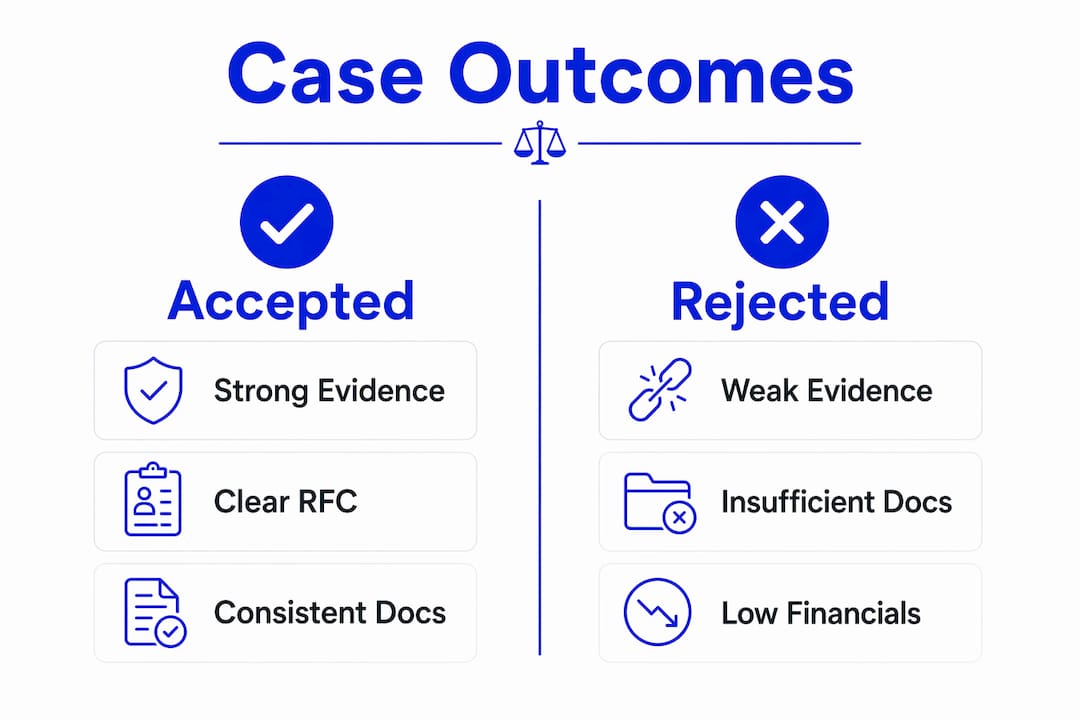
A claimant with severe rheumatoid arthritis, consistent rheumatology records, and an RFC stating they cannot sit or stand for more than two hours presents a strong case. A claimant with chronic fatigue syndrome, no specialist records, and a treatment gap of 18 months presents a weak one, even if their suffering is equally real. The SSA's legal definition of disability is specific, and approval rates at the ALJ level reach 51% with legal representation, compared to significantly lower rates without it. That gap exists because attorneys select cases with the strongest evidence and prepare them thoroughly.
The pattern that emerges from accepted cases is consistent: strong objective medical evidence, a treating physician willing to document functional limitations, and a claimant whose history is coherent and credible. Cases that lack any one of these elements face a harder road to acceptance. A lawyer not accepting your case often reflects a mismatch with their business model or evidentiary standards, not a verdict on whether your disability is real.
Key takeaways
Disability lawyers reject cases based on financial viability, evidentiary strength, and client credibility, not on the severity of the claimant's suffering.
| Point | Details |
|---|---|
| Contingency fees drive decisions | Lawyers take 25% of back pay, so cases with low financial recovery are routinely declined. |
| RFC opinions are critical | A Residual Functional Capacity opinion from a treating physician is often the deciding evidentiary factor. |
| Inconsistent records hurt cases | Contradictory medical records give ALJs grounds to deny claims and give lawyers reason to decline representation. |
| Client credibility matters | Social media posts, inconsistent statements, and adversarial attitudes are common non-medical rejection triggers. |
| Representation improves outcomes | ALJ approval rates reach 51% with legal representation, making attorney selection worth pursuing even after a rejection. |
What I've learned about case rejections after years in this field
Gerard here. After years of working in and around disability law, the most consistent mistake I see claimants make is treating a lawyer's rejection as a final verdict. It is not. It is diagnostic information.
When a lawyer declines your case, ask why. Most will tell you. If the answer is insufficient medical evidence, that is fixable. Schedule an appointment with your treating physician specifically to discuss functional limitations and request a formal RFC. If the answer is financial viability, consider whether your onset date documentation is accurate and whether you have captured all the back pay you are entitled to.
Inconsistent medical documentation is the issue I see most often, and it is the one claimants are least aware of. People see multiple doctors, report symptoms differently depending on the day, and never think about how those records will read together. An attorney reads them as a whole, and so does an ALJ. Coherence across your medical history is not optional.
The other thing I would tell you directly: get a second opinion after a rejection. Different attorneys have different risk tolerances and different areas of focus. A lawyer who specializes in mental health disability claims will evaluate a psychiatric case differently than a general SSDI practitioner. One rejection does not mean no attorney will take your case.
Prepare thoroughly, communicate honestly, and treat the consultation as a two-way evaluation. You are assessing whether the attorney is right for your case, and they are assessing whether your case is right for them.
— Gerard
How Ssdilawyer can help you move forward
If a lawyer has declined your disability claim, the next step is a case evaluation with an attorney who understands the specific criteria that drive acceptance decisions.
Ssdilawyer connects claimants with experienced SSDI attorneys who work on contingency and provide honest assessments of case strength before committing to representation. The attorneys in the network help you identify evidentiary gaps, obtain RFC documentation from treating physicians, and prepare for ALJ hearings with the documentation that matters. Whether you are filing for the first time, responding to a denial, or preparing for a hearing, Ssdilawyer offers the legal guidance needed to give your claim the best possible foundation.
FAQ
Why do disability lawyers reject cases even when the disability is real?
Disability lawyers operate on contingency fees and can only accept cases with sufficient financial recovery and legal viability. A real disability that does not meet SSA's legal definition or lacks documented functional limitations will be declined regardless of the claimant's actual suffering.
What medical records do disability lawyers look for before accepting a case?
Attorneys look for consistent treatment history, objective diagnostic results, specialist involvement, and a formal Residual Functional Capacity opinion from a treating physician. Cases without RFC documentation are among the most commonly declined.
Can I reapply to a lawyer after being rejected?
Yes. A rejection from one attorney does not prevent you from consulting others. Different firms have different case thresholds and specializations. Addressing the specific reason for rejection, such as obtaining an RFC or resolving record inconsistencies, improves your chances with the next attorney.
Does past the date last insured mean no lawyer will take my case?
Cases where the claimant is past their date last insured face significant eligibility barriers, and most SSDI attorneys will decline them. If your insured status has lapsed, an attorney may still evaluate whether a Supplemental Security Income (SSI) claim is viable instead.
How does legal representation affect SSDI approval rates?
Approval rates at the ALJ hearing level reach 51% with legal representation, compared to significantly lower rates for unrepresented claimants. Attorneys improve outcomes by selecting strong cases, preparing thorough documentation, and presenting RFC evidence effectively at hearings.