
Social Security Disability Insurance (SSDI) benefits are monthly payments from the Social Security Administration (SSA) designed for workers who become disabled and cannot perform substantial gainful activity for at least 12 months. As of January 2026, 8.1 million people receive SSDI, with an average monthly payment of $1,633. This program is not welfare. It is an earned insurance benefit funded by the payroll taxes you paid throughout your working life. This guide covers eligibility, payment calculations, auxiliary benefits for family members, and the application process so you know exactly what to expect.
What are the eligibility requirements for SSDI benefits?
SSDI eligibility rests on three pillars: a qualifying medical condition, sufficient work history, and income below the Substantial Gainful Activity (SGA) limit. Meeting all three is required before the SSA will approve a claim.
Medical eligibility requires a medically determinable physical or mental impairment that has lasted, or is expected to last, at least 12 months or result in death. The SSA maintains a formal Listing of Impairments, sometimes called the "Blue Book," which catalogs conditions that automatically qualify. Conditions not on the list can still qualify if they prevent you from performing any work you previously did or any other work in the national economy.

Work credit requirements are the part most applicants underestimate. SSDI is an earned benefit funded by FICA payroll taxes, so you must have accumulated enough work credits to qualify. Most applicants need 40 credits total, with 20 earned in the last 10 years before becoming disabled. Younger workers may qualify with fewer credits because they have had less time in the workforce.
Substantial Gainful Activity limits define the income ceiling above which the SSA considers you capable of working. The SGA monthly limit is $1,690 for non-blind individuals and $2,830 for statutorily blind individuals in 2026. Earning above those thresholds generally disqualifies you from receiving benefits, regardless of your medical condition.
- You must have a disabling condition lasting 12 or more months, or one expected to result in death
- You need sufficient work credits earned through FICA payroll taxes
- Your monthly earnings must stay below the SGA limit ($1,690 for non-blind in 2026)
- Statutorily blind individuals have a higher SGA threshold of $2,830 per month
- SSDI has no income or asset limits beyond the SGA earnings test
Pro Tip: Check your Social Security Statement at ssa.gov before applying. It shows your exact work credit total and estimated benefit amount, which saves time and prevents surprises during the application.
How is the SSDI benefit amount calculated?
SSDI benefit amounts are calculated from your Average Indexed Monthly Earnings (AIME), which the SSA converts into your Primary Insurance Amount (PIA) using a progressive formula. The formula applies different percentages to different portions of your AIME, meaning lower earners receive a higher replacement rate relative to their prior wages than higher earners do.
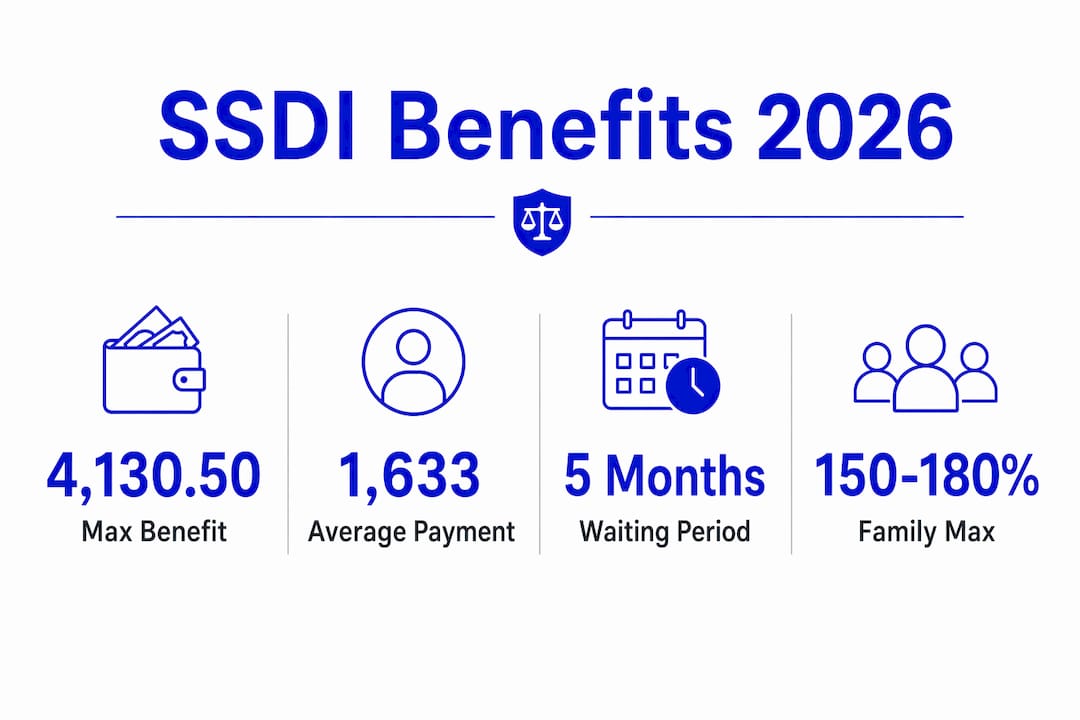
The maximum monthly SSDI benefit is $4,130.50 in 2026, but most recipients receive considerably less. The average payment sits at $1,633 per month. Your actual amount depends entirely on your earnings history over your working years, not on the severity of your disability.
Understanding auxiliary benefits for family members
SSDI also provides what is ssdi auxiliary benefits: additional payments for qualifying family members of the disabled worker. Spouses aged 62 or older, spouses of any age caring for a child under 16, and dependent children under 18 (or up to 19 if still in high school) can each receive auxiliary benefits. This is a significant distinction from SSI, which offers no equivalent family payments.
The family maximum benefit caps total household payments at roughly 150 to 180 percent of the disabled worker's PIA. If the combined auxiliary payments exceed that cap, each family member's auxiliary benefit is proportionally reduced. The disabled worker's own payment is never reduced. Only family benefits are subject to the family maximum reduction, protecting the worker's income regardless of household size.
| Payment component | Key details |
|---|---|
| Disabled worker benefit | Based on AIME and PIA; average $1,633/month in 2026 |
| Spousal auxiliary benefit | Available at age 62 or if caring for a child under 16 |
| Child auxiliary benefit | Available for dependent children under 18 (or 19 in high school) |
| Family maximum benefit | Capped at 150 to 180% of worker's PIA; reduces auxiliary payments only |
| Maximum individual benefit | $4,130.50/month in 2026 |
Pro Tip: If you have dependent children or a qualifying spouse, notify the SSA when you apply. Auxiliary benefits are not automatically issued. You must request them, and back pay applies from the date of your application.
What is the SSDI application process?
Applying for SSDI involves submitting a formal claim to the SSA, either online at ssa.gov, by phone, or in person at a local SSA office. The application requires detailed medical records, employment history, and documentation of how your condition limits your ability to work. Incomplete documentation is one of the most common reasons for early denial.
- Submit your application online, by phone at 1-800-772-1213, or in person at your local SSA office with full medical and work history documentation.
- Wait through the mandatory 5-month period. SSDI includes a 5-month waiting period before payments begin, counted from the established disability onset date. No payments are issued during those five months.
- Receive an initial decision, which typically takes three to six months. The SSA denies a large share of initial applications, often due to insufficient medical evidence or earnings above the SGA limit.
- File a Request for Reconsideration if denied. This is the first level of appeal and involves a fresh review by a different SSA examiner.
- Request a hearing before an Administrative Law Judge (ALJ) if reconsideration is denied. Legal representation notably improves success rates at ALJ hearings, making this stage the most critical point to have an attorney.
- Receive back pay if approved after a delay. Back pay covers the period from your established onset date through the approval date, minus the 5-month waiting period.
The SSDI application to payment timeline often exceeds 12 months when appeals are involved. That delay is not unusual. Medicare eligibility begins after 24 months of receiving SSDI benefits, with one notable exception: individuals diagnosed with ALS (Amyotrophic Lateral Sclerosis) have the 24-month Medicare waiting period waived entirely.
Pro Tip: Keep a detailed symptom journal from the day you stop working. Judges and reviewers weigh consistent, dated documentation of how your condition affects daily activities. It strengthens your case at every stage.
How do SSDI benefits differ from SSI?
SSDI and Supplemental Security Income (SSI) are two separate federal disability programs that are frequently confused. SSDI is work-history based and funded by payroll taxes. SSI is needs-based and funded by general federal revenues. The distinction matters because it determines eligibility, benefit amounts, and what additional support you can access.
The table below captures the core differences:
| Feature | SSDI | SSI |
|---|---|---|
| Funding source | FICA payroll taxes | General federal revenues |
| Eligibility basis | Work credits and disability | Financial need and disability or age |
| Income and asset limits | No asset test; SGA earnings limit only | Strict income and resource limits apply |
| Auxiliary family benefits | Available for qualifying spouses and children | Not available |
| Health insurance | Medicare after 24 months | Medicaid (immediate in most states) |
| Benefit amount | Based on earnings history | Flat federal rate, adjusted for income |
Misunderstanding SSDI vs SSI leads applicants to file under the wrong program, which delays benefits and complicates the process. If you have a substantial work history and paid into Social Security, SSDI is almost certainly the correct program. If you have limited work history or have never worked, SSI may be the only option. Some individuals qualify for both programs simultaneously, a situation the SSA calls "concurrent benefits."
- SSDI requires work credits; SSI does not
- SSDI links to Medicare; SSI links to Medicaid
- Auxiliary benefits for family members exist only under SSDI
- SSI has strict asset limits (generally $2,000 for individuals); SSDI does not
- Both programs require a qualifying disability under SSA definitions
Key takeaways
SSDI is an earned insurance program that pays monthly benefits to disabled workers based on their payroll tax contributions, with eligibility determined by medical condition, work credits, and income below the SGA limit.
| Point | Details |
|---|---|
| SSDI is earned insurance | Benefits are based on your work history and FICA contributions, not financial need. |
| SGA limits are strict | Earning above $1,690/month (non-blind, 2026) disqualifies you regardless of your medical condition. |
| Auxiliary benefits exist | Qualifying spouses and children can receive additional payments under SSDI, not SSI. |
| The process takes time | The application-to-payment timeline often exceeds 12 months; back pay covers the approved period. |
| Legal help matters | Attorney representation significantly improves approval rates at ALJ hearings. |
What I have learned from watching SSDI cases play out
The single biggest misconception I see is that people treat SSDI as a last resort they apply for when they are desperate, rather than a structured insurance claim they prepare for carefully. That framing costs people months of back pay and, in some cases, their entire claim.
The SGA earnings limit is where I see the most preventable mistakes. Working even a few hundred dollars above $1,690 per month while a claim is pending can trigger a denial that takes a year to appeal. The SSA does not grade on a curve. Earnings above the SGA limit are treated as disqualifying, full stop. If you are still working while applying, you need to know that number precisely.
Auxiliary benefits are the other area that surprises people. Most applicants focus entirely on their own monthly payment and never ask about spousal or child benefits. For a family with two children and a non-working spouse, auxiliary payments can add several hundred dollars per month to household income. That money is available from the date of application, not the date of approval.
My practical advice: get a disability attorney involved before you reach the ALJ stage, not after. By the time most people consider legal help, they have already made procedural errors that complicate the hearing. Earlier involvement changes the outcome.
— Gerard
How Ssdilawyer can help with your SSDI claim
Applying for SSDI without legal guidance is possible. Getting approved without it is harder, particularly after an initial denial.
Ssdilawyer connects you with experienced disability attorneys who handle applications, denials, appeals, and ALJ hearings. The attorneys in the network understand SSA procedures, know how to document medical evidence effectively, and represent claimants at every stage of the process. If you are preparing to apply for SSDI or have already received a denial, Ssdilawyer provides the legal support that makes a measurable difference in approval outcomes. Visit ssdilawyer.co to connect with a qualified disability attorney today.
FAQ
What does SSDI mean?
SSDI stands for Social Security Disability Insurance, a federal program administered by the Social Security Administration that provides monthly payments to workers who become disabled and cannot perform substantial gainful activity.
How much do SSDI benefits pay per month?
The average SSDI payment is $1,633 per month in 2026, with a maximum of $4,130.50. Your actual amount depends on your earnings history and the payroll taxes you paid over your working years.
What is the 5-month waiting period for SSDI?
The SSA requires a mandatory 5-month waiting period from your established disability onset date before SSDI payments begin. No benefits are paid during those five months, but back pay can cover the period after the waiting period if your approval is delayed.
Can family members receive SSDI benefits?
Yes. Qualifying spouses and dependent children of an approved SSDI recipient can receive auxiliary benefits. These payments are subject to a family maximum benefit cap of roughly 150 to 180 percent of the disabled worker's Primary Insurance Amount.
What is the difference between SSDI and SSI?
SSDI is based on your work history and funded by payroll taxes; SSI is needs-based and funded by general revenues. SSDI offers auxiliary family benefits and links to Medicare; SSI does not offer auxiliary benefits and links to Medicaid instead.