
Disability attorney consultation preparation is the process of assembling medical records, employment history, and personal testimony before your first attorney meeting to build the strongest possible SSDI claim. The Social Security Administration denies roughly 67% of initial SSDI claims nationwide, most often due to incomplete applications and missing medical details. That statistic means your attorney consultation is not a formality. It is the strategic foundation of your case. Arriving prepared with organized documentation, a clear medical summary, and targeted questions gives your attorney everything needed to identify evidence gaps and build a legal strategy from day one.
What documents to gather before your disability attorney consultation
The first pillar of disability attorney consultation preparation is documentation. Represented claimants have statistically higher approval rates at hearings because attorneys identify evidence gaps early. That advantage only materializes if you arrive with the right records.
Medical records and clinical evidence form the core of your file. Gather the following before your first appointment:
- All physician and specialist records from the past 12 to 24 months
- Diagnostic test results: MRIs, X-rays, blood panels, and neurological evaluations
- Treatment plans, surgical notes, and hospitalization records
- Residual Functional Capacity (RFC) forms completed by your treating physician
- Mental health records if your condition includes psychological components
Employment and financial records are equally necessary. The SSA evaluates your work history to determine insured status and to assess whether you can return to past relevant work. Bring your most recent W-2 forms, a written work history covering the past 15 years, and any documentation of workplace accommodations your employer provided.
Medication documentation is frequently overlooked. Prepare a typed list of every medication you currently take, including dosages, frequency, and known side effects. Side effects such as drowsiness, cognitive fog, or nausea can directly affect your functional capacity argument. Complete records and third-party statements can fill evidentiary gaps that would otherwise weaken your claim.

Pro Tip: Start a symptom diary at least two weeks before your consultation. Record daily pain levels, mobility limits, fatigue episodes, and any activities you could not complete. This diary gives your attorney specific, dated evidence of functional decline rather than general complaints.
Organize physical documents in a labeled binder with a simple table of contents. For digital copies, a folder structure on Google Drive or Dropbox with subfolders for medical, employment, and financial records works well. Bring two printed sets to the consultation: one for your attorney and one for your own reference.
How to document your medical condition and limitations clearly
Specific, measurable descriptions of daily limitations influence claim outcomes far more than vague statements. "I have back pain" carries no legal weight. "I cannot stand for more than 10 minutes without sharp lumbar pain rated 7 out of 10" gives your attorney a concrete functional limit to argue.
Before your consultation, write a one to two page medical summary using this structure:
- Onset date. When did your condition first affect your ability to work? Include the specific month and year.
- Progression timeline. Describe how your condition worsened over time, with approximate dates for each significant change.
- Current functional limits. State exactly how far you can walk, how long you can sit or stand, how much weight you can lift, and whether you have cognitive or concentration impairments.
- Medication side effects. List any treatment-related effects that reduce your daily functioning.
- Medical providers. Include the full name, specialty, and contact information for every doctor, therapist, or specialist you have seen.
"Clients who maintain a symptom diary and detailed medical timeline provide valuable context that enhances attorney understanding and claim credibility." — How to Prepare for a Disability Hearing
This summary shapes attorney strategy directly. If your records show a gap in treatment, your attorney can address it proactively. If your functional limits align with a specific SSA listing, your attorney can build the argument around that listing from the start. Practicing answers aloud before the consultation also builds confidence and helps you deliver your medical history clearly and consistently.
What questions to ask your disability attorney at the first meeting
Prepared, specific questions lead to more productive consultations and clearer case planning. The top questions to ask your disability attorney cover four categories: experience, evidence, process, and fees.
Experience and case fit:
- How many SSDI cases similar to mine have you handled in the past two years?
- Have you represented clients with my specific medical condition before?
- What is your approval rate at the ALJ hearing stage?
Evidence and deadlines:
- What additional medical evidence do you need from me?
- Are there any gaps in my current records that could hurt my claim?
- What is the deadline for submitting evidence before my hearing? Note that evidence must be submitted at least 5 business days before any scheduled hearing, and late submissions may be rejected by the Administrative Law Judge.
Process and appeals:
- What stage is my claim at, and what are the next procedural steps?
- If my claim is denied again, what does the appeals process look like?
- How long do cases at my stage typically take to resolve?
Fees and expectations:
- How does your fee structure work, and when do fees apply?
- What documentation will you need from me on an ongoing basis?
Understanding fee structures and documentation requirements upfront helps you set realistic expectations and avoid surprises. Most disability attorneys work on contingency, meaning they collect a percentage of back pay only if you win. Confirm this arrangement explicitly.
Pro Tip: Prioritize your questions based on your claim stage. If you are at the initial application stage, focus on evidence and documentation questions. If you are preparing for an ALJ hearing, shift focus to hearing strategy and expert witness preparation.
Common mistakes to avoid when preparing for your consultation
Frequent claimant errors reduce consultation value and can directly harm claim outcomes. Avoiding these five mistakes gives your attorney the clearest possible picture of your case.
- Arriving without documentation. An attorney cannot assess your claim without records. Showing up empty-handed turns a strategy session into a basic intake interview and wastes billable time.
- Understating your limitations. Claimants often describe their best days rather than their typical days. Your attorney needs to know how your condition affects you on average, not on your most functional day.
- Failing to take notes. Attorneys cover significant ground in a single consultation. Bring a notepad or use your phone to record key advice, deadlines, and next steps. What you do not write down, you will likely forget.
- Overloading the attorney with irrelevant information. Personal grievances, unrelated health complaints, and lengthy backstory slow the consultation. Stick to medically documented conditions and work-related functional limits.
- Ignoring submission deadlines. Missing evidence deadlines is one of the most damaging procedural errors a claimant can make. Ask your attorney for a written deadline schedule and add each date to your calendar immediately.
Staying focused on documented, relevant medical and employment information keeps the consultation efficient and gives your attorney the material needed to build a strong legal strategy. You can also review why attorneys reject certain cases before your meeting to understand what red flags to address proactively.
How to organize and present your information for maximum impact
Organizational tools such as binders with indexes or document management apps reduce errors and speed attorney review. How you present your information is nearly as important as what you bring.
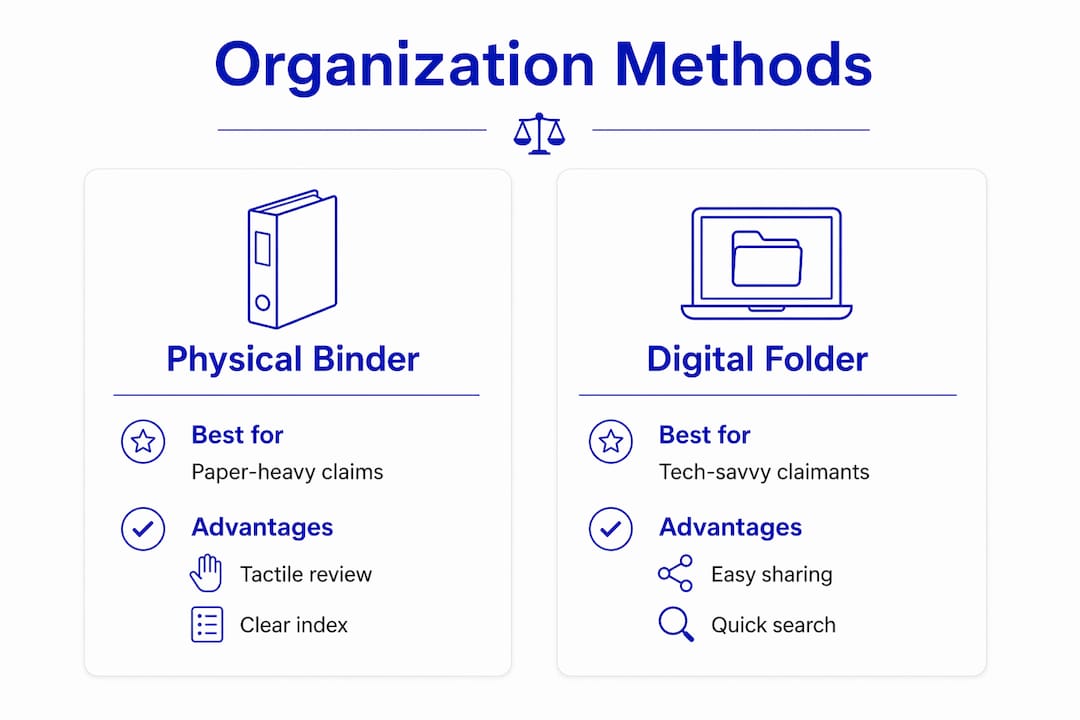
The table below compares two common organization methods to help you choose the right approach for your situation.
| Method | Best for | Key advantage |
|---|---|---|
| Physical binder with index | Claimants with extensive paper records | Easy to reference during the consultation without a device |
| Digital folder system (Google Drive, Dropbox) | Claimants with electronic medical records | Shareable with attorney before the meeting for advance review |
Regardless of which method you use, prepare a one-page case overview document. This document should include your full name, Social Security number, claim number if applicable, diagnosis list, current treating physicians, and a three to five sentence summary of why you cannot work. Place this overview at the front of your binder or at the top of your digital folder.
Clients who bring organized provider lists, medications, and a written functional timeline make consultations more efficient and directly improve legal strategy development. A simple chronological timeline of your medical history, formatted as a one-page chart, can help your attorney spot patterns and gaps in treatment that might otherwise take multiple follow-up calls to uncover. For additional guidance on what to bring, the disability lawyer checklist at Ssdilawyer covers document requirements in detail.
Key takeaways
Thorough disability attorney consultation preparation requires organized medical records, a written functional summary, and targeted questions prepared before the meeting.
| Point | Details |
|---|---|
| Gather core documents first | Bring medical records, RFC forms, W-2s, and a full medication list with dosages and side effects. |
| Write a measurable functional summary | Describe specific limits such as walking distance and sitting tolerance rather than general pain complaints. |
| Prepare targeted questions | Ask about evidence gaps, deadlines, fee structure, and the attorney's experience with similar cases. |
| Avoid the five common mistakes | Do not understate limitations, arrive without records, or miss evidence submission deadlines. |
| Organize for attorney speed | Use a labeled binder or shared digital folder with a one-page case overview at the front. |
What I have learned from watching claimants prepare (and not prepare)
After reviewing hundreds of SSDI case outcomes, one pattern is consistent: the claimants who treat the initial consultation as a strategy session rather than a venting session get better results. The attorney's job in that first meeting is to assess facts and build a legal framework, not to hear a full life history. Claimants who arrive with a one-page summary, a sorted binder, and three specific questions get their strategy built in 45 minutes. Claimants who arrive unprepared spend that same 45 minutes on intake basics.
The detail that surprises most people is how much weight a symptom diary carries. Attorneys and Administrative Law Judges both respond to dated, specific entries. "October 14: could not drive due to medication-induced dizziness, missed physical therapy appointment" is far more credible than "I often feel dizzy." That specificity is not something your attorney can manufacture after the fact. You have to build it before the consultation.
The other underestimated factor is fee clarity. Most disability attorneys work on contingency under SSA-regulated fee caps, but the exact percentage and back-pay calculation method varies. Claimants who ask about fees directly in the first meeting avoid confusion later and build a cleaner working relationship with their attorney. You can read more about attorney approval advantages to understand what representation actually delivers at each claim stage.
Preparation is not about impressing your attorney. It is about giving them the raw material to do their job at full capacity from the first hour.
— Gerard
Ready to connect with an experienced disability attorney?
Ssdilawyer connects SSDI claimants with experienced disability attorneys who handle applications, denials, appeals, and ALJ hearings. If you have gathered your documents and prepared your questions, the next step is a free consultation with an attorney who can assess your specific case.
At Ssdilawyer, the process starts with a no-cost case review. An attorney will identify evidence gaps, explain your claim stage, and outline the steps needed to move your case forward. Legal representation correlates directly with higher hearing approval rates, and the earlier you engage an attorney, the more time they have to build your record. Visit Ssdilawyer to request your free consultation today.
FAQ
What documents should I bring to my first disability attorney meeting?
Bring medical records, diagnostic test results, treatment plans, a medication list with dosages, W-2 forms, and a written work history covering the past 15 years. An RFC form completed by your treating physician is particularly valuable.
How do I describe my limitations to a disability attorney?
Use specific, measurable terms. State how far you can walk, how long you can sit or stand, and how much weight you can lift. Vague descriptions carry less legal weight than concrete functional limits tied to your diagnosis.
What questions should I ask a disability attorney at the consultation?
Ask about their experience with similar cases, what evidence gaps exist in your file, the timeline for your claim stage, and how their fee structure works. Prepared questions lead to more productive consultations and clearer case planning.
How far in advance should I submit evidence before a hearing?
All evidence must be submitted at least 5 business days before a scheduled ALJ hearing. Late submissions may be rejected, so confirm your deadline with your attorney immediately after the consultation.
Does having an attorney improve my chances of SSDI approval?
Represented claimants have statistically higher approval rates at disability hearings because attorneys identify evidence gaps, prepare legal briefs, and effectively question vocational and medical experts during proceedings.