Hiring a qualified disability lawyer directly increases your chances of Social Security disability benefits approval at every stage of the process. Without legal representation, most SSDI and SSI applicants face approval rates below 25% at the initial stage. With a lawyer, those numbers change substantially. This article explains why disability lawyers improve approval odds, what specific actions they take, and how to find the right attorney before your next deadline.
Why disability lawyers improve approval odds: the data
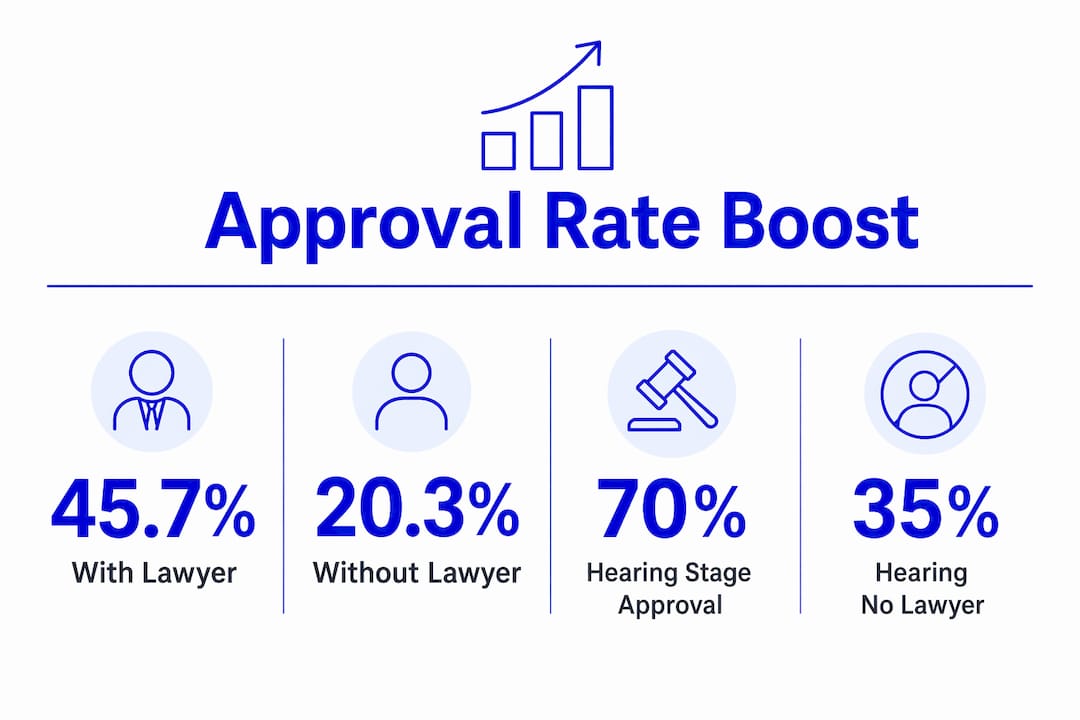
The numbers are direct. Approval rates nearly double when a disability attorney is involved, rising from 20.3% to 45.7% at the initial application stage. At the hearing level, the difference is even sharper. Represented claimants see approval rates of 68.4%, compared to 33.9% for those without legal help. That gap represents thousands of claimants who receive benefits they would otherwise have been denied.
Legal representation also reduces claim processing time by nearly one year by preventing avoidable denials. Each denial triggers a new appeal cycle, adding months or years to an already slow process. A lawyer who prevents the first denial eliminates that delay entirely.
| Claim stage | Approval rate without lawyer | Approval rate with lawyer |
|---|---|---|
| Initial application | 20.3% | 45.7% |
| Reconsideration | ~12% | ~30% |
| ALJ hearing | 33.9% | 68.4% |
The hearing stage deserves particular attention. Approval odds triple at appeal hearings with legal representation compared to self-representation. Administrative Law Judges (ALJs) conduct formal proceedings where vocational experts and medical experts testify. Claimants without legal training are at a structural disadvantage in that setting.
How lawyers strengthen your claim from paperwork to hearing
Most serious claims are denied initially due to technical errors, missing evidence, or paperwork mistakes. A disability attorney addresses these problems before they become denials. The specific actions lawyers take include:
- Reviewing every form for completeness and accuracy before submission
- Collecting medical records, treatment histories, and specialist reports
- Obtaining Residual Functional Capacity (RFC) assessments that translate diagnoses into work limitations
- Identifying whether a claim qualifies for Compassionate Allowances or Quick Disability Determinations to speed up reviews for severe conditions
- Preparing clients for hearing testimony and cross-examining vocational and medical experts
The RFC assessment is the most critical document in most SSDI cases. The Social Security Administration (SSA) does not approve claims based on diagnosis alone. A diagnosis alone is insufficient for SSA approval. Legal success depends on translating medical conditions into clear functional limitations that affect work ability. A lawyer knows how to request this assessment, which questions to ask the treating physician, and how to present the results in SSA-accepted language.
Lawyers also master the complex SSA administrative guidelines, enabling them to present evidence in the precise format and terminology that ALJs require. This is not a minor procedural detail. SSA judges evaluate evidence within a specific regulatory framework, and submissions that do not align with that framework are routinely dismissed or discounted.

Pro Tip: Involve a disability attorney before you submit your initial application, not just after a denial. Early involvement prevents the most common and costly mistakes, and it shortens your overall time to approval.
Represented vs. unrepresented claimants: a direct comparison
The practical differences between represented and unrepresented claimants go beyond approval statistics. Unrepresented claimants frequently miss appeal deadlines, submit incomplete medical documentation, and fail to address SSA's specific evidentiary requirements. These are procedural failures, not medical ones, and they result in denials that have nothing to do with the severity of the claimant's condition.
| Factor | Unrepresented claimant | Represented claimant |
|---|---|---|
| Initial approval rate | ~20% | ~46% |
| Hearing approval rate | ~35% | ~70% |
| Risk of technical denial | High | Low |
| Hearing preparation | Self-managed | Attorney-led |
| Expert cross-examination | Rarely performed | Standard practice |
| Average time to decision | Longer (avoidable delays) | Shorter (fewer denials) |
The hearing approval rate with a lawyer is approximately 70%, compared to roughly 35% without legal representation. That 35-point gap reflects the structural advantage lawyers hold at the ALJ hearing stage. Lawyers prepare clients for testimony, counter SSA challenges with tailored legal arguments, and cross-examine vocational experts who might otherwise testify that the claimant can perform jobs they realistically cannot.
The SSA's relationship with claimants is adversarial by design. The agency's role is to evaluate claims against strict eligibility criteria, not to help applicants build their case. Lawyers succeed by expertly navigating SSA's complex administrative rules that most claimants do not understand. Unrepresented claimants often do not know what the SSA is looking for, which means they cannot provide it.
Pro Tip: If you have already received a denial, you have 60 days to file an appeal. Missing this window forces you to restart the entire process. A disability attorney tracks these deadlines as a standard part of case management.
When and how to hire a disability lawyer
Timing matters. The disability attorney benefits are greatest when legal help begins before the initial application, but representation at any stage improves outcomes. Here is a practical sequence for engaging legal help:
- Before the initial application. A lawyer reviews your medical records, identifies gaps, and submits a complete, well-documented application. This is the most cost-effective point of intervention because it prevents the denial cycle entirely.
- After an initial denial. You have 60 days to request reconsideration. A lawyer can strengthen the record and address the specific reasons for denial before the next review.
- Before an ALJ hearing. This is the stage where legal representation has the most dramatic statistical impact. Lawyers prepare hearing strategy, gather updated medical evidence, and handle expert witnesses.
- Ask about approval rates. When evaluating attorneys, ask directly about their approval rates at the hearing level and their experience with cases similar to yours.
- Understand the fee structure. Contingency fee arrangements in SSDI cases mean lawyers get paid only if you win, often capped at 25% of backpay. There are no upfront costs, which removes the financial barrier to getting legal help.
The contingency fee structure is worth understanding clearly. The SSA caps attorney fees at 25% of past-due benefits, with a maximum of $7,200 as of recent SSA guidelines. This means a lawyer's financial incentive aligns directly with your approval. They are paid more when you win more, and nothing when you do not win.
Selecting the right attorney also means verifying their specific experience with Social Security disability law. General practice attorneys who occasionally handle SSDI cases do not carry the same procedural knowledge as attorneys who specialize in SSA regulations. Specialization matters because the SSA's administrative framework is distinct from civil litigation or other legal practice areas. Resources like Ssdilawyer connect applicants with attorneys who focus specifically on SSDI and SSI claims.
Key takeaways
Disability lawyers improve approval odds at every stage of the SSDI process by preventing errors, building stronger medical evidence, and applying specialized knowledge of SSA regulations.
| Point | Details |
|---|---|
| Approval rates nearly double | Initial approval rises from 20.3% to 45.7% with legal representation. |
| Hearing stage is most critical | Lawyer-represented claimants approve at 68.4% versus 33.9% without help. |
| RFC assessments are decisive | Lawyers obtain functional capacity reports that translate diagnoses into work limitations SSA accepts. |
| Early involvement saves time | Hiring before the initial application prevents denials and reduces total processing time by close to one year. |
| No upfront cost | Contingency fees mean lawyers are paid only from backpay if you win, capped at 25%. |
What I have seen working with disability claimants
The statistic that surprises most people is not the hearing approval rate. It is the initial application rate. Most claimants assume the first application is a formality and that the real fight happens later. The data says otherwise. Approval at the initial stage with a lawyer is 45.7%. Without one, it is 20.3%. That means the majority of unrepresented claimants are entering a multi-year appeal process that a lawyer could have prevented at the start.
The most common mistake I see is claimants submitting their own medical records without an RFC assessment. A stack of treatment notes tells the SSA what is wrong with you. An RFC assessment tells the SSA what you cannot do. Those are different documents, and the SSA evaluates work capacity, not medical history. Lawyers know this distinction. Most claimants do not.
There is also a procedural reality that rarely gets discussed. SSA hearings involve vocational experts who testify about what jobs a claimant can perform. These experts are not adversarial by default, but they respond to the questions they are asked. A lawyer who knows how to cross-examine a vocational expert can expose limitations in their testimony that an unrepresented claimant would never identify. That skill is not taught. It is developed through repeated practice in SSA proceedings.
The financial argument for hiring a lawyer is also straightforward. You pay nothing unless you win. The fee comes from backpay you would not have received without the lawyer's help. The risk of not hiring one is a multi-year delay or a permanent denial.
— Gerard
How Ssdilawyer connects you with the right disability attorney
Ssdilawyer connects SSDI and SSI applicants with experienced disability attorneys who handle claims at every stage, from initial applications to ALJ hearings and federal appeals. The attorneys in the Ssdilawyer network specialize in assembling complete medical documentation, obtaining RFC assessments, and preparing clients for hearing testimony. Every case is handled on a contingency fee basis, meaning no upfront costs and no fees unless you win. If you are preparing an initial application, facing a denial, or approaching a hearing deadline, get legal help through Ssdilawyer before your next SSA deadline.
FAQ
Why do disability lawyers improve approval odds so significantly?
Disability lawyers improve approval odds by preventing technical errors, obtaining RFC assessments, and presenting evidence in the specific format SSA judges require. At the hearing level, represented claimants approve at nearly 70% compared to roughly 35% without legal help.
When is the best time to hire a disability lawyer?
The best time is before the initial application, because early involvement prevents the denial cycle and can reduce total processing time by close to one year. Representation at reconsideration or before an ALJ hearing also produces measurable improvements in approval rates.
How much does a disability lawyer cost?
SSDI attorneys work on contingency, meaning they collect no fee unless you win. The SSA caps attorney fees at 25% of past-due benefits, so there is no financial risk in hiring legal representation.
What is an RFC assessment and why does it matter?
A Residual Functional Capacity (RFC) assessment documents what physical and mental tasks a claimant cannot perform due to their condition. The SSA evaluates work capacity, not diagnosis, so an RFC assessment is the document that directly connects a medical condition to benefit eligibility.
Can a lawyer help after an initial denial?
A lawyer can assist at reconsideration, ALJ hearing, and federal court appeal stages. The 60-day appeal window after a denial is a hard deadline, and missing it requires restarting the entire application process from the beginning.