
A disability lawyer's role at the reconsideration stage is to provide strategic legal guidance that increases your chances of overturning an initial Social Security Disability Insurance denial. Reconsideration is the mandatory first formal appeal after an SSDI denial, where a different SSA examiner reviews your full file as a desk review without a live hearing. The role of disability lawyer at reconsideration stage goes far beyond paperwork. An attorney analyzes why your claim was denied, identifies evidentiary gaps, coordinates with your treating physicians, and submits targeted new evidence before the 60-day deadline expires. Missing this window or resubmitting the same records almost always produces the same result: another denial.
How does a disability lawyer improve your chances during reconsideration?
A disability attorney's primary contribution at reconsideration is reading the denial letter and building a response that directly addresses SSA's stated reasons. Most claimants treat reconsideration as a formality. It is not. Resubmitting old evidence leads to the same conclusion, because the examiner has already seen it. A lawyer's job is to change the evidentiary picture.
Here is what a benefits reconsideration lawyer does differently:
- Analyzes the denial rationale. SSA denial letters cite specific reasons, such as insufficient medical documentation or a finding that you can perform sedentary work. A lawyer targets those exact points with new evidence.
- Identifies evidentiary gaps. If your file lacks functional capacity documentation, a lawyer requests a Residual Functional Capacity (RFC) assessment from your treating physician.
- Coordinates with treating physicians. Specific physician statements like "cannot stand more than 15 minutes" or "misses 3 or more days per month due to migraines" carry far more weight than general diagnoses.
- Submits new medical records. Recent treatment notes, imaging results, and specialist evaluations that postdate the initial application can shift the examiner's assessment.
- Applies SSA procedural knowledge. Lawyers understand SSA's internal rules, including the five-step sequential evaluation process, and frame evidence to satisfy each criterion.
The difference between a strong and weak reconsideration appeal is not volume of records. Lawyers focus on strategic medical evidence aligned with SSA's functional criteria rather than simply adding more pages. That targeted approach is what separates approvals from repeat denials.
Pro Tip: Ask your attorney to request a copy of your complete SSA file before filing the reconsideration. Reviewing what the examiner already has prevents redundant submissions and reveals exactly what is missing.

What is the reconsideration process and timeline?
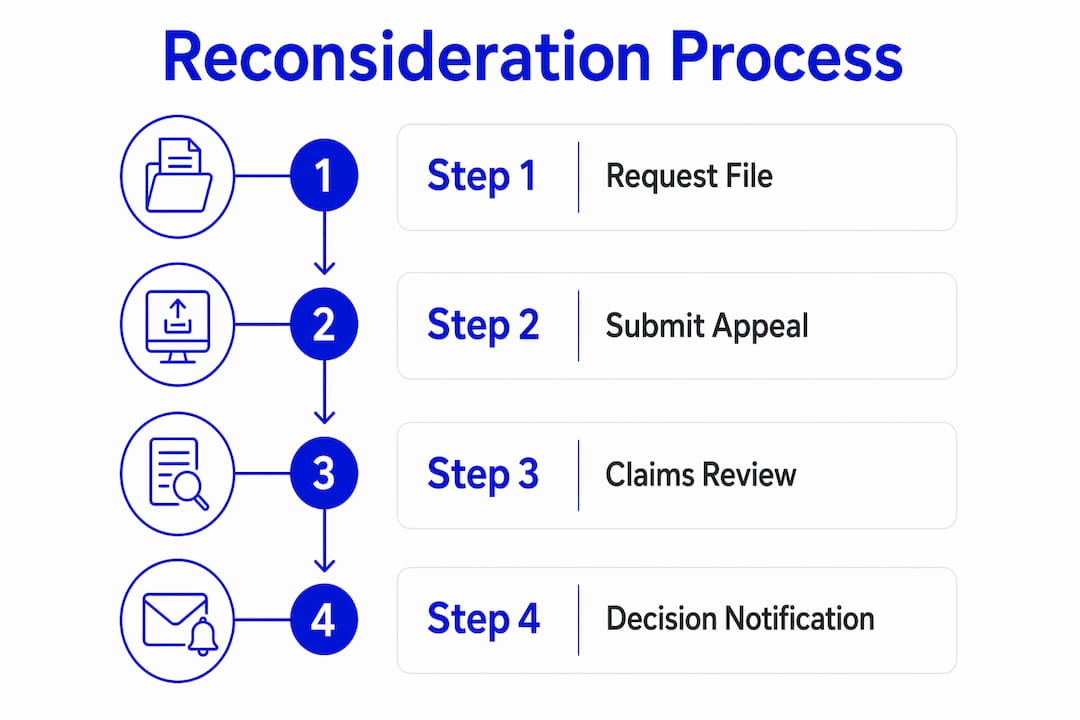
The reconsideration process is a paper-based review conducted by a different SSA claims examiner who was not involved in the original decision. Reconsideration is a desk review with no face-to-face interview or live hearing. That means the quality of your written record is everything.
The procedural steps, in order, are:
- Receive your denial notice. SSA mails the decision. The clock starts immediately.
- Count your deadline. You have 60 days from receipt to file. SSA counts receipt as 5 days after the notice date, giving you effectively 65 days from the date printed on the letter.
- Complete Form SSA-561. This is the Request for Reconsideration form. Filing Form SSA-561 correctly and on time preserves your appeal rights. Errors or late filing can end your current appeal path entirely.
- Submit the form. You can file online through SSA's website, by mail, or in person at your local SSA office.
- Supplement with new evidence. After filing, you and your attorney continue gathering and submitting updated medical records and physician opinions.
- Await the desk review decision. The new examiner reviews all original and new evidence and issues a written decision.
The table below summarizes the key procedural facts:
| Step | Detail |
|---|---|
| Filing deadline | 60 days from receipt (65 days from notice date) |
| Required form | Form SSA-561, Request for Reconsideration |
| Submission methods | Online (SSA.gov), mail, or in-person SSA office |
| Review type | Desk review, no live hearing |
| Evidence accepted | All original records plus new submissions |
| Decision format | Written notice mailed to claimant |
State variations matter here. Some states participating in SSA's disability redesign pilot program skip reconsideration entirely and proceed directly from denial to an Administrative Law Judge (ALJ) hearing. If you live in one of those states, your attorney must prepare a full ALJ-level case from the start, with no intermediate review stage.
How does reconsideration compare to an ALJ hearing?
Reconsideration and the ALJ hearing are both SSDI appeals, but they operate very differently and produce very different outcomes. Understanding the gap between them explains why the role of attorney in disability claims matters most at the ALJ level, but why preparation at reconsideration is the foundation for that success.
| Factor | Reconsideration | ALJ Hearing |
|---|---|---|
| Approval rate | Approximately 13–15% | Approximately 45–55% |
| Review format | Desk review, written records only | Live hearing with testimony |
| Decision maker | Different SSA claims examiner | Administrative Law Judge |
| Opportunity to testify | None | Yes, claimant and witnesses |
| New evidence accepted | Yes | Yes |
| Average wait time | Weeks to a few months | Often 12–24 months |
Reconsideration approval rates sit around 13–15%, making it statistically the weakest stage in the SSDI appeals process. ALJ hearings, by contrast, approve roughly 45–55% of claims. That gap exists because ALJ hearings allow claimants to testify, present witnesses, and respond directly to examiner concerns in real time.
"Reconsideration is not where most claims are won. But it is where poorly prepared claims are permanently weakened. Every record submitted, every physician statement filed, and every procedural choice made at reconsideration becomes part of the ALJ record." — Disability appeals practitioners consistently make this point.
The paper-based nature of reconsideration means clarity and internal consistency in your medical record are the primary tools available. A disability case review attorney uses this stage to build a coherent, well-documented file that supports not just the reconsideration decision but the ALJ hearing if reconsideration is denied.
What strategies do disability lawyers use to build a strong appeal?
A disability attorney approaches reconsideration as a two-phase process: file immediately to protect your rights, then build the strongest possible evidentiary record. This is the "file first, perfect later" approach that practitioners consistently recommend to avoid missing the deadline while medical records are still being gathered.
The core strategies a lawyer applies include:
- Target the denial rationale directly. If SSA denied the claim because it found you capable of light work, the lawyer requests an RFC from your treating physician that specifies exactly what you cannot do and why.
- Obtain functional detail, not just diagnoses. A letter stating "patient has degenerative disc disease" is far less useful than one stating "patient cannot sit for more than 20 minutes without severe pain and cannot lift more than 5 pounds." SSA evaluates function, not diagnosis labels.
- Ensure medical record consistency. Conflicting treatment notes, gaps in care, or records that contradict your stated limitations give examiners grounds to discount your claim. A lawyer reviews the full file for inconsistencies before submission.
- Coordinate with specialists. Primary care records alone are often insufficient. Lawyers identify which specialists, such as neurologists, orthopedic surgeons, or psychiatrists, should provide supporting opinions.
- Plan for the ALJ hearing simultaneously. Even while pursuing reconsideration, a lawyer begins preparing the ALJ case. Evidence gathered now will carry forward.
Pro Tip: Never wait until the last week of your deadline to contact an attorney. Lawyers need time to request medical records, which can take weeks to arrive from providers. Starting early gives your attorney room to build a complete file before the deadline.
The importance of disability advocacy at this stage extends beyond paperwork. A lawyer reduces the risk of procedural errors that can permanently close your appeal path. Missing the 60-day window forces you to file a new initial claim, restarting the entire process and delaying benefits by months or years. You can learn more about why attorneys improve outcomes at each stage of the SSDI process.
Key takeaways
A disability lawyer at the reconsideration stage improves your approval odds by submitting targeted new evidence, meeting strict deadlines, and building a documented record that supports both the current review and any future ALJ hearing.
| Point | Details |
|---|---|
| Reconsideration is a desk review | A different SSA examiner reviews written records only, with no live hearing or testimony. |
| The 60-day deadline is firm | SSA counts receipt as 5 days after the notice date, giving claimants 65 days total to file Form SSA-561. |
| New targeted evidence is required | Resubmitting old records produces the same denial; lawyers submit evidence that directly addresses the denial rationale. |
| Approval rates are low at this stage | Reconsideration approves roughly 13–15% of claims, compared to 45–55% at the ALJ hearing level. |
| Reconsideration builds the ALJ record | Every document filed now becomes part of the file reviewed at the ALJ hearing if reconsideration is denied. |
Why reconsideration deserves more respect than it gets
Most people I talk to treat reconsideration as a box to check before getting to the "real" appeal at the ALJ hearing. That view is a mistake, and it costs claimants.
The low approval rate at reconsideration, around 13–15%, leads many attorneys to deprioritize it. I think that is backwards. The reconsideration stage is where the evidentiary record gets set. Every physician statement, every functional assessment, and every treatment note you submit now travels with your file to the ALJ. A weak reconsideration record forces the ALJ to work harder to find grounds for approval, and some never do.
The other misconception I see regularly is that hiring a lawyer only matters at the ALJ hearing. In reality, the benefits of hiring a disability attorney show up at every stage, including reconsideration. An attorney who starts at reconsideration knows your file, knows your physicians, and knows your denial history before the ALJ hearing begins. That continuity matters more than most claimants realize.
Realistic expectations are also part of the job. Most reconsideration appeals are denied. That is not a failure. It is the expected outcome for most claimants, and a good attorney prepares you for it while simultaneously building the strongest possible foundation for the next stage.
— Gerard
Get legal help for your reconsideration appeal
Facing an SSDI denial without legal representation at the reconsideration stage puts you at a significant procedural disadvantage. Ssdilawyer connects claimants with experienced disability attorneys who handle every aspect of the reconsideration process, from analyzing your denial letter to coordinating physician documentation and filing Form SSA-561 on time.
Ssdilawyer attorneys understand SSA's functional criteria, know how to fill evidentiary gaps, and prepare your file for the ALJ hearing from day one. If your reconsideration deadline is approaching or you have already received a second denial, do not wait. Visit Ssdilawyer to connect with a disability attorney who can review your case and help you pursue the benefits you are entitled to.
FAQ
What does a disability lawyer do at reconsideration?
A disability lawyer analyzes the denial rationale, gathers targeted new medical evidence, coordinates with treating physicians for functional opinions, and files Form SSA-561 before the deadline. The attorney's goal is to submit a record that directly addresses SSA's stated reasons for denial.
How long do i have to file a reconsideration request?
You have 60 days from the date you receive your denial notice. SSA assumes receipt occurs 5 days after the notice date, giving you effectively 65 days from the date printed on the letter to file Form SSA-561.
What is the approval rate for SSDI reconsideration?
Reconsideration approves approximately 13–15% of claims, making it the lowest approval stage in the SSDI appeals process. ALJ hearings approve roughly 45–55% of claims, which is why thorough preparation at reconsideration is critical for building a strong ALJ record.
Can i submit new evidence at the reconsideration stage?
Yes. The reconsideration examiner reviews both your original file and any new evidence you submit. Submitting new, targeted medical records and physician opinions is the primary strategy for improving your chances at this stage.
Do all states require reconsideration before an ALJ hearing?
No. Some states participating in SSA's disability redesign pilot program skip reconsideration and proceed directly from denial to an ALJ hearing. Claimants in those states must prepare a complete ALJ-level case from the start, with no intermediate desk review stage.