
SSA Form SSA-1696 is the official SSDI attorney authorization form used to appoint a representative who can legally act on your behalf during Social Security Disability Insurance claims and appeals. The Social Security Administration (SSA) requires this specific form, submitted in writing and in its most current version, before any attorney or non-attorney representative can communicate with SSA on your behalf. Without it, SSA will not recognize your representative, regardless of any private agreement you have signed. Understanding SSA-1696 is the first step toward effective SSDI legal representation.
What is the SSDI attorney authorization form (ssa-1696)?
SSA Form SSA-1696, formally titled "Appointment of Representative," is the document that formally notifies SSA of your chosen representative. Once SSA accepts it, your attorney or advocate gains the authority to communicate with SSA, access your claims file, and act on your behalf at every stage of the process.
The form collects specific information from both parties:
- Claimant section: Your full name, Social Security number, contact information, and the scope of representation you are authorizing.
- Representative section: The attorney's or advocate's name, contact details, professional credentials, and whether they will charge a fee.
- Signatures: Both the claimant and the representative must sign. Electronic signatures are accepted for online submissions.
SSA-1696 covers representation across the full SSDI lifecycle, including the initial application, reconsideration, hearings before an Administrative Law Judge, and Appeals Council review. This means one properly filed form can authorize your attorney to act at every level without requiring a new appointment at each stage.
Pro Tip: Always confirm your attorney is using the most current version of SSA-1696. SSA rejects outdated form versions, which can delay your representation and create gaps in your claims file.
How does ssa-1696 differ from ssa-827 and other authorization forms?
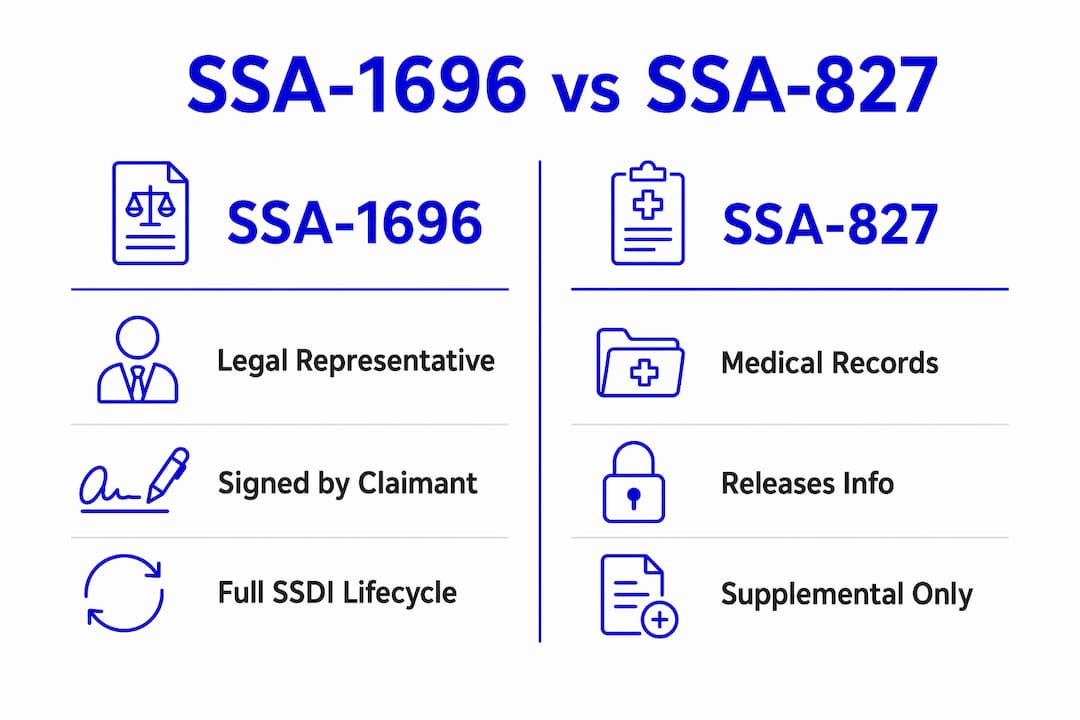
Many applicants confuse SSA-1696 with SSA-827, but these are separate forms with completely different functions. Mixing them up is one of the most common procedural errors in SSDI claims.

SSA-827, titled "Authorization to Disclose Information to the Social Security Administration," is a medical records release form. You sign it during the online SSDI application to give SSA permission to obtain your medical records from doctors, hospitals, and clinics. It does not appoint anyone to represent you. SSA-1696, by contrast, is a legal appointment document. It gives your attorney the authority to submit evidence, request reconsiderations, attend hearings, and receive official SSA correspondence on your behalf.
Failing to submit SSA-1696 while only submitting SSA-827 means your attorney can do nothing beyond accessing records. SSA will not route notices to them, will not accept their filings, and will not allow them to speak for you at a hearing.
| Form | Purpose | Who Signs | When Used |
|---|---|---|---|
| SSA-1696 | Appoints a legal representative | Claimant and representative | At any stage: application, reconsideration, hearing, appeals |
| SSA-827 | Releases medical records to SSA | Claimant only | During initial application or when records are needed |
| SSA-3288 | Releases records to a third party | Claimant only | When authorizing disclosure to non-SSA entities |
Pro Tip: Submit SSA-1696 and SSA-827 as separate documents. Do not assume one covers the function of the other. Your attorney needs SSA-1696 to act; SSA needs SSA-827 to gather your medical evidence.
What are the key ssa-1696 updates for 2026?
SSA issued a significant policy update on February 27, 2024, revising the routine disclosure rules tied to SSA-1696. This change has direct implications for every claimant appointing a representative today.
Before the update, claimants had the option to opt out of certain disclosures to their representative's staff and affiliated organizations. That opt-out option no longer exists. SSA now treats disclosures to representatives, their staff, and their affiliates as routine. This means anyone working within your attorney's office on your case has access to your claims information as a standard part of the process.
The key procedural changes include:
- Elimination of opt-out rights: Claimants can no longer restrict information sharing with a representative's staff or affiliated entities.
- Expanded disclosure scope: SSA now routinely discloses information to representatives' affiliates, not just the named attorney.
- Fee authorization rules: Representative fees still require SSA approval. SSA caps fees at 25% of past-due benefits or the Commissioner's maximum, whichever is lower. Attorneys submit either a fee agreement or a fee petition, both tied to the SSA-1696 appointment.
- Updated form versions: The 2024 policy changes produced a revised SSA-1696 form. Using a pre-2024 version will cause processing delays or outright rejection.
These changes matter because they affect your privacy planning and your understanding of who can access your records. Before signing SSA-1696, ask your attorney which staff members and affiliates will have access to your file under their office's standard practices.
How to fill out and submit ssa-1696 correctly
Completing SSA-1696 correctly the first time prevents delays and avoids the need to resubmit. Follow these steps:
- Download the current form. Obtain SSA-1696 directly from SSA.gov or through your attorney. Confirm the form version matches the most recent SSA release.
- Complete the claimant section. Enter your full legal name, Social Security number, date of birth, mailing address, and phone number. Specify the claim or matter you are authorizing representation for.
- Complete the representative section. Your attorney fills in their name, business address, phone number, and professional designation (attorney or non-attorney). They also indicate whether they will charge a fee.
- Sign and date the form. Both you and your representative must sign. Unsigned forms are rejected without exception.
- Choose a submission method. You can submit via the e1696 online system, by mail to your local SSA office, or in person at an SSA field office. Online submission via e1696 accepts digital signatures and processes faster than paper.
- Retain a copy and document the submission date. Keep a copy of the signed form and note the date and method of submission.
Common mistakes include submitting an incomplete form with missing fields, using an outdated version, and failing to get the representative's signature before submission. If SSA rejects your form, request written confirmation of the reason and resubmit the corrected version promptly.
Pro Tip: If you submit by mail, use certified mail with return receipt. This gives you documented proof of the submission date, which matters if a deadline dispute arises later.
What role does ssa-1696 play in the SSDI appeals process?
SSA-1696 is not just a formality. It is the mechanism that ties your attorney legally to your claims file and triggers SSA's obligation to route all official correspondence to your representative.
The form's functional impact at each stage of the SSDI process includes:
- Initial application: Your attorney can submit supporting documentation, respond to SSA requests for information, and track your application status.
- Reconsideration: Your representative can request reconsideration on your behalf, gather additional medical evidence, and submit written arguments.
- Hearing before an Administrative Law Judge: Your attorney can prepare your case, subpoena records, question witnesses, and present legal arguments. This is where disability attorneys improve approval odds most significantly.
- Appeals Council and federal court: The appointment carries forward, allowing your attorney to continue representation without filing a new SSA-1696.
When SSA-1696 is missing or outdated, SSA sends notices directly to the claimant, not the attorney. Deadlines get missed. Hearings proceed without proper preparation. The benefits of hiring a disability attorney disappear entirely if the authorization paperwork is not in order. Submitting SSA-1696 promptly after retaining an attorney is the single most important administrative step in the SSDI process.
Key takeaways
SSA Form SSA-1696 is the required legal document that authorizes an SSDI attorney to act on your behalf, and submitting the current version promptly is the most critical administrative step in the entire claims process.
| Point | Details |
|---|---|
| SSA-1696 is the official form | It formally appoints your attorney and must be the most current version to be accepted by SSA. |
| SSA-827 serves a different purpose | SSA-827 releases medical records only; it does not authorize legal representation. |
| 2024 policy changes affect privacy | SSA now routinely discloses your information to your representative's staff and affiliates with no opt-out option. |
| Fee authorization is tied to the form | SSA caps representative fees at 25% of past-due benefits; approval requires a fee agreement or petition. |
| Submission method affects speed | Electronic submission via the e1696 system processes faster than paper and accepts digital signatures. |
What i have learned about ssa-1696 after years of watching claims go wrong
The most preventable SSDI delays I have seen come down to one thing: the SSA-1696 was missing, outdated, or confused with SSA-827. Applicants assume their attorney "handles all the paperwork," but the authorization form requires the claimant's active participation. You must sign it. You must confirm it was submitted. You must verify the version is current.
The 2024 disclosure changes caught many claimants off guard. People did not realize that appointing a representative now means their entire claims file is accessible to the attorney's staff and affiliated organizations as a matter of routine. That is not necessarily a problem, but you should know it before you sign. Ask your attorney directly who in their office will access your file and under what circumstances.
Fee agreements also deserve more attention than most claimants give them. SSA limits fees to 25% of past-due benefits, but disputes still arise when the agreement is vague or not submitted on time. Review the attorney-client agreement before signing SSA-1696, not after.
My practical advice: submit SSA-1696 the same day you retain your attorney. Document the submission. Follow up with SSA within two weeks to confirm receipt. These three steps eliminate the majority of authorization-related delays.
— Gerard
How Ssdilawyer can help with your SSDI authorization
Ssdilawyer connects SSDI applicants with experienced disability attorneys who handle SSA-1696 filing, fee agreements, and representation at every stage of the claims process.
When you work with an attorney through Ssdilawyer, the authorization paperwork is handled correctly from the start. Representatives are current on the 2024 SSA-1696 updates, understand the disclosure rules, and submit forms through the e1696 system for faster processing. Whether you are filing an initial application, facing a denial, or preparing for a hearing, proper authorization is the foundation of effective representation. Contact Ssdilawyer today to get matched with a qualified disability attorney.
FAQ
What is SSA form ssa-1696?
SSA Form SSA-1696 is the official Appointment of Representative form required by the Social Security Administration to authorize an attorney or advocate to act on a claimant's behalf during SSDI claims and appeals.
Is ssa-1696 the same as a power of attorney?
SSA-1696 is not a general power of attorney. It is a specific SSA authorization form that grants representation rights only within SSA proceedings, including applications, reconsiderations, hearings, and appeals.
What happens if i do not submit ssa-1696?
If SSA-1696 is not submitted, SSA will not recognize your representative, will not route official notices to them, and will not allow them to act on your behalf at any stage of the claims process.
Can i submit ssa-1696 online?
Yes. SSA accepts electronic submission via e1696, which processes faster than paper and accepts digital signatures from both the claimant and the representative.
How does ssa-1696 differ from ssa-827?
SSA-1696 appoints a legal representative to act on your behalf. SSA-827 is a medical records release form that authorizes SSA to obtain your medical records. Both are required in most SSDI claims, but they serve entirely separate functions.