
An attorney's role in SSDI onset date cases is to establish the earliest medically supported disability start date, which directly determines how much back pay you receive and when Medicare eligibility begins. The onset date is not simply the day you stopped working. It is a legal and medical determination that the Social Security Administration (SSA) evaluates against objective clinical evidence. Attorneys who specialize in SSDI claims, like those connected through Ssdilawyer, focus specifically on closing evidence gaps, securing retrospective medical opinions, and challenging SSA decisions that assign a later onset date than the medical record supports. Understanding the role of attorney in SSDI onset date disputes is the first step toward protecting your full benefits.
What does an attorney do for your SSDI onset date?
The role of lawyer in SSDI process begins with a precise review of your medical history to identify the earliest date the evidence supports. SSA does not accept your word alone. The agency requires objective clinical findings, treatment records, and physician documentation that tie your functional limitations to a specific point in time. Attorney involvement ensures that medical records are collected, organized, and presented to support the earliest defensible onset date.
Attorneys also identify what is missing. A gap in treatment records during the disputed period is one of the most common reasons SSA assigns a later onset date than the claimant deserves. An experienced disability attorney will contact treating physicians, request records from hospitals and clinics, and fill those gaps before the claim is submitted or appealed. This preparation directly affects the outcome.

The standard industry term for the disability start date in SSDI law is the established onset date (EOD). When SSA sets an EOD that is later than the actual date your condition became disabling, the difference can cost you thousands of dollars in back pay. Attorneys build arguments around the EOD using the same evidentiary standards SSA applies, which means their advocacy carries weight at every stage of the process.
How attorneys use medical records to establish onset date
Medical record analysis is the core function of SSDI onset date attorney advice. Attorneys review every doctor visit, diagnostic test, hospital admission, and treatment note from the disputed period. They are looking for objective findings, not just subjective complaints, because SSA relies on objective evidence rather than claimant testimony alone when setting the EOD.
The most persuasive tool in an attorney's arsenal is the retrospective medical opinion. This is a written statement from a treating or consulting physician explaining that, based on clinical findings from an earlier date, the claimant was already disabled at that time. Retrospective opinions are most effective when they reference specific lab results, imaging studies, or functional assessments rather than general statements about the claimant's condition.
Attorneys also look for inconsistencies that could undermine the claim. A record showing the claimant was working full-time while claiming total disability creates a conflict that SSA will use against you. Identifying and addressing those conflicts before the hearing is part of what separates a well-prepared claim from one that gets denied or receives a reduced back pay award.
- Review all treatment records from the disputed onset period, including emergency visits and specialist consultations
- Identify documentation gaps and contact providers directly to obtain missing records
- Request retrospective medical opinions from treating physicians that reference objective clinical findings
- Cross-check work history against medical evidence to resolve any conflicts before submission
- Organize the full medical record into a coherent timeline that SSA adjudicators and ALJ judges can follow
Pro Tip: Ask your attorney specifically whether they have obtained a retrospective opinion from your primary treating physician. This single document often carries more weight than dozens of routine office visit notes.
How do attorneys handle SSDI onset date disputes and appeals?
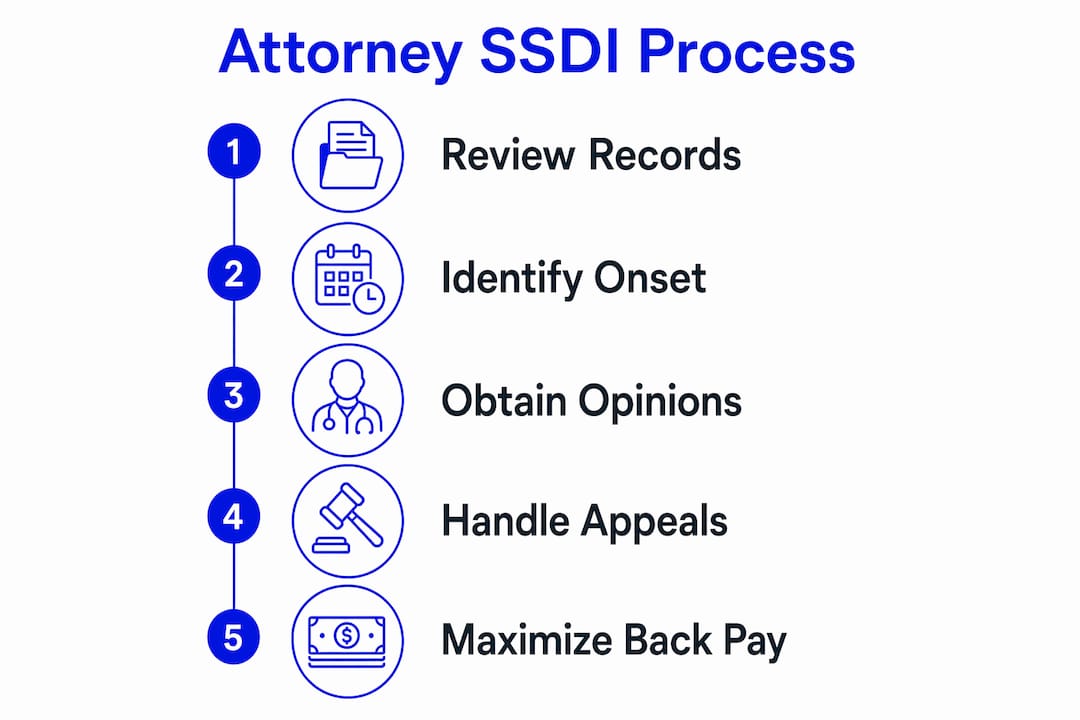
When SSA sets an onset date that is too late, the process for challenging it follows a defined sequence. Initial SSA decisions take 3 to 6 months, and appeals including an administrative law judge (ALJ) hearing can take 12 to 24 months. Knowing that timeline helps you understand why early attorney involvement matters. Waiting until after a denial to hire representation costs time and, often, money.
The standard appeal path attorneys follow in onset date disputes:
- Request for reconsideration. The attorney submits a formal request within 60 days of the initial decision, along with any new medical evidence supporting the earlier onset date.
- ALJ hearing request. If reconsideration is denied, the attorney files for a hearing before an administrative law judge. This is where most onset date disputes are actually resolved.
- Pre-hearing preparation. The attorney submits a pre-hearing brief, organizes the medical exhibit file, and prepares you to testify about your functional limitations during the disputed period.
- ALJ hearing. The attorney presents evidence, questions vocational and medical experts, and argues the legal standard for onset date under SSR 18-01p, the SSA ruling that governs how onset dates are determined.
- Post-hearing follow-up. If the ALJ issues an unfavorable decision, the attorney can appeal to the SSA Appeals Council or federal district court.
Courts have held that SSA cannot ignore medical records that support an earlier onset date. This legal precedent gives attorneys a firm foundation when the evidence clearly predates the date SSA assigned. The attorney's job is to make that evidence impossible to overlook.
How does attorney involvement affect SSDI back pay?
The financial stakes of onset date disputes are significant. An earlier established onset date directly increases the amount of back pay you receive and moves up your Medicare eligibility date. Back pay differences can reach $20,000 or more depending on how far back the corrected onset date goes. That figure represents real money that claimants lose when they accept an incorrect EOD without challenge.
Attorneys track every component of the back pay calculation. SSDI back pay runs from the established onset date through a five-month waiting period, then continues until the date of approval. A one-year difference in the onset date, on a monthly benefit of $1,500, equals $18,000 in additional back pay. Attorneys who understand this math fight harder for earlier dates because the outcome is measurable.
| Scenario | Onset Date | Estimated Back Pay |
|---|---|---|
| SSA-assigned date | 24 months before approval | $27,000 |
| Attorney-corrected date | 36 months before approval | $45,000 |
| Difference | 12 additional months | $18,000 more |
The attorney's impact on SSDI outcomes extends beyond back pay. Medicare eligibility begins 24 months after the onset date. An earlier EOD means earlier access to health coverage, which has its own financial and medical value for claimants managing serious conditions. Attorneys who understand benefit calculations factor Medicare timing into their onset date strategy.
Common pitfalls in onset date cases and how attorneys prevent them
Missing medical records are the most frequent obstacle in onset date disputes. If you did not see a doctor regularly during the period when your disability began, SSA has no objective evidence to anchor the earlier date. Attorneys address this by locating any available records, including urgent care visits, pharmacy records, and employer accommodation requests, that can corroborate the claimant's account.
A second common problem is the misalignment between when you stopped working and when the medical record shows your condition became disabling. SSA applies Substantial Gainful Activity (SGA) rules on a month-by-month basis. If you were still earning above the SGA threshold when you claim your disability began, SSA will push the onset date forward regardless of your medical condition. Attorneys analyze your work history against SGA limits to identify the earliest month that qualifies.
- Claimants often assume the onset date is simply the day they stopped working. SSA requires medical evidence, not just employment history.
- Gaps in treatment records during the disputed period give SSA grounds to assign a later date. Attorneys close those gaps before the hearing.
- Claimants sometimes accept SSA's onset date without realizing it can be challenged. An attorney reviews the determination and advises whether an appeal is worth pursuing.
- Poorly worded retrospective opinions that lack specific clinical references are routinely dismissed by ALJ judges. Attorneys guide physicians on how to write effective opinions.
Pro Tip: Gather any documentation from your employer, such as accommodation requests, performance reviews, or attendance records, from the period when your disability began. These records can corroborate your onset date even when medical documentation is thin.
Attorneys also advise on why certain cases get rejected before they are filed. If the evidence cannot support the claimed onset date, an experienced attorney will tell you that directly and help you identify the earliest date that is actually defensible.
Key takeaways
An attorney's primary function in SSDI onset date cases is to secure the earliest medically supported disability start date, using retrospective medical opinions, evidence gap analysis, and SSR 18-01p appeals to maximize back pay and Medicare eligibility.
| Point | Details |
|---|---|
| Onset date defines back pay | A one-year difference in the established onset date can mean $18,000 or more in additional benefits. |
| Medical records are the foundation | Attorneys collect and organize objective clinical evidence to support the earliest defensible onset date. |
| Retrospective opinions are decisive | Physician statements referencing specific clinical findings from the disputed period carry the most weight with ALJ judges. |
| Appeals follow a defined path | Reconsideration, ALJ hearing, and federal court are the three stages where onset date disputes are resolved. |
| Early attorney involvement matters | Waiting until after denial to hire an attorney costs time and risks losing months of back pay. |
Why onset date advocacy is the most underestimated part of SSDI practice
Most claimants focus on whether they will be approved at all. The onset date question gets treated as a secondary issue, something to sort out after the approval comes through. That is a mistake I have seen cost people significant sums.
The clients who come to me after accepting SSA's onset date without question are often surprised to learn the date was set months or even years later than the medical record supports. SSA adjudicators are not advocates for the claimant. They set the date the evidence in front of them supports, and if that evidence is incomplete, the date moves forward.
What most applicants overlook is that the onset date argument requires a different skill set than the basic disability argument. You are not just proving you are disabled. You are proving you were disabled on a specific earlier date, using records that may be incomplete, physicians who may not remember the details, and legal standards that require objective clinical correlation. That is a technical argument, and it requires an attorney who has made it before.
My advice: when selecting representation, ask specifically about the attorney's experience with onset date disputes and ALJ hearings. A disability law firm that handles onset date challenges regularly will approach your case differently than one that focuses only on initial applications. The difference shows up in your back pay check.
— Gerard
Get expert help with your SSDI onset date from Ssdilawyer
Onset date disputes require precise legal and medical analysis. Ssdilawyer connects you with experienced disability attorneys who specialize in exactly this work, from collecting retrospective medical opinions to preparing for ALJ hearings under SSR 18-01p.

If SSA assigned an onset date that does not match when your disability actually began, you may be owed thousands of dollars in back pay. Attorneys in the Ssdilawyer network review your medical records, identify evidence gaps, and build the strongest possible case for the earliest supported onset date. Visit Ssdilawyer to request a free case review and find out whether your onset date can be corrected.
FAQ
What is the role of attorney in SSDI onset date cases?
An attorney establishes the earliest medically supported disability start date by analyzing medical records, obtaining retrospective physician opinions, and challenging SSA decisions through reconsideration and ALJ hearings.
How much can an attorney change my SSDI back pay?
Correcting an onset date by one year on a $1,500 monthly benefit adds approximately $18,000 in back pay. Back pay differences can reach $20,000 or more depending on the length of the correction.
What is SSR 18-01p and why does it matter?
SSR 18-01p is the SSA ruling that governs how onset dates are determined during appeals. Attorneys use it to argue that SSA must consider all available medical evidence when setting the established onset date.
Can I dispute my onset date after being approved for SSDI?
Yes. You can request reconsideration and then an ALJ hearing to challenge an onset date SSA set too late. Submitting additional medical evidence and a retrospective physician opinion strengthens that appeal.
What happens if my medical records have gaps during the onset period?
Attorneys address gaps by locating alternative records, such as pharmacy history, urgent care visits, or employer accommodation documents, and by requesting retrospective opinions from treating physicians that reference earlier clinical findings.