
A disability lawyer is a licensed attorney who represents individuals pursuing Social Security disability benefits through the Social Security Administration (SSA). The attorney manages every stage of the process: filing applications, gathering medical evidence, meeting deadlines, and arguing cases before Administrative Law Judges (ALJs). Understanding what does disability lawyer do is the first step toward deciding whether you need one. The short answer is that a disability lawyer handles the legal complexity so you can focus on your health and your claim.
What does a disability lawyer do at the application stage?
A disability lawyer's role starts before you submit a single form. Hiring a lawyer early creates a cleaner medical record and prevents application mistakes that can delay or sink a claim. The contingency payment basis means fees stay the same whether you hire counsel on day one or day one hundred, so there is no financial reason to wait.
The core services of a disability lawyer at the application stage include:
- Reviewing application forms for accuracy and completeness before submission to the SSA
- Gathering and organizing medical records, work history, and treating physician statements
- Explaining SSA disability criteria so you understand exactly what evidence the agency requires
- Identifying gaps in documentation that could trigger an automatic denial
- Coordinating Residual Functional Capacity (RFC) assessments from treating physicians, which are among the most persuasive evidence in Social Security disability claims
SSDI and SSI claims involve complex procedural rules with strict deadlines and documentation standards. A single missing form or an incomplete medical history can result in denial even when the underlying disability is severe.
Pro Tip: Ask your attorney to request your complete medical records before filing, not after. Gaps discovered post-submission are far harder to correct.
How do disability lawyers handle denials and ALJ hearings?
About 60% of initial Social Security disability applications are denied. That statistic means the majority of claimants will need to appeal, and the appeal stage is where legal representation matters most.
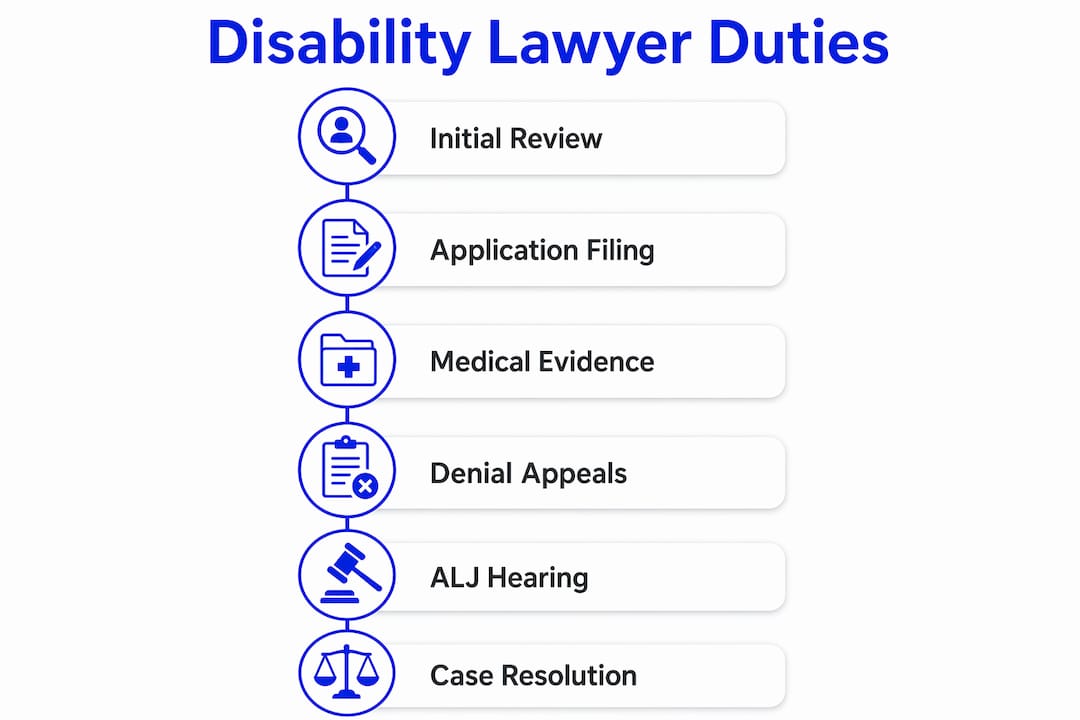
Here is how a disability lawyer manages the appeal process step by step:
- Files the Request for Reconsideration within the 60-day deadline after an initial denial
- Reviews the denial letter to identify the SSA's specific objections and evidence gaps
- Submits additional medical evidence to address those objections before the reconsideration review
- Files a Request for Hearing before an ALJ if reconsideration is also denied
- Prepares you for testimony by conducting mock questioning sessions before the hearing date
- Presents legal arguments to the ALJ based on SSA regulations and medical evidence
- Cross-examines the Vocational Expert (VE), a critical step that challenges testimony about jobs the claimant can still perform
That last point deserves attention. Cross-examination of the Vocational Expert is often the decisive factor in ALJ hearings. VEs testify about available jobs in the national economy that a claimant could theoretically perform. A skilled attorney challenges that testimony by pointing to the claimant's specific limitations, inconsistencies in the VE's job data, and SSA regulatory definitions. Many claimants who represent themselves never challenge the VE at all. That omission alone can cost them their case.
The appeal hearing is where legal skills in evidence presentation and expert cross-examination most impact the outcome. Approval rates at the ALJ level are significantly higher for represented claimants than for those who appear without counsel.
Pro Tip: Bring a written list of your worst days to the hearing, not your average days. ALJs assess your functional limits, and understating your symptoms is the most common claimant mistake.
What does a disability lawyer charge?
The fee structure for disability lawyers is set by federal law, which removes most of the financial uncertainty for clients.
| Fee Element | Details |
|---|---|
| Fee model | Contingency: no fee if the claim is lost |
| Federal fee cap | 25% of back pay or $9,200, whichever is less |
| Payment method | SSA deducts the fee directly from your back pay award |
| Upfront cost | None for attorney fees |
| Additional costs | Postage, medical record copies, expert report fees (typically $100–$500) |
| Free consultation | Available from most disability attorneys to evaluate case merits |
The contingency model is the standard in Social Security disability law. You pay nothing unless you win. When you do win, the SSA calculates your back pay (the benefits owed from your disability onset date to your approval date) and deducts the attorney fee before sending you the remainder. The federal cap protects you from excessive fees regardless of how large your back pay amount is.
How much do Social Security disability lawyers charge beyond the fee cap? Most do not charge more. Some firms bill separately for out-of-pocket costs like obtaining medical records or hiring independent medical experts. Ask about these costs upfront. A reputable attorney will disclose them in the attorney client agreement before you sign anything.
Free disability lawyer consultations allow you to assess your case strength and legal options at no cost. A typical consultation reviews your medical conditions, current claim status, and any denial letters you have received.
Disability lawyers vs. disability advocates: which do you need?
Not every person who helps with disability claims is a lawyer. Understanding the difference protects you from choosing the wrong type of representation.
| Factor | Disability Lawyer | Disability Advocate |
|---|---|---|
| Credentials | Licensed attorney | Certified non-attorney representative |
| Application help | Yes | Yes |
| ALJ hearing representation | Yes | No |
| Legal argumentation | Yes | Limited |
| Cross-examination of experts | Yes | No |
| Fee structure | Contingency, federal cap applies | Contingency, federal cap applies |
| Best for | Denied claims, complex cases, hearings | Simple initial applications |
Disability advocates assist with applications but cannot represent clients in ALJ hearings. That is the defining limitation. If your claim is straightforward and you have never been denied, an advocate may be sufficient. If you have received a denial letter or expect a hearing, you need a licensed attorney. The role of disability attorneys becomes most critical at the appeal and hearing stages, where legal strategy and courtroom advocacy directly affect outcomes.
How to hire a disability lawyer: key questions to ask
Selecting the right attorney affects both your timeline and your approval odds. Use these questions to evaluate any attorney before signing a representation agreement:
- How many SSDI and SSI cases have you handled? Experience with Social Security disability specifically matters more than general legal experience.
- What is your approval rate at ALJ hearings? A lawyer who regularly appears before ALJs will know the specific judges in your hearing office and their tendencies.
- Who will handle my case day to day? Some firms assign cases to paralegals after the initial consultation. Know who your primary contact will be.
- How do you communicate with clients? Establish whether updates come by phone, email, or a client portal, and how quickly you can expect responses.
- What documents do you need from me immediately? Prepare your medical records, work history for the past 15 years, and all SSA correspondence before the first meeting.
The checklist for finding a disability lawyer near you covers local availability and specialization in detail. Timelines for SSDI claims vary widely. Initial applications take three to six months. Appeals can add another one to three years. An attorney who sets realistic expectations from the start is more reliable than one who promises fast results.
No disability lawyer can guarantee approval. Final decisions rest on medical criteria evaluated by the SSA, not on legal arguments alone. A lawyer strengthens your case. The SSA makes the final call.
Key takeaways
A disability lawyer's most critical function is not paperwork. It is legal advocacy at the ALJ hearing stage, where cross-examination of vocational experts and structured evidence presentation directly determine whether a denied claim gets approved.
| Point | Details |
|---|---|
| Early involvement matters | Hiring a lawyer before filing prevents documentation errors that cause initial denials. |
| Appeals are where lawyers earn their value | 60% of initial claims are denied; attorney representation at ALJ hearings significantly raises approval odds. |
| Federal fee caps protect clients | Fees are capped at 25% of back pay or $9,200, whichever is less, with no upfront cost. |
| Lawyers outperform advocates at hearings | Only licensed attorneys can cross-examine vocational experts at ALJ hearings, a decisive step in most appeals. |
| RFC assessments are critical evidence | Lawyers coordinate Residual Functional Capacity assessments from treating physicians to build the strongest possible medical record. |
What i have learned watching disability cases win and lose
After years of observing how Social Security disability claims play out, one pattern stands out clearly. Claimants who lose at ALJ hearings almost always share one trait: they treated the hearing like a medical appointment instead of a legal proceeding.
The SSA's decision is not purely about how sick you are. It is about how well your limitations are documented, categorized, and argued against SSA's own regulatory framework. A treating physician who writes "patient cannot work" is far less useful than one who completes a detailed RFC form specifying that the patient cannot sit for more than 20 minutes, cannot lift more than 10 pounds, and needs to lie down twice daily. That specificity is what lawyers extract from physicians. Most claimants without counsel never obtain it.
The vocational expert cross-examination point is one most people outside the process never hear about. VEs are not adversarial witnesses. They are neutral experts. But their testimony about available jobs is based on job classification data that is often outdated or misapplied to a claimant's specific limitations. A prepared attorney can expose those gaps in under five minutes of questioning. That five minutes can be the difference between approval and another denial.
My honest observation is this: the claimants who fare best are not necessarily the most severely disabled. They are the ones with the most organized, specific, and legally framed evidence. A good disability attorney builds that record from day one.
— Gerard
Start your disability claim with expert legal support
Ssdilawyer connects individuals with experienced disability attorneys who handle SSDI and SSI claims from initial application through ALJ hearings. Every attorney in the network works on a contingency basis. You pay nothing unless your claim is approved. A free case evaluation takes less than 15 minutes and gives you a clear picture of your options, your evidence gaps, and your next steps. Whether you are filing for the first time or responding to a denial, Ssdilawyer provides the legal guidance you need to move forward with confidence and clarity.
FAQ
What does a disability lawyer do for an SSDI claim?
A disability lawyer manages the full SSDI process: filing applications, gathering medical evidence, meeting SSA deadlines, and representing you at ALJ hearings. Their role is to present your limitations in the legal framework the SSA uses to evaluate claims.
How much do social security disability lawyers charge?
Federal law caps disability lawyer fees at 25% of your back pay or $9,200, whichever is less. No fee is charged if the claim is not approved, and the SSA deducts the fee directly from your back pay award.
When should you consult a disability lawyer?
Consult a disability lawyer as soon as you decide to file or immediately after receiving a denial letter. Early involvement prevents application errors and gives the attorney more time to build a complete medical record.
Can a disability advocate represent you at an ALJ hearing?
No. Disability advocates can assist with initial applications but cannot represent clients at Administrative Law Judge hearings. Only licensed attorneys provide full legal representation at the hearing level.
What is a disability lawyer case evaluation?
A disability lawyer case evaluation is a free consultation where the attorney reviews your medical conditions, work history, and claim status to assess your approval odds and identify the strongest legal strategy for your case.