
Hiring an SSDI attorney means engaging a professional who translates your medical records into the precise functional language the Social Security Administration requires for approval. This is why hire ssdi attorney explained matters: the SSA does not approve claims based on diagnosis alone. It approves claims based on documented functional limitations that prevent work. An attorney's job is to build that case, fill evidence gaps, and present it correctly at every stage, from initial filing through administrative hearings. Without that expertise, claimants routinely lose winnable cases on procedural and evidentiary grounds.
How do SSDI attorneys build stronger cases compared to self-filing?
The foundation of any successful SSDI claim is evidence that matches the SSA's specific criteria. Legal definitions of disability focus on functional limitations, not just medical diagnosis. That distinction is the core reason self-filed claims fail at high rates.
An attorney begins with a detailed review of your entire medical file before a single form is submitted. The goal is to identify what the SSA needs to see and what is currently missing. This pre-filing audit is where most of the real work happens.

The most common gap attorneys find is a missing Residual Functional Capacity (RFC) assessment. Filing without RFC forms is a frequent reason for denials, because raw medical notes rarely describe how your condition limits your ability to sit, stand, lift, or concentrate. Attorneys work directly with your treating physicians to obtain RFC forms that document those specific limitations in SSA-compatible language.
Attorneys also organize your evidence to match the SSA's Blue Book criteria, which lists recognized disabling conditions and the clinical findings required to meet each one. When your condition does not meet a Blue Book listing exactly, attorneys build a medical-vocational argument showing why your age, education, and work history combine with your limitations to prevent any gainful employment.
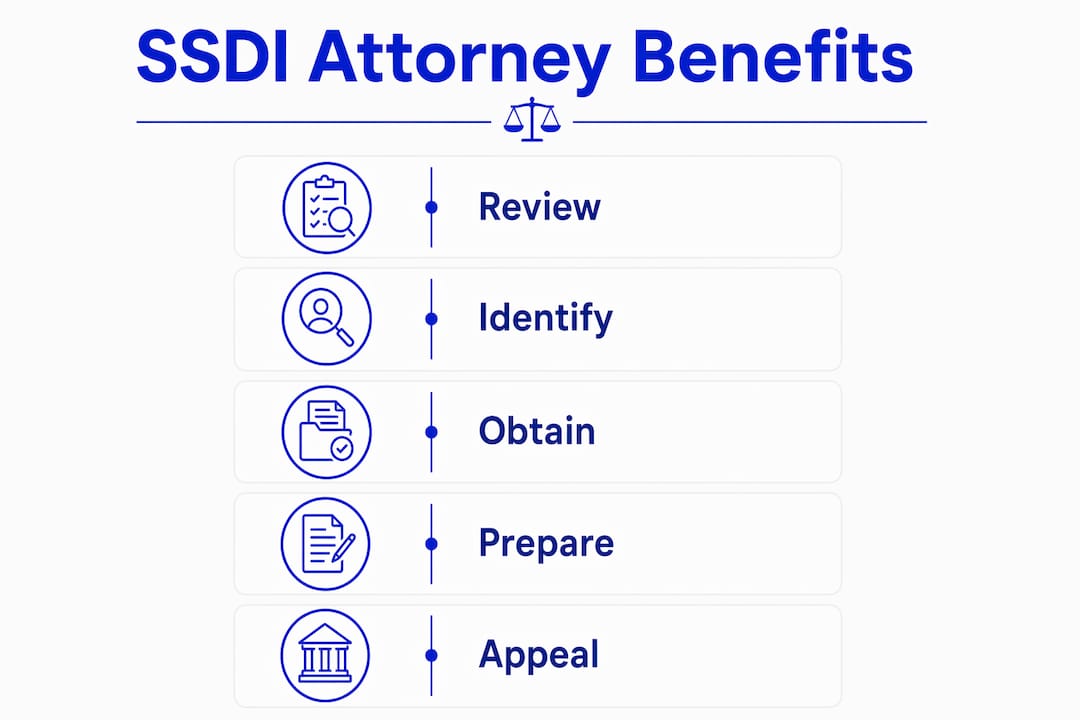
Key steps attorneys take during case development:
- Review all medical records for completeness and consistency
- Identify missing RFC assessments and request them from treating physicians
- Obtain supportive medical opinions that address functional work limitations
- Organize evidence to align with SSA Blue Book criteria
- Flag and correct inconsistencies before they become denial reasons
- Document vocational history to support medical-vocational arguments
Pro Tip: Ask your attorney specifically whether your treating physician has completed an RFC form. If not, that is the single most important document to obtain before filing or appealing.
What advantages do SSDI attorneys provide during claims and appeals?
The SSA system is complex, and attorneys act as advocates across all claim phases, not just at the hearing. Each phase has distinct procedural requirements where errors cause delays or outright denials.
The advantages attorneys provide at each stage:
-
Initial filing. Attorneys complete forms accurately, select the correct alleged onset date, and submit supporting records that match SSA requirements from day one. Errors at this stage create problems that follow the claim for years.
-
Reconsideration. The first appeal after denial requires updated medical records and a written argument. Attorneys add new treatment records and frame the reconsideration request to address the specific reasons for the initial denial.
-
Appeal deadline management. Claimants have 60 days from denial to file an appeal. Missing that window means starting over. Attorneys track every deadline and handle all SSA communications.
-
Hearing preparation. Before an Administrative Law Judge (ALJ) hearing, attorneys prepare a written hearing brief that summarizes your medical evidence, legal arguments, and applicable SSA regulations. This document frames how the judge reviews your file.
-
Local knowledge. Attorneys tailor evidence presentation according to local SSA offices and individual ALJ preferences. Different judges weight RFC limitations differently. An attorney who regularly appears before a specific ALJ knows what that judge needs to see.
-
Hearing representation. Claimants with attorney representation are significantly more likely to win at the hearing level. Face-to-face presentation, cross-examination of vocational experts, and real-time legal argument require professional skill that most claimants do not have.
The hearing level is where SSDI legal representation benefits are most visible. But the preparation that makes hearings winnable starts months earlier.
What are common misconceptions about SSDI attorneys?
Most people believe an SSDI attorney's job is to show up at a hearing and argue your case. That belief misses the most critical work entirely.
"The most important work an SSDI attorney does happens before you ever enter a hearing room. Pre-hearing evidence development, medical questionnaire procurement, and record organization determine whether a case is winnable long before a judge sees it."
Pre-hearing evidence development is the core workload. Attorneys spend the majority of their time reviewing records, identifying gaps, and obtaining the specific documentation the SSA needs. By the time a hearing occurs, the case should already be built.
A second misconception is that attorneys simply fill out forms. The actual skill is translation. Physicians document diagnoses and treatment in clinical language. The SSA requires functional language: how far can you walk, how long can you sit, can you follow multi-step instructions under stress. Attorneys convert clinical records into that functional framework, which is what the SSA actually evaluates.
The case management phases attorneys handle are filing, development, appeal, and hearing. Each phase requires different skills. Filing requires procedural accuracy. Development requires medical knowledge and physician relationships. Appeals require legal writing. Hearings require courtroom skills. An attorney covers all four. A claimant handling their own case typically struggles with at least two of them.
Pro Tip: When evaluating an SSDI attorney, ask how they handle the development phase specifically. An attorney who only mentions hearings is telling you something important about how they work.
Should you hire an SSDI attorney, and when?
The decision to hire an attorney depends on your claim's complexity, your medical history, and where you are in the process. Not every situation carries the same risk, but certain factors make professional help clearly worth pursuing.
Situations where earlier attorney involvement is the right call:
- Complex medical history. Multiple interacting impairments, inconsistent treatment records, or conditions not listed in the SSA Blue Book all require expert organization and argument.
- Cognitive or organizational challenges. If your condition affects memory, concentration, or your ability to manage paperwork, an attorney handles the administrative burden that would otherwise fall to you.
- Language barriers. SSA forms and correspondence are dense. Errors caused by language barriers are common and preventable with legal help.
- Prior denials. Legal representation becomes more valuable as claim complexity grows, particularly after repeated denials. Each denial adds procedural history that must be addressed in subsequent filings.
- Approaching deadlines. If your 60-day appeal window is closing, an attorney can file quickly and correctly while you focus on your health.
Some claimants with straightforward medical records and clear Blue Book listings successfully file on their own. The risk is not knowing what you do not know. A missing RFC form or a procedural error at the initial stage can cost you months and require a full appeal cycle to correct.
The practical guidance on when to hire a disability attorney is clear: the earlier you involve an attorney, the more control you have over how your case is built. Waiting until after a denial means working with a record that already has problems.
Key Takeaways
Hiring an SSDI attorney improves approval odds because attorneys translate medical evidence into SSA functional language, fill RFC gaps, manage deadlines, and tailor case presentation to local ALJ preferences.
| Point | Details |
|---|---|
| RFC forms are critical | Missing RFC assessments are a leading cause of denials; attorneys obtain them from treating physicians. |
| Translation is the core skill | Attorneys convert clinical diagnoses into the functional limitation language the SSA requires for approval. |
| Local ALJ knowledge matters | Attorneys familiar with specific judges tailor evidence presentation to match that judge's evaluation preferences. |
| Appeals have strict deadlines | Claimants have 60 days from denial to appeal; attorneys manage this timeline and all SSA communications. |
| Earlier involvement is better | Hiring an attorney before filing gives you the most control over how your case record is built from the start. |
What I've learned about the attorney's role that most guides get wrong
Most articles about SSDI attorneys focus on approval rates and fees. Those are real considerations. But after years of watching how these cases actually develop, the detail that matters most is almost never discussed: the quality of the pre-hearing record.
I've seen claimants arrive at hearings with strong medical histories and lose, because no one ever obtained an RFC form from their treating physician. The physician's notes documented the diagnosis clearly. They said nothing about functional limitations. The SSA denied the claim not because the person was not disabled, but because the record never proved it in the language the SSA uses.
Attorneys who understand SSDI onset date claims and the full development phase are worth far more than attorneys who specialize in hearing advocacy alone. The hearing is the last step. The record is built long before that.
The other thing most guides understate is local knowledge. ALJs are not interchangeable. Some weight treating physician opinions heavily. Others rely more on independent medical experts. An attorney who appears regularly before a specific judge knows this. A claimant filing alone does not. That asymmetry in knowledge is a real disadvantage that representation corrects.
Not every claim wins with an attorney. Some cases simply do not meet SSA criteria. But representation improves your odds, reduces procedural errors, and removes a significant burden from someone who is already dealing with a serious health condition. That combination of factors makes the benefits of hiring a disability attorney concrete, not theoretical.
— Gerard
Get matched with an SSDI attorney through Ssdilawyer
Ssdilawyer connects individuals with experienced disability attorneys who handle SSDI applications, denials, appeals, and hearings. There are no upfront fees. Attorneys work on contingency, meaning you pay nothing unless your case is approved.
If you are dealing with a denial, approaching a deadline, or filing for the first time with a complex medical history, Ssdilawyer can match you with an attorney who knows the SSA process and your local ALJ environment. Visit Ssdilawyer to start the process and get the legal support your claim deserves.
FAQ
Why hire an SSDI attorney instead of filing alone?
An SSDI attorney translates your medical records into the functional limitation language the SSA requires, obtains RFC forms, and manages deadlines that claimants frequently miss when filing without help.
What does an SSDI attorney actually do before the hearing?
The majority of an attorney's work happens before the hearing: reviewing records, identifying evidence gaps, obtaining RFC assessments from treating physicians, and organizing the file to match SSA criteria.
When should I hire an SSDI attorney?
Hire an attorney as early as possible, especially if you have a complex medical history, prior denials, cognitive challenges, or an approaching appeal deadline. Earlier involvement gives you more control over how your case record is built.
How do SSDI attorneys improve approval odds at hearings?
Attorneys prepare written hearing briefs, cross-examine vocational experts, and tailor evidence presentation to individual ALJ preferences, all of which significantly improve the likelihood of a favorable decision.
Do SSDI attorneys cost money upfront?
SSDI attorneys typically work on contingency. You pay no upfront fees, and the attorney's fee is capped by federal regulation and paid only if your claim is approved.