
A disability lawyer is a licensed attorney authorized to represent you at every stage of a Social Security Disability claim, including federal court appeals, while a non-attorney representative assists at the administrative level only. That single distinction carries serious consequences if your claim is denied beyond the Appeals Council. Approximately 66% of initial Social Security disability claims are denied, which means most claimants will face at least one appeal. Understanding the disability lawyer vs non-attorney rep difference before you hire anyone is the most practical step you can take.
What qualifications separate disability lawyers from non-attorney reps?
A disability lawyer holds a law degree, has passed the bar exam in at least one state, and operates under formal legal ethics rules. Those ethics rules include duties of confidentiality, competence, and loyalty that are enforced by state bar associations. Violations can result in suspension or disbarment, which gives claimants a formal accountability mechanism.
A non-attorney representative, by contrast, does not hold a law degree. The Social Security Administration (SSA) recognizes two categories of non-attorney reps. The first is the Eligible Direct Pay Non-Attorney (EDPNA), a designation that requires meeting specific SSA standards. The second is a general non-attorney representative who lacks that accreditation.

To qualify as an EDPNA, a representative must pass a 50-question SSA-administered exam with a minimum score of 70% within a three-hour time limit. They must also demonstrate relevant education or experience and carry at least $100,000 in professional liability insurance per incident. That insurance requirement matters because it protects you if the representative makes a costly error.
Key qualification differences at a glance:
- Disability lawyer: law degree, state bar admission, legal ethics obligations, unlimited scope of representation
- EDPNA non-attorney rep: SSA exam, education or experience requirement, $100,000 liability insurance, direct payment eligibility
- General non-attorney rep: no formal SSA accreditation, no direct payment from SSA, claimant manages fee payment personally
Pro Tip: Ask any representative you interview whether they hold EDPNA status. The answer tells you immediately whether SSA will pay them directly from your back pay or whether you will have to manage that payment yourself.
How do scope of services and appeals handling differ?
Both disability lawyers and non-attorney representatives can help you file an initial application, request reconsideration, and represent you at an Administrative Law Judge (ALJ) hearing. The ALJ hearing is where most claims are won or lost, and both types of representatives can prepare evidence, gather medical records, and argue your case before the judge.
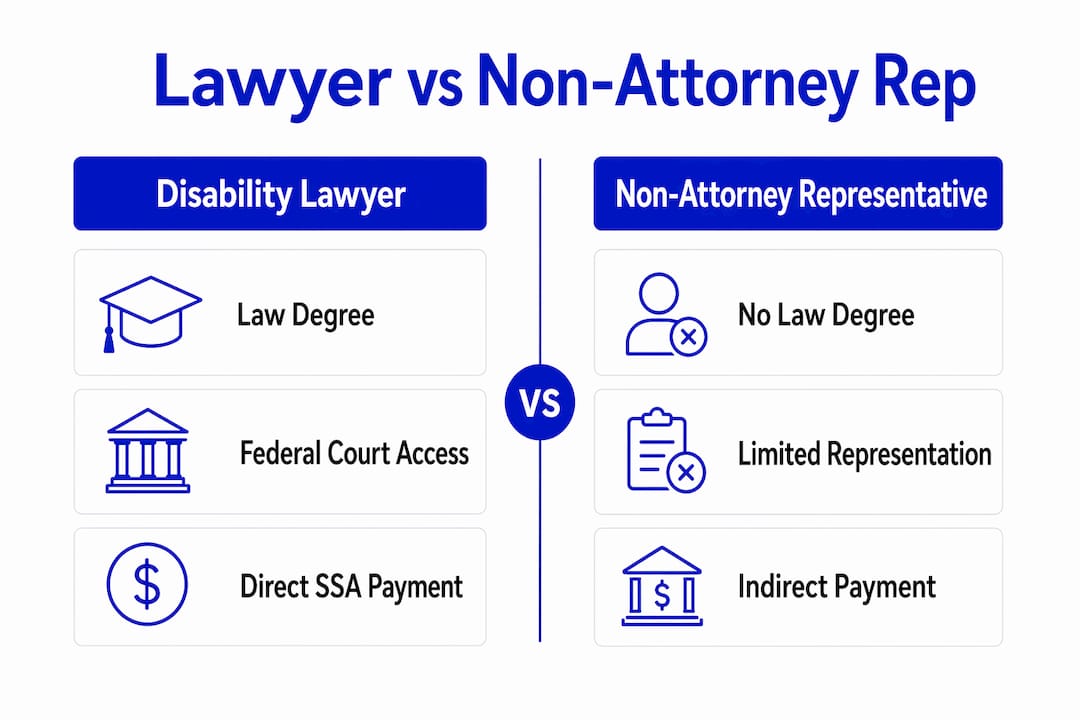
The critical difference appears when a claim is denied at the Appeals Council and needs to go to federal district court. Only attorneys can represent claimants in federal court. A non-attorney representative, regardless of how experienced they are, cannot file or argue a federal lawsuit on your behalf. That limitation is not a technicality. It is a hard legal boundary set by federal law.
The stages where each representative can act:
- Initial application: Both can assist with filing and documentation.
- Reconsideration: Both can request and support a reconsideration review.
- ALJ hearing: Both can represent you before an Administrative Law Judge.
- Appeals Council: Both can submit a request for review.
- Federal district court: Attorneys only. Non-attorney reps cannot proceed past this point.
"The key strategic advantage lawyers hold is their authority to represent cases at federal court level, while non-attorney reps excel in managing administrative hearing stages."
Starting with a non-attorney rep and then needing to switch to an attorney at the federal stage creates real problems. Switching representatives after an Appeals Council denial can cause missed federal filing deadlines and repeated file familiarization delays that directly hurt your claim. A new attorney must learn your entire case history under time pressure. That risk is avoidable if you choose an attorney from the start.
What are the fee and payment differences?
Both disability lawyers and qualified non-attorney representatives work on a contingency basis. You pay nothing upfront. The SSA caps fees at the lesser of 25% of back pay or $9,200. That cap applies to both attorneys and EDPNA-accredited non-attorney reps.
The payment process is where the two types diverge. Attorneys and EDPNA representatives receive payment directly from SSA out of your withheld back pay. SSA processes the fee automatically before sending you the remainder. You never handle the money yourself.
Non-accredited non-attorney representatives do not receive direct payment from SSA. After you receive your back pay, you are responsible for paying the representative yourself. That arrangement introduces two risks. First, you must manage a potentially large payment on your own. Second, disputes about the amount or timing of payment fall on you to resolve without SSA acting as an intermediary.
Pro Tip: Confirm payment method before signing any representation agreement. If a non-attorney rep is not EDPNA-accredited, you will receive your full back pay first and then owe the fee. Budget accordingly and get the fee agreement in writing.
The fee structure comparison:
| Feature | Disability lawyer | EDPNA non-attorney rep | General non-attorney rep |
|---|---|---|---|
| Contingency fee | Yes | Yes | Yes |
| SSA fee cap applies | Yes | Yes | Yes |
| Direct payment from SSA | Yes | Yes | No |
| Claimant manages payment | No | No | Yes |
| Federal court representation | Yes | No | No |
How to choose between a disability lawyer and a non-attorney rep
The right choice depends on your case complexity, your medical situation, and how far your claim may need to go. Non-attorney representatives often have strong SSA process knowledge that is genuinely useful for medically straightforward cases. If your condition is well-documented, your work history is clear, and you are unlikely to need federal court review, a qualified EDPNA representative may serve you well.
A disability attorney is the stronger choice when:
- Your medical records are incomplete or disputed
- You have already been denied at the ALJ level
- Your condition involves complex legal definitions, such as mental health impairments or multiple overlapping diagnoses
- You want a single representative who can carry your case all the way to federal court if needed
- You prefer the accountability structure of a licensed attorney and state bar oversight
When evaluating any representative, ask these specific questions:
- Are you a licensed attorney or an EDPNA-accredited non-attorney representative?
- Who will handle my day-to-day case management and communications?
- Have you represented claimants with my specific medical condition before?
- What happens to my case if it needs to go to federal court?
That last question is the most revealing. A non-attorney rep who cannot answer it clearly is telling you something important about the limits of their service. Understanding SSDI legal representation benefits before you commit to any representative gives you a real advantage in that conversation.
The communication question matters more than most claimants expect. Many lawyers delegate daily claim management to paralegals, which is standard practice in law firms. That is not necessarily a problem, but you should know who your primary contact is and how quickly they respond. A non-attorney rep at a small advocacy firm may give you more direct access, while a large law firm may route most communication through support staff.
Key Takeaways
A disability lawyer is the only representative who can follow your claim all the way to federal court, making attorney representation the lower-risk choice for complex or repeatedly denied claims.
| Point | Details |
|---|---|
| Federal court access | Only attorneys can represent you in federal district court if SSA denies your claim at all administrative levels. |
| EDPNA accreditation matters | Non-attorney reps with EDPNA status receive direct SSA payment; those without it require you to manage fees yourself. |
| Fee cap applies to both | SSA caps fees at 25% of back pay or $9,200, whichever is less, for both attorneys and EDPNA-accredited reps. |
| Switching reps carries risk | Changing from a non-attorney rep to an attorney after an Appeals Council denial can cause missed deadlines and delays. |
| Ask who manages your case | Law firms often use paralegals for daily tasks; confirm your primary contact before signing any agreement. |
What I've learned about choosing representation early
After years of watching disability claims move through the SSA system, one pattern stands out clearly. Claimants who start with an attorney almost never regret it. Claimants who start with a non-attorney rep and later need federal court review often do.
The federal court deadline issue is not theoretical. After an Appeals Council denial, you have 60 days to file in federal district court. If your non-attorney rep cannot make that filing, you need a new attorney who must learn your entire case history under that deadline. That is a genuinely difficult situation that is entirely avoidable.
The fee argument for choosing a non-attorney rep over an attorney is also weaker than it appears. Both types of representatives work on contingency, and the SSA fee cap is identical. You are not saving money by choosing a non-attorney rep. You are simply accepting a narrower scope of representation for the same cost.
The one area where I think non-attorney reps get unfair criticism is at the ALJ hearing stage. A skilled EDPNA representative with years of SSA hearing experience can be highly effective at that level. The benefits of hiring a disability attorney are real, but they are most pronounced at the federal court stage, not necessarily at the ALJ hearing. If your case is medically clear and unlikely to reach federal court, a well-credentialed non-attorney rep is a legitimate option.
My practical advice: ask every representative you interview what happens if your case needs to go to federal court. The answer tells you everything about whether they are the right fit for your situation.
— Gerard
Ssdilawyer connects you with qualified disability attorneys
Choosing the right representative is one of the most consequential decisions in your SSDI claim. Ssdilawyer connects claimants directly with experienced disability attorneys who handle applications, denials, ALJ hearings, and federal appeals.
Every attorney in the Ssdilawyer network works on a contingency basis, meaning no upfront costs and no fees unless you win. SSA pays attorney fees directly from your back pay, so you never manage that payment yourself. If your claim has been denied or you are preparing to file, connect with a disability attorney at Ssdilawyer to get qualified legal representation from the start.
FAQ
What is a non-attorney disability rep?
A non-attorney disability representative is a trained advocate without a law degree who can assist with SSA applications, reconsiderations, and ALJ hearings. Those who hold EDPNA accreditation meet SSA's exam, experience, and insurance requirements.
Can a non-attorney rep take my case to federal court?
No. Only licensed attorneys can represent claimants in federal district court. If your claim is denied at the Appeals Council level, a non-attorney rep cannot proceed further.
Are fees the same for lawyers and non-attorney reps?
Yes. The SSA fee cap applies equally: the lesser of 25% of back pay or $9,200. The difference is in payment method, not the fee amount.
What is EDPNA status and why does it matter?
EDPNA stands for Eligible Direct Pay Non-Attorney. Representatives with this status receive payment directly from SSA out of your back pay, which removes the burden of managing that payment yourself.
When should I choose a disability lawyer over a non-attorney rep?
Choose a disability lawyer when your case is medically complex, when you have already been denied at the ALJ level, or when there is any chance your claim may need to proceed to federal court.