
SSDI legal representation is defined as professional legal assistance provided by a licensed attorney or qualified advocate to help claimants obtain Social Security Disability Insurance benefits. The ssdi legal representation benefits explained in this guide are backed by federal data and independent research. A 2022 National Bureau of Economic Research study found that having an attorney increases initial claim approval by 23 percentage points. GAO analysis of SSA ALJ decisions from fiscal years 2007–2015 shows claimants with representatives were allowed benefits nearly 3 times more often than those without. This guide breaks down why representation matters, what attorneys actually do, and how to decide if you need one.
How does SSDI legal representation improve your approval chances?
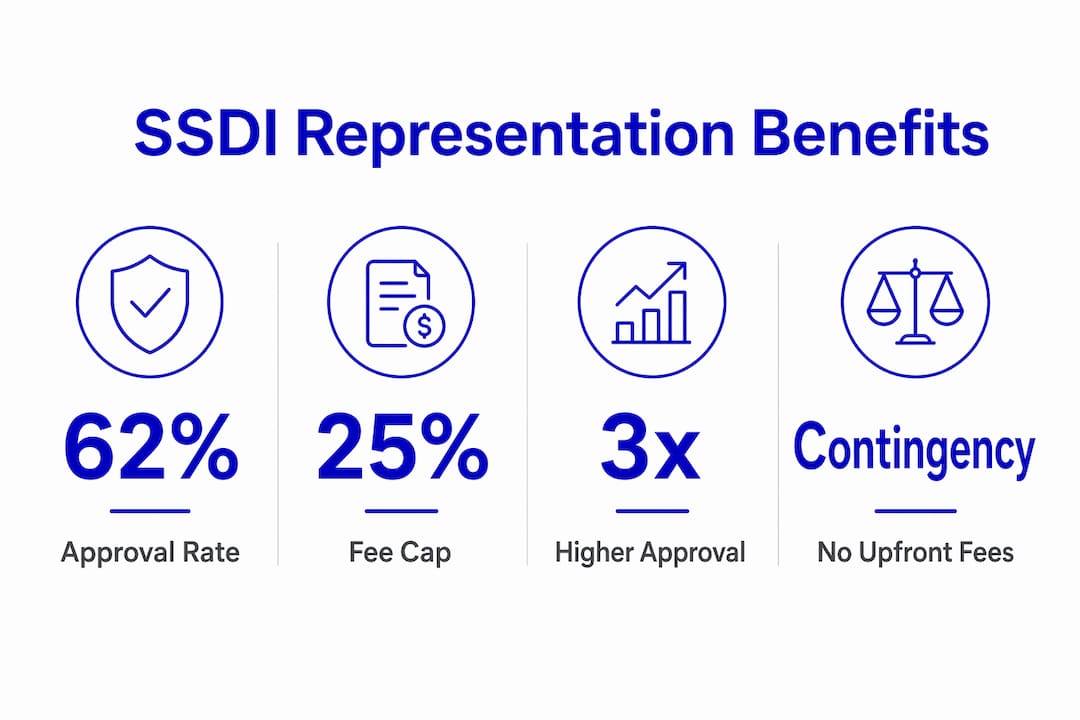
The approval rate gap between represented and unrepresented claimants is one of the most consistent findings in Social Security research. GAO data covering fiscal years 2007–2015 confirms that represented claimants were allowed benefits at nearly three times the rate of those without an attorney or advocate. That gap does not appear by accident. It reflects the direct impact of skilled legal submissions on how SSA adjudicators evaluate cases.
The difference is sharpest at the Administrative Law Judge hearing stage. Represented claimants are approved at 62% versus 34% for unrepresented claimants at ALJ hearings. That is an 82% improvement in approval odds at the most critical stage of the process. For claimants who have already been denied once or twice, this data point alone makes the case for hiring an attorney before requesting a hearing.

The reasons behind these numbers are practical, not abstract. Attorneys know how to frame medical evidence in terms SSA adjudicators recognize. They meet filing deadlines, respond to SSA requests correctly, and prepare claimants for hearing testimony. Each of these steps reduces the risk of a procedural denial that has nothing to do with the severity of the claimant's condition.
Pro Tip: If your case has reached the ALJ hearing stage, representation is not optional. The complexity of hearing rules, vocational expert testimony, and medical evidence standards makes self-representation a significant liability at that point.
What services do SSDI attorneys provide?
SSDI attorneys provide a defined set of services that address every stage of the claims process, from initial application through federal court appeal. Understanding what they do makes it easier to see where their involvement adds the most value.
-
Initial case evaluation. An attorney reviews your medical history, work record, and financial situation to determine whether you qualify for SSDI, Supplemental Security Income (SSI), or both. SSDI is based on work credits; SSI is need-based. Confusing the two programs is a common and costly mistake.
-
Application filing and deadline tracking. Attorneys file the initial application, track SSA response deadlines, and submit reconsideration requests within the required 60-day window. Missing a deadline forces claimants to restart the process entirely.
-
Medical evidence gathering. Attorneys request records from treating physicians, hospitals, and specialists. They also obtain Residual Functional Capacity (RFC) letters, which document exactly how a claimant's condition limits their ability to work. RFC letters are among the most persuasive documents in any SSDI file.
-
Hearing representation. At ALJ hearings, attorneys present opening statements, question medical experts, and cross-examine vocational experts who testify about job availability. Vocational expert testimony is a primary reason claims are denied at the hearing level. An attorney who knows how to challenge that testimony directly affects the outcome.
-
Appeals and federal court representation. If an ALJ denies the claim, attorneys can appeal to the SSA Appeals Council and, if necessary, to federal district court. SSDI federal court representation requires knowledge of administrative law that goes well beyond standard disability procedure.
Legal representation improves case preparation quality across all of these stages, including evidence gathering and deadline compliance, which reduces the risk of procedural errors that derail otherwise valid claims.
The fee structure removes the financial barrier most claimants worry about. SSDI attorneys work on contingency, meaning no upfront costs. Fees are capped at 25% of back pay or $7,200, whichever is less, and SSA pays the attorney directly from the claimant's award. You owe nothing if the claim is not approved.
Pro Tip: Ask any attorney you consult to explain the fee cap in writing before signing a representation agreement. The SSA fee structure is standardized, but confirming it upfront removes any ambiguity.
When do you need SSDI legal representation?
Not every claimant needs an attorney from day one, but the threshold for needing one is lower than most people assume. The right time to hire an attorney depends on where you are in the process and how complex your case is.
Representation is strongly recommended in these situations:
- Your initial claim was denied and you are filing for reconsideration.
- You have received a second denial and are requesting an ALJ hearing.
- Your medical records are extensive, involve multiple conditions, or require specialist interpretation.
- Your claim was denied on a technicality rather than a medical determination.
- You have previously filed and been denied without legal help.
Self-representation carries real risk at the hearing level. Self-represented claimants face significantly lower approval rates at ALJ hearings due to the complexity of hearing rules, medical evidence standards, and vocational expert questioning. The process is not designed to be navigated without legal knowledge.
Representation is especially critical during appeals and ALJ hearings, where legal expertise on evidence presentation, hearing rules, and expert cross-examination directly affects outcomes. Attorneys who specialize in SSDI understand how individual ALJs approach cases, which informs how they prepare and present evidence.
| Situation | Attorney recommended? |
|---|---|
| First-time initial application, straightforward medical history | Optional |
| Initial claim denied, filing reconsideration | Yes |
| Second denial, requesting ALJ hearing | Strongly recommended |
| Complex medical records or multiple conditions | Yes |
| Prior failed claims without legal help | Yes |
| Federal court appeal after ALJ denial | Required |
When selecting an attorney, prioritize those who specialize exclusively in Social Security disability law. A disability lawyer checklist can help you evaluate credentials, experience with ALJ hearings, and communication practices before you commit.
Common misconceptions about SSDI attorney fees and guarantees
The most persistent misconception about SSDI legal support is that attorneys guarantee approval. No attorney can guarantee an SSDI claim will be approved. What attorneys do is substantially improve the odds by preparing a stronger case and avoiding procedural errors that lead to preventable denials.
The second most common misconception is that hiring an attorney is expensive. Fee arrangements protect claimants by requiring no upfront costs and capping fees as a percentage of past-due benefits. The SSA pays the attorney directly, so claimants never write a check to their lawyer. The financial risk of hiring an attorney is effectively zero.
A third misconception is that the claims process is straightforward enough to handle alone. The SSA denies the majority of initial applications. The process involves medical documentation standards, SSA program rules, and hearing procedures that are not intuitive for people without legal training. Claimants who attempt to navigate appeals without help frequently make errors that extend the process by months or years.
Pro Tip: Know your rights before your first attorney consultation. The SSA fee cap is federal law, not a negotiable term. Any attorney who quotes fees above the cap or requests upfront payment is not operating within SSA guidelines.
The benefits of hiring a disability attorney extend beyond approval rates. Attorneys reduce the administrative burden on claimants who are already managing serious health conditions. That reduction in stress has practical value that does not show up in approval statistics but matters significantly to the people going through the process.
Key Takeaways
Legal representation is the single most consistent factor in improving SSDI claim approval rates, with represented claimants approved at nearly three times the rate of those without an attorney.
| Point | Details |
|---|---|
| Approval rate impact | Represented claimants are approved at nearly 3 times the rate of unrepresented claimants per GAO data. |
| ALJ hearing advantage | Attorneys improve ALJ hearing approval from 34% to 62%, an 82% improvement in odds. |
| No upfront cost | SSDI attorneys work on contingency with fees capped at 25% of back pay or $7,200, whichever is less. |
| When to hire | Representation is strongly recommended at reconsideration, ALJ hearings, and federal court appeals. |
| Services provided | Attorneys handle evidence gathering, RFC letters, deadline tracking, and vocational expert cross-examination. |
What I have seen working with SSDI claimants
The data on representation is clear, but the numbers do not fully capture what I have observed in practice. The claimants who struggle most are not those with the weakest medical cases. They are the ones who waited too long to get legal help and arrived at an ALJ hearing without the documentation or preparation their case required.
The medical evidence piece is where attorneys add the most value that claimants do not anticipate. Treating physicians often write notes that are clinically accurate but legally insufficient for SSDI purposes. An attorney who understands how onset date documentation affects a claim will go back to the physician and request a properly structured RFC letter. That single document can change the outcome of a hearing.
Cost concerns are real, but they are almost always outweighed by the financial benefit of a successful claim. Back pay awards can cover years of unpaid benefits. An attorney's capped fee comes out of that award. The net financial result of winning with an attorney is almost always better than losing without one.
My honest recommendation is to consult an attorney before filing, not after the first denial. Early involvement means better documentation from the start, fewer procedural errors, and a stronger record if the case goes to a hearing. Waiting until you are denied costs time and often weakens the case.
— Gerard
Ssdilawyer connects you with experienced SSDI attorneys
Ssdilawyer connects claimants with disability attorneys who handle applications, denials, appeals, and ALJ hearings on a contingency fee basis. No upfront costs. No fees unless your claim is approved.
If your claim has been denied or you are preparing to file, working with an attorney from the start gives you the best chance of approval. Ssdilawyer's network includes attorneys with direct experience in SSDI hearings and federal court appeals. Visit Ssdilawyer to request a free case evaluation and connect with a qualified disability attorney who can assess your claim and guide you through the process.
FAQ
What is SSDI legal representation?
SSDI legal representation is professional legal assistance from a licensed attorney or qualified advocate who helps claimants file for, appeal, or obtain Social Security Disability Insurance benefits. Attorneys handle documentation, deadlines, hearings, and appeals on the claimant's behalf.
How much does an SSDI attorney cost?
SSDI attorneys work on contingency with no upfront fees. The SSA caps attorney fees at 25% of back pay or $7,200, whichever is less, and pays the attorney directly from the claimant's award.
Does having an attorney guarantee SSDI approval?
No attorney can guarantee SSDI approval. Representation significantly improves approval odds, with represented claimants approved at nearly three times the rate of unrepresented claimants per GAO data.
When should I hire an SSDI attorney?
Hire an attorney before your first denial if possible, and no later than when you request an ALJ hearing. Representation at the hearing stage improves approval rates from 34% to 62%.
What does an SSDI attorney do at a hearing?
At an ALJ hearing, an SSDI attorney presents medical evidence, questions expert witnesses, and cross-examines vocational experts whose testimony is a leading cause of claim denials at the hearing level.