
SSDI case development is the formal process by which the Social Security Administration (SSA) and Disability Determination Services (DDS) gather, review, and supplement evidence to decide whether a claimant qualifies for disability benefits. This process drives every initial application and every appeal. Understanding it gives you a direct advantage. Most claimants treat the SSDI claim process as a waiting game. It is not. The evidence you submit, when you submit it, and how completely it addresses functional limitations determines the outcome at every stage.
What is SSDI case development and why does it matter?
SSDI case development is the structured, evidence-driven review process the SSA uses to build a complete medical and vocational record for each disability claim. The SSA delegates most of this work to state-level DDS agencies, which assign examiners to collect records, request physician statements, and order additional testing when the file is incomplete. The process applies at the initial application stage and repeats in a new form at reconsideration.
The SSDI claim process follows a five-step sequential evaluation codified at 20 C.F.R. § 404.1520. That framework assesses whether a claimant is working, whether the impairment is severe, whether it meets a listed condition, and whether the claimant retains the residual functional capacity (RFC) to perform past or other work. Case development feeds every one of those steps with evidence.

Without complete case development, examiners cannot accurately assess impairment severity, duration, or functional limits. An incomplete record almost always produces a denial.
What are the key steps in SSDI case development?
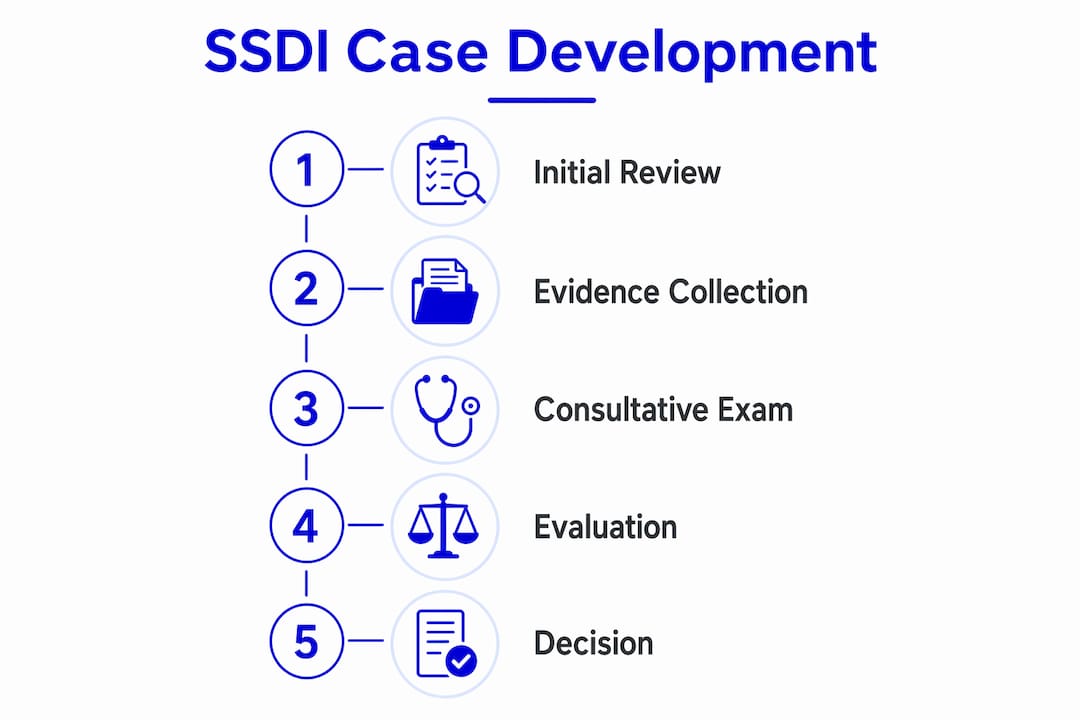
The SSA and DDS follow a defined sequence when developing a disability case. Each step builds on the last, and gaps at any point can stall or derail the claim.
-
Initial evidence collection. DDS contacts your treating physicians, hospitals, and clinics to obtain medical records. You provide a list of sources on your application. The more complete your list, the faster this step moves.
-
Evidence review against the five-step framework. Examiners evaluate what the records show at each step of the sequential evaluation process. They look for documented impairment severity, duration of at least 12 months, and RFC findings.
-
Identification of evidentiary gaps. If records are missing, outdated, or internally inconsistent, DDS flags the file for supplemental development. This is where many claims slow down.
-
Supplemental development. DDS sends additional requests to providers or asks you to submit updated records. Claimant cooperation at this stage is not optional. DDS can take adverse action if you fail to respond.
-
Consultative examinations (CEs). When the record still lacks sufficient evidence, DDS orders a CE with an independent physician or psychologist. CEs fill gaps or resolve inconsistencies and can be ordered even if you declined one during a prior stage.
Pro Tip: Request copies of all records DDS collects on your behalf. Knowing what is in your file before a decision is issued lets you spot gaps and submit targeted evidence before the examiner closes the case.
How does reconsideration differ from the initial application?
Reconsideration is a full, independent review of your claim. It is not a supervisory check on the initial decision. Per SSA POMS DI 27001.010, the reconsideration examiner must be different from the initial examiner and must conduct a complete, de novo review of all evidence, including anything you submit after the first denial.
This distinction matters because the evidentiary standard does not lower at reconsideration. DDS must still confirm impairment severity, duration, and functional limitations. If the initial record was thin, the reconsideration examiner has the same obligation to develop it further.
Key differences between initial and reconsideration case development:
- New examiners. A different DDS team reviews your file. They bring no assumptions from the initial decision.
- New evidence accepted. You can submit updated medical records, new specialist reports, or a treating physician's functional capacity statement.
- Supplemental development repeats. DDS may order new consultative exams even if you attended one at the initial stage.
- Evidence gaps must be closed. The examiner must address any material inconsistencies or insufficiencies in the record before issuing a decision.
"Reconsideration should be treated as an opportunity to correct specific evidentiary deficiencies rather than just resubmitting previous records." — MyBenefitsData
Submitting the same evidence that was denied at the initial stage is the most common reason reconsideration appeals fail. New evidence detailing your current condition and functional limits is what changes outcomes. A disability lawyer at reconsideration can identify exactly which gaps need to be filled before you resubmit.
What types of evidence are critical during case development?
Medical evidence drives every case development decision. The SSA does not approve claims based on diagnosis alone. Examiners need documentation that shows what you cannot do, not just what condition you have.
The strongest case files include:
- Treating physician functional statements. Claims are stronger when a treating doctor documents specific functional limitations, such as how long you can sit, stand, or lift. A diagnosis record without functional detail adds little weight.
- Specialist reports. Opinions from neurologists, orthopedic surgeons, psychiatrists, or other specialists carry significant weight when they address RFC directly.
- Disability reports and claimant statements. Your Adult Disability Report (SSA-3368) and Function Report (SSA-3373) describe how your condition affects daily activities. These documents are part of the official record and reviewed by DDS.
- Updated records. Evidence must reflect your current condition. Records that are more than a year old may not capture how your impairment has progressed.
- Mental health documentation. For psychiatric or psychological impairments, a psychiatric record review that documents cognitive and functional limits is particularly useful for building a complete medlegal record.
Pro Tip: Ask your treating physician to complete an RFC form specific to your condition, such as a Mental RFC or Physical RFC assessment. These forms translate medical findings directly into the language SSA examiners use to make decisions.
How can you manage your SSDI case development to improve outcomes?
Proactive case management is the single biggest factor claimants control. Most people wait for DDS to act. The claimants who get approved faster, and at higher rates, treat case development as a task they own.
-
Request your Disability Determination Explanation (DDE). The DDE documents the agency's reasoning at each decision point. Using the DDE early helps you identify which concerns drove the denial and guides your evidence submissions on appeal. NOSSCR, the National Organization of Social Security Claimants' Representatives, has published detailed guidance on how practitioners use the DDE to target appeals.
-
Review the Disability Determination Transmittal (DDT). The DDT shows what evidence DDS actually reviewed. Comparing the DDT to your full medical history reveals which records were never obtained. Those gaps are your first priority.
-
Respond to all DDS requests immediately. DDS sets deadlines for evidence submissions and CE attendance. Missing a deadline does not just slow your case. It can result in an adverse action based on an incomplete record.
-
Work with a legal representative to target functional evidence. An attorney who understands how to develop an SSDI case knows which functional limitations are most relevant to your specific impairment and the jobs SSA considers in your RFC analysis.
-
Prepare for consultative examinations. Attend every CE DDS schedules. Bring a written summary of your daily limitations. Be specific and consistent with what your treating physicians have documented. Inconsistencies between your CE performance and your medical records create problems that are hard to correct later.
Key Takeaways
SSDI case development determines approval or denial at every stage, and claimants who actively manage evidence submission consistently achieve better outcomes than those who wait.
| Point | Details |
|---|---|
| Case development is evidence-driven | DDS collects and reviews medical and vocational records to assess severity, duration, and RFC at each claim stage. |
| Reconsideration is a fresh review | New examiners conduct a de novo review; submitting the same denied evidence almost always fails again. |
| Functional evidence outweighs diagnosis | Treating physician RFC statements and specialist functional reports carry more weight than diagnosis records alone. |
| DDE and DDT reveal gaps | Reviewing these documents early shows exactly which evidence concerns drove a denial and what to address on appeal. |
| Cooperation is required | Attending CEs and responding to DDS requests on time directly affects case progress and outcome. |
What I have learned about SSDI case development after years of watching claims fail
Most claimants lose at reconsideration for a reason that is entirely preventable. They resubmit the same records, assume the new examiner will see something different, and get the same result. The denial was not about the records being unread. It was about the records being insufficient.
The DDE is one of the most underused tools in disability law. Claimants rarely know it exists. Attorneys who use it early can see exactly where the agency's reasoning broke down and build a targeted response. That is not a trick. It is just reading the file the agency already created.
The other pattern I see consistently is claimants who treat consultative examinations as adversarial. They attend, they minimize their symptoms, and then they wonder why the CE report contradicts their treating physician's notes. A CE is a documentation opportunity. Treat it that way.
Understanding SSDI case management at a structural level, knowing what DDS is looking for at each step, and knowing which evidence gaps are fatal, changes how you approach every stage of the process. You stop reacting and start building. That shift alone improves outcomes more than any single piece of evidence.
— Gerard
How Ssdilawyer can help you develop a stronger SSDI case
SSDI case development is technical, sequential, and unforgiving of evidentiary gaps. Ssdilawyer connects claimants with experienced disability attorneys who know exactly what DDS and SSA look for at each stage of the process. Whether you are filing an initial application, responding to a denial, or preparing for a reconsideration appeal, an attorney can review your DDE, identify missing functional evidence, and represent you through every step. Visit Ssdilawyer to connect with a disability attorney who handles SSDI applications, denials, and appeals. Legal guidance at the case development stage is not a luxury. It is the most direct path to a complete, decision-ready file.
FAQ
What is SSDI case development in simple terms?
SSDI case development is the process by which DDS gathers and reviews medical and vocational evidence to decide if you qualify for disability benefits. It happens at every stage of the claim, from initial application through reconsideration.
How long does SSDI case development take?
Processing times vary by state and case complexity, and the SSA does not publish a fixed timeline for case development alone. Supplemental development and consultative examinations add time to the overall review.
What happens if I miss a consultative examination?
Missing a CE without a valid reason can result in an adverse action by DDS, meaning a denial based on an incomplete record. Attending all scheduled CEs is a requirement of the SSDI claim process.
Can I submit new evidence at reconsideration?
Yes. Reconsideration is a de novo review, meaning new evidence is accepted and must be considered. Submitting updated medical records and functional assessments is the most effective way to strengthen a reconsideration appeal.
What is a Disability Determination Explanation (DDE)?
A DDE is an agency document that records the reasoning behind a disability determination. Reviewing the DDE after a denial shows which evidentiary concerns drove the decision and guides targeted evidence submission on appeal.