
Yes, hiring a disability lawyer usually improves your chances of approval, and the case for representation is strongest before an Administrative Law Judge (ALJ) hearing. If you have already received a denial, hire before your hearing. If you are filing for the first time with a complex medical history, consult an attorney now. If your claim is straightforward and well-documented, you may file alone, but a free consultation costs nothing and often surfaces issues you would not catch on your own.
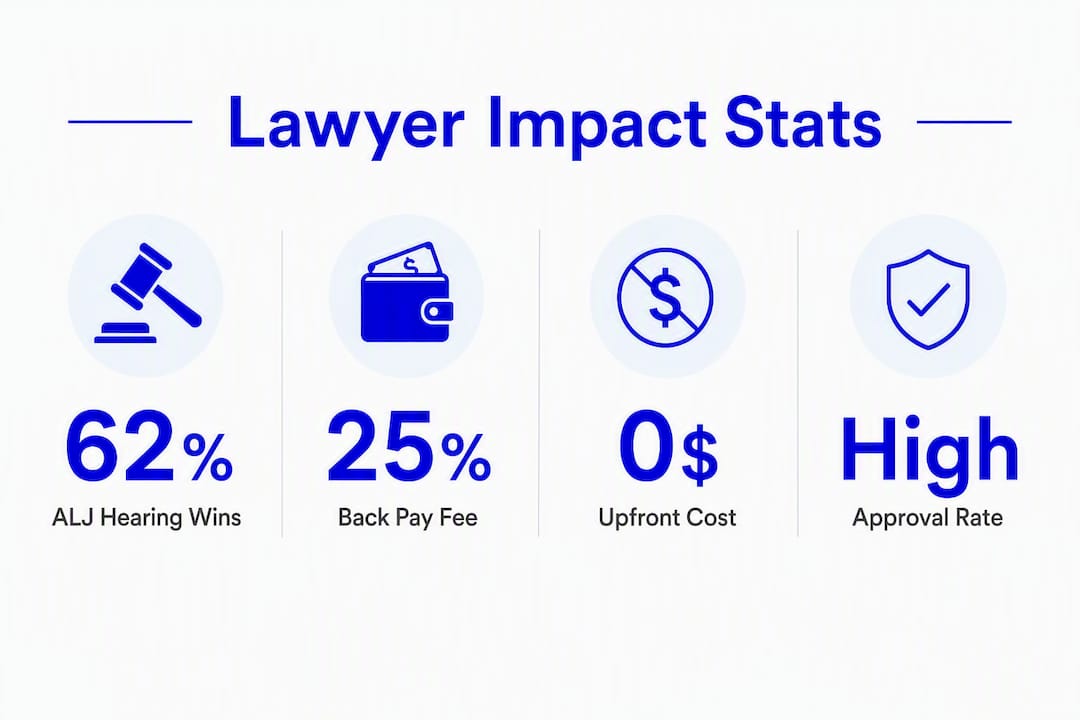
Three facts support this recommendation. Claimants with attorneys win at the ALJ hearing level roughly 62% of the time versus about 34% without one. Most disability attorneys work on contingency, meaning you pay nothing upfront and nothing if you lose. The Social Security Administration (SSA) regulates attorney fees directly, so the payment structure is governed by federal rules, not negotiated in private.
Table of Contents
- Does a lawyer actually improve your chances?
- What a Social Security disability lawyer actually does
- When should you consider hiring a disability lawyer?
- How disability attorneys charge and what it costs you
- How to choose the right disability lawyer
- Alternatives to hiring an attorney: non-attorney reps, legal aid, and DIY
- Common mistakes applicants make and how to avoid them
- Key Takeaways
- The case for specialized representation
- How Ssdilawyer can match you with a disability attorney
- Useful sources
Does a lawyer actually improve your chances?
The hearing-level numbers are the clearest evidence available. Represented claimants win ALJ hearings at roughly 62% versus about 34% for those who go unrepresented. That gap, nearly 30 percentage points, is the single strongest argument for hiring before a hearing.

The effect appears earlier in the process too. A study summarized by AARP found that representation increases the probability of an initial claim being approved by about 23 percentage points.
Two important limits apply. First, correlation is not causation. Claimants who hire attorneys may already have stronger cases or be more persistent in gathering records. Second, for very straightforward impairments with clear, consistent medical documentation, the marginal benefit of an attorney is smaller. The numbers are most meaningful for contested, complex, or borderline cases.
| Claim stage | Unrepresented approval rate | Represented approval rate |
|---|---|---|
| Initial filing | Qualitative baseline | Higher, with about a 23 percentage-point increase when represented |
| ALJ hearing | ~34% | ~62% |
What a Social Security disability lawyer actually does
A disability attorney's work is not limited to showing up at a hearing. The tasks begin well before any SSA decision and continue through appeals if needed.
- Application review: Checks your initial filing for gaps, inconsistencies, and missing medical codes that trigger early denials.
- Medical record collection: Requests records from every treating provider, often catching gaps the claimant did not know existed.
- Residual Functional Capacity (RFC) support: Works with your treating doctors to produce RFC statements that describe your specific functional limits in the language SSA adjudicators use.
- Consulting with treating physicians: Coordinates medical opinion letters that go beyond a standard chart note and address SSA's five-step evaluation criteria directly.
- Hearing preparation: Prepares you for the ALJ's questions, identifies the theory of your case, and anticipates the vocational expert's testimony.
- Cross-examination at the hearing: Questions the vocational expert (VE) and medical expert (ME) to challenge job classifications or medical conclusions that could sink your claim.
- Appeals Council and federal court: Handles written briefs and legal arguments at the Appeals Council level; if the case goes to federal district court, a licensed attorney is required.
Non-attorney representatives can handle most SSA stages, including ALJ hearings, but they cannot represent you in federal court if your case reaches that level. That distinction matters most for claimants with strong cases who face repeated SSA denials.
When should you consider hiring a disability lawyer?
Timing affects how much value an attorney can add. The clearest rule: hire before your ALJ hearing. That is where legal advocacy has the largest effect, and attorneys need time to build the record before the hearing date is set.
Hire early (at initial filing) if:
- Your medical records come from multiple providers and are inconsistent or incomplete.
- Your condition is a mental health impairment, a fluctuating condition, or a combination of impairments.
- Your treating doctor is unavailable, unsupportive, or unfamiliar with SSA's evaluation process.
- You have already missed one deadline or had a prior claim denied.
Filing alone may be reasonable if:
- Your impairment is well-documented, stable, and clearly meets an SSA Listing of Impairments.
- Your treating doctor is engaged and willing to complete RFC forms.
- You are organized, can track deadlines, and understand the five-step sequential evaluation.
Even in the second scenario, a free disability attorney consultation is worth scheduling before you file. Attorneys routinely identify record gaps or timing issues in a 30-minute call that would take months to fix after a denial.
Standard claim timeline and where attorneys matter most:
Initial filing → Denial (most first claims are denied) → Reconsideration → ALJ hearing → Appeals Council → Federal district court

Attorney impact is highest at the ALJ hearing stage and at federal court. It is meaningful but more variable at initial filing and reconsideration.
How disability attorneys charge and what it costs you
Most disability attorneys work on a contingency basis. You pay no hourly rate and no retainer. If you lose, you owe nothing. If you win, the fee comes out of your back pay, the lump sum SSA pays for the months between your application date and your approval.
The SSA regulates this fee structure directly. Under current SSA rules, attorney fees are withheld from back pay and subject to a statutory cap. Published guidance from 2024–2025 sources cites the standard percentage at 25% of back pay, with a dollar cap set by SSA that limits the total fee regardless of how large the back pay amount is. Confirm the current cap figure with your attorney or directly at ssa.gov, as SSA adjusts it periodically.
| Fee element | Typical structure |
|---|---|
| Percentage of back pay | 25% (standard contingency rate) |
| SSA dollar cap | Set by SSA; verify current figure at ssa.gov |
| Out-of-pocket case costs | Medical records, expert opinions (some firms advance these) |
One cost category claimants often overlook: case expenses. Obtaining medical records, ordering expert opinions, and paying for consultative exams can add up. Ask every prospective attorney directly: "Will you advance case costs, and are those reimbursed from my back pay or billed separately?" The answer varies by firm.
How to choose the right disability lawyer
Specialization is the first filter. A general practice attorney who handles disability cases occasionally is not the same as a firm where SSDI and SSI cases make up the majority of the caseload. Ask what percentage of their practice is devoted to Social Security disability before anything else.
Screening checklist for your consultation:
- What percentage of your practice is SSDI/SSI cases?
- How many ALJ hearings have you handled in the past 12 months?
- What is your hearing-level win rate, and can you document it with recent decisions?
- Who will handle my file day-to-day, and who will appear at my hearing?
- What is your communication policy, and how quickly do you return calls or messages?
- What does your fee agreement cover, and are case expenses advanced or billed separately?
- Can you provide a reference from a claimant with a similar condition?
Red flags to watch for:
- Any attorney who guarantees approval. No legitimate attorney can promise an SSA outcome.
- Requests for upfront fees before SSA approves the arrangement.
- Vague answers about who will handle hearing prep or appear at the hearing itself.
- Pressure to sign a fee agreement at the first contact without time to review it.
Pro Tip: Ask the attorney to show you a recent hearing decision from your SSA region. Familiarity with local ALJ tendencies, preferred evidence formats, and common denial reasons is a practical advantage that does not show up in a firm's marketing materials.
Evaluating an attorney's track record takes more than reading online ratings. For a detailed approach to verifying hearing win rates and spotting overstated claims, review the specific criteria before your consultation.
Alternatives to hiring an attorney: non-attorney reps, legal aid, and DIY
Hiring a licensed attorney is not the only path. Three alternatives exist, each with real tradeoffs.
Non-attorney representatives can appear at SSA hearings and handle most administrative stages. They are often less expensive and sometimes work through advocacy organizations. The hard limit: they cannot represent you in federal court if your case reaches that level. For claimants whose cases are unlikely to go beyond the Appeals Council, a qualified non-attorney rep may be sufficient. For a detailed comparison of what each can and cannot do, the attorney vs. non-attorney rep breakdown covers the practical differences.
Legal aid and law school clinics provide free representation to income-eligible applicants. Legal aid organizations and nonprofit clinics handle disability cases in most states. Availability varies by location and caseload, and wait times can be long. Check your state's legal aid directory or contact your local bar association for referrals.
DIY filing is reasonable when your impairment clearly meets an SSA Listing, your records are complete and consistent, and you are comfortable tracking SSA deadlines. The risk is not the initial filing itself. It is the appeal. Claimants who file alone and receive a denial often reach the ALJ hearing stage without the medical evidence development an attorney would have done months earlier. Rebuilding that record under time pressure is harder and less effective.
The tradeoff in plain terms: an attorney costs nothing upfront, adds the most value at hearings and appeals, and is the only option if your case reaches federal court. A non-attorney rep costs less and covers most SSA stages. DIY saves the contingency fee but carries the highest risk at the hearing and appeal stages.
Common mistakes applicants make and how to avoid them
Most denials trace back to a small set of avoidable errors. Knowing them before you file is more useful than learning them after a denial.
Incomplete or inconsistent medical records. SSA adjudicators rely on what is in the file. If your records show gaps in treatment, they may conclude your condition is not as limiting as you claim. Request your complete records before filing and identify any gaps.
Downplaying symptoms at appointments or in forms. Claimants often describe their "best days" to doctors or on SSA forms. SSA evaluates your ability to work on a consistent, sustained basis. Describe your worst days and your average days, not the exceptions.
Missing deadlines. The SSA appeals process has strict time limits at each stage. Missing a reconsideration or hearing request deadline can force you to start the entire process over. Track every deadline in writing.
Weak or generic doctor statements. A note that says "patient is disabled" carries little weight. SSA needs functional specifics: how long you can sit, stand, or walk; how often you need breaks; how your condition affects concentration and attendance. Ask your doctor to complete an RFC form, not just write a letter.
What not to say at your hearing. Avoid phrases like "I feel fine most of the time" or "I can do light activity." These statements, even when meant casually, give the ALJ and vocational expert grounds to find you capable of sedentary or light work. Instead, describe specific limits: "I can sit for about 20 minutes before the pain requires me to stand," or "I miss two to three days of activity per week due to fatigue."
Quick corrective steps:
- Keep a daily symptom log for 30–60 days before your hearing.
- Ask your doctor to complete an RFC form specific to your condition.
- Request all medical records and review them for accuracy before submission.
- Confirm every SSA deadline in writing and set calendar reminders.
Key Takeaways
Hiring a disability attorney before your ALJ hearing is the single highest-impact step most claimants can take, with represented claimants winning hearings noticeably more often than those without representation.
| Point | Details |
|---|---|
| Hearing-level impact | Represented claimants win ALJ hearings at ~62% vs. ~34% unrepresented, a gap of nearly 30 percentage points. |
| Initial filing benefit | Representation increases initial approval odds by about 23 percentage points, per AARP-cited research. |
| Cost to you | Most attorneys charge 25% of back pay with an SSA-set dollar cap; you pay nothing upfront and nothing if you lose. |
| When to hire | Hire before your ALJ hearing at minimum; consult at initial filing if your case is complex or your records are incomplete. |
| Ssdilawyer matching | Ssdilawyer connects claimants with specialized disability attorneys at no cost to the applicant; submit an inquiry to get matched. |
The case for specialized representation
The statistics in this article point in one direction, but the number that stays with me is the hearing-level gap: 62% versus 34%. That is not a marginal difference. It is close to double the approval rate, and it holds across a wide range of case types.
What the numbers do not show is why the gap exists. The answer is not that attorneys are more persuasive speakers. It is that specialized disability firms build the record differently. They collect RFC narratives, coordinate treating-physician opinions, and anticipate vocational expert testimony months before the hearing. By the time the ALJ opens the file, the case is constructed to address the exact criteria SSA uses to deny claims. A claimant going in alone, even a well-prepared one, is working without that infrastructure.
The other thing worth saying plainly: the contingency fee structure removes the financial barrier that keeps people from getting help. There is no rational reason to face an ALJ hearing without representation when the cost of representation is zero unless you win. The only real question is whether you have found the right attorney, and that comes down to specialization, hearing volume, and who actually handles your file.
How Ssdilawyer can match you with a disability attorney
Claimants who need representation often spend weeks searching for an attorney with the right specialization, only to find the first consultation raises more questions than it answers.
Ssdilawyer cuts that search short. The service matches you with experienced disability attorneys who focus on SSDI and SSI cases, at no cost to you for the match itself. A free consultation through the network typically covers a review of your claim stage, an assessment of your medical evidence, likely next steps, and a clear explanation of the fee agreement before you commit to anything.
To get matched with a disability attorney who handles cases at your stage, submit an inquiry at SSDILawyer.co. The process takes a few minutes and puts you in contact with representation that knows the SSA process from initial filing through federal court.
Useful sources
- Social Security Administration: Disability Benefits — SSA's official application portal and process overview.
- SSA Publication EN-05-10075 — SSA's guide to representation and your rights as a claimant.
- AARP: Do I Need a Lawyer to Apply for SSI or SSDI Benefits? — Summary of the NBER study on representation and initial approval rates.
- Disability Exchange: How to Get a Disability Lawyer in 2026 — Hearing-level win-rate data and timing guidance.
- DisabilityFiled: How to Find and Hire a Disability Lawyer — Contingency fee mechanics and SSA fee cap explanation.
- Nolo: How to Find the Best Disability Attorney — Screening criteria, red flags, and selection checklist.
- GAO Report GAO-18-37 — Government Accountability Office review of SSA disability hearings and representation.
This article is general information, not legal advice. Disability rules, fee caps, and SSA procedures change. Confirm current requirements with SSA directly or with a qualified disability attorney for your specific situation.