
SSDI back pay can be taxable, but whether it actually raises your tax bill depends on your combined income and filing status, not the size of the check itself. Form SSA-1099 reports the full amount to the IRS the year you receive it, and the default rule taxes it all in that single year. The fix, when it applies, is the lump-sum election under IRC Section 86(e) using Publication 915 worksheets.
TL;DR:
- Most SSDI back pay is only taxed if your combined income exceeds $25,000 for singles or $32,000 for joint filers, with up to 85% of benefits taxable above those thresholds.
- Filing the lump-sum election under IRC 86(e) typically reduces taxable benefits when prior years' income was lower than the year the check arrives, but requires detailed records and worksheets.
- The IRS reports the full lump sum as current-year income by default, which can push benefits into higher tax bands, unless you utilize the worksheets to spread income over previous years.
- No automatic withholding occurs on a lump sum, and the Treasury Offset Program can reduce your check for debts, potentially creating tax liabilities on money not received physically.
- A large lump-sum payment can increase Medicare premiums two years later through IRMAA, making accurate election and documentation crucial for minimizing future costs.
Table of Contents
- Is SSDI Back Pay Taxable? The Rules and Thresholds
- Why the Lump-Sum Election Under IRC 86(e) Exists
- How to Calculate and Elect: A Step-by-Step Walkthrough
- Withholding, Offsets, State Tax, and IRMAA: What Else Changes
- Documents to Gather and When to Call for Help
- What Most People Get Wrong About This Election
- Get Help With Complex SSDI Back Pay Situations
- Where to Read More
- Sources
- FAQ
Is SSDI Back Pay Taxable? The Rules and Thresholds
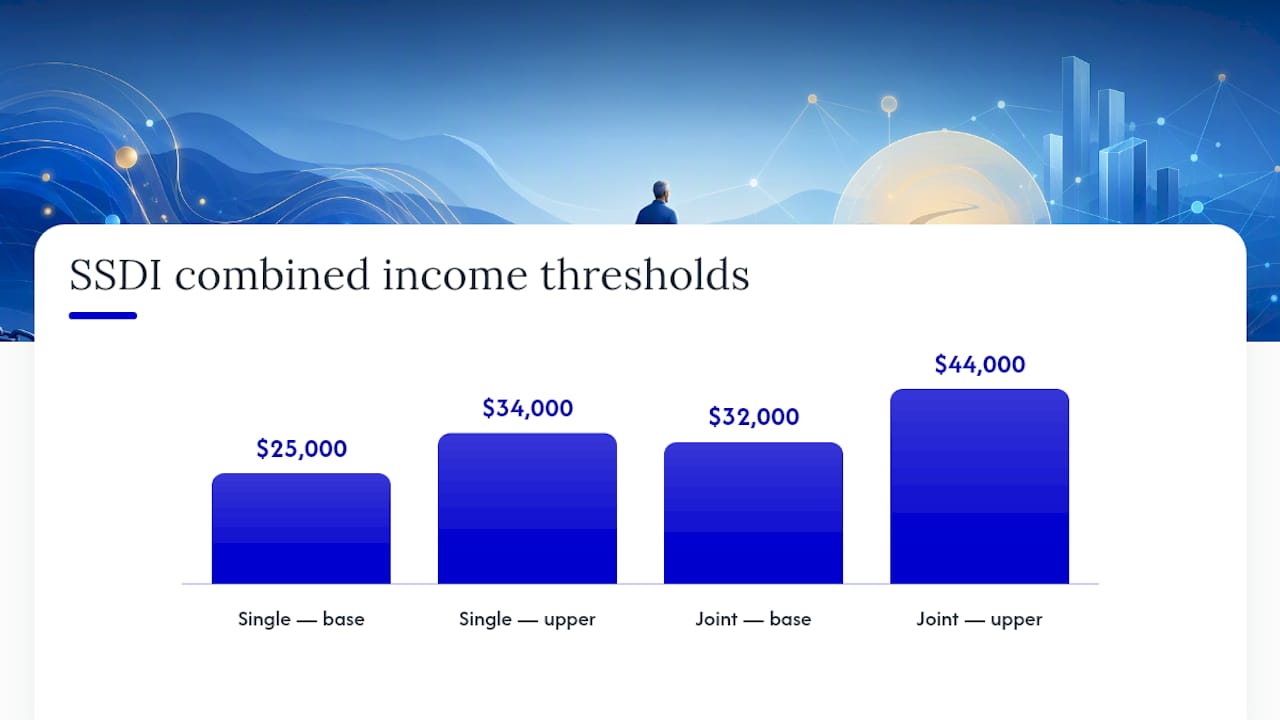
Whether any of your SSDI back pay gets taxed comes down to one calculation: combined income, sometimes called provisional income. Add your adjusted gross income, any tax-exempt interest, and half of your Social Security benefits for the year (including back pay). Compare that total to the federal base thresholds: $25,000 for single filers, $32,000 for married couples filing jointly.
Cross those numbers and a portion of your benefits becomes taxable, not the whole amount. Here's how the bands work:
- Below the base threshold: none of your SSDI is taxable that year.
- Combined income between $25,000 and $34,000 (single) or $32,000 and $44,000 (joint): up to 50% of benefits may be taxable.
- Combined income above those upper limits: up to 85% of benefits may be taxable.
Form SSA-1099, the Social Security Benefit Statement, shows the total benefits paid in Box 5, along with a description of any amounts covering prior years. That figure flows to Form 1040, where you report Social Security benefits on line 6a (total benefits), calculate the taxable portion on line 6b, and check the lump-sum election box on line 6c if you use it.
One relief valve worth knowing: SSI, Supplemental Security Income, is never taxable, unlike SSDI. If you're not sure which program paid your back pay, that distinction changes everything about your filing. Most states also skip taxing Social Security benefits entirely, though a minority still tax some portion, so check your state's specific rules before assuming you're clear.
Why the Lump-Sum Election Under IRC 86(e) Exists
A lump-sum SSDI payment covering two, three, or even five years of back benefits gets dumped into your income for the year you receive it under the default IRS method. That can push your combined income into the 85% taxable band even though you never actually earned that much in any single year. Congress built the lump-sum election into the tax code specifically to prevent this kind of distortion.
Publication 915 provides the mechanism through a series of worksheets:
- Worksheet 1 figures your taxable benefits using the standard current-year method, treating the entire lump sum as this year's income.
- Worksheets 2 through 4 recalculate what your taxable benefits would have been if each year's portion of the back pay had been received on time, then compare that result to Worksheet 1.
You use whichever method produces the lower taxable amount. No filing amendment happens for those prior years. The math simply runs backward to find a fairer number.
Here's the pattern that matters: the election tends to help most when your income in the back-pay years was lower than your income in the year you actually received the check. A claimant who was unemployed for three years while their SSDI claim worked through appeals, then went back to part-time work the year the payment arrived, is a textbook case. Someone whose income stayed flat across all the years involved often finds the election makes little or no difference, because there's nothing to smooth out.
How to Calculate and Elect: A Step-by-Step Walkthrough
Running the lump-sum election isn't complicated, but it does require paperwork you may not have handy. Gather these first:
- Your current-year SSA-1099, which should break out how much of your back pay applies to each prior year.
- Prior-year Form 1040s or AGI figures for every year the back pay covers.
- Records of other income for those same years (wages, pensions, interest) since combined income needs the full picture, not just the SSDI portion.
Once you have those documents, the sequence looks like this:
- Complete Worksheet 1 in Publication 915 using the full lump sum as current-year income.
- For each prior year the payment covers, complete a version of Worksheet 2 to see what the taxable amount would have been if you'd received that year's portion on time.
- Use Worksheets 3 and 4 to total the alternative-year figures and compare them against Worksheet 1's result.
- Choose whichever method gives you the lower taxable benefit amount.
- On your current Form 1040, report total benefits on line 6a, enter the taxable portion on line 6b, and check the box on line 6c if you used the lump-sum election.
Pro Tip: Keep every completed worksheet with your tax records. You don't file them with your return, but if the IRS ever questions the election, you'll need to produce them to back up your numbers.
If you're missing old returns, don't guess. Request wage and income transcripts directly from the IRS, or pull them from tax software you used in prior years. Guessing at old AGI figures is one of the fastest ways to botch this election.
Withholding, Offsets, State Tax, and IRMAA: What Else Changes
A lump-sum SSDI payment triggers a handful of secondary tax issues that catch people off guard, mostly because nothing about the payment itself flags them in advance.
- No withholding happens automatically. The Social Security Administration doesn't withhold federal tax from a lump-sum back payment. Form W-4V lets you request voluntary withholding at 7%, 10%, 12%, or 22%, but it only applies to future monthly payments, never retroactively to the lump sum you already received.
- Estimated tax payments may be required. If the taxable portion of your back pay is large enough, you could owe an underpayment penalty unless you make an estimated payment or adjust withholding elsewhere before year-end.
- Offsets create a mismatch. The Treasury Offset Program can reduce your actual check for things like unpaid debts, but SSA-1099 still reports the gross amount before offset. You may owe tax on money you never physically received.
- State treatment varies. Most states don't tax Social Security benefits, but check your state's specific rules rather than assume.
- IRMAA exposure shows up two years later. Medicare's Income-Related Monthly Adjustment Amount uses your modified adjusted gross income from two years prior, so a big lump sum this year can raise Medicare premiums down the road. A successful lump-sum election can soften that hit.
Attorney fees add one more wrinkle. SSA often pays your attorney directly out of the back pay, but the IRS still counts the gross amount, fee included, as your income. Whether any part of that fee is deductible depends on current tax law and your filing situation, so this is a conversation for a tax professional, not a guess.
Documents to Gather and When to Call for Help
Before you touch a worksheet, pull together your SSA-1099, your last several years of Form 1040s, any SSA correspondence breaking down back pay by year, records of offsets or garnishments, and your attorney's fee statement if one applies.
Some situations call for more than a worksheet and a calculator:
- A multi-year award spanning four or more years of back pay, where the math gets genuinely complicated.
- Any offset or levy that reduced your check, since reconciling gross versus net amounts trips up even careful filers.
- A dispute over attorney fees or their tax treatment.
- Uncertainty about which years' AGI figures to use because old returns are missing or incomplete.
A tax preparer familiar with Publication 915 can run the election correctly the first time. If your case also involves a benefits dispute, a fee disagreement, or a recalculation fight with SSA, connecting with an experienced SSDI attorney often resolves the underlying issue faster than working the tax problem alone. Reviewing how SSDI differs from SSI also helps confirm which tax rules actually apply to your award.
What Most People Get Wrong About This Election
The most expensive mistake isn't miscalculating the worksheets. It's not knowing the election exists and letting tax software default to treating the whole lump sum as current-year income. The second mistake is tossing the worksheets after filing instead of keeping them on hand. The third is assuming SSA withheld something, when it almost never does on a lump sum.
Start with your SSA-1099 and last few years of AGI figures. Run the comparison yourself or hand it to someone who knows Publication 915 well.
— Gerard
Get Help With Complex SSDI Back Pay Situations
Tax worksheets solve the arithmetic, but they don't solve a benefits recalculation dispute, an offset you believe was applied incorrectly, or a fee disagreement with the attorney who won your case. Some services connect claimants nationwide with experienced disability attorneys who handle exactly those situations, sometimes at no upfront cost to the claimant.
If your back-pay award involves multiple years, an unexpected offset, or questions about how your award was calculated, a conversation with an attorney can clarify what you're actually owed and why. Visit Ssdilawyer to request a case review and get matched with an SSDI attorney who can look at the specifics of your award, not just the tax math around it.
Where to Read More
- IRS: Back Payments FAQ
- IRS Publication 915
- Form W-4V, Voluntary Withholding Request
- SSDI Back Pay and Taxes: Wages Explained
This article is general information, not a substitute for advice from a qualified financial advisor. Consult a qualified financial professional about your own circumstances before acting on anything here.
Sources
- Back Payments | Internal Revenue Service
- Publication 915 (2025), Social Security and Equivalent Railroad Retirement Benefits | Internal Revenue Service
- Form W-4V (Voluntary Withholding Request) | IRS
FAQ
Is SSDI back pay taxable in 2026?
It can be, depending on your combined income for the year. If your combined income exceeds $25,000 single or $32,000 joint, up to 50% or 85% of your benefits, including back pay, may be taxable.
How much is SSDI back pay usually?
Amounts vary widely based on your monthly benefit rate and how long your claim took to approve, sometimes covering a year or several years of retroactive benefits. Your Form SSA-1099 shows the exact total and its year-by-year breakdown.
Can you get SSDI if you owe back taxes?
Owing back taxes doesn't disqualify you from receiving SSDI, but the Treasury Offset Program can intercept part of your payment to cover certain federal debts.
How much can the IRS take from your disability check?
The IRS can levy Social Security disability benefits, generally limited to 15% per payment under the Federal Payment Levy Program, though this applies to ongoing federal tax debt rather than routine filing situations.
Will my SSDI back pay affect my Medicare premiums?
It can. A large lump sum raises your modified adjusted gross income, which factors into IRMAA surcharges on Medicare premiums two years later, and the lump-sum election can help limit that effect.