
Back payments are money owed for a past period that was not paid when it was due. In U.S. law, the term covers two distinct situations: Social Security Disability Insurance (SSDI) retroactive benefits and wage back pay. The rules, agencies, and tax consequences differ significantly between the two.
- SSDI retroactive benefits are paid by the Social Security Administration (SSA) when an approved claimant was eligible before the approval date. Taxes on the lump sum are generally due in the year the payment is received.
- Wage back pay covers unpaid wages, overtime, or other compensation owed by an employer. The U.S. Department of Labor (DOL) and its Wage and Hour Division (WHD) enforce recovery under federal statutes including the Fair Labor Standards Act (FLSA).
- First check: Sign into your SSA online account for SSDI status, or search the DOL Workers Owed Wages (WOW) tool for unpaid wages.
- Tax reporting: Expect a Form SSA-1099 for SSDI back pay or a W-2 for wage back pay. Both are taxable in the year paid.
- Legal help: If your SSDI claim was denied or your back-pay amount is large, contact Ssdilawyer for attorney matching before deadlines pass.
Key Takeaways
SSDI retroactive benefits and wage back pay follow separate rules, but both are taxable in the year received and both require prompt action to avoid losing recovery rights to deadlines.
| Point | Details |
|---|---|
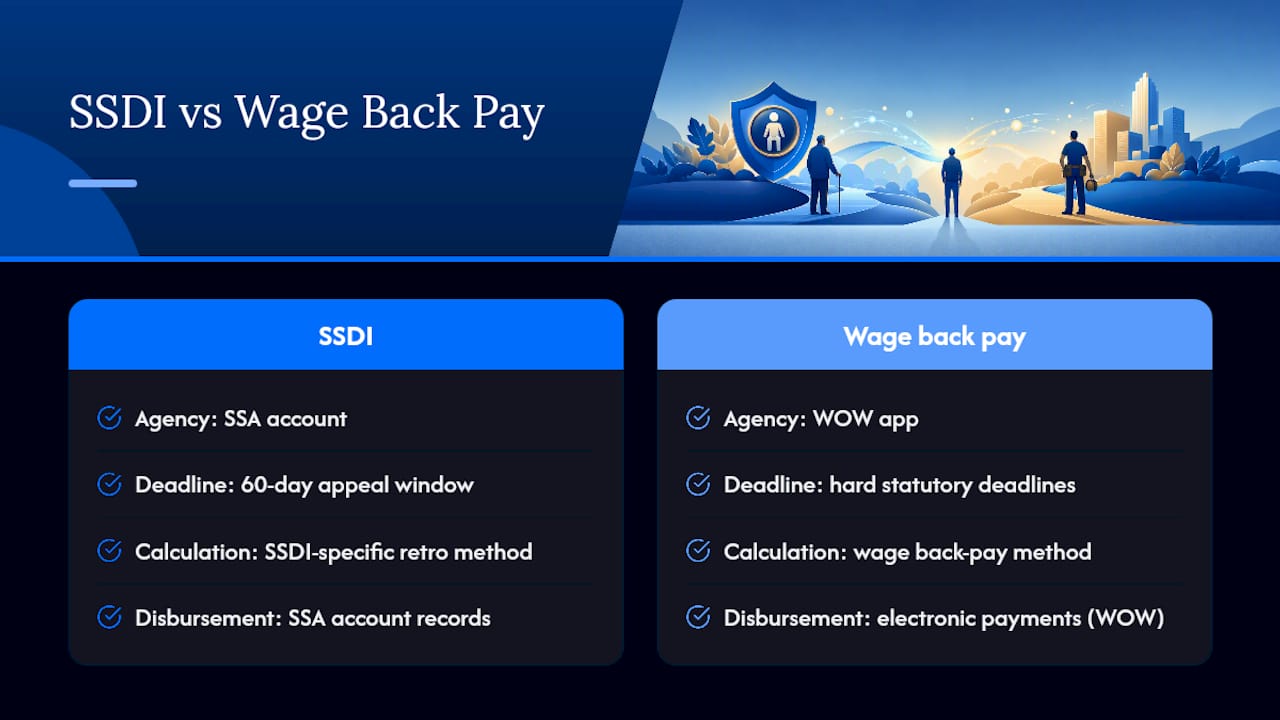
| Two types of back payments | SSDI retroactive benefits (SSA) and wage back pay (DOL/WHD) operate under separate rules and agencies. |
| Five-month SSDI waiting period | SSA does not pay benefits for the five months after your Established Onset Date, reducing retroactive months. |
| Taxable in the year paid | Both SSDI lump sums and wage back pay are taxed in the year received; use IRS Publication 957 to refigure SSDI. |
| Statute of limitations | Wage claims carry a two-year federal deadline (three years for willful violations); state deadlines can be shorter. |
| Check WOW and SSA first | Search the DOL WOW app and your SSA account before filing any claim to confirm what has already been recovered. |
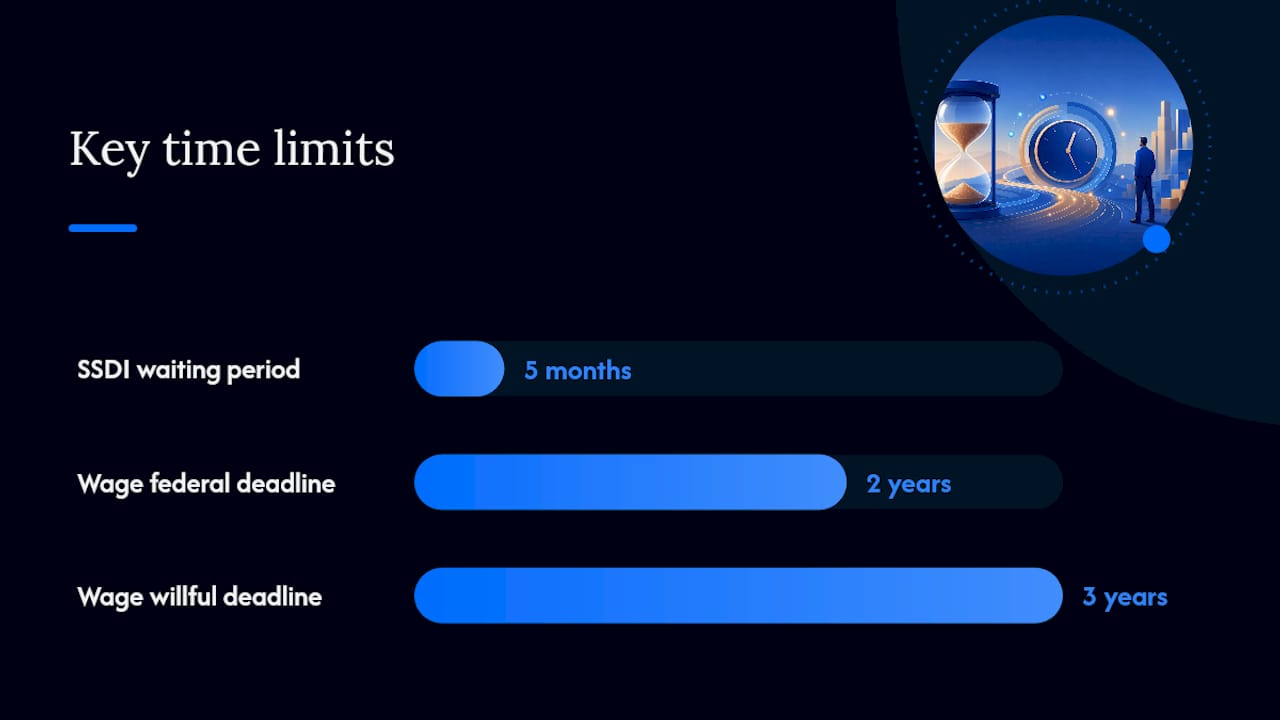
Table of Contents
- What do back payments mean legally, and how do they differ from late payments?
- How does SSDI retroactive back pay work?
- How are back payments taxed and reported?
- What wage back pay remedies does the DOL provide?
- What are the practical next steps to check for owed back payments?
- When does it make sense to hire an attorney for a back-pay claim?
- What most guides on back payments get wrong
- Sources
What do back payments mean legally, and how do they differ from late payments?
Back pay is formally defined as compensation for work performed, or benefits earned, in a prior period where payment was not made at the time it was due. The DOL uses the same concept to describe wages an employer owes under federal law. The IRS, SSA, and DOL each apply their own rules to back payments, but the core definition is consistent: money owed for a past period, paid later.
A delayed or late payment is different. A payroll processing error that pushes a Friday paycheck to Monday is a timing issue, not a statutory violation. Back pay, by contrast, arises from a legal obligation: an employer failed to pay minimum wage, a disability claimant was entitled to benefits months before approval, or a federal employee was wrongfully removed. The distinction carries real consequences.
- Back pay can trigger statutory remedies: back wages, liquidated damages equal to the unpaid amount, and attorney fees under the FLSA.
- Late payments are generally resolved through payroll correction with no statutory penalty unless a state payday law sets specific deadlines.
- Agencies involved: IRS (tax reporting), SSA (disability benefits), DOL/WHD (wage enforcement).
Pro Tip: Mislabeling a delayed payroll issue as a wage-theft claim can send your complaint to the wrong agency and delay recovery by months. Before filing, confirm whether the employer failed to pay wages owed by law, not merely paid them late.
How does SSDI retroactive back pay work?
SSDI retroactive payments cover the months between your Established Onset Date (EOD) and your application date, subject to SSA rules. The EOD is the date SSA determines your disability began. If that date precedes your application, SSA may owe you benefits for those earlier months, up to 12 months before the application date.
The five-month waiting period
SSA program rules impose a mandatory five-month waiting period after the EOD. No SSDI benefits are payable for those five months, regardless of when you applied. That waiting period directly reduces the number of retroactive months SSA will pay.
Example calculation (simplified):
- EOD: January 1, 2023
- Five-month waiting period ends: June 1, 2023 (first payable month: June 2023)
- Application date: October 1, 2023
- Approval date: March 1, 2025
- Retroactive months payable: June 2023 through September 2023 (4 months before the application date, subject to the 12-month cap)
- Monthly benefit: $1,500
- Estimated lump-sum retroactive payment: $6,000 (before any offsets)
How SSA pays and handles attorney fees
SSDI back pay is typically issued as a lump sum, paid 30–60 days after approval, though timing varies. SSI (Supplemental Security Income) retroactive payments may be issued in installments to limit impact on asset limits.
- SSA must approve all representative fees before payment.
- The maximum fee SSA will approve is set by regulation (currently $7,200 or 25% of past-due benefits, whichever is less, for most cases).
- Offsets for prior overpayments, workers' compensation, or other public disability benefits will reduce the net amount paid.
Pro Tip: Read every SSA notice carefully after approval. Notices itemize withheld amounts, offsets, and Medicare premium deductions. Errors in these calculations do occur, and you have the right to request reconsideration.
Older claimants should also review SSDI rules for workers ages 55–65, which can affect how SSA evaluates your past relevant work and, in turn, your EOD.
How are back payments taxed and reported?
IRS Publication 957 is the primary authority on this. Back pay awards are treated as wages in the year they are received, not the years they cover. A lump sum covering three years of SSDI or unpaid wages is taxable in the single year it lands in your account.
Social Security back pay and Form SSA-1099
SSDI back payments appear on Form SSA-1099. When a lump sum pushes your income above the applicable threshold, more of your benefits become taxable. The IRS allows a special calculation under IRS back-payment guidance that lets you refigure the taxable portion as if the benefits had been paid in the years they were earned. This does not reduce the tax owed to zero, but it can prevent the lump sum from being taxed entirely at the higher bracket created by receiving multiple years of benefits at once.
Wage back pay and W-2 reporting
Wage back pay appears on a W-2 from the employer. Federal income tax, Social Security tax, and Medicare tax are all withheld. If the employer failed to withhold correctly, the IRS may still hold the employee responsible for the employee's share.
Key documents to gather:
- Form SSA-1099 (SSDI back pay)
- W-2 (wage back pay)
- IRS Publication 957 (refiguring guidance)
- Prior-year tax returns (needed for the refiguring calculation)
Statistic note: The IRS refiguring method under Publication 957 applies specifically when a taxpayer receives Social Security benefits attributable to prior years in a single lump sum. The calculation is done on the current-year return; no amended prior-year returns are filed.
Receiving a multi-year lump sum is one of the situations where early consultation with a tax professional pays for itself. Withholding adjustments or estimated-tax payments made before year-end can prevent a large balance due at filing.
What wage back pay remedies does the DOL provide?
The DOL's Wage and Hour Division enforces back-wage recovery under the FLSA, the Davis-Bacon Act, the Service Contract Act, and other federal statutes. Three recovery paths exist: voluntary employer correction, WHD enforcement, and private lawsuits.
Statute of limitations
- Two years from the date of the violation for most FLSA claims.
- Three years for willful violations, meaning the employer knew or recklessly disregarded that its conduct violated the law.
- State deadlines vary. Texas, for example, sets a 180-day filing window under the Texas Payday Law for state wage claims. Missing a state deadline can bar recovery even when the federal window is still open.
Remedies available
Under the FLSA, successful claimants may recover:
- Back wages equal to the unpaid amount.
- Liquidated damages in an equal amount (effectively doubling the recovery).
- Attorney fees paid by the employer in court-ordered cases.
Federal employees covered by 5 U.S.C. 5596 may also be entitled to interest on back-pay awards. The Office of Personnel Management publishes applicable interest rates and an online calculator for those cases.
How to claim recovered wages
The WHD directs workers to the Workers Owed Wages (WOW) application to search for and claim recovered back wages. Starting October 1, 2025, WHD moved to fully electronic disbursements. Paper checks are no longer issued. If WHD cannot locate a worker, recovered funds are held for three years before being deposited to the U.S. Treasury.
Steps to file a wage claim with WHD:
- Gather pay stubs, time records, bank statements, and your employment contract.
- Search the WOW app at dol.gov/agencies/whd/wow to check for funds already recovered in your name.
- If no funds appear, submit a complaint via WHD's online portal or call 1-866-4-US-WAGE.
- Provide documentation of hours worked, rates agreed upon, and amounts actually paid.
- Track your case number and follow up at 30-day intervals.
Workers dealing with overlapping workplace injury issues may also want to review workers' compensation options alongside a wage claim, since the two remedies can sometimes run concurrently.
What are the practical next steps to check for owed back payments?
The first action depends on which type of back payment applies to your situation.
For SSDI retroactive benefits:
- Sign into your SSA online account and review your claim status, notices, and payment history.
- Check for any pending appeals or reconsideration requests that could affect retroactive months.
- Gather medical records, work history, and SSA correspondence documenting your EOD.
- If your claim was denied, note the appeal deadline (generally 60 days from the notice date).
- Contact Ssdilawyer if you need attorney matching for an appeal or retroactivity dispute.
For wage back pay:
- Search the DOL WOW app immediately. Funds recovered by WHD may already be waiting in your name.
- Pull pay stubs, time logs, and bank statements covering the period in dispute.
- Identify the applicable statute of limitations for your state and federal claim.
- File a WHD complaint or a state labor agency claim before the deadline.
- Notify any benefit programs (Medicaid, SNAP) if you expect a lump-sum receipt that could affect eligibility.
Pro Tip: Create a dated log of every phone call, email, and letter exchanged with SSA, WHD, or your employer. Note the representative's name, the date, and what was said. That log can be decisive if a dispute goes to a hearing or court.
Understanding how your prior work history affects SSDI entitlement is also relevant when calculating retroactive months. The SSDI past relevant work guide explains how SSA evaluates that history.
When does it make sense to hire an attorney for a back-pay claim?
Legal representation tends to produce better outcomes in specific situations. Knowing when to seek counsel, and what to expect from the engagement, saves time and avoids missteps.
Situations where an attorney commonly adds value:
- SSDI claim denied with significant retroactive months at stake.
- Wage underpayment spanning multiple years or involving multiple employees.
- Employer insolvency or bankruptcy, where recovery requires navigating creditor priority.
- Complex offset issues (workers' compensation, other public benefits reducing SSDI).
- Employer conduct that appears willful, which can double the damages available under the FLSA.
How SSDI representative fees work
SSA regulates attorney fees in disability cases. The attorney files a fee agreement or fee petition, and SSA approves the amount before payment. The claimant pays nothing out of pocket in most cases; the fee comes from the back-pay award itself.
What an attorney does
An attorney will gather medical and work records, file appeals or wage claims, negotiate settlements with employers or SSA, and represent you at administrative hearings or in federal court. For wage cases, attorneys often work on contingency, meaning no fee unless recovery is made. FLSA cases also allow the court to order the employer to pay attorney fees, so the claimant's net recovery is not reduced.
Pro Tip: Before the first consultation, bring your SSA notices (or employer pay records), a timeline of key dates, and any written communications from the agency or employer. Ask the attorney specifically about the retroactive period at stake, the likelihood of offsets, and the fee structure.
Claimants whose disability stems from physically demanding prior work should also review how physical job history supports an SSDI claim, since that history directly affects the strength of a retroactivity argument.
What most guides on back payments get wrong
The standard advice on back payments treats SSDI retroactive benefits and wage back pay as variations of the same problem. They are not. The agencies, deadlines, calculation methods, and tax forms are entirely separate. Conflating them leads claimants to contact the wrong agency, miss the correct filing window, or prepare the wrong documentation.
The second gap in conventional coverage is the tax consequence. Most articles mention that back pay is taxable, then move on. The more useful point is that a multi-year lump sum can push a claimant into a higher bracket for a single year, and the IRS refiguring method under Publication 957 exists precisely to address that. Claimants who do not know about that calculation may overpay taxes they were not required to owe.
The third oversight is timing. Wage claims have hard statutory deadlines. SSDI appeals have 60-day windows. The WOW app now operates on electronic disbursements only. Recovered funds that go unclaimed for three years are deposited to the U.S. Treasury. The practical consequence of delay is not inconvenience; it is permanent loss of recovery rights.
The most defensible first action for any claimant is the same regardless of which type of back payment applies: check the relevant agency record first (SSA account or WOW), then gather documentation, then assess whether the complexity of the case warrants legal representation. For SSDI cases with denied claims or significant retroactive periods at stake, that assessment usually points toward counsel.
This article is general information, not a substitute for advice from a qualified financial advisor. Consult a qualified financial professional about your own circumstances before acting on anything here.
Sources
- Workers Owed Wages (WOW) - U.S. Department of Labor
- Publication 957 (01/2024), Reporting Back Pay and ...
- Social Security Administration Program Operations Manual - Back Pay (Handbook 13)
- Back pay | ADP