
Past relevant work (PRW) is any job you performed within the five years before SSA adjudicates your claim that was Substantial Gainful Activity (SGA), lasted long enough for you to learn it, and was not started and stopped in fewer than 30 calendar days. Under SSR 24-2p, effective June 22, 2024, SSA applies this definition at step four of the sequential evaluation process. If your Residual Functional Capacity (RFC) allows you to perform any PRW, either as you actually did it or as it is generally performed in the national economy, SSA will find you not disabled at step four. That finding ends the claim before step five is ever reached.
POMS DI 25005.015 gives adjudicators the procedural framework for applying these tests. Understanding each requirement lets you assess which past jobs SSA will count and which will not survive the relevancy screen.
Table of Contents
- What past work counts as past relevant work under SSDI?
- How does SSA evaluate PRW at step four?
- How skill level and exertional category affect your PRW finding
- Examples of work that is and is not past relevant work
- What evidence proves past relevant work for your claim?
- The June 22, 2024 PRW policy change and what it means for your claim
- Common mistakes in PRW claims and how to strengthen an appeal
- Key Takeaways
- Why attorneys treat PRW development as the most controllable part of a claim
- Ssdilawyer can help you document PRW and prepare your appeal
- Useful sources for claimants and advocates
What past work counts as past relevant work under SSDI?
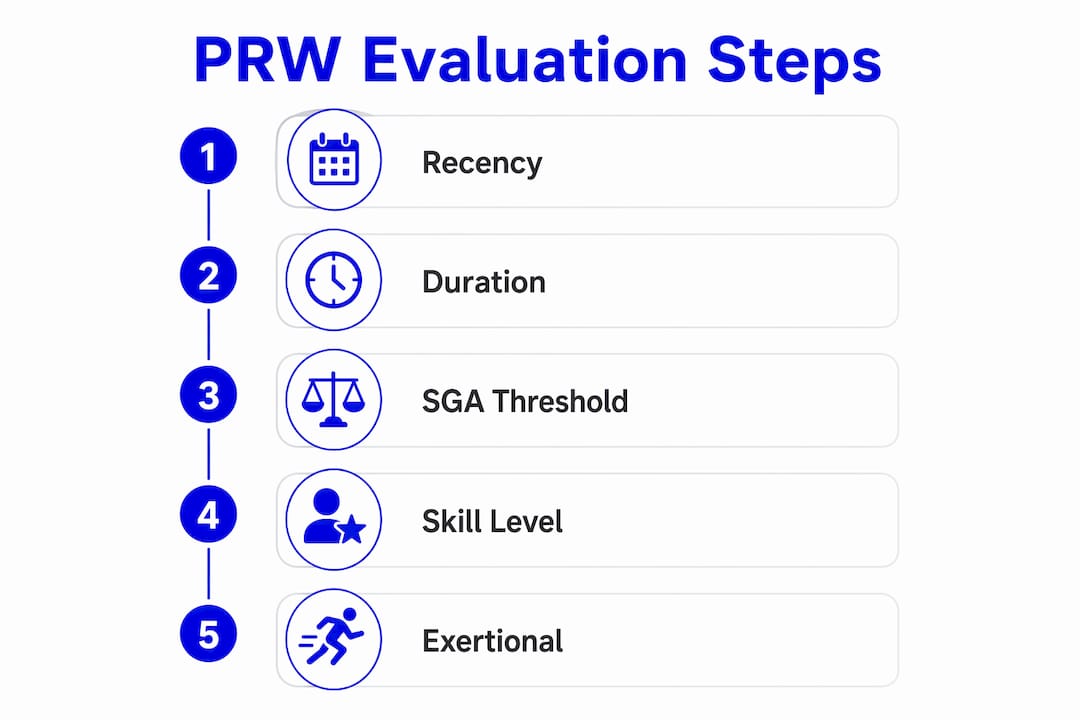
POMS DI 25005.015 sets out four tests. A job must pass all four to qualify as PRW.
- Recency. The work must fall within the relevant period, which is generally the five years immediately before the date of adjudication. If the relevant period ended December 20, 2024, it began December 21, 2019. For certain Title II claims, the period may end earlier, such as at the date last insured (DLI). The POMS DI 25001.001 relevant-period chart maps the correct ending date for each claim type.
- 30-calendar-day rule. Work started and stopped in fewer than 30 consecutive calendar days is excluded. SSA counts calendar days, not hours worked or shifts completed. Part-time and full-time work are treated the same. For self-employed or contract workers, SSA looks at whether the claimant was engaged in the same type of work for 30 consecutive days, even when individual contracts were shorter.
- Long enough to learn. The claimant must have performed the job long enough to learn how to do it. Learning time is tied to the job's Specific Vocational Preparation (SVP) rating in the Dictionary of Occupational Titles (DOT). A job with SVP 1 or 2 requires only a short demonstration; a job with SVP 5 may require six months or more. The 30-day minimum can count toward this learning period, but the two tests are evaluated separately.
- SGA level earnings. Earnings must meet SSA's monthly SGA thresholds for the years the work was performed. Employment history alone does not establish SGA. Tracking actual earnings can sometimes remove a job from PRW entirely, which can change the step-four outcome.
The table below shows how each test applies to common work situations.
| Relevancy Test | What SSA Checks | Common Failure Scenario |
|---|---|---|
| Recency (5-year period) | Work falls within five years before adjudication date | Job ended more than five years before the claim decision |
| 30 calendar days | Work lasted 30 consecutive days from first day | Two-week temp assignment ending before day 30 |
| Long enough to learn | Duration meets SVP-based learning time for that job | Brief trial period before termination |
| SGA earnings | Monthly earnings meet SSA's threshold for that year | Part-time or hobby-level income below SGA |
How does SSA evaluate PRW at step four?
At step four, SSA compares your RFC to your PRW in two ways: as you actually performed the job, and as the job is generally performed in the national economy. Under 20 C.F.R. § 404.1520 and SSR 24-2p, if you can do the work under either standard, the claim is denied at step four. You carry the burden of showing that your limitations prevent both.

The "as actually performed" comparison is function-by-function. Adjudicators look at the specific physical and mental demands of your job: how much you lifted, how long you stood or sat, whether you used ladders or operated machinery, the pace of work, and the level of supervision. A warehouse associate who lifted 50 pounds regularly faces a different comparison than a warehouse associate who only processed paperwork at a desk, even if both held the same job title. Two jobs with the same official title can produce opposite PRW outcomes when the task-level details differ.
The "as generally performed" comparison uses DOT occupational data and vocational resources to describe what the job typically demands across the national economy. If your RFC cannot meet the generally performed standard but can meet your actual performance standard, or vice versa, SSA stops at step four. POMS DI 25005.001 confirms that adjudicators must conduct this function-by-function RFC analysis and may not skip to step five simply because PRW exists in significant numbers.
Pro Tip: When submitting medical evidence or a work history report, describe your job in task-level detail: exact weight lifted, hours spent standing versus sitting, tools operated, and pace requirements. Adjudicators weigh your own job narrative heavily, and a detailed description can shift the RFC-vs-PRW comparison in your favor.
How skill level and exertional category affect your PRW finding
Skill levels and SVP
SSA classifies every job by skill level, which reflects how long a worker needs to become proficient.
- Unskilled work (SVP 1–2): requires 30 days or less to learn. Simple, repetitive tasks with little independent judgment. Examples include hand packaging or basic cleaning.
- Semi-skilled work (SVP 3–4): requires three months or less to learn. Involves more than routine tasks but does not require complex judgment. Assembly line work with machine operation often falls here.
- Skilled work (SVP 5 and above): requires six months or more. Involves complex tasks, independent judgment, or specialized knowledge.
Many applicants underestimate semi-skilled work. Repetitive tasks can still produce transferable skills if the claimant learned specific, identifiable techniques or used specialized equipment. A production line worker who operated a CNC press and read technical tolerances acquired skills that may transfer to other precision manufacturing jobs, even if the work felt routine day to day.
Exertional categories
20 C.F.R. § 404.1567 defines five exertional levels based on lifting and carrying demands:
- Sedentary: lifting no more than 10 pounds, primarily seated work
- Light: lifting up to 20 pounds, frequent lifting or carrying of up to 10 pounds
- Medium: lifting up to 50 pounds, frequent lifting or carrying of up to 25 pounds
- Heavy: lifting up to 100 pounds, frequent lifting or carrying of up to 50 pounds
- Very heavy: lifting objects over 100 pounds
Your RFC's exertional level determines which past jobs remain in play. A claimant limited to light work cannot be found capable of a medium or heavy PRW job, regardless of job title.
Transferable skills versus general aptitudes
SSR 82-41 requires adjudicators to distinguish between innate worker traits and skills actually learned on the job. The ability to follow instructions or work with others is a general aptitude, not a transferable skill. A specific learned ability, such as operating a forklift, reading blueprints, or performing medical coding, is a transferable skill. Adjudicators who conflate the two can incorrectly deny claims at step four or incorrectly find transferability at step five.
Examples of work that is and is not past relevant work
Understanding which jobs pass all four tests helps you focus your documentation.
Work that typically qualifies as PRW:
A bakery line worker who earned above SGA thresholds for two years, ending 18 months before adjudication, and whose job required operating mixing equipment for at least 60 days, passes all four tests. The work is recent, lasted well beyond 30 days, met the learning-time requirement for the SVP rating, and was performed at SGA level.
A commercial truck driver who held a CDL and earned above SGA thresholds for three years, ending two years before adjudication, also qualifies. The job is within the five-year period, lasted long enough to learn, and earnings clearly exceeded SGA. The CDL requirement becomes relevant if a medical impairment prevents licensure renewal.
Work that typically falls outside PRW:
A two-week temp assignment that ended on day 14 fails the 30-calendar-day test, regardless of earnings or what the job involved. The failure is categorical.
Hobby-level or sub-SGA income, such as occasional freelance work earning below SSA's monthly SGA threshold for the relevant year, fails the SGA test. The work may appear on a resume, but SSA will not treat it as PRW.
Quick self-check for your own work history:
- Did the job fall within the five years before your adjudication date?
- Did it last at least 30 consecutive calendar days?
- Did you perform it long enough to learn the tasks (check the SVP for that job)?
- Did your earnings meet SSA's SGA threshold for those years?
If any answer is no, that job is likely not PRW.
What evidence proves past relevant work for your claim?
Assembling the right documentation before your application or hearing prevents gaps that adjudicators fill with unfavorable assumptions. For SSDI case development, the evidence list for PRW falls into two categories.
For "as actually performed" documentation:
- Pay stubs and earnings records confirming SGA-level income for the relevant years
- W-2s or 1099s covering the work period
- Employer letters stating job title, dates of employment, hours per week, and functional demands (lifting, standing, tools used, pace)
- Personnel records, performance reviews, or job task checklists
- Photographs of the worksite or equipment if physical demands are disputed
- Witness statements from coworkers or supervisors who observed your duties
For "as generally performed" documentation:
- DOT occupational descriptions for the job code
- Vocational assessments from a qualified vocational expert (VE)
- SSA's own occupational resources used by adjudicators
Pro Tip: An employer statement is most persuasive when it includes specific functional details: the maximum weight lifted, whether lifting was frequent or occasional, continuous standing requirements, use of ladders or scaffolding, and any production quotas. A letter that says only "performed warehouse duties" gives an adjudicator nothing to work with.
A sample job-description entry for submission or attorney review might read: "From [start date] to [end date], claimant worked as [job title] at [employer]. Duties included lifting boxes weighing up to [X] pounds [frequently/occasionally], standing for [X] hours per shift, operating [specific equipment], and meeting a production quota of [X units] per hour."
The June 22, 2024 PRW policy change and what it means for your claim
The most significant recent change to PRW rules took effect June 22, 2024, when SSR 24-2p reduced the lookback period from 15 years to 5 years. This affects every claim adjudicated on or after that date.
Under the prior 15-year rule, SSA could consider jobs you held more than a decade ago. Under the current rule, only work within the five years before adjudication qualifies. For some claimants, this is favorable: older jobs with heavy physical demands no longer count as PRW, removing a potential step-four denial. For others, it can be neutral or even complicate the analysis if the only jobs within the five-year window are ones the claimant can still perform.
| Scenario | Prior Rule (15-year lookback) | Current Rule (5-year lookback, effective June 22, 2024) |
|---|---|---|
| Job ended 6 years before adjudication | Counted as PRW | Not PRW — outside relevant period |
| Job ended 3 years before adjudication | Counted as PRW | Counted as PRW |
| Job ended 14 years before adjudication | Counted as PRW | Not PRW |
| Adjudication date before June 22, 2024 | 15-year rule applies | N/A |
POMS DI 25001.001 provides the relevant-period chart for different claim types, including Title II claims where the relevant period may end at the DLI rather than the adjudication date. If any portion of the period when you performed past work extends into the relevant five-year window, that work is in the relevant period and must be evaluated.
Common mistakes in PRW claims and how to strengthen an appeal
Where applicants go wrong
- Relying on job title instead of task detail. SSA adjudicators need function-by-function information, not a job title. "Cashier" tells an adjudicator almost nothing about lifting, standing, or pace demands.
- Failing to document SGA-level earnings. Assuming employment equals SGA is a frequent error. Earnings must be verified against SSA's thresholds for each specific year.
- Ignoring the 30-calendar-day and learning-time issues. Short-term or trial-period jobs are often included in work histories when they should be excluded.
- Omitting licensure or certification barriers. If your impairment prevents you from meeting a licensure requirement for a past job, that restriction must be documented. POMS DI 25005.001 confirms that a medically based licensure barrier affects the ability to return to PRW and must be part of the record.
Appeal strategies that work
- Provide granular task descriptions in your work history report and in any employer letter. Specificity is the single most effective tool for shifting the RFC-vs-PRW comparison.
- Obtain employer letters that confirm exact dates, earnings, and functional demands. A letter that documents lifting requirements and continuous standing time gives a vocational expert something concrete to analyze.
- Request VE analysis that ties your RFC directly to PRW. A VE who testifies that your RFC precludes the actual demands of your past job is far more persuasive than a general assertion of disability.
- Document medication side effects that prevent safe performance or licensure renewal. Cognitive impairment from pain medication, for example, may preclude a job that requires operating heavy machinery.
Pro Tip: If self-employment is part of your work history, request field office (FO) assistance early. DDS often needs completed SSA-820 and SSA-823 forms to document whether self-employment income met SGA thresholds. Delays in obtaining these forms can stall the entire PRW determination.
For complex cases involving transferable-skills disputes or licensure barriers, working with an SSDI attorney from the start of an appeal reduces the risk of underdeveloped records.
Key Takeaways
PRW under SSR 24-2p is defined by four tests, evaluated at step four, and limited to the five years before adjudication for all claims decided on or after June 22, 2024.
| Point | Details |
|---|---|
| PRW definition | Work within 5 years before adjudication that was SGA, lasted 30+ calendar days, and was long enough to learn. |
| Step-four decision rule | If your RFC allows PRW as actually or generally performed, SSA denies the claim at step four. |
| 5-year lookback (June 22, 2024) | Jobs ending more than five years before adjudication no longer count as PRW under SSR 24-2p. |
| Documentation priority | Task-level detail, verified earnings, and employer letters are the most persuasive PRW evidence. |
| Ssdilawyer | Connects claimants with disability attorneys who develop PRW evidence and represent clients at hearings. |
Why attorneys treat PRW development as the most controllable part of a claim
The conventional wisdom in disability advocacy is that medical evidence wins or loses cases. That is often true at step three, where listed impairments are evaluated. At step four, though, the outcome frequently turns on something more controllable: the quality of the work history record.
Attorneys who handle PRW disputes focus on two things the claimant alone rarely does well. First, they obtain employer statements that contain the specific functional language adjudicators and vocational experts need. A statement that says "claimant lifted up to 75 pounds regularly and stood for eight-hour shifts" is worth more than a stack of medical records when the RFC limits lifting to 20 pounds. Second, they frame the RFC itself to capture every relevant limitation, including medication side effects, concentration deficits, and licensure barriers, so the function-by-function comparison reflects the claimant's actual capacity.
The 5-year lookback change under SSR 24-2p has made PRW development more important, not less. With a shorter relevant period, some claimants have fewer past jobs in play, which can mean a single well-documented job becomes the entire step-four analysis. Getting that documentation right matters more when there is only one job to examine.
Professional help is most valuable in three situations: self-employment SGA disputes, transferable-skills arguments where the claimant held semi-skilled work, and cases where a licensure or certification barrier exists. These are the scenarios where underdeveloped records most often produce incorrect step-four denials. Prepare a detailed job diary and collect corroborating documents before your first attorney consultation. The more specific your account of daily tasks, the faster counsel can identify the strongest arguments.
Ssdilawyer can help you document PRW and prepare your appeal
Gathering employer statements, verifying SGA earnings, and preparing a vocational record for a hearing requires time and knowledge of SSA's procedural requirements. Ssdilawyer connects claimants with experienced disability attorneys who handle exactly this work: obtaining functional employer letters, preparing vocational reports, and representing claimants at ALJ hearings where step-four denials are challenged.
If you received a step-four denial or are preparing an initial application and want to get the PRW documentation right the first time, a case review with an attorney can identify gaps before they become grounds for denial. This article is general information, not legal advice. For guidance specific to your claim, consult a qualified disability attorney or accredited representative.
Contact Ssdilawyer for a free case review and connect with an attorney who can assess your PRW record and appeal options.
Useful sources for claimants and advocates
The sources below are the primary authorities on PRW. Citing them directly in a request for reconsideration or hearing brief strengthens the record.
- SSR 24-2p (effective June 22, 2024): the governing Social Security Ruling on PRW definition, the four relevancy tests, and the 5-year lookback. Available at ssa.gov.
- POMS DI 25005.015: adjudicator instructions for applying the four relevancy tests, the 30-calendar-day rule, and SGA determinations for both employee and self-employment work.
- POMS DI 25001.001: the relevant-period chart for different Title II and Title XVI claim types, plus quick-reference vocational guidance on SVP and exertional categories.
- POMS DI 25005.001: step-four basics, claimant burden of proof, and the licensure-barrier discussion.
- 20 C.F.R. § 404.1520: the sequential evaluation regulation that places PRW at step four.
- 20 C.F.R. § 404.1567: physical exertion definitions (sedentary through very heavy).
- 20 C.F.R. § 404.1568: transferable skills framework, including the advanced-age rules.
- SSR 82-41: legacy ruling distinguishing innate aptitudes from transferable skills.
"Do not consider past work at step four unless it is relevant. Past work is relevant if it meets all four relevancy requirements: performed within the relevant period, not started and stopped in fewer than 30 calendar days, lasted long enough to learn, and was substantial gainful activity." — POMS DI 25005.015, Section A
When citing these sources in an appeal brief, quote the specific passage that applies to your argument and attach a printed copy. Adjudicators and ALJs are required to follow POMS and SSRs, and a brief that cites the controlling authority directly is harder to dismiss. For SSI-specific benefit questions, the SSI for a child with autism resource at Autism Victory covers related SSI appeal strategies that may be useful for families navigating concurrent SSDI and SSI claims.