
A history of physical labor is one of the strongest assets you can bring to a Social Security Disability Insurance claim. The Social Security Administration has built specific rules and profiles that recognize the toll of strenuous work, and understanding why physical jobs help your SSDI claim can change how you approach the entire process. Two major developments, SSR 24-2p and the medical-vocational profile framework, now give physical laborers a measurable advantage at multiple steps of the SSA's five-step sequential evaluation. Ssdilawyer connects claimants with attorneys who know exactly how to use these rules.
Why physical jobs help your SSDI claim under the new 5-year look-back rule
The SSA's past relevant work (PRW) rule determines which of your previous jobs can be used against you at Step 4 of the disability evaluation. Under the old standard, SSA could reach back 15 years into your work history. Under SSR 24-2p, that window shrinks to 5 years. That single change removes years of physically demanding jobs from the equation, making it far harder for SSA to deny your claim at Step 4.
For workers who spent decades in construction, warehousing, agriculture, or manufacturing, this matters enormously. A 58-year-old who spent 20 years doing heavy labor but switched to a lighter job 6 years ago no longer has to worry about that lighter job blocking a Step 4 denial. The 5-year window captures only recent work, and if that recent work was also physically demanding, the SSA must evaluate whether your current limitations prevent you from doing it now.

The 30-day exclusion adds another layer of protection. Any job lasting fewer than 30 calendar days does not count as PRW. This is calendar days, not working days. A claimant who tried returning to a job for three weeks and could not continue does not have that attempt counted against them. Short trial returns to physical work no longer create automatic Step 4 denials.
Pro Tip: Keep a written record of every job attempt, including start and end dates. If any attempt lasted fewer than 30 calendar days, document it carefully. Your attorney can use that record to exclude it from PRW consideration.
| Factor | Old PRW Rule | New PRW Rule (SSR 24-2p) |
|---|---|---|
| Look-back window | 15 years | 5 years |
| Short job exclusion | No clear minimum | Jobs under 30 calendar days excluded |
| Impact on physical laborers | Many old jobs counted against claim | Fewer jobs available to deny at Step 4 |
| Benefit to older workers | Limited | Significant, especially for claimants 50+ |
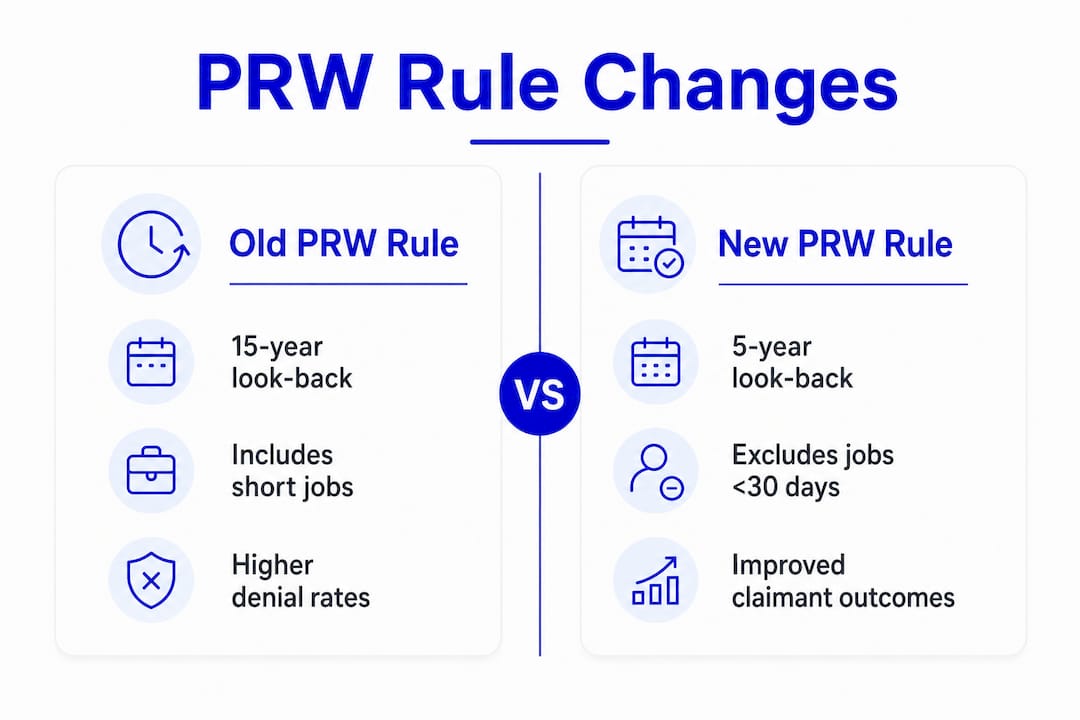
Older claimants gain the most from this shift. Denial rates decreased and win rates increased for claimants aged 50 and older after the 5-year rule took effect. When fewer jobs qualify as PRW, more claims advance to Step 5, where the Grid Rules apply. The Grid Rules are far more favorable to older workers with physical limitations. For more detail on how this plays out by age, the SSDI older worker rules breakdown covers the specifics.
What are medical-vocational profiles, and how do they favor physical laborers?
Medical-vocational profiles are SSA-defined categories that grant automatic disability findings to claimants who meet specific criteria. They exist precisely because the SSA recognizes that some workers have spent their entire lives doing physically demanding jobs and have no realistic path to lighter work. These profiles bypass the Grid Rule analysis entirely, which speeds up approval significantly.
Three profiles matter most for physical laborers:
- Arduous Unskilled Work Profile: Applies to claimants who have done only arduous, unskilled physical labor throughout their working life, are 55 or older, have a severe impairment, and cannot return to their past work. No transferable skills are assumed.
- No Past Relevant Work Profile: Applies when a claimant has no PRW at all. For this profile, adjudicators skip the RFC evaluation entirely and grant disability directly when other criteria are met.
- Lifetime Commitment Profile: Applies to claimants with 30 or more years of strenuous work, marginal education, and a severe impairment. This profile grants automatic disability findings without requiring a full vocational analysis.
Jobs that commonly qualify for these profiles include dock work, roofing, concrete work, heavy assembly line positions, farm labor, and mining. The key is that the work must be physically demanding and largely unskilled or semi-skilled.
Claimants often underestimate the power of these profiles. Many go through the full Grid Rule process when they would have qualified for a faster approval under a profile. An experienced attorney identifies profile eligibility early and frames the claim accordingly.
Pro Tip: Do not describe your job by title alone. Write out exactly what you did physically: how much you lifted, how long you stood, how often you bent or climbed. That physical detail is what triggers profile eligibility, not the job name.
Proving physical work demands requires detailed work history descriptions that go beyond DOT codes. Lifting 50 to 80 pounds regularly, carrying bulk materials across a shift, and standing for 8 to 10 hours are the kinds of specifics that matter. A job title like "laborer" tells SSA almost nothing. A narrative that describes the physical demands tells SSA everything.
How does the SSDI sequential evaluation use your work history?
The SSA evaluates every SSDI claim through a five-step process. Your physical job history affects multiple steps, not just one.
- Step 1: Substantial Gainful Activity (SGA). SSA checks whether you are currently working above the SGA threshold. Working part-time at a physically reduced capacity does not automatically disqualify you. Working while applying for SSDI does not trigger automatic denial as long as earnings stay below SGA limits.
- Step 2: Severity of impairment. SSA determines whether your medical condition is severe. Physical impairments like degenerative disc disease, joint damage, or chronic pain from years of labor are evaluated here.
- Step 3: Listing of Impairments. SSA checks whether your condition meets a listed impairment. If it does, you receive an automatic approval. Physical laborers with severe musculoskeletal conditions often qualify here.
- Step 4: Past Relevant Work. SSA asks whether you can still do any of your PRW. Under SSR 24-2p, only the last 5 years count. Physical jobs from earlier in your career no longer block approval at this step.
- Step 5: Other work. If you cannot do your PRW, SSA asks whether you can do any other work. The Grid Rules apply here. Older workers with physical limitations and limited education often receive favorable findings at Step 5.
Your Residual Functional Capacity (RFC) assessment runs through Steps 4 and 5. The RFC describes what you can still do physically, including how much you can lift, how long you can sit or stand, and whether you can handle repetitive tasks. A well-documented physical work history helps your doctor and attorney build an RFC that accurately reflects your limitations.
A common misconception is that any work history disqualifies a claim. The opposite is true. Physical work history, properly documented, often accelerates approval by triggering favorable profile findings or Grid Rule outcomes.
Practical steps for claimants with physical job backgrounds
Documentation is the difference between an approved claim and a denial. Physical laborers face a specific challenge: their impairments are real, but SSA needs proof that the work was demanding and that current limitations prevent returning to it.
- Describe physical demands in writing. List every physical task from your jobs: weight lifted, distance carried, time spent standing, bending, climbing, or operating machinery. Specifics matter more than job titles.
- Report income changes promptly. Timely reporting of any earnings prevents overpayment clawbacks and protects your benefits during trial work periods. Physical job claimants who attempt short returns to work must report those attempts immediately.
- Get medical records that match your job demands. If you lifted heavy loads for 20 years and now have spinal damage, your medical records should document that connection. Ask your doctor to note the relationship between your work history and your current condition.
- Avoid describing your job as lighter than it was. Some claimants downplay physical demands out of habit or pride. That understatement can cost them a profile finding or a favorable RFC.
- Hire an attorney before your hearing. Legal representation improves outcomes for physical laborers because attorneys know how to frame work history in terms SSA adjudicators recognize. They identify profile eligibility, challenge incorrect PRW classifications, and build RFC arguments that match actual job demands.
The most common documentation mistake is relying on the SSA's work history form alone. That form captures job titles and dates. It does not capture the physical reality of the work. A supplemental written statement from you, and ideally from a former supervisor or coworker, adds credibility that forms cannot provide.
Key Takeaways
Physical job history strengthens SSDI claims because SSA's 5-year PRW rule, medical-vocational profiles, and Grid Rules all give measurable advantages to claimants with long records of strenuous labor.
| Point | Details |
|---|---|
| 5-year PRW look-back | SSR 24-2p limits past relevant work to 5 years, removing older physical jobs from Step 4 denial. |
| 30-day job exclusion | Jobs lasting fewer than 30 calendar days do not count as PRW under SSR 24-2p. |
| Medical-vocational profiles | Claimants with 30+ years of arduous work may qualify for automatic approval without full Grid analysis. |
| Detailed documentation | Describing physical job demands specifically, not just by title, is critical for profile and RFC eligibility. |
| Legal representation | An attorney identifies profile eligibility early and frames physical work history to maximize approval chances. |
What I've seen change for physical laborers since SSR 24-2p
The shift from a 15-year to a 5-year PRW window is the most significant structural change to SSDI evaluation in years. Before SSR 24-2p, I saw claimants denied at Step 4 because of jobs they had done a decade ago and could barely remember. A 60-year-old roofer would get denied because SSA found a warehouse supervisor role from 12 years back and decided he could still do that. That logic was always flawed, and the new rule corrects it.
What surprises me most is how few claimants know about medical-vocational profiles. These profiles exist specifically for people who have spent their lives doing hard physical work. They are not obscure loopholes. They are written SSA policy. Yet most claimants go through the full sequential evaluation when they could have been approved faster under a profile. The gap between what the rules allow and what claimants actually receive comes down almost entirely to representation.
My advice is direct: if you have spent 20 or more years doing physically demanding work and you now have a severe medical condition, do not file alone. The case strategy required to use these rules correctly is not something most people can build without legal help. The rules are on your side. Use them.
— Gerard
How Ssdilawyer helps physical laborers win SSDI claims
Physical job history is a legal asset in an SSDI claim. Using it correctly requires knowing which rules apply, how to document work demands, and when to invoke a medical-vocational profile instead of going through the full Grid Rule process.
Ssdilawyer connects claimants with experienced disability attorneys who specialize in exactly this kind of case. Whether you are filing for the first time, appealing a denial, or preparing for a hearing, the attorneys at Ssdilawyer know how to frame your physical work history in terms that SSA adjudicators recognize and approve. Physical laborers have real advantages under current SSA rules. Getting those advantages to work for you starts with the right legal support.
FAQ
What does SSR 24-2p change for physical job claimants?
SSR 24-2p reduces the past relevant work look-back period from 15 years to 5 years. This means SSA can only use jobs from the last 5 years to deny a claim at Step 4, which directly benefits claimants with long physical work histories.
Do short-term job attempts hurt my SSDI claim?
No. Any job lasting fewer than 30 calendar days is excluded from past relevant work under SSR 24-2p. Brief returns to physical work do not count against you at Step 4.
What is a medical-vocational profile?
A medical-vocational profile is an SSA-defined category that grants automatic disability approval to claimants who meet specific criteria, such as 30 or more years of arduous unskilled work combined with a severe impairment and marginal education.
Can I work part-time while applying for SSDI?
Working part-time does not automatically disqualify a claim. SSA evaluates whether your earnings exceed the Substantial Gainful Activity threshold. Reporting any income changes promptly protects your benefits and avoids overpayment issues.
Does job title matter more than physical job duties for SSDI?
Physical job duties matter far more than job title. SSA and medical-vocational profile evaluations depend on specific descriptions of lifting, carrying, standing, and repetitive tasks, not on what the job was called.