
An SSDI vision loss claim is approved when severe vision impairment meets the Social Security Administration's Blue Book listings or prevents you from performing substantial gainful activity. The SSA evaluates these claims under a formal framework called the Special Senses and Speech listings, which sets exact thresholds for visual acuity, visual field loss, and visual efficiency. To qualify, your condition must be expected to last at least 12 months, and you must meet the SSA's work history requirements. Understanding the ssdi vision loss claim explained process from the start gives you a clear path forward.
What vision loss qualifies for SSDI under SSA Blue Book listings?
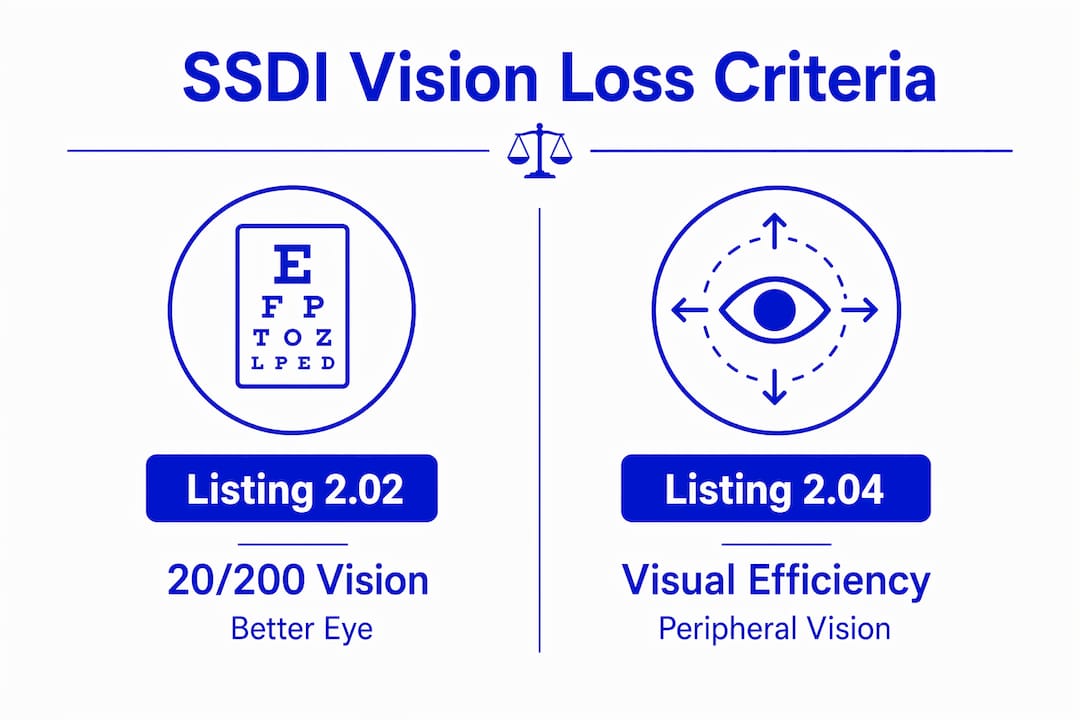
The SSA's Blue Book groups vision loss evaluations under the Special Senses and Speech category, focusing on central acuity, peripheral field contraction, and visual efficiency. Two listings apply directly to vision impairment claims: Listing 2.02 and Listing 2.04.
Listing 2.02: Loss of central visual acuity
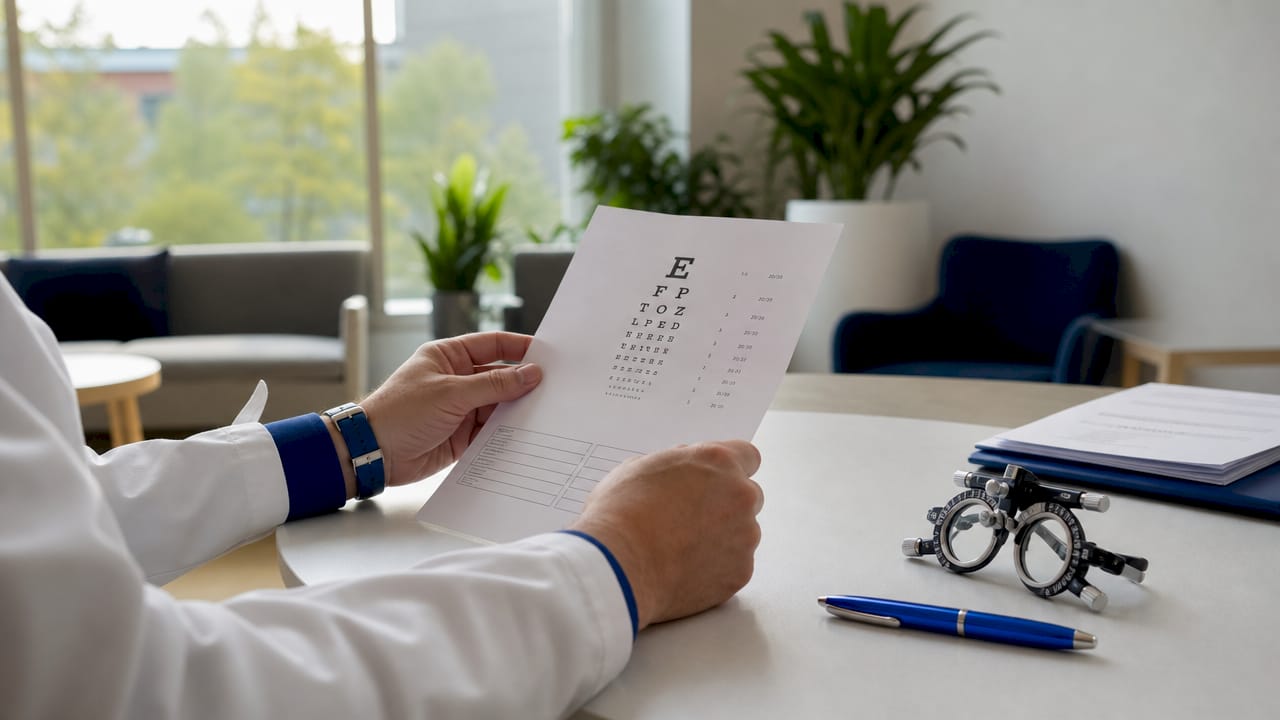
Listing 2.02 requires that your remaining vision in the better eye, after best correction, is 20/200 or worse. Best-corrected vision means the SSA measures your sight using the strongest corrective lenses available, not your uncorrected vision. Submitting uncorrected measurements is one of the most common reasons claims are denied at this stage.
Listing 2.04: Loss of visual efficiency or visual impairment
Listing 2.04 covers cases where acuity alone does not capture the full extent of your vision loss. The SSA requires your visual efficiency in the better eye to be 20% or less, or your calculated visual impairment value to be 1.00 or greater. This listing combines both acuity loss and peripheral field loss into a single measure.
The SSA mandates specific testing methods for both listings:
- Snellen or ETDRS charts for central visual acuity measurement
- Automated static threshold perimetry for peripheral visual field mapping
- Best-corrected measurements in the better eye, not the weaker eye
- Formal clinical reports from a licensed ophthalmologist or optometrist
The table below summarizes the two primary Blue Book listings for vision loss:
| Listing | Criterion | Required Test |
|---|---|---|
| 2.02 | 20/200 or worse in better eye (best corrected) | Snellen or ETDRS chart |
| 2.04 | Visual efficiency ≤20% or impairment value ≥1.00 | Automated static threshold perimetry |
Pro Tip: Request that your eye doctor document results using the exact SSA-required formats. A report that uses non-standard testing methods will not satisfy Blue Book criteria, regardless of how severe your vision loss is.
How to document and prove your vision loss for an SSDI claim
Medical evidence is the foundation of any successful vision impairment SSDI claim. The SSA denies claims when records rely on screening tests instead of formal Snellen or ETDRS measurements and lack perimetry results. Gathering the right documentation from the start prevents avoidable denials.
Your medical file should include the following:
- Comprehensive eye examination reports from a licensed ophthalmologist or optometrist, including the cause of your vision loss
- Formal visual acuity test results using Snellen or ETDRS charts, documented as best-corrected measurements in the better eye
- Automated perimetry results showing peripheral field loss, measured with static threshold perimetry
- Diagnosis records identifying the underlying condition, such as diabetic retinopathy, optic neuropathy, glaucoma, or macular degeneration
- Treatment history including surgeries, medications, and any corrective interventions
- Functional limitation statements from your treating physician describing how your vision loss affects daily tasks and work activities
The cause of your vision loss matters beyond the test numbers. Conditions like diabetic retinopathy connect your vision claim to a broader medical picture, which also supports related claims such as an ssdi diabetes complications claim or an ssdi neuropathy claim explained under separate listings. Documenting the underlying cause strengthens the overall record.
Doctors' functional limitation statements and attorney coordination improve documentation quality significantly. A statement from your ophthalmologist explaining that you cannot read standard print, operate machinery, or safely travel independently carries real weight in the SSA's review.
Pro Tip: Ask your eye care provider to write a narrative report, not just submit test scores. The SSA evaluator needs to understand how your vision loss affects your ability to function at work, not just what your acuity number is.
What if your vision loss doesn't meet the Blue Book listings?
Not every applicant meets the exact thresholds in Listing 2.02 or 2.04. The SSA has a second path to approval called the Residual Functional Capacity assessment, or RFC. The RFC assessment evaluates combined impairments and your overall capacity to perform work, even when no single listing is met.
Applicants who don't meet exact Blue Book listings have a strong chance of approval through RFC evaluations when they document how vision loss combined with other impairments limits their ability to work. Here is how the RFC path works in practice:
- The SSA reviews all your conditions together. Vision loss combined with diabetic neuropathy, kidney disease, or chronic pain may collectively prevent any form of gainful employment, even if vision loss alone does not qualify.
- The SSA assesses your functional limits. Reviewers consider whether you can read, use a computer, operate equipment, drive, or perform close-up tasks required by your past or potential jobs.
- Your age, education, and work history factor in. An older applicant with limited transferable skills and significant vision loss faces a lower bar for RFC approval than a younger applicant with broad skills.
- Legal representation strengthens RFC arguments. An attorney can present your combined impairments in a structured way that makes the functional limitations clear to SSA reviewers and administrative law judges.
The RFC path is particularly relevant for applicants pursuing an ssdi kidney disease claim explained alongside vision loss, or those with diabetes complications affecting multiple body systems. Working with an SSDI attorney to build an RFC argument is often the difference between approval and denial for borderline cases.
How to apply for SSDI with vision loss and avoid common mistakes
Applying for SSDI benefits for vision loss requires careful preparation. Applications can be submitted online at SSA.gov, by phone, by mail, or in person at a local SSA office. The method matters less than the quality of the documentation you submit with it.
Follow these steps to give your claim the strongest foundation:
- Gather all medical records before filing. Missing records delay processing and create gaps that reviewers use to deny claims.
- Confirm your work history qualifies. You must have worked five of the last ten years and paid Social Security taxes during that period.
- Verify the SGA threshold. In 2025, blind recipients can earn up to $2,590 monthly without losing benefits, which is higher than the limit for other disability categories.
- Submit only SSA-compliant test results. Screening tests and informal eye exams do not satisfy Blue Book standards. Only formal Snellen, ETDRS, or automated perimetry results qualify.
- Request a functional limitations statement from your doctor. This document explains how your vision loss prevents specific work tasks.
- Do not underestimate your RFC. Many applicants describe their limitations conservatively. Be specific and thorough about what you cannot do safely or reliably.
- Meet all deadlines. Missing an appeal deadline can end your claim entirely. The SSDI appeals process has strict timeframes at each stage.
Common mistakes include submitting incomplete medical records, failing to document best-corrected vision, and not connecting vision loss to other disabling conditions. Applicants who treat vision loss as an isolated impairment often miss the stronger RFC argument available to them.
Pro Tip: If the SSA denies your initial claim, file an appeal immediately. Most successful SSDI approvals for vision loss come at the hearing level, not the initial application stage.
Key Takeaways
A successful SSDI vision loss claim requires meeting SSA Blue Book Listing 2.02 or 2.04, or demonstrating through RFC evidence that combined impairments prevent gainful employment.
| Point | Details |
|---|---|
| Blue Book thresholds | Listing 2.02 requires 20/200 or worse; Listing 2.04 requires visual efficiency ≤20% in the better eye. |
| Required testing | Only Snellen, ETDRS, and automated static threshold perimetry results satisfy SSA standards. |
| RFC as a backup path | Combined impairments like vision loss with neuropathy or diabetes can qualify through RFC analysis. |
| Documentation quality | Functional limitation statements from eye care providers significantly strengthen claim approval odds. |
| Appeals matter | Most vision loss approvals occur at the hearing level, making timely appeals critical. |
What I've learned from vision loss SSDI cases
The applicants I see struggle most are not those with the worst vision. They are the ones who arrive with incomplete records, informal eye exam printouts, and no functional limitation statement from their doctor. The SSA's criteria are technical, and the gap between a qualifying record and a denial is often a single missing test result.
One pattern stands out consistently. Applicants with diabetic retinopathy or optic neuropathy often have a stronger combined case than they realize. Their vision loss connects directly to systemic conditions that affect multiple body systems. When those connections are documented properly, the RFC argument becomes far more persuasive than the Blue Book numbers alone.
The other underestimated factor is the appeals process. An initial denial is not the end of the claim. The SSDI legal representation benefits available to claimants at the hearing stage are substantial. An attorney who knows how to present visual acuity data, perimetry results, and functional limitation evidence to an administrative law judge gives you a genuinely different outcome than filing alone.
Do not let the technical complexity of SSA listings convince you that your case is hopeless. The RFC path exists precisely for applicants whose impairments are real and disabling, even when the numbers do not land exactly on a Blue Book threshold.
— Gerard
Legal support for your SSDI vision loss case
Filing an SSDI claim for vision loss without legal guidance means navigating SSA Blue Book criteria, RFC assessments, and strict documentation standards on your own.
Ssdilawyer connects you with experienced disability attorneys who specialize in vision impairment claims. They know which tests the SSA requires, how to request the right records from your eye care providers, and how to build an RFC argument when Blue Book listings are not met. Whether you are filing for the first time or appealing a denial, get a case evaluation at Ssdilawyer to understand your options before your next deadline.
FAQ
What is the SSA's vision threshold for SSDI approval?
The SSA requires best-corrected visual acuity of 20/200 or worse in the better eye under Listing 2.02, or visual efficiency of 20% or less under Listing 2.04.
Can I qualify for SSDI if my vision loss doesn't meet Blue Book criteria?
Yes. The SSA's RFC assessment evaluates combined impairments, so vision loss paired with conditions like neuropathy or diabetes complications can still result in approval.
What tests does the SSA require for a vision loss claim?
The SSA requires formal Snellen or ETDRS chart testing for acuity and automated static threshold perimetry for peripheral field loss. Screening tests do not qualify.
How much can I earn while receiving SSDI for blindness?
Blind SSDI recipients can earn up to $2,590 per month in 2025 without losing benefits, which is a higher threshold than the limit for other disability categories.
What should I do if my SSDI vision loss claim is denied?
File an appeal immediately. Most successful SSDI approvals for vision loss occur at the administrative law judge hearing level, not at the initial application stage.