
An SSDI case strategy with attorney guidance is the most direct path to improving your disability claim approval odds at every stage of the Social Security Administration process. SSDI, formally known as Social Security Disability Insurance, provides monthly benefits to workers who can no longer perform substantial gainful activity due to a qualifying medical condition. The claim process moves through distinct stages: initial application, reconsideration, Administrative Law Judge (ALJ) hearing, and federal court review. Each stage has strict procedural rules, evidence requirements, and deadlines. Claimants who work with an attorney from the start build stronger records, file on time, and present evidence in the format SSA adjudicators actually use to make decisions.
What does an effective SSDI case strategy with attorney guidance involve?
An effective SSDI legal strategy centers on building a complete medical and functional record before SSA ever makes a decision, not just filling out forms. Attorneys review your work history, medical conditions, and treatment records to identify which impairments best support your claim under SSA's five-step sequential evaluation process.
The attorney's role goes well beyond paperwork. Attorneys collect and organize medical evidence, complete forms accurately, and set realistic expectations about timelines. Initial applications take three to six months for a decision. Reconsideration adds several more months. ALJ hearings can take over a year to schedule. Knowing this timeline upfront prevents claimants from abandoning valid claims too early.

Early case record development is the single most important factor attorneys control. Experienced lawyers prioritize obtaining Residual Functional Capacity (RFC) forms from treating physicians to document the functional limits SSA values most. An RFC assessment translates a diagnosis like degenerative disc disease into concrete limits: cannot sit more than two hours, cannot lift more than ten pounds, requires unscheduled breaks. That translation is what wins cases.
Key forms and documents attorneys manage
| Document | Purpose |
|---|---|
| Form SSA-16 | Initial application for disability insurance benefits |
| Form SSA-827 | Authorization to release medical records to SSA |
| RFC questionnaire | Documents functional limits from treating physician |
| Form SSA-561-U2 | Request for reconsideration after initial denial |
| Pre-hearing memorandum | Legal brief submitted to ALJ before the hearing |
Pro Tip: Request your treating physician complete an RFC questionnaire at your very first attorney consultation. Waiting until the ALJ hearing stage to gather this evidence costs months and weakens your record.
Attorneys also help claimants understand SSDI benefits basics before filing, which prevents common misunderstandings about work credits, back pay calculations, and Medicare eligibility timelines.
How do SSA appeal deadlines affect your SSDI case?
SSA appeal deadlines are strict, and missing one can end your claim entirely. SSDI appeals must be filed within 60 days from the date SSA presumes you received the denial notice. SSA adds five days to the printed notice date as a mailing presumption, giving claimants an effective 65-day window from the notice date.
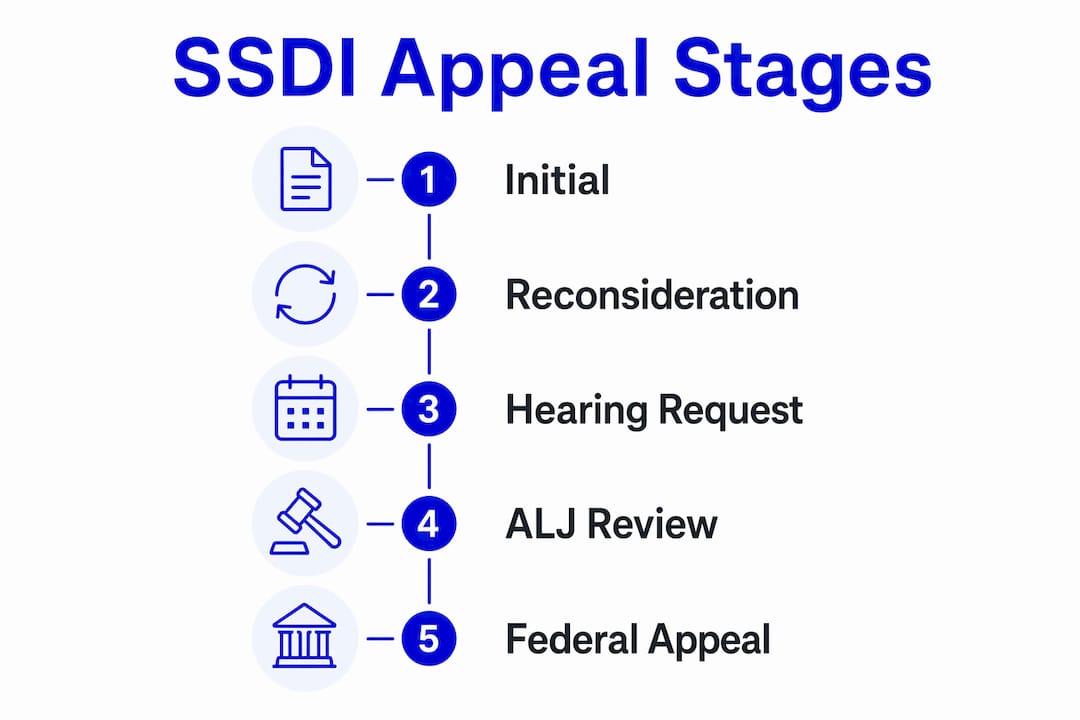
That five-day rule is where claimants most often miscalculate. If your denial letter is dated june 1, SSA presumes you received it by june 6. Your 60-day appeal window then runs from june 6, making the deadline august 5. One day past that date and SSA can dismiss your appeal without reviewing the merits.
Missing an appeal deadline can cause dismissal and force you to restart the entire claim process, losing months or years of potential back pay. SSA may excuse a missed deadline if you can prove good cause with supporting documentation, but approval is reviewed case by case and is never guaranteed.
SSDI appeal stages and deadlines
| Appeal stage | Form required | Deadline |
|---|---|---|
| Reconsideration | SSA-561-U2 | 65 days from denial notice date |
| ALJ hearing request | HA-501 | 65 days from reconsideration denial |
| Appeals Council review | HA-520 | 65 days from ALJ decision |
| Federal district court | Civil complaint | 65 days from Appeals Council denial |
Form SSA-561-U2 is used to request reconsideration and takes about ten minutes to complete. Attaching current medical evidence to the form significantly improves reconsideration outcomes. Reconsideration approval rates are low, roughly 10–15%, but the stage is mandatory before requesting an ALJ hearing.
Pro Tip: Track every SSA notice the day it arrives. Write the printed date on the envelope, count five days forward for the presumed receipt date, then add 60 days to get your exact filing deadline. Put that date in your phone calendar immediately.
Attorneys calculate these deadlines precisely and file well before the cutoff. They also monitor SSA correspondence on your behalf so nothing slips through.
What attorney strategies strengthen SSDI cases before and during appeals?
Represented claimants at the ALJ hearing stage are granted benefits at nearly three times the rate of unrepresented claimants. That gap exists because attorneys take specific tactical steps that self-represented claimants rarely know to take.
The most impactful steps attorneys take include:
- RFC assessments from treating physicians. Law firms send structured RFC questionnaires to clinicians tailored to their detailed knowledge of the claimant's limitations. These forms document sitting, standing, walking limits, and unscheduled break requirements that SSA adjudicators rely on directly.
- Addressing gaps in medical records. Attorneys identify missing treatment periods and send formal legal requests to providers for complete records. Gaps in treatment history give SSA grounds to question the severity of your condition.
- Pre-hearing legal memorandums. A pre-hearing memorandum explains the full claim narrative and shows exactly how the medical facts meet SSA's disability criteria. This document shapes the ALJ's understanding before the hearing begins.
- Cross-examining vocational experts. Cross-examining vocational experts at hearings is a decisive attorney tactic. Vocational experts testify about jobs claimants can allegedly perform. Attorneys challenge those job classifications by exposing inconsistencies between the expert's testimony and the claimant's documented functional limits.
- Preparing claimants for testimony. Proper preparation and rehearsal for vocational expert testimony helps claimants provide consistent functional descriptions. Inconsistent answers at hearings are one of the most common reasons ALJs deny otherwise valid claims.
Pro Tip: Ask your attorney to walk you through the specific questions the vocational expert is likely to ask. Practicing your answers out loud before the hearing reduces inconsistencies that ALJs use to question your credibility.
Understanding how attorneys develop SSDI cases after denials gives you a clearer picture of what to expect and how to support your attorney's work throughout the process.
What mistakes do claimants make without attorney guidance?
The most damaging SSDI claim errors are procedural, not medical. Claimants lose valid claims not because their conditions are insufficient, but because they miss deadlines, submit incomplete records, or fail to respond to SSA requests.
The most common mistakes include:
- Delaying the initial filing. SSDI back pay is calculated from your established onset date, not your application date. Filing late reduces the back pay you can collect, sometimes by thousands of dollars.
- Submitting incomplete or inconsistent medical evidence. SSA denies claims when the medical record does not document functional limits clearly. A diagnosis alone is not enough. The record must show how the condition prevents work.
- Failing to respond to SSA communications. SSA sends requests for additional information with strict response deadlines. Missing these requests can result in denial without any review of your medical evidence.
- Not updating SSA on new medical treatment. If you begin new treatment or receive a new diagnosis after filing, SSA needs that information. Attorneys systematically monitor your case and prompt you to report changes.
- Misunderstanding the reconsideration stage. Many claimants skip reconsideration and refile a new application after denial. This resets the clock and eliminates any back pay tied to the original filing date.
Attorneys prevent these errors by managing SSA correspondence, tracking deadlines, and keeping the medical record current. A disability lawyer at the reconsideration stage can also reframe the denial reasons with targeted evidence before the case reaches an ALJ.
SSA instructions emphasize supporting your disagreement with concrete facts and attached medical evidence on Form SSA-561. A vague statement that you disagree with the denial carries no weight. A specific explanation tied to medical records does.
Key Takeaways
An attorney-guided SSDI case strategy built on complete medical evidence, precise deadline management, and targeted ALJ hearing preparation produces the highest approval rates at every stage of the claim process.
| Point | Details |
|---|---|
| RFC assessments are critical | Attorneys obtain functional capacity forms from treating physicians to document limits SSA uses in decisions. |
| Deadlines are exact and strict | SSA's 5-day mailing rule makes the effective appeal window 65 days from the denial notice date. |
| ALJ representation triples approval odds | Represented claimants at ALJ hearings are approved at nearly three times the rate of unrepresented claimants. |
| Reconsideration requires specific evidence | Form SSA-561-U2 must include concrete medical facts, not just a general disagreement with SSA's decision. |
| Early filing protects back pay | Delaying your initial application reduces the back pay SSA can award based on your onset date. |
What I've learned after watching hundreds of SSDI cases unfold
The single biggest mistake I see claimants make is treating SSDI as a paperwork problem. They assume that if the medical condition is real and severe, SSA will recognize it. That is not how the process works. SSA adjudicators evaluate functional limits, not diagnoses. A claimant with stage three cancer who can still perform sedentary work may be denied. A claimant with a well-documented back condition that prevents sitting for more than two hours may be approved. The medical facts matter only when they are translated into functional language SSA uses.
Attorneys who win SSDI cases are not just filing forms faster. They are building a record from day one that speaks directly to SSA's five-step evaluation criteria. That means RFC forms, treatment records with functional notations, and a pre-hearing memorandum that connects every piece of evidence to the legal standard. Claimants who wait until after a denial to hire an attorney are already behind.
The other pattern I see consistently is claimants who go silent between stages. They file, get denied, and then wait passively for the next notice. The claimants who succeed stay in regular contact with their attorney, report new treatment, and respond to SSA requests within days, not weeks. Proactive communication between you and your legal counsel is not optional. It is part of the strategy.
If you are weighing whether to file without representation, review the approval rate data for represented versus unrepresented claimants at the ALJ stage. The numbers make the decision straightforward.
— Gerard
How Ssdilawyer connects you with experienced SSDI attorneys
Ssdilawyer helps claimants at every stage of the SSDI process, from initial applications to ALJ hearings and federal appeals.
Experienced disability attorneys in the Ssdilawyer network manage RFC evidence collection, calculate and track SSA deadlines, prepare pre-hearing memorandums, and represent claimants at ALJ hearings. The attorneys understand SSA's procedural rules and know how to present medical evidence in the format that produces approvals. If your claim has been denied or you are preparing to file for the first time, connect with an SSDI attorney through Ssdilawyer to get qualified legal representation working on your case.
FAQ
What is an SSDI legal strategy?
An SSDI legal strategy is a structured plan for building medical evidence, meeting SSA deadlines, and presenting functional limitations in the format SSA uses to approve disability claims. Attorneys develop this strategy from the initial application through ALJ hearings.
How long do I have to appeal an SSDI denial?
SSA gives claimants 60 days from the presumed receipt date of the denial notice to file an appeal. SSA adds five days to the printed notice date as the presumed receipt date, making the effective window 65 days from the notice date.
Does having an attorney really improve SSDI approval odds?
Yes. Represented claimants at ALJ hearings are approved at nearly three times the rate of unrepresented claimants, according to a GAO report on SSDI representation outcomes.
What is Form SSA-561-U2 used for?
Form SSA-561-U2 is the official request for reconsideration form used after an initial SSDI denial. It must be filed within the 65-day appeal window and should include specific medical evidence supporting your disagreement with SSA's decision.
Can I win SSDI without an attorney?
Claimants can and do win SSDI without an attorney, but approval rates are significantly lower, especially at the ALJ hearing stage. Attorneys add the most value by obtaining RFC assessments, cross-examining vocational experts, and filing pre-hearing memorandums that frame the case for the ALJ.