
The SSDI attorney withdrawal process is the formal procedure by which a claimant or attorney ends legal representation during a Social Security Disability Insurance claim or appeal. Ending this relationship requires submitting written notification to the Social Security Administration, not simply telling your attorney you no longer want their services. The SSA governs this process through specific forms and procedures, including Form SSA-1696-SUP1 for claimants and Form SSA-1696-SUP2 for attorneys. Understanding the correct steps protects your claim, preserves your filing date, and clarifies your fee obligations before you make any changes.
What are the official steps to withdraw from an SSDI attorney?
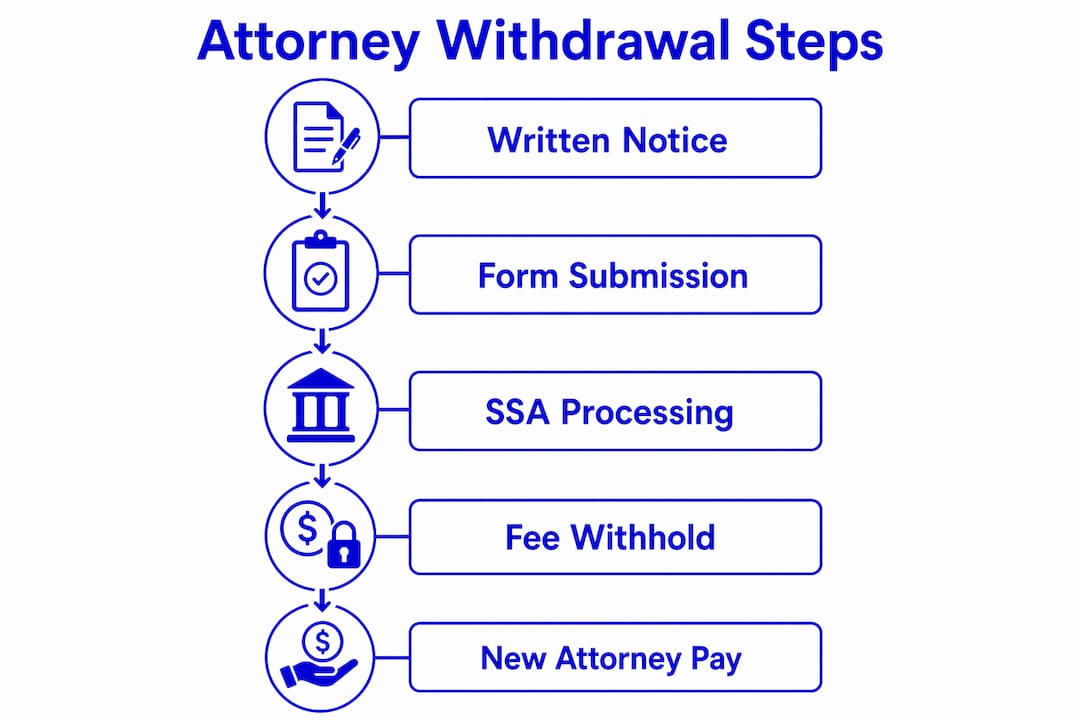
The SSDI attorney withdrawal process begins with a written, dated, and signed revocation statement submitted to the SSA. A verbal notice to your attorney is not sufficient. The SSA requires documented proof of your intent to terminate representation.
Follow these steps to terminate SSDI attorney services correctly:
- Write a revocation letter or complete Form SSA-1696-SUP1. Your letter must include your full name, Social Security number, the attorney's name, and a clear statement that you are revoking their appointment as your representative. Sign and date the document.
- Submit the notice to the correct SSA office. Send your revocation to your local SSA office, the hearing office handling your case, or SSA customer service, depending on where your claim currently sits in the process.
- Request written confirmation. Ask the SSA to confirm receipt of your revocation. This creates a paper trail that protects you if disputes arise later.
- Notify your attorney directly. Send a copy of your revocation letter to your attorney. This step is not required by the SSA but avoids confusion about the status of representation.
- Understand how your attorney withdraws. If your attorney initiates the withdrawal, they file Form SSA-1696-SUP2 to formally notify the SSA. This form is specific to attorney-initiated terminations and carries the same legal weight as a claimant revocation.
After submission, the SSA processes the revocation and updates your claim record. Processing time varies by office, so follow up within two weeks if you do not receive confirmation.
Pro Tip: Request a copy of your complete claim file from your former attorney before the revocation takes effect. You are legally entitled to it, and having it speeds up the transition to new representation.
For a detailed breakdown of the authorization forms involved, the SSDI authorization form guide at Ssdilawyer covers the 2026 procedures clearly.
How does attorney withdrawal affect SSDI fees and payments?
SSDI attorney fees are capped at 25% of your past-due benefits, with a maximum of $7,200 as of 2025–2026. That cap applies regardless of how many attorneys work on your case. You do not pay twice if you switch attorneys mid-claim.
The table below compares the two main fee structures you may encounter:
| Fee Structure | How It Works | Risk to Claimant |
|---|---|---|
| Fee Agreement | Capped at 25% of backpay, max $7,200 | Low. SSA enforces the cap automatically. |
| Fee Petition | Uncapped; attorney requests specific amount | Higher. Fees can exceed $7,200 in complex cases. |
Fee petitions differ from fee agreements in one critical way: they are not subject to the standard cap. Attorneys use fee petitions in more complex cases where work performed exceeds what the standard cap covers. Before signing any agreement, confirm whether it is a fee agreement or a fee petition.
When you change attorneys, the SSA withholds fees directly from your lump-sum past-due benefits and pays each attorney based on the work they performed. This protects you from paying out of pocket. The division between your former and new attorney requires precise record-keeping from both parties to allocate fees accurately under SSA guidelines.

Pro Tip: Review your signed fee agreement before initiating withdrawal. If it includes a fee petition clause, consult a second attorney before proceeding to understand your full financial exposure.
For more detail on how fee agreements govern SSDI cases, the disability fee agreement guide at Ssdilawyer explains the 2026 standards.
What are the key pitfalls when withdrawing your SSDI attorney?
The most common and costly mistake claimants make is confusing withdrawal of a hearing request with withdrawal of the entire SSDI claim. These are two entirely different actions with very different consequences.
Withdrawing a hearing request cancels your scheduled ALJ hearing but preserves your underlying claim and your original filing date. Withdrawing your claim application ends your pursuit of benefits entirely. That distinction matters because your filing date determines your potential back pay amount. Losing it can cost you months or years of benefits.
Key risks and safeguards to understand:
- ALJ approval is required. A hearing withdrawal request requires approval from the Administrative Law Judge. You cannot simply cancel a hearing without going through the proper channel.
- Ambiguous language is treated as hearing withdrawal. The SSA default interpretation treats unclear withdrawal requests as hearing-level withdrawals, not full claim withdrawals. This protects claimants from accidentally forfeiting their entire claim.
- Document your intent precisely. State clearly in writing whether you are withdrawing representation, withdrawing a hearing request, or withdrawing the full claim application. Vague language creates processing errors.
- Withdrawing an appeal has specific procedures. A pending appeal withdrawal is handled differently depending on whether it is at the reconsideration, hearing, or Appeals Council level. Each stage has its own requirements.
- Misconduct is a separate matter. If you are withdrawing because your attorney behaved improperly, that is not just a representation change. SSA representatives are held to strict conduct standards, and you can report violations to the SSA Office of General Counsel independently of your withdrawal.
"Withdrawal requests should always be documented clearly to avoid accidental loss of claim rights or benefits." — NOSSCR Practice Tip
Reporting misconduct and terminating representation are two separate actions. You can and should do both if the situation warrants it.
How to switch attorneys or find a new SSDI lawyer after withdrawal
Changing SSDI representation does not have to delay your claim. The key is notifying the SSA promptly and transferring your records without gaps.
Steps to follow when switching attorneys:
- Notify the SSA in writing about your new representative. Your new attorney will typically file Form SSA-1696 to establish their appointment. Confirm this has been submitted and processed before your next claim deadline.
- Transfer your complete claim file. Request all records, medical evidence, correspondence, and notes from your former attorney. Proper notification and file transfer avoids claim processing interruptions and keeps your case moving.
- Check timing relative to hearings or deadlines. Switching attorneys two weeks before an ALJ hearing creates real risk. If possible, complete the transition at least 60 days before any scheduled proceeding.
- Review the new fee agreement carefully. Confirm it is a fee agreement, not a fee petition, and that both parties understand how fees will be divided with your former attorney.
- Maintain direct communication with the SSA. Do not assume your new attorney has notified the SSA of all relevant changes. Call or write to confirm your representation record is current.
- Use vetted resources to find qualified attorneys. The SSA website, state bar referral services, and platforms like Ssdilawyer connect claimants with attorneys who specialize in disability claims.
The SSA holds representatives to strict standards, and timely communication is required throughout the process. A new attorney who does not promptly file their authorization form creates the same problems as no attorney at all.
Key takeaways
The SSDI attorney withdrawal process requires written, signed notice to the SSA, clear documentation of intent, and an understanding of fee obligations to protect your claim and benefits.
| Point | Details |
|---|---|
| Written notice is mandatory | Submit a signed, dated revocation letter or Form SSA-1696-SUP1 to the SSA to end representation. |
| Fee cap protects claimants | The 25% backpay cap, max $7,200 in 2025–2026, applies across all attorneys on your case. |
| Hearing vs. claim withdrawal | Withdrawing a hearing request preserves your claim; withdrawing the application ends it entirely. |
| ALJ approval is required | You cannot cancel an ALJ hearing without formal approval from the Administrative Law Judge. |
| File transfer is critical | Request your complete claim file from your former attorney before the transition to avoid delays. |
What i have seen go wrong with SSDI attorney withdrawals
After working with SSDI claimants across many stages of the process, the pattern I see most often is not malice or bad faith. It is confusion about what "withdrawal" actually means in a legal context.
Claimants assume that telling their attorney "I'm done" is enough. It is not. The SSA does not recognize informal communications. Until a signed revocation reaches the correct office, your former attorney remains your legal representative of record. That means they can still receive correspondence about your claim, and you may not.
The fee issue also catches people off guard. Many claimants believe switching attorneys means paying double. That fear stops them from making a change they genuinely need to make. The 25% cap is a hard ceiling. The SSA enforces it. Your total attorney cost does not increase because you switched.
What I tell people is this: document everything, submit everything in writing, and do not assume the SSA has processed anything until you have confirmation. The SSA handles millions of claims. Your revocation is one document in a large queue. Follow up.
The one area where I urge real caution is the hearing withdrawal. I have seen claimants lose years of back pay because they used vague language in a withdrawal request and the SSA processed it at the wrong level. Write exactly what you mean. If you want to withdraw your attorney but keep your hearing, say that explicitly. If you want to withdraw your hearing but keep your claim, say that explicitly. Ambiguity costs money.
— Gerard
Get the right SSDI attorney from the start
Changing or ending attorney representation mid-claim adds complexity you do not need. Ssdilawyer connects you with experienced SSDI attorneys who understand the full claims process, from initial applications through ALJ hearings and Appeals Council reviews. If you are considering a representation change or starting fresh, the right attorney makes the difference between a denied claim and approved benefits. Visit Ssdilawyer to get matched with a qualified disability attorney who can review your case, explain your options, and take over representation without disrupting your claim timeline.
FAQ
What is the SSDI attorney withdrawal process?
The SSDI attorney withdrawal process is the formal procedure for ending legal representation during an SSDI claim. It requires submitting a written, signed, and dated revocation to the SSA using a letter or Form SSA-1696-SUP1.
Can i switch SSDI attorneys without losing my benefits?
Yes. Switching attorneys does not affect your underlying claim or benefits. The SSA applies the 25% fee cap across all attorneys, so your total attorney cost stays within the $7,200 maximum as of 2025–2026.
What happens if i withdraw my SSDI hearing request?
Withdrawing a hearing request cancels your scheduled ALJ hearing but preserves your claim and original filing date. It requires ALJ approval and must be stated clearly in writing to avoid being processed as a full claim withdrawal.
How does my new SSDI attorney get paid after i switch?
The SSA withholds attorney fees directly from your past-due benefits and divides the payment between your former and new attorney based on work each performed. You do not pay either attorney out of pocket.
What is form ssa-1696-sup2 used for?
Form SSA-1696-SUP2 is the form attorneys file to formally withdraw from representing a claimant. It notifies the SSA of the attorney-initiated termination and updates the official representation record on your claim.