
Social Security Disability Insurance (SSDI) older worker rules are age-specific criteria the Social Security Administration (SSA) uses to evaluate disability eligibility for claimants aged 55 to 65. These rules, formally called the medical-vocational grid rules, recognize that older workers face steeper barriers to retraining and reemployment than younger applicants. If you are between 55 and 65 and cannot perform your past work due to a disabling condition, the grid rules may work significantly in your favor. Understanding how age, work history, residual functional capacity (RFC), and education combine under this framework is the first step toward a stronger SSDI claim.
How do medical-vocational grid rules apply to SSDI claims for workers aged 55 to 65?
The medical-vocational grid rules are the SSA's structured framework for deciding disability at Step 5 of the five-step evaluation process. At Step 5, the SSA determines whether you can perform any work in the national economy, not just your past job. The grid rules combine four factors: age, education level, work history, and RFC.
RFC is the SSA's assessment of your maximum physical and mental work capacity. The main RFC classifications are sedentary, light, medium, heavy, and very heavy work. The lower your RFC, the more the grid rules tend to favor you. A 56-year-old restricted to sedentary work with limited education and no transferable skills will almost certainly be found disabled, unlike a 35-year-old with the exact same profile.
The SSA divides age into brackets that carry progressively more weight:
- Ages 45–49: Considered a "younger individual approaching advanced age." Limited favorable treatment.
- Ages 50–54: "Closely approaching advanced age." More favorable consideration begins.
- Ages 55–59: "Advanced age." The grid rules shift substantially in your favor at this bracket.
- Ages 60–64: "Closely approaching retirement age." The most favorable non-retirement bracket.
The 55–59 and 60–64 brackets are where the SSDI age 55 advantage becomes most concrete. The SSA recognizes that employers are less likely to hire or retrain workers near retirement age. Limitations that would deny a 35-year-old can strongly support approval for someone over 55.
Education level also matters. If you have a limited education and no skills that transfer to sedentary or light work, the grid rules are more likely to direct a finding of disabled. A college-educated office manager with administrative skills may face a harder path than a manual laborer with no transferable skills.

The SSA also applies a borderline age policy. If you are within six months of turning 55, 60, or another key age threshold, the SSA may consider you under the higher, more favorable age category. This is not automatic. You or your representative must explicitly request that the adjudicator apply the borderline age policy.
Pro Tip: If you are within six months of a key age threshold like 55 or 60, ask your attorney to formally request borderline age consideration in writing before the SSA issues a decision.
What work credit and employment history requirements must older workers meet?
SSDI is an earned benefit tied directly to your work history. To qualify, you generally need 40 work credits, with at least 20 of those credits earned in the 10 years immediately before your disability began. In 2026, you earn one work credit for every $1,810 in covered wages, up to four credits per year. That means you can earn the maximum four credits in a year by earning $7,240 in covered employment.
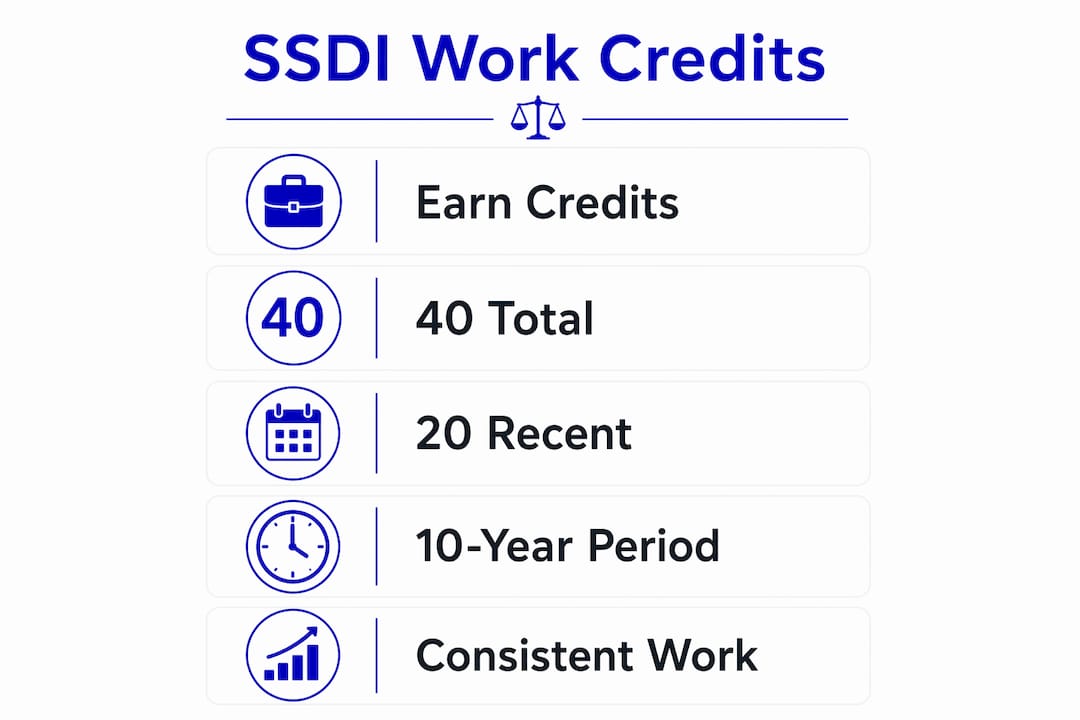
This is the standard 20/40 rule, and it applies to older workers just as it does to younger ones. The key difference for workers aged 55–65 is that most have a long enough work history to meet this threshold without difficulty. The more common problem is a gap in recent work history, not a shortage of total credits.
Here is what older workers need to know about work history requirements:
- Recent work matters most. The SSA focuses on the 10 years before your disability onset date. If you stopped working several years before applying, you may have fewer recent credits than you think.
- Covered wages only count. Self-employment income, certain government jobs, and some railroad work may not count toward SSDI credits. Review your Social Security earnings record at SSA.gov to confirm your credit total.
- SGA limits apply regardless of age. You must not be engaging in substantial gainful activity to qualify. In 2026, working and earning above the SGA threshold disqualifies applicants regardless of age or medical condition.
- Gaps from caregiving or illness reduce recent credits. Many older workers took time off to care for a spouse or manage their own health. Those years produce no credits and can create eligibility problems.
- Check your earnings record early. Errors in SSA records are more common than most people expect. Correcting a mistake before you apply is far easier than disputing it during a claim.
The work credit system rewards consistent employment, which most workers aged 55–65 have. The risk is assuming your history is sufficient without verifying it.
How does age 55 provide an advantage when applying for SSDI?
The SSDI age 55 advantage is real, but it is not automatic. The SSA's grid rules treat older workers more favorably because the agency acknowledges the social reality that retraining and reemployment become harder with age. This is a policy recognition, not a medical one. Age alone is never a disability.
The advantage works like this: when the grid rules apply, a claimant aged 55 or older who is limited to sedentary or light work and has no transferable skills is far more likely to receive a "disabled" finding than a younger person with identical medical limitations. The grid essentially acknowledges that asking a 58-year-old with a bad back and a 30-year history of physical labor to learn a new desk job is unrealistic.
However, transferable skills can limit this advantage. An older worker with office management experience, for example, may find that the SSA considers those skills transferable to sedentary administrative roles. The SSA may deny a claimant who has skills that apply to lighter work, even if the claimant is 60 years old and physically limited.
Common misperceptions about the age 55 advantage include:
- "I will be automatically approved at 55." False. Medical evidence of a severe impairment is still required.
- "My age replaces the need for an RFC assessment." False. RFC remains the foundation of any grid analysis.
- "Older age always overrides transferable skills." Not true. Transferable skills can and do override the age advantage in many cases.
Pro Tip: If the SSA claims you have transferable skills, ask your attorney to challenge whether those skills genuinely apply to available sedentary jobs in the current labor market.
What practical steps can older workers take to improve SSDI approval chances?
Strong medical documentation is the single most controllable factor in an SSDI claim. The grid rules provide a favorable framework, but they require accurate medical evidence to function. Without a well-supported RFC, even the most favorable grid outcome is out of reach.
Build a complete medical record
Every treating physician, specialist, and therapist should document your functional limitations in writing. Vague notes like "patient has back pain" are far less useful than "patient cannot stand for more than 15 minutes or lift more than 5 pounds." Ask your doctors to complete RFC forms that describe exactly what you can and cannot do.
Prepare for consultative examinations
The SSA often schedules consultative examinations when your medical record is incomplete. These exams typically last only 30–60 minutes, which is rarely enough time to capture complex or chronic conditions. Prepare a written list of all your symptoms and functional limits before the appointment. Hand it to the examiner at the start of the visit to make sure nothing is missed.
Challenge an inaccurate RFC
The RFC classification the SSA assigns can determine approval or denial. A one-level difference between sedentary and light work can change the grid outcome entirely for a claimant aged 55 or older. If the SSA assigns you a light work RFC when your medical evidence supports sedentary, that classification is worth challenging before a final decision is issued.
Work with a qualified SSDI attorney
Older workers navigating the grid rules benefit significantly from legal representation. An attorney familiar with SSDI case strategy can identify whether borderline age policy applies, challenge an inaccurate RFC, and ensure your work history is correctly evaluated. The benefits of hiring a disability attorney are especially pronounced in cases where grid rules are the deciding factor.
Common pitfalls to avoid:
- Applying without verifying your work credit total at SSA.gov
- Failing to request borderline age consideration when you are within six months of a key threshold
- Accepting an RFC classification without reviewing whether it matches your actual medical record
- Missing appeal deadlines after an initial denial
Key Takeaways
The SSDI medical-vocational grid rules give workers aged 55–65 a measurable structural advantage, but only when medical evidence, RFC accuracy, and work history all align correctly.
| Point | Details |
|---|---|
| Grid rules favor older workers | The SSA's medical-vocational grid rules treat claimants aged 55–64 more favorably than younger applicants with the same limitations. |
| RFC classification is decisive | A one-level RFC difference, such as sedentary versus light work, can determine approval or denial under the grid rules. |
| Work credits must be verified | You need 40 total credits with 20 earned in the last 10 years; check your SSA earnings record before applying. |
| Transferable skills can limit the age advantage | If the SSA finds your skills transfer to sedentary jobs, the age 55 advantage may not apply. |
| Borderline age policy requires a request | If you are within six months of a key age threshold, your representative must formally request borderline age consideration. |
What I have seen working SSDI cases for older workers
The grid rules are genuinely more favorable for workers aged 55 and older. That part is true. What I have seen repeatedly, though, is older claimants walking into the process assuming the rules will do the work for them. They do not.
The cases that succeed are the ones where the claimant's RFC is accurately documented and matches what the grid requires. A 58-year-old with severe degenerative disc disease who gets assigned a light work RFC instead of sedentary is not going to benefit from the grid, even though the grid would have directed a disabled finding at the sedentary level. That RFC error is the difference between approval and denial, and it happens more often than it should.
Borderline age is another area where I see older workers leave value on the table. A claimant who is 54 years and 8 months old at the time of the decision is within six months of 55. The SSA will not automatically apply the more favorable age category. Someone has to ask. If no one asks, the claim gets evaluated under the less favorable younger individual rules.
The other pattern I see is older workers giving up after an initial denial. The denial rate at the initial application stage is high across all age groups. The grid rules apply at the hearing level too, and that is often where older worker claims succeed. Giving up before the hearing stage means walking away from a claim that might have been approved.
Representation matters at every stage, but it matters most at the hearing. An attorney who understands the grid rules, RFC standards, and borderline age policy can make the difference between a favorable decision and a second denial.
— Gerard
Ssdilawyer can help you apply SSDI older worker rules to your claim
Older workers aged 55–65 face a specific set of rules that can work in their favor, but only when applied correctly. Ssdilawyer connects you with experienced disability attorneys who understand the medical-vocational grid rules, RFC assessments, and borderline age policies that govern your claim.

Whether you are filing for the first time or appealing a denial, the attorneys in the Ssdilawyer network know how to build the medical record and legal argument your case requires. You can find an SSDI attorney with no upfront cost, since most disability attorneys work on contingency. Visit Ssdilawyer to request a free case evaluation and get clarity on where your claim stands.
FAQ
What are the SSDI grid rules for age 55?
The SSA's medical-vocational grid rules place claimants aged 55–59 in the "advanced age" category, which directs more favorable disability findings for those limited to sedentary or light work with limited education and no transferable skills.
Does turning 55 automatically qualify me for SSDI?
No. Age 55 improves your chances under the grid rules, but you still need documented medical evidence of a severe impairment and a qualifying RFC classification to be approved.
How many work credits do I need for SSDI at age 55?
You generally need 40 work credits total, with at least 20 earned in the 10 years before your disability began. In 2026, one credit equals $1,810 in covered wages, with a maximum of four credits per year.
What is the borderline age policy in SSDI?
The borderline age policy allows the SSA to evaluate claimants within six months of a key age threshold, such as 55 or 60, under the higher, more favorable age category. You or your representative must request this consideration explicitly.
Can transferable skills hurt my SSDI claim as an older worker?
Yes. If the SSA determines your past work gave you skills that transfer to sedentary or light jobs, it may deny your claim even if you are 60 or older and physically limited to lower-exertion work.