
Contingency fee representation is the standard payment model for SSDI attorneys, meaning you pay nothing upfront and owe nothing if you lose. The Social Security Administration caps attorney fees at 25% of your past-due benefits, with a maximum dollar limit set by the SSA. About 60% of initial SSDI applications are denied, which makes professional legal help critical at the hearing stage. When you need to find an SSDI attorney no upfront cost, the two main paths are contingency fee attorneys and truly free legal aid programs. Both exist, and both are accessible if you know where to look.
How to find an SSDI attorney no upfront cost
The term "no upfront cost" covers two distinct arrangements in SSDI law. Understanding the difference protects you from surprises later.
Contingency fee representation means the attorney collects a fee only if you win your case. Attorneys on contingency charge no upfront fees or retainers. Their payment comes directly from your awarded back pay, not from your pocket before the case starts. This is the most common model used by disability law firms across the country.

Truly free representation means no fee at all, win or lose. Free advocates owe nothing even if you lose, because their funding comes from government grants or private donations. These programs are less common and harder to access, but they do exist.
Here is what each model means in practice:
- Contingency fee: Attorney paid 25% of back pay, capped by SSA rules. You pay zero upfront. If you lose, you owe nothing.
- Truly free legal aid: No fee regardless of outcome. Funded by grants, nonprofits, or law school programs. Eligibility is income-based and often limited to specific case stages.
- No retainer: Neither model requires a retainer or hourly billing. You will never receive an invoice before your case resolves.
- Out-of-pocket expenses: Some attorneys may charge small costs for records or copying. Ask about this separately from the attorney fee itself.
Pro Tip: Ask every attorney you consult: "Do you charge any fees or costs if I lose?" A clear yes or no tells you exactly what model they use.
One common misconception is that contingency fees are "free." They are not. You pay from your back pay award. The distinction matters because it affects how much you receive after winning. A truly free advocate costs you nothing from your benefits. Understanding this difference helps you choose the right fee structure before signing any agreement.
Where to find truly free SSDI legal assistance
Truly free SSDI legal help exists through several types of organizations. Access is limited, but persistence pays off.
Legal aid societies are nonprofit organizations funded by federal and state grants. They provide free civil legal services to low-income individuals, including SSDI claimants. Income eligibility typically falls at or below 125% of the federal poverty level. Most legal aid offices prioritize cases at the hearing stage because that is where representation has the greatest impact.
Protection and Advocacy (P&A) programs operate in every state. Congress established P&A programs specifically to protect the rights of people with disabilities. They handle SSDI and SSI cases, often at no cost, and do not always require income verification. Your state's P&A program is one of the most reliable free resources available.
Law school clinics offer supervised representation at no cost. Students handle cases under the direct supervision of licensed attorneys. Law school clinics have limited availability tied to academic calendars, so timing your application matters. Clinics typically open intake in september and january at the start of each semester.
Pro bono programs through state bar associations connect claimants with volunteer attorneys. These programs vary widely by state. Some focus exclusively on disability cases; others handle a broader range of civil matters.
Key fact: Free services prioritize cases closer to hearing due to limited capacity. If your case is still at the initial application stage, you may need to start with a contingency fee attorney and transition to free aid later, or apply to multiple programs simultaneously.
One insight that surprises many claimants: rejection from one free legal aid program does not end your options. Different organizations specialize in different claimant types, so a program that turns you down may simply not handle your type of case. Apply to multiple programs and ask each one for a referral if they cannot help you.
Step-by-step guide to securing no-cost SSDI representation
A structured approach saves time and improves your odds of finding qualified help quickly.
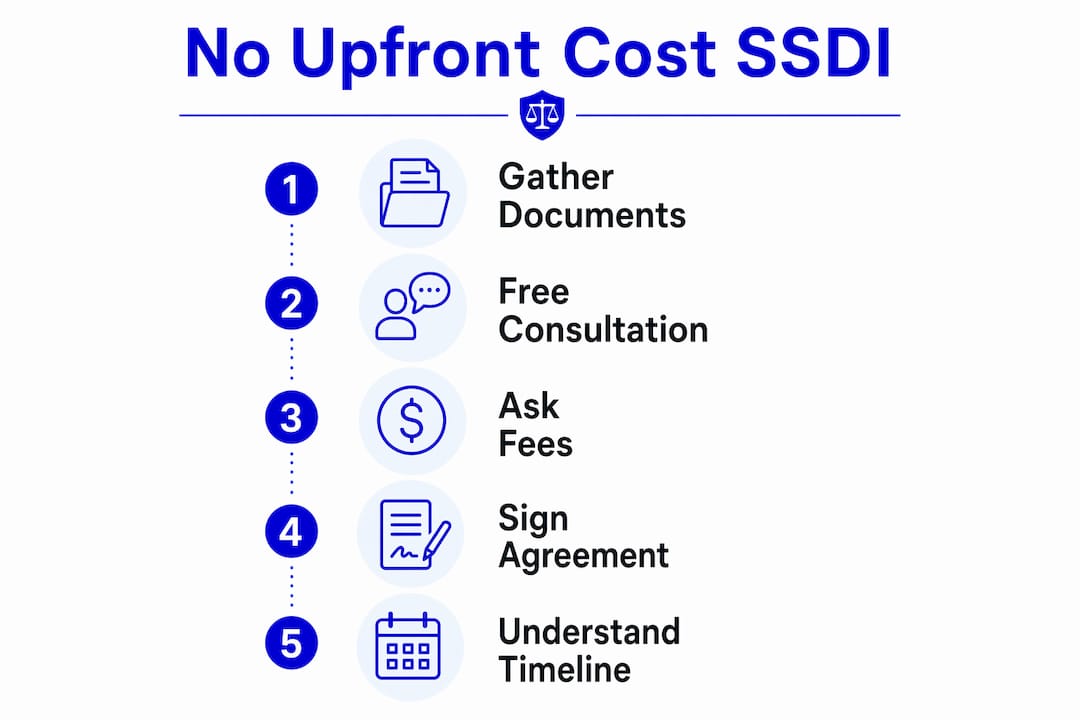
Step 1: Gather your documents first
Before contacting any attorney or legal aid office, collect your medical records, denial letters, work history, and Social Security notices. Attorneys assess case strength immediately. Arriving prepared signals that you are a serious claimant and speeds up the intake process.
Step 2: Search multiple channels at once
Do not rely on a single source. Use these channels in parallel:
- Ssdilawyer at ssdilawyer.co connects you with experienced SSDI attorneys and provides clear information on fee structures.
- Your state's P&A program (find it through the National Disability Rights Network website).
- Local legal aid society (search by zip code through lawhelp.org).
- State bar association's lawyer referral service (most offer a free initial consultation).
- Law school clinics at nearby universities with law programs.
Step 3: Prepare for your free consultation
Most disability attorneys offer a free initial consultation. Bring your denial letter, a summary of your medical conditions, and a list of your treating doctors. Write down your questions before the meeting so you do not forget them under pressure.
Step 4: Ask the right questions about fees
| Question to ask | What it tells you |
|---|---|
| Do you charge any upfront fees or retainers? | Confirms the no upfront cost model |
| What percentage of back pay do you take? | Verifies SSA-compliant 25% cap |
| Are there any out-of-pocket costs I pay directly? | Identifies record fees or filing costs |
| Do I owe anything if I lose? | Distinguishes contingency from free aid |
| Have you handled cases at my current stage? | Confirms relevant experience |
Step 5: Review the attorney-client agreement carefully
Every attorney will ask you to sign a fee agreement before they begin work. Read it line by line. The attorney-client agreement for disability cases governs exactly how and when fees are collected. If anything is unclear, ask for a written explanation before signing.
Pro Tip: Request a copy of the signed agreement for your records. You have the right to a copy, and keeping it protects you if any fee dispute arises later.
Step 6: Understand the timeline
SSDI cases take time. Initial applications take three to six months for a decision. Appeals and hearings can extend the process by one to two years. Knowing this upfront helps you stay patient and maintain contact with your attorney throughout.
Common mistakes when seeking no-cost SSDI attorneys
Claimants make avoidable errors that delay or derail their cases. Knowing these mistakes in advance keeps your claim on track.
- Confusing contingency fees with free legal aid. These are different arrangements. A contingency attorney is paid from your back pay. A free advocate costs you nothing at all. Mixing them up leads to mismatched expectations.
- Waiting too long to seek representation. Delays in seeking representation cause claim issues. The earlier you get an attorney involved, the better your documentation and strategy from the start.
- Not disclosing your financial situation accurately. Free legal aid programs use income verification. Providing inaccurate information disqualifies you and wastes everyone's time.
- Failing to ask about all potential costs. Attorney fees and case expenses are separate. Always ask about both in writing.
- Giving up after one rejection. Free legal aid programs have limited capacity. One rejection does not mean no help exists. Contact at least three to five organizations before concluding that free aid is unavailable to you.
- Skipping the written agreement review. Verbal assurances about fees are not enforceable. Get every fee arrangement in writing before your attorney begins work.
The benefits of SSDI legal representation are well documented, particularly at the Administrative Law Judge hearing stage. Claimants with attorneys consistently achieve higher approval rates than those who represent themselves.
Key Takeaways
Finding a no upfront cost SSDI attorney requires understanding the difference between contingency fee arrangements and truly free legal aid, then applying to multiple sources simultaneously.
| Point | Details |
|---|---|
| Contingency fees are not free | You pay 25% of back pay upon winning; you owe nothing if you lose. |
| Truly free aid has strict eligibility | Income limits and case stage determine access to legal aid and P&A programs. |
| Apply to multiple sources | Rejection from one program does not close all options; persistence opens more doors. |
| Ask about all costs in writing | Confirm both attorney fees and out-of-pocket expenses before signing any agreement. |
| Early representation improves outcomes | Getting an attorney involved before a hearing increases your approval odds significantly. |
What I have learned after years of watching claimants navigate this process
The single biggest mistake I see is claimants treating "no upfront cost" as a guarantee that everything is simple. It is not. The contingency fee model is genuinely fair and accessible, but it requires you to understand what you are agreeing to before you sign. I have seen claimants surprised by the 25% deduction from their back pay because no one explained it clearly at the start. That surprise is avoidable.
The second thing I have learned is that free legal aid is real, but it rewards persistence. Most claimants contact one organization, get turned away, and conclude that free help does not exist. That conclusion is wrong. P&A programs, law school clinics, and pro bono networks each serve different populations. The claimant who contacts five organizations in the same week is far more likely to find a match than the one who stops after the first rejection.
My practical recommendation: start with a contingency fee attorney to get representation in place quickly, and simultaneously apply to free legal aid programs. If a free program accepts your case later, you can discuss transitioning. The goal is to have qualified representation at every stage of your claim, not to hold out for a perfect arrangement that may take months to secure.
— Gerard
Ssdilawyer connects you with qualified SSDI attorneys
Ssdilawyer exists to make this process straightforward for you. The platform connects claimants with experienced SSDI attorneys who work on contingency, meaning you pay nothing upfront and nothing if you lose.
At Ssdilawyer, you can review attorney information, understand fee structures clearly, and take the first step toward representation without any financial barrier. Whether your case is at the initial application stage or you have already received a denial, qualified attorneys are available to assess your situation. The no win no fee model used by attorneys in the network means your financial situation is never a reason to go without legal help.
FAQ
What does "no upfront cost" mean for an SSDI attorney?
It means the attorney charges no retainer or hourly fee before your case resolves. Most SSDI attorneys work on contingency, collecting 25% of your back pay only if you win.
How do I find an SSDI attorney free consultation near me?
Contact your state bar association's lawyer referral service, local legal aid society, or use Ssdilawyer at ssdilawyer.co. Most disability attorneys offer a free initial consultation at no charge.
What is the SSA fee cap for SSDI attorneys?
The Social Security Administration caps attorney fees at 25% of your past-due benefits. This limit applies to all contingency fee agreements and is enforced directly by the SSA.
Are there truly free SSDI attorneys who charge nothing at all?
Yes. Protection and Advocacy programs, legal aid societies, and law school clinics provide representation at no cost regardless of outcome. Eligibility is income-based and availability is limited, so apply to multiple programs.
What happens if I lose my SSDI case with a contingency fee attorney?
You owe the attorney nothing. Contingency fee arrangements mean the attorney is paid only from a successful award. No win means no fee, with no out-of-pocket cost to you.