
Disability lawyers work on contingency, meaning they collect fees only if you win your claim and receive past-due benefits. No upfront payment is required. This fee structure is the standard model for Social Security Disability Insurance (SSDI) and Supplemental Security Income (SSI) cases across the United States. Understanding why disability lawyers work on contingency helps you make an informed decision before signing any fee agreement. Federal law caps these fees, the Social Security Administration (SSA) approves every payment, and the money comes directly from your retroactive award.
How contingency fees are regulated and capped in disability cases
Federal law governs every dollar a disability attorney can collect. Under 42 U.S.C. § 406, fee caps protect claimants at the administrative level and in federal court. The SSA must approve the fee before any payment is released.
The $9,200 cap explained
Federal law caps SSDI fees at the lesser of 25% of past-due benefits or $9,200, effective november 30, 2024. That means a $40,000 retroactive award produces a $9,200 fee, not $10,000. The cap protects claimants from paying a percentage that grows disproportionately large on high awards.
At the federal court stage, 42 U.S.C. § 406(b) applies a separate 25% cap on past-due benefits. No fee is owed if the claim fails at that stage. Payment still comes from the claimant's retroactive award, not from government funds.
How SSA pays the attorney
SSA withholds the fee directly from your past-due benefits and pays the attorney. If the amount withheld exceeds the authorized fee, SSA refunds the difference to you. This process removes the burden of tracking and sending payments yourself.
The Supreme Court's decision in Gisbrecht v. Barnhart (2002) confirmed contingency fee agreements as the standard for Social Security claims. Courts review reasonableness rather than imposing strict hourly calculations. A fee can be reduced if it amounts to a windfall or results from attorney-caused delay.
Fee calculation at a glance:
| Past-due benefit amount | 25% calculation | Fee cap applied | Claimant receives |
|---|---|---|---|
| $20,000 | $5,000 | $5,000 (under cap) | $15,000 |
| $36,800 | $9,200 | $9,200 (at cap) | $27,600 |
| $60,000 | $15,000 | $9,200 (cap applies) | $50,800 |
Pro Tip: Ask your attorney whether they use a fee agreement or a fee petition. Fee agreements are simpler and apply to most cases. Fee petitions require itemized time records and apply when a case involves multiple hearings or reaches federal court.
Why contingency fits the complexity of disability claims
SSDI and SSI cases are not quick. Cases include medical development, administrative filings, hearings, and appeals that can stretch across years. Most claimants are not working and cannot afford hourly legal fees while waiting for a decision.

Contingency fees solve a real access problem. A claimant who cannot pay $200 to $400 per hour can still retain an experienced attorney. The attorney absorbs the time and financial risk of a case that may be denied at multiple levels before succeeding.
The contingency model also aligns incentives. An attorney paid only on success has a direct financial reason to build the strongest possible case. That alignment benefits claimants who need thorough medical documentation, strong hearing preparation, and persistent appeals.
Key reasons contingency fits disability cases:
- SSDI initial denial rates are high, meaning many cases require at least one appeal before approval.
- Cases can span two to five years from application to final decision.
- Claimants are typically out of work and have limited or no income during the process.
- Medical record collection, expert opinions, and hearing preparation require significant attorney time.
- The outcome is binary: either benefits are awarded or they are not.
Pro Tip: Before hiring an attorney, ask how many SSDI cases they handle annually and what percentage reach the hearing level. Attorneys who regularly appear before Administrative Law Judges tend to be better prepared for contested cases.
Contingency is a risk-sharing arrangement. The attorney bets their time on your case. You get representation you could not otherwise afford. When you win, both parties benefit. That structure is why disability lawyers improve approval odds compared to unrepresented claimants.
Contingency vs. hourly and flat fees: which structure fits disability cases?
Hourly and flat fee arrangements exist in law but are rare in disability representation. Understanding the difference helps you recognize why contingency is the practical standard.
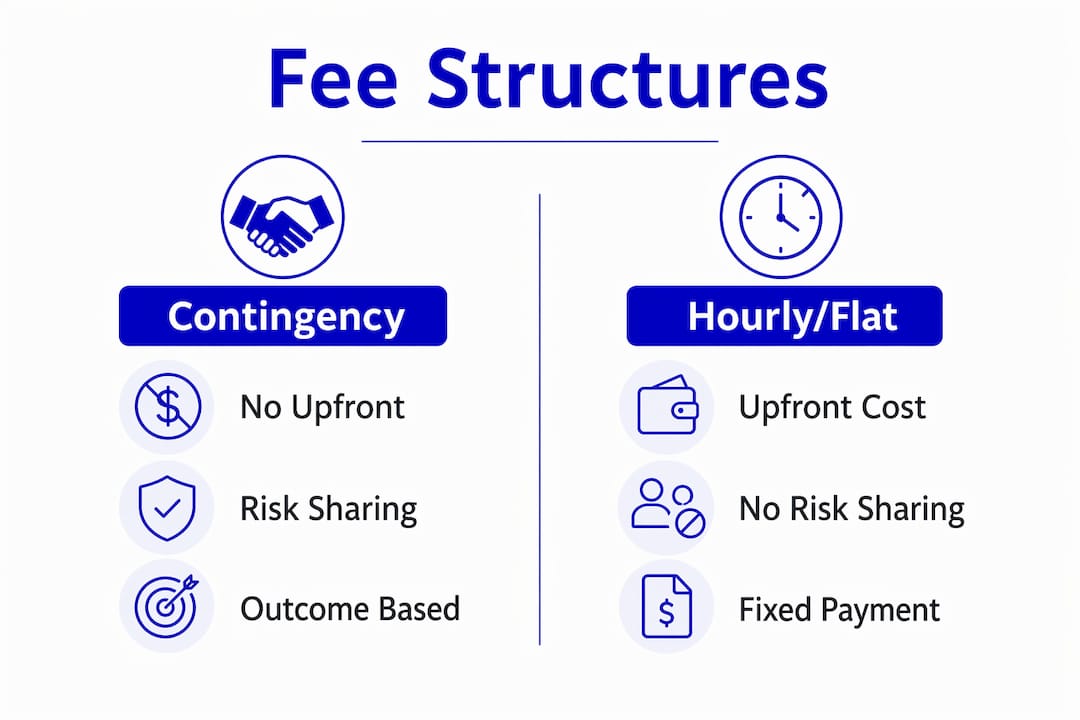
With an hourly fee, you pay regardless of outcome. A case that takes 40 hours at $300 per hour costs $12,000 whether you win or lose. For a claimant with no income, that cost is prohibitive. Flat fees present a similar problem: you pay a fixed amount upfront, and the attorney has no financial incentive tied to your result.
Contingency removes both barriers. You pay nothing unless benefits are awarded. The disability lawyer fee agreement locks in the percentage and the cap before work begins, giving you cost certainty from day one.
Comparison of fee structures for disability cases:
| Fee type | Payment timing | Claimant risk | Attorney incentive |
|---|---|---|---|
| Contingency | After award, from benefits | None if claim denied | High: paid only on success |
| Hourly | Ongoing, regardless of outcome | Full cost even if denied | Neutral: paid by the hour |
| Flat fee | Upfront or in installments | Full cost even if denied | Neutral: paid regardless |
One common misconception is that contingency fees are a disadvantage because the attorney "takes a cut." The reality is that the fee comes from money you would not have received without legal help. A claimant who wins $40,000 in past-due benefits and pays $9,200 in fees nets $30,800. A claimant who handles the case alone and loses nets nothing.
Hourly fees are occasionally used for non-SSDI disability matters, such as private long-term disability insurance disputes. For SSA claims specifically, the benefits of hiring a disability attorney on contingency far outweigh any perceived cost of the fee.
What to expect when hiring a disability attorney on contingency
The practical side of contingency fees involves several steps that claimants should understand before signing anything.
- Sign a written fee agreement. The SSA requires a signed fee agreement before your attorney can collect any fee. The agreement must state the percentage and acknowledge the federal cap. Review it carefully before signing.
- Understand what the cap covers. The $9,200 cap applies to attorney fees only. Out-of-pocket case expenses like medical record retrieval may be billed separately and could be charged even if no benefits are awarded. Ask your attorney for a written list of potential costs outside the fee cap.
- Know when a fee petition applies. If your case involves multiple hearings or reaches federal court, your attorney may file a fee petition instead of relying on the standard fee agreement. Fee petitions require itemized time records and are reviewed by the SSA or a judge for reasonableness.
- Track your past-due benefits calculation. SSA calculates past-due benefits from your established onset date. A longer wait before approval generally means a larger retroactive award, which affects the fee calculation. Ask your attorney to explain how your onset date is determined.
- Confirm SSA authorization before payment. SSA must approve the fee before your attorney receives payment. No attorney can legally collect a disability fee without that authorization. If an attorney asks for upfront payment on an SSDI case, that is a red flag.
The fee collection timing at the administrative level differs significantly from what happens in federal court. At the administrative level, SSA handles withholding automatically. In federal court, a judge issues a fee order. Claimants should clarify which stage their case is at and what the payment process looks like at each step.
Key Takeaways
Disability lawyers work on contingency because federal law, SSA rules, and the financial reality of claimants make it the only practical and legally sound fee structure for SSDI and SSI cases.
| Point | Details |
|---|---|
| No upfront cost | Fees are deducted from past-due benefits only after SSA approves the award. |
| Federal fee cap | The cap is the lesser of 25% of past-due benefits or $9,200 as of november 2024. |
| SSA controls payment | SSA withholds and pays the attorney directly, then refunds any overage to the claimant. |
| Extra costs exist | Medical records and case expenses fall outside the fee cap and may be billed separately. |
| Fee agreements vs. petitions | Standard cases use fee agreements; complex or court-level cases may require fee petitions. |
The case for contingency: a practical perspective
The contingency fee model is not just a billing preference. It is the mechanism that makes legal representation accessible to people who need it most.
I have seen claimants assume that contingency fees are somehow a trick or that they would be better off representing themselves. That assumption costs people real money. Unrepresented claimants face a structurally harder path through the SSA system. The attorney's fee comes from benefits the claimant would likely not have secured alone.
What I find most underappreciated is the fee cap itself. The $9,200 ceiling is a genuine protection. Without it, a claimant with $80,000 in past-due benefits could theoretically owe $20,000 at 25%. The cap cuts that in half. Federal law built this protection in deliberately, and claimants rarely know it exists until they read their fee agreement.
The one area where I urge real caution is out-of-pocket expenses. The fee cap does not cover medical record costs, evaluation fees, or other case development expenses. A claimant who wins a modest award and faces several hundred dollars in unreimbursed costs can feel blindsided. Ask for a written estimate of those costs before you sign anything.
Transparency in the fee agreement is the single most important factor in a good attorney-client relationship on a disability case. An attorney who explains the fee structure clearly, including what falls outside the cap, is an attorney worth trusting.
— Gerard
Ssdilawyer connects you with contingency-based disability attorneys
Ssdilawyer exists to help disabled Americans find experienced SSDI attorneys who work on contingency, with no upfront cost required.
Every attorney in the Ssdilawyer network operates under the federal fee cap, meaning you will never pay more than the law allows. Whether your claim is at the initial application stage, under appeal, or heading toward a hearing, Ssdilawyer can connect you with legal representation that costs nothing unless you win. Visit Ssdilawyer.co to get started with a free consultation and understand your options before your next SSA deadline.
FAQ
What does contingency fee mean for disability lawyers?
A contingency fee means the attorney collects payment only if you win your case and receive past-due benefits. No fee is owed if your claim is denied.
How much can a disability attorney charge on contingency?
Federal law caps the fee at the lesser of 25% of past-due benefits or $9,200 at the administrative level, effective november 30, 2024.
Does the SSA have to approve my attorney's fee?
Yes. SSA must authorize the fee before your attorney receives any payment. SSA withholds the fee directly from your retroactive award and pays the attorney.
Are there costs outside the contingency fee cap?
Yes. Out-of-pocket expenses like medical record retrieval are separate from the capped attorney fee and may be charged even if your claim is denied. Ask your attorney for a written cost estimate upfront.
What is the difference between a fee agreement and a fee petition?
A fee agreement is a signed document used in most standard cases. A fee petition applies in complex cases or federal court proceedings and requires itemized time records reviewed for reasonableness by the SSA or a judge.