
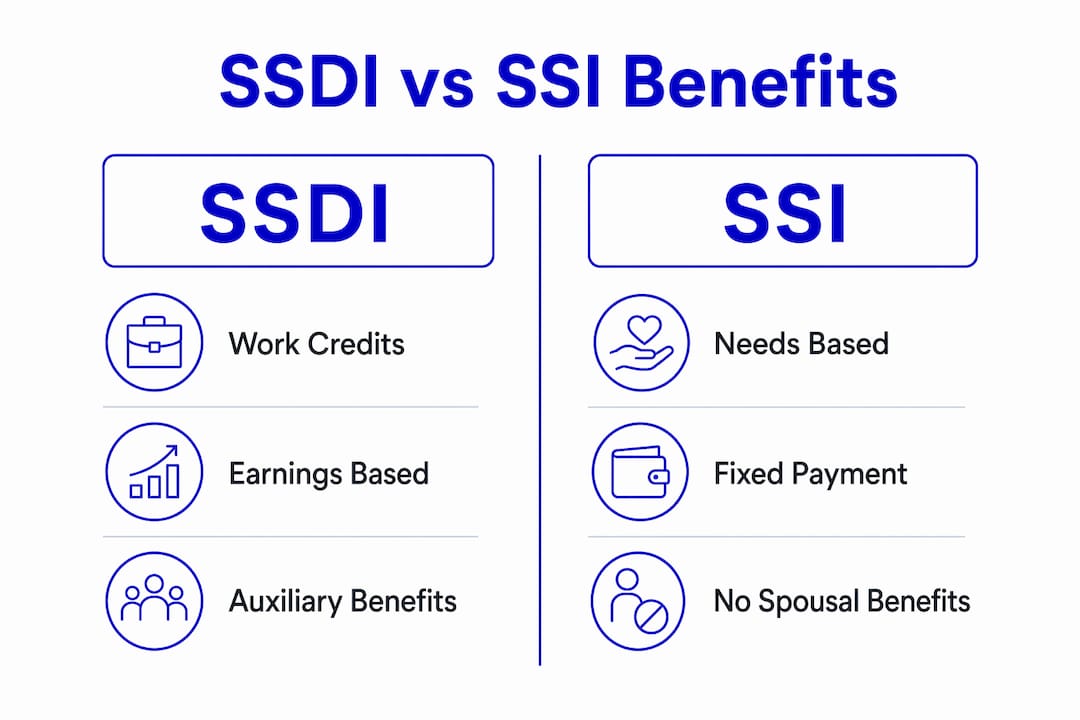
Social Security Disability Insurance (SSDI) and Supplemental Security Income (SSI) are two distinct federal disability programs that differ fundamentally in eligibility, funding, and benefit structure. The SSDI vs SSI difference comes down to one core fact: SSDI is an earned insurance benefit tied to your work history, while SSI is a needs-based program for people with limited income and assets. Both programs use the Social Security Administration's (SSA) same medical definition of disability, but they serve different populations and pay different amounts. Knowing which program fits your situation can determine how much you receive, when your health coverage starts, and whether you qualify at all.
What are the eligibility requirements for SSDI and SSI?
SSDI requires a sufficient work history measured in Social Security credits. Most applicants need 40 credits total, with 20 earned in the last 10 years before becoming disabled. Credits are earned through FICA payroll tax contributions, so workers who leave the workforce early may lose eligibility over time. The SSA assigns each applicant a Date Last Insured (DLI), which is the expiration date for SSDI eligibility based on recent work. Filing after your DLI passes means losing access to SSDI entirely, regardless of your medical condition.
SSI has no work history requirement. Instead, it applies strict financial limits: individuals must have countable resources below $2,000, and couples below $3,000. Not every asset counts against these limits. The home you live in, one vehicle, and burial plots are excluded from the resource calculation. That exclusion prevents people from being disqualified simply for owning a car or a house. Awareness of these exclusions remains low among applicants, which causes unnecessary disqualifications.
Both programs apply the same SSA medical standard for adults: your condition must prevent substantial gainful activity and be expected to last at least 12 months or result in death. SSI also covers children with qualifying disabilities, while SSDI does not cover children unless they apply as disabled adult children on a parent's work record. Blind applicants face slightly different income rules under SSI.
Pro Tip: If you stopped working due to disability, apply for SSDI immediately. Every month you wait moves you closer to your DLI, and missing it means permanent loss of SSDI eligibility.
How do SSDI and SSI benefits and payment amounts differ?
SSDI calculates your benefit using your Average Indexed Monthly Earnings (AIME), a formula that reflects your lifetime taxable earnings. The average SSDI payment in 2026 is approximately $1,580 per month, though higher earners receive more. SSI pays a flat federal maximum of $994 per month for individuals in 2026. That flat rate does not reflect your earnings history because SSI is not an earned benefit.
| Feature | SSDI | SSI |
|---|---|---|
| Benefit basis | Lifetime earnings (AIME formula) | Fixed federal maximum |
| 2026 average/max payment | ~$1,580/month average | $994/month maximum |
| Income or asset limits | None | Strict ($2,000/$3,000 resource cap) |
| Family auxiliary benefits | Yes, for spouses and dependents | No |
| Back pay available | Yes, up to 12 months retroactive | No retroactive pay |
SSDI also pays auxiliary benefits for spouses and dependents, which can significantly increase total household income. SSI provides no family benefits. SSI payments are also reduced by countable income: the first $65 of earned income is excluded, and then benefits drop by $1 for every $2 earned above that threshold. That reduction structure means even part-time work can meaningfully cut your SSI check.
One often-overlooked advantage of SSDI: it pays the equivalent of your full retirement benefit without reduction. Early retirement claimed at age 62 can permanently reduce your Social Security benefit by up to 30%. SSDI avoids that penalty entirely. At full retirement age, SSDI converts automatically to retirement benefits at the same payment level, with no interruption in coverage.
Pro Tip: If you are considering early retirement because of a health condition, apply for SSDI first. Claiming early retirement before an SSDI approval can permanently reduce your lifetime benefit.
What health insurance coverage does SSDI provide compared to SSI?
Health coverage is one of the sharpest practical differences between the two programs. SSDI recipients qualify for Medicare after a mandatory 24-month waiting period from the date of their first benefit payment. That two-year gap leaves many newly approved SSDI recipients without federal health coverage during a period when medical needs are often highest.

SSI recipients generally qualify for Medicaid immediately upon approval, though the exact timing depends on the state. Most states link SSI eligibility directly to Medicaid enrollment, so approval for SSI triggers Medicaid coverage without a separate application. That immediate access is a significant advantage for people with urgent or ongoing medical needs.
Key health coverage facts for each program:
- SSDI recipients wait 24 months for Medicare, regardless of age or medical severity.
- SSI recipients in most states receive Medicaid automatically and immediately.
- Medicaid typically covers more services with lower out-of-pocket costs than Medicare alone.
- Some states have expanded Medicaid under the Affordable Care Act, broadening SSI-linked coverage further.
- Concurrent beneficiaries receive both Medicare and Medicaid, which can nearly eliminate out-of-pocket medical expenses.
The 24-month Medicare gap is one reason disability attorneys often advise clients to apply early and pursue all available coverage options during the waiting period.
Can you receive both SSDI and SSI at the same time?
Concurrent benefits are possible when your SSDI payment is low enough to fall below the SSI income threshold. In that case, SSI acts as a supplement to bring your total monthly income closer to the federal benefit rate. Individuals with low SSDI payments may qualify for concurrent SSI benefits to fill the income gap. This situation is more common than most applicants realize, particularly for workers with limited earnings histories.
How concurrent benefits work in practice:
- The SSA calculates your SSDI payment based on your earnings record.
- If that payment falls below the SSI federal benefit rate, you may qualify for a partial SSI payment.
- SSI subtracts your SSDI income (after applicable exclusions) from the maximum SSI benefit to determine your SSI supplement amount.
- You receive both payments, which together bring your income closer to the SSI maximum.
- As a concurrent beneficiary, you gain access to both Medicare (after 24 months) and immediate Medicaid, which significantly reduces out-of-pocket medical expenses.
The SSA screens most applicants for both programs simultaneously, so you do not need to file two separate applications. One application triggers evaluation for both SSDI and SSI eligibility.
Pro Tip: Do not assume a low SSDI award means you are out of options. A partial SSI supplement plus dual health coverage can make a meaningful difference in your monthly budget.
What should you know before applying for SSDI or SSI?
Timing and preparation determine outcomes in federal disability claims. SSDI carries a mandatory five-month waiting period before payments begin, even after approval. SSI has no such waiting period. SSDI also pays retroactively for up to 12 months before your application date, which can result in a substantial lump-sum back payment. SSI provides no retroactive pay, so the date you file is the date your benefits can begin.
Critical application considerations:
- Apply for SSDI as soon as you stop working due to disability. Waiting until age 62 for early retirement instead of filing for SSDI can cause permanent benefit reductions.
- The SSA screens most applicants for both programs at once, so one application covers both.
- Your DLI is a hard deadline. Missing it eliminates SSDI eligibility permanently.
- SSI income rules reduce your benefit for nearly any countable income, including gifts and support from family members.
- Work activity above the Substantial Gainful Activity (SGA) threshold disqualifies you from both programs during that period.
- SSI does not have a formal trial work period. Instead, payments reduce gradually as income rises, which allows you to test returning to work without an abrupt benefit cutoff.
- Complex cases involving prior denials, appeals, or concurrent eligibility benefit from legal guidance on SSDI strategy before filing.
The SSDI application process can take months and often requires appeals. During that wait, some applicants claim early retirement as a financial bridge. If SSDI is later approved, the SSA can make retroactive adjustments, but the permanent early retirement reduction may still apply to the base benefit. Understanding that risk before filing is critical.
Older applicants face additional considerations. The SSA applies special vocational rules for workers aged 50 and older under the Medical-Vocational Guidelines, which can make it easier to qualify for SSDI. Applicants in the 55–65 age range should review SSDI rules for older workers before making any filing decisions.
Key Takeaways
SSDI and SSI serve different populations, pay different amounts, and provide different health coverage, making program selection a decision with long-term financial consequences.
| Point | Details |
|---|---|
| Eligibility basis | SSDI requires work credits; SSI requires limited income and resources below $2,000 for individuals. |
| Benefit amounts | SSDI averages ~$1,580/month based on earnings; SSI pays a flat $994/month maximum in 2026. |
| Health coverage timing | SSDI leads to Medicare after 24 months; SSI provides immediate Medicaid in most states. |
| Concurrent benefits | Low SSDI payments can qualify you for partial SSI, plus dual Medicare and Medicaid coverage. |
| Application timing | Apply for SSDI immediately after stopping work to avoid losing eligibility at your Date Last Insured. |
What I have seen applicants get wrong about these programs
The single most costly mistake I see is waiting. People stop working due to a serious medical condition, assume they will recover, and delay filing. By the time they accept the disability is permanent, their DLI has passed. SSDI eligibility is gone. They are left with SSI, which pays less and has strict asset limits they may not meet.
The second mistake is misreading SSI's resource rules. Applicants panic when they hear "$2,000 limit" and assume they must spend down savings before applying. They sell assets unnecessarily. What they do not know is that their home, their car, and their burial plot do not count. A disability attorney catches these errors before they cost someone their eligibility or their assets.
Financial eligibility criteria for SSI are often the most confusing part of the application, and even small income amounts can reduce or eliminate benefits. I have seen applicants disqualified because a family member sent them $200 for groceries. That counts as unearned income under SSI rules. Knowing the rules before you apply changes the outcome.
My consistent recommendation: apply early, apply for both programs at once, and get a legal review if your case involves a prior denial, a DLI deadline, or concurrent eligibility. The SSA process is not designed to maximize your benefit. That is your job, and a qualified attorney makes it significantly easier.
— Gerard
Legal support for your SSDI and SSI claim
Navigating federal disability programs without guidance is a high-stakes process. Missed deadlines, incomplete documentation, and misunderstood eligibility rules are the most common reasons claims are denied.
Ssdilawyer connects you with experienced disability attorneys who handle SSDI and SSI claims, appeals, and hearings. Whether you are filing for the first time or responding to a denial, the legal team at Ssdilawyer reviews your work history, medical records, and financial situation to build the strongest possible case. Early case review protects your DLI deadline and identifies concurrent benefit opportunities you may not know exist. Get a free case evaluation and find out where you stand.
FAQ
What is the main difference between SSDI and SSI?
SSDI is an insurance program funded by payroll taxes and based on your work history, while SSI is a needs-based program funded by general federal revenue with strict income and asset limits.
Can you apply for both SSDI and SSI at the same time?
Yes. The SSA screens most applicants for both programs simultaneously through a single application, so you do not need to file separately for each.
How long does it take to get Medicare with SSDI?
SSDI recipients must wait 24 months from their first benefit payment before Medicare coverage begins. SSI recipients in most states receive Medicaid immediately upon approval.
What happens to SSDI benefits when you reach retirement age?
SSDI benefits convert automatically to Social Security retirement benefits at full retirement age, with no reduction in payment amount and no interruption in coverage.
Does working part-time affect SSI benefits?
Yes. SSI excludes the first $65 of earned income per month, then reduces benefits by $1 for every $2 earned above that threshold, so even part-time work reduces your SSI payment.