
Your spouse and children can collect SSDI auxiliary benefits if you qualify for disability and have dependents who meet Social Security's age, marriage, or disability criteria. Each eligible dependent may receive up to 50% of your Primary Insurance Amount (PIA), though a household cap called the family maximum limits the total paid out. Your own SSDI check stays exactly the same no matter how many dependents draw payments.
TL;DR:
- Dependents can receive up to 50% of your PIA, but the household total is limited by a family maximum usually between 100% and 150% of your PIA.
- Eligible family members must file separate applications, and delays in claiming can lead to lost back pay, especially if claims are made weeks after approval.
- Dependent benefits stop automatically at age 18 or upon certain life changes such as remarriage or divorce, requiring prompt reporting to avoid overpayment issues.
- The family maximum is often misunderstood as a guarantee rather than a ceiling, leading to smaller-than-expected payments if multiple dependents qualify.
- Filing dependent claims promptly, ideally within a week of your own SSDI approval, is crucial to secure full benefits and avoid unnecessary reductions.
Table of Contents
- Who Qualifies for Auxiliary Benefits on Your SSDI Record
- How Much Dependents Can Receive and What the Family Maximum Means
- How to Apply for Dependent Benefits (and Protect Back Pay)
- When Dependent Payments Stop or Change
- Common SSA Mistakes and When to Call an Attorney
- Where to Verify These Rules Yourself
- Why the Family Maximum Catches So Many Families Off Guard
- Sources
Who Qualifies for Auxiliary Benefits on Your SSDI Record
Auxiliary benefits attach to your earnings record once your SSDI claim is approved. Social Security does not hand these out automatically. Each family member has to meet specific criteria, and each has to file a separate application.
The main categories of eligible dependents are:
- Spouse age 62 or older, based on your work record.
- Spouse of any age caring for your child who is under 16 or disabled.
- Unmarried children under 18 (or under 19 and still in high school full time).
- Adult children disabled before age 22, who can draw benefits indefinitely as long as the disability continues.
This is one place where SSDI and Supplemental Security Income part ways sharply. SSI is a needs-based program with no work-history requirement, and it has no auxiliary benefit structure at all. If you're not sure which program applies to your household, the difference between SSDI and SSI matters more than most people realize when planning for dependents.
Divorced spouses can qualify too, but only if the marriage lasted at least 10 years and the ex-spouse is currently unmarried. Stepchildren and grandchildren living in your care can also qualify under certain custody arrangements. None of these edge cases resolve themselves. Social Security wants documentation for every one of them, which is exactly where families get tripped up. Our guide on SSDI and marriage walks through the spouse rules in more detail.
How Much Dependents Can Receive and What the Family Maximum Means
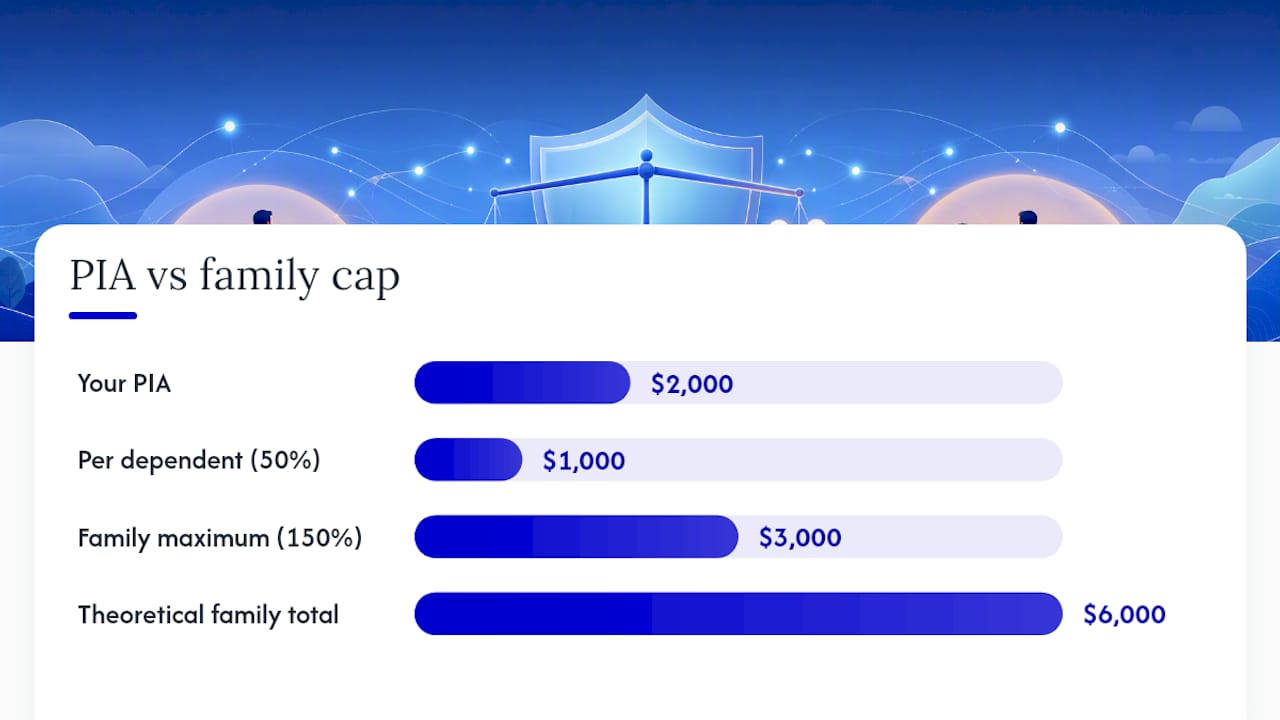
Every eligible dependent can receive up to 50% of your PIA, the base figure Social Security uses to calculate your own monthly check. That's the theoretical ceiling per person, not a guarantee.
The real number almost always comes in lower because of the family maximum, a household cap that keeps total payments (yours plus every dependent's) from ballooning past a set ceiling.
By the numbers: The family maximum for disability claims generally runs between roughly 100% and 150% of your PIA. Social Security's 2026 bend points for calculating that cap are set at $1,643, $2,371, and $3,093.
Here's what that looks like in practice, using AARP's plain-language walkthroughs as a guide:
- If your PIA is $2,000 and you have a spouse and two kids, each could theoretically claim $1,000 (50%).
- Add that up and the family total would hit $6,000, far past a family maximum near $3,000 (150% of PIA).
- Social Security doesn't reject the claims. It reduces each dependent's check proportionally until the household total fits under the cap.
Your own $2,000 SSDI payment never gets touched. The reductions land entirely on the dependent side. In some earnings histories with several dependents, that math can leave each person with a modest check instead of the full 50% they expected. For more on how this interacts with your base payment, see our breakdown of SSDI benefits.
How to Apply for Dependent Benefits (and Protect Back Pay)
Dependent claims are not something you can fully file online. Social Security requires a phone call or an in-person visit to a local field office for most auxiliary applications, since original or certified documents typically need to be reviewed in person.
Follow these steps once your own SSDI approval comes through:
- Call 800-772-1213 or schedule an appointment at your local Social Security office right away.
- Gather documents for each dependent: birth or adoption certificates, Social Security numbers, marriage or divorce certificates for spouses, school enrollment verification for teenagers, and medical records for a disabled adult child.
- File a separate application for each person. Approval of your own disability claim does not automatically add anyone to your record.
- Confirm the filing date on record for each dependent, since that date, not your own entitlement date, generally determines their back pay.
Pro Tip: File dependent applications the same week your SSDI approval letter arrives. Back pay for dependents is tied to their own filing date, and waiting even a few months can cost a child or spouse benefits they were entitled to receive.
Bring originals or certified copies whenever possible. Field offices routinely bounce back photocopies and uncertified scans, which adds weeks to processing. If you're still assembling paperwork on the disability side, our case development guide covers what to have ready before you walk in.
When Dependent Payments Stop or Change
Auxiliary benefits are not permanent for most recipients. Certain milestones cut them off automatically, and Social Security expects you to report changes as they happen.
- Children age out at 18, unless they're still enrolled in high school full time (extends to 19) or became disabled before age 22.
- Spouses generally lose benefits upon divorce (unless the 10-year rule applies) or remarriage, and the payment type shifts once the spouse reaches full retirement age on their own record.
- Disabled adult children keep benefits as long as the disabling condition continues and they remain unmarried, subject to periodic medical review.
Report these events to Social Security promptly: a child turning 18 and dropping out of school, a marriage or divorce, a dependent's death, or a disabled adult child's medical improvement. Waiting to report almost always creates an overpayment, and overpayments get clawed back from future checks.
Common SSA Mistakes and When to Call an Attorney
Family maximum math is where Social Security trips up most often. Families sometimes assume every dependent gets 50% of the PIA, file the paperwork, and then get confused when the actual check is a fraction of that. In other cases, a dependent is simply never filed for, because nobody realized the disability approval didn't automatically add them.
Watch for these red flags:
- A dependent check that's far smaller than 50% of PIA with no clear explanation.
- A dependent application that was denied without a written reason.
- Custody or divorce disputes complicating who counts as an eligible child.
Pro Tip: If your family maximum calculation looks wrong, request a written explanation of the computation from Social Security before you accept the amount. It's the only way to catch an error before back pay is finalized.
When a dependent claim gets denied or a family maximum calculation seems off, an experienced disability attorney can request the underlying computation and file an appeal. There are services that connect SSDI recipients with attorneys who handle exactly these disputes, sometimes at no cost to check whether your case needs a second look.
Where to Verify These Rules Yourself
Before filing, check Social Security's own family benefits page for the current eligibility list and required documents, and the family maximum formula and bend points for the exact figures behind your cap. Save or print both pages when preparing an application or appeal.
Why the Family Maximum Catches So Many Families Off Guard
The biggest misunderstanding in this whole system is treating "50% of PIA" as a promise instead of a ceiling. Most families read that figure, do the math for three or four dependents, and expect a number that the family maximum was never going to allow. That's not a rare edge case. It's the default outcome for any household with more than one or two dependents.
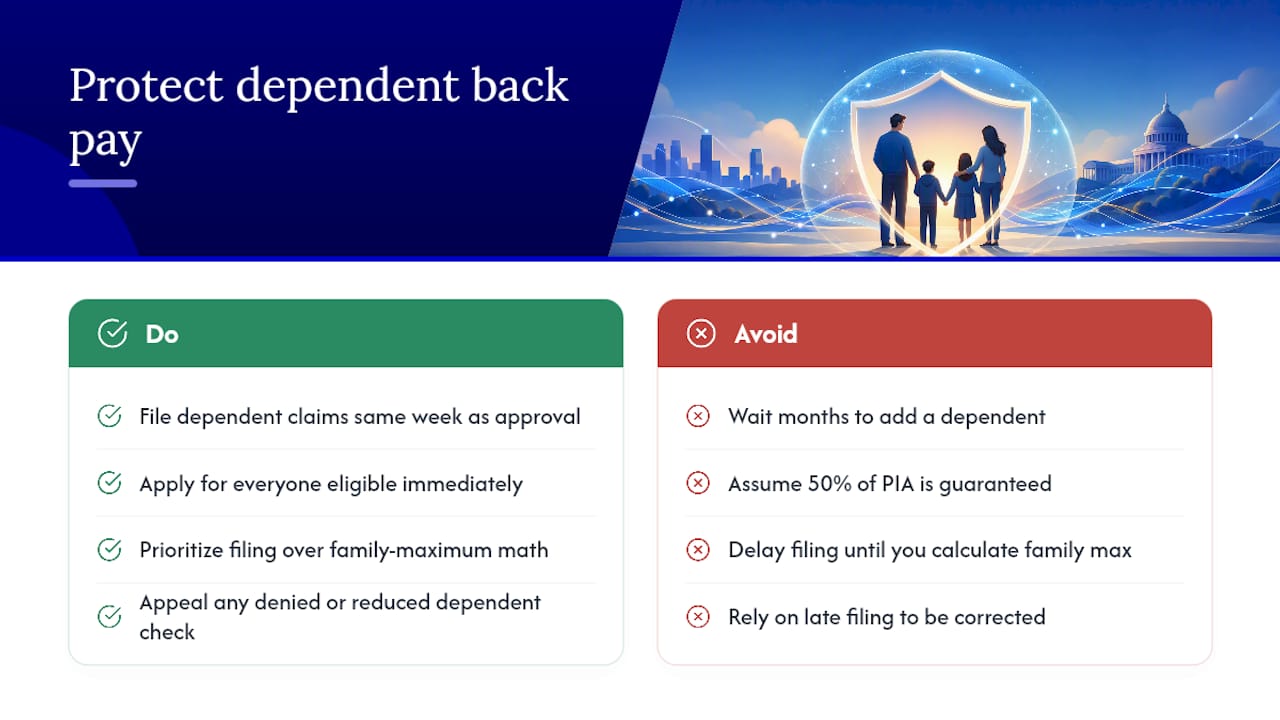
Conventional advice tells people to "just apply for everyone eligible," which is correct but incomplete. The part that gets skipped is the timing. Because dependent back pay tracks each person's own filing date, a family that waits three months to add a teenager after the disability approval has likely given up real money for good.
If you take one thing from this, prioritize filing dependent claims the same week your SSDI approval lands, then worry about the family maximum math after. A denied or reduced dependent check can be appealed. A late filing date usually cannot be undone.
— Gerard
This article is general information, not a substitute for advice from a qualified financial advisor. Consult a qualified financial professional about your own circumstances before acting on anything here.
Sources
- Social Security Bulletin: family and auxiliary benefits discussion
- AARP: What is the family maximum benefit payment for SSDI?