Getting married does not reduce or terminate SSDI benefits paid on your own work record. The Social Security Administration is direct on this point: your SSDI payment is tied to your earnings record and payroll-tax history, not your household income or your spouse's finances. That said, marriage can affect related programs and benefits, so knowing exactly which programs you receive matters.
The situations where marriage can change something include:
- SSI (Supplemental Security Income): Your spouse's income is counted toward your eligibility, which can reduce or end SSI payments.
- Spousal or auxiliary benefits: Your spouse may become eligible for benefits on your record.
- Survivor benefits: Remarriage rules can affect whether you keep survivor benefits from a deceased former spouse.
- Divorced-spouse benefits: Marriage ends eligibility for divorced-spouse benefits.
- Children's benefits: A new household arrangement can affect dependent benefit calculations.
Pro Tip: Confirm right now whether you receive SSDI, SSI, or both. The answer determines how much marriage actually affects your monthly payment. Call SSA at 1-800-772-1213 if you are unsure.
Table of Contents
- Why SSDI and SSI work differently — and why it matters
- When marriage can actually change your benefits
- What to do before and after you marry
- When does it make sense to contact a disability attorney?
- Key Takeaways
- The part most people get wrong about marriage and benefits
- Ssdilawyer can connect you with a disability attorney
- Useful sources and official SSA contacts
Why SSDI and SSI work differently — and why it matters
SSDI is an insurance program. You earn it by working and paying Social Security taxes over time. Your benefit amount, called the Primary Insurance Amount (PIA), is calculated from your lifetime earnings record. None of that changes when you marry. Your spouse's income is irrelevant to your SSDI payment because the program was never designed around household finances.
SSI operates on entirely different logic. It is a needs-based program funded by general tax revenue, not payroll taxes. SSA looks at your total household resources, including your spouse's income and assets, to decide whether you qualify and how much you receive. When you marry, your spouse's income is "deemed" to you, meaning SSA treats a portion of it as yours. That can reduce your SSI payment significantly or eliminate it.
"If you get Social Security disability or retirement benefits and you marry, your benefit will stay the same. However, other benefits such as SSI, Survivors, Divorced Spouses, and Child's benefits may be affected." — SSA FAQ: If I get married, will it affect my benefits?
Two common scenarios that illustrate the difference:
Scenario A: You receive SSDI only and marry someone with a high income. Your SSDI payment stays exactly the same. SSA does not ask about your spouse's salary. Your benefit next month will be identical to the month before the wedding.
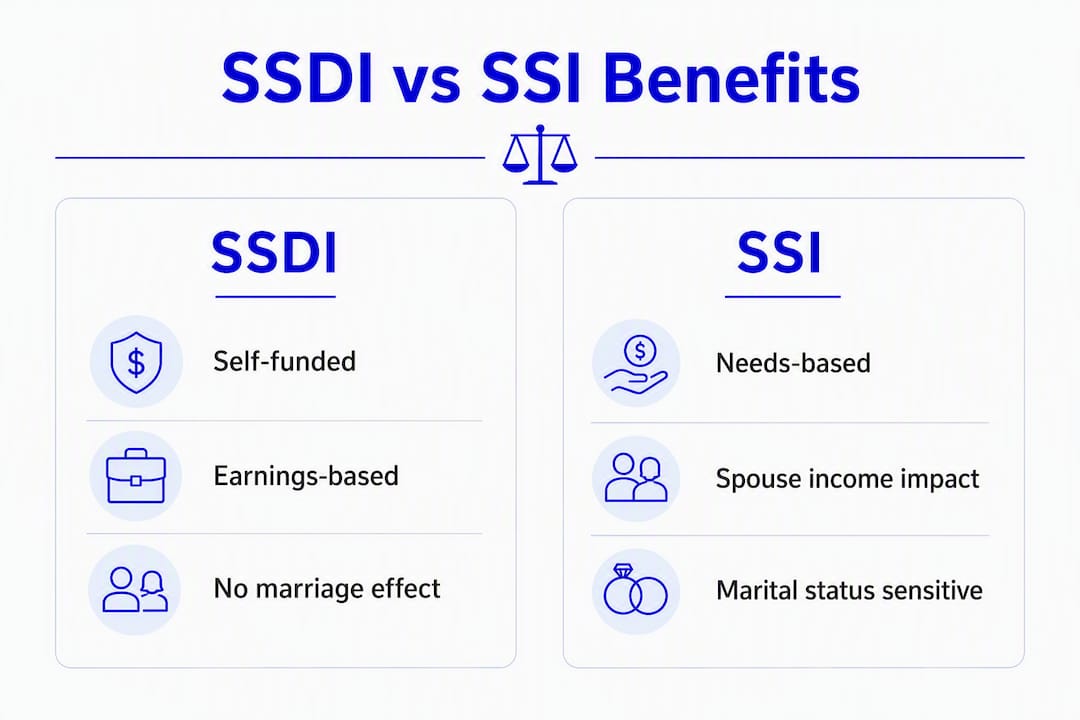
Scenario B: You receive SSI only and marry someone who works full time. SSA deems a portion of your spouse's income to you. Depending on how much your spouse earns, your SSI could drop to zero. This is the situation that requires planning before the wedding date.
For a deeper breakdown of how these two programs differ, SSDI vs. SSI explained covers the key distinctions in plain terms.
When marriage can actually change your benefits
Most SSDI recipients will see no change in their own payment. But several connected programs and benefit types do respond to marital status. Here is where to pay attention.

Concurrent SSDI and SSI
Some recipients qualify for both programs at the same time, called concurrent entitlement. SSDI pays first; SSI fills the gap if the SSDI amount falls below the federal SSI threshold. When you marry, the SSDI portion stays intact, but the SSI portion is subject to spousal income deeming. The practical result: your total monthly payment may drop even though your SSDI itself did not change.
Spousal and auxiliary benefits
Your new spouse may be eligible for benefits on your SSDI record. Spouses can receive up to 50% of your PIA if they are age 62 or older, or if they are caring for your child who is under 16 or receives Social Security disability benefits. Family maximum rules apply, meaning total household payments from your record cannot exceed a set ceiling. If you already have children receiving benefits on your record, adding a spousal benefit may reduce each individual payment due to the family maximum.
Survivor benefits
If you currently receive survivor benefits based on a deceased spouse's record, remarriage can end those payments. The general rule: survivor benefits stop if you remarry before age 60, or before age 50 if you are disabled. Remarrying at 60 or older typically does not affect survivor benefits.
Divorced-spouse benefits
If you receive divorced-spouse benefits on a former spouse's record, getting married ends that eligibility immediately.
"Survivor benefits can end if a surviving spouse remarries before certain ages — before age 60, or before age 50 if disabled." — Nolo: Does Getting Married Affect Your SSDI Disability Benefits?
Medicaid and Medicare coordination
SSDI recipients typically receive Medicare after a 24-month waiting period. Marriage itself does not affect Medicare eligibility tied to your own SSDI. SSI recipients, however, often receive Medicaid automatically. If marriage reduces or ends your SSI, Medicaid eligibility may also be affected, depending on your state's rules.
What to do before and after you marry
The steps below apply whether your wedding is three months away or already happened.
Before the wedding
After the wedding
Report the marriage to SSA promptly. SSA requires you to report changes in marital status by the 10th day of the month following the event. Late reporting can trigger overpayment notices or administrative reviews, even when your underlying SSDI amount is unchanged.
"Be sure to tell us about the change by the 10th of the month after the change occurs." — SSA: Communicate Changes to Your Personal Situation
Documents to have ready when you contact SSA:
- Marriage certificate
- Your spouse's full legal name and Social Security number
- Proof of current address
- Information about any children in the household who receive benefits
You can report by calling 1-800-772-1213, visiting your local SSA office, or using your My Social Security online account. If you need to apply for spousal benefits on your record, SSA Form SSA-2 covers the application process.
For a full preparation checklist before speaking with an attorney or SSA representative, the disability attorney consultation guide walks through exactly what to bring.
When does it make sense to contact a disability attorney?
For most SSDI-only recipients, marriage is a reporting task, not a legal crisis. An attorney becomes useful when the situation is more complicated.
Situations that warrant legal help:
- You receive concurrent SSDI and SSI and need to calculate the SSI impact of your spouse's income before marrying.
- SSA sends an overpayment notice after you report your marriage.
- You receive survivor or divorced-spouse benefits and are unsure whether remarriage ends them.
- SSA opens an investigation or requests documentation following a life-change report.
- Your spouse wants to claim spousal benefits on your record and the family maximum is already close to its limit.
- You are considering marriage and want a benefit-impact review before making a financial decision.
What an attorney typically does in these situations:
- Reviews your complete benefit record to identify all programs you receive.
- Estimates the effect of spousal income deeming on any SSI portion.
- Advises on auxiliary benefit eligibility and family maximum calculations.
- Negotiates overpayment amounts or repayment plans with SSA.
- Represents you at hearings if SSA takes adverse action.
When preparing for a first consultation, bring your award letters, recent SSA correspondence, your spouse's income documentation, and a list of all programs you currently receive. The 9 signs you need a disability attorney article covers additional triggers that indicate legal help is warranted.
Key Takeaways
Marriage does not reduce SSDI benefits paid on your own earnings record, but it can affect SSI, survivor benefits, and auxiliary payments, so confirming your program type and reporting promptly are the two most important steps.
| Point | Details |
|---|---|
| SSDI stays the same | Your SSDI payment is based on your earnings record; marriage does not reduce it. |
| SSI can change | Spouse income is deemed to SSI recipients, which can reduce or eliminate that payment. |
| Report by the 10th | SSA requires you to report marriage by the 10th day of the following month to avoid overpayment issues. |
| Spousal benefits possible | Your spouse may qualify for up to 50% of your PIA if age-eligible or caring for a qualifying child. |
| Ssdilawyer connects you | If your situation involves SSI, concurrent benefits, or overpayments, Ssdilawyer matches you with a disability attorney who can review your case. |
The part most people get wrong about marriage and benefits
Many people approaching marriage while on disability benefits assume the worst: that a spouse's income will wipe out everything they worked to qualify for. That fear is understandable, but it is usually misplaced, and it is almost always rooted in confusing SSDI with SSI.
SSDI is not welfare. It is an insurance benefit you earned through years of work and payroll-tax contributions. No one can take that away by marrying you. The confusion persists because SSI operates so differently, and because SSA administers both programs, people assume the same rules apply to both. They do not.
The practical reassurance here is straightforward: verify your program type, report the marriage on time, and get a benefit-impact estimate if you receive SSI or concurrent benefits. Those three steps cover the vast majority of situations. The emotional weight of a major life change can make this feel more complicated than it is. It usually is not, provided you act on the right information.
Ssdilawyer can connect you with a disability attorney
If your situation involves SSI, concurrent benefits, an overpayment notice, or survivor benefit questions after marriage, getting a qualified disability attorney to review your records is the most direct path to a clear answer.
Ssdilawyer matches individuals with experienced disability attorneys who handle exactly these situations. The matching service is free to you. Attorneys in the network can review your full benefit record, estimate the impact of spousal income on any SSI portion, address overpayment claims, and represent you at SSA hearings if needed.
To get started, submit your information through the Ssdilawyer intake form. Bring your award letters, recent SSA correspondence, and your spouse's income information to the first consultation so the attorney can give you a specific, accurate assessment from the start.
This article provides general information about Social Security programs, not legal advice. Benefit rules can change, and individual circumstances vary. Confirm current rules with SSA directly or consult a qualified disability attorney.
Useful sources and official SSA contacts
Official SSA pages:
- If I get married, will it affect my benefits? — SSA FAQ
- Communicate changes to your personal situation — SSA
- Benefits for Spouses — SSA
- Do You Qualify for Social Security Spouse's Benefits? — SSA Blog
- SSI Resources — SSA
Additional reading:
- Does Getting Married Affect Your SSDI Disability Benefits? — Nolo
- I Get SSDI. Is My Spouse Eligible for Benefits? — AARP
SSA contact: Call 1-800-772-1213 (TTY: 1-800-325-0778), Monday through Friday, 8:00 AM to 7:00 PM. You can also visit your local SSA office without an appointment, though scheduling one in advance reduces wait time.