
Social Security Disability Insurance (SSDI) protects your retirement savings by paying 100% of your full retirement age (FRA) benefit from day one of eligibility, shielding you from the permanent reductions that early retirement triggers. This distinction matters enormously for anyone aged 55–65 who has spent decades building a retirement nest egg. The Social Security Administration (SSA) treats SSDI as an earned insurance benefit, not a means-tested program, so your savings accounts, 401(k)s, and investment portfolios have no bearing on eligibility. Understanding why SSDI protects retirement savings is the first step toward making a financially sound decision when disability strikes before your planned retirement date.
Why SSDI protects retirement savings through its benefit calculation
SSDI benefits are calculated as if you had already reached full retirement age, regardless of how old you are when disability begins. That single design feature is the core reason SSDI safeguards savings: you receive the highest possible Social Security benefit amount without waiting until 67.
Early retirement at age 62 permanently reduces monthly benefits by up to 30% for workers whose FRA is 67. That reduction never reverses. A worker entitled to $2,000 per month at FRA would receive only $1,400 per month for the rest of their life if they claimed at 62.
SSDI eliminates that penalty entirely. The SSA calculates your Primary Insurance Amount (PIA) using your full earnings record, then pays that amount from the date you qualify. For those born in 1960 or later, FRA is 67, and SSDI pays the FRA benefit from the start, not a reduced early-retirement figure.

What the numbers look like in practice
Consider a 58-year-old with a projected FRA benefit of $2,200 per month. On SSDI, that person receives $2,200 per month immediately upon approval. If the same person claimed early retirement at 62 instead, the monthly check would drop to roughly $1,540. Over ten years, the SSDI path generates approximately $79,200 more in cumulative income. That gap directly reduces the pressure to draw down retirement savings prematurely.
- SSDI pays 100% of the FRA benefit from approval date
- Early retirement at 62 cuts benefits by up to 30% permanently
- FRA for workers born in 1960 or later is age 67
- SSDI benefit amount carries forward unchanged when it converts to retirement benefits at FRA
Pro Tip: Request your Social Security Statement at ssa.gov before making any benefit decision. The statement shows your projected FRA benefit and your estimated SSDI benefit side by side, making the financial comparison concrete.
Does SSDI affect retirement plans through asset or savings limits?
SSDI imposes no asset or savings limits whatsoever. Your bank balances, retirement accounts, and investment portfolios are completely invisible to the SSA when it evaluates SSDI eligibility or calculates your monthly benefit.
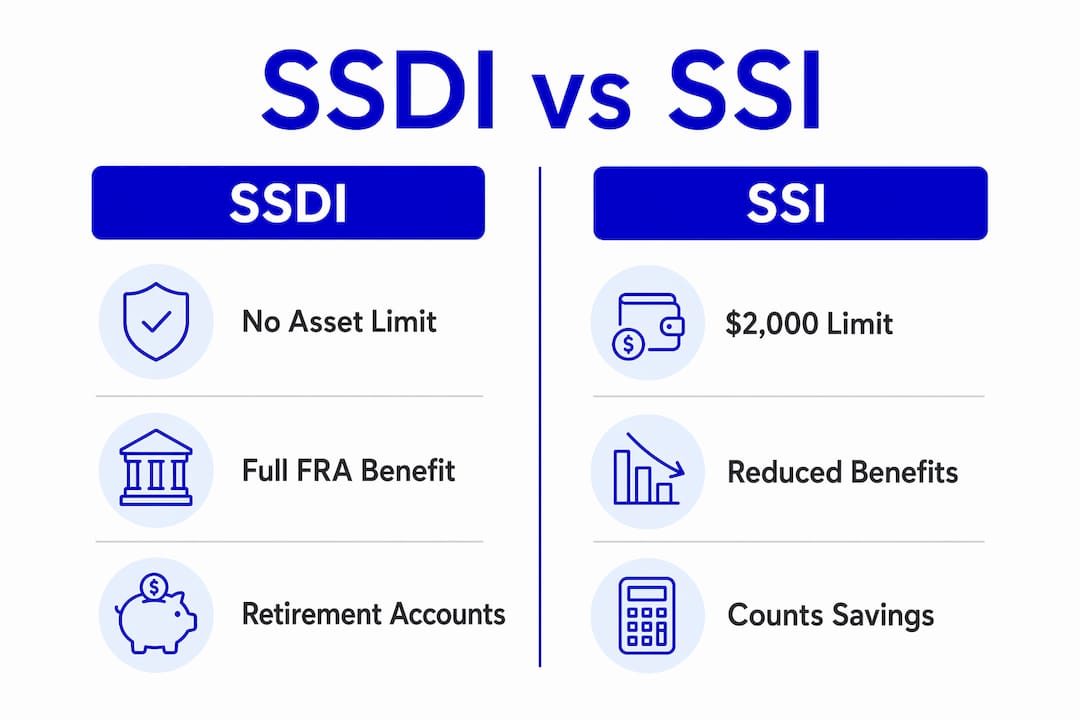
SSDI ignores bank balances and retirement savings when determining eligibility. This stands in sharp contrast to Supplemental Security Income (SSI), which caps countable assets at $2,000 for an individual. Many people confuse the two programs and unnecessarily fear that their 401(k) or IRA will disqualify them from benefits.
The only income test that matters for SSDI is the Substantial Gainful Activity (SGA) threshold. The 2026 SGA limit for non-blind recipients is $1,690 per month in earned income. Passive income, including dividends, interest, rental income, and pension distributions, does not count toward SGA and does not reduce your SSDI benefit.
SSDI vs. SSI: the key differences for savers
| Feature | SSDI | SSI |
|---|---|---|
| Asset limit | None | $2,000 individual |
| Retirement accounts counted | No | Yes, in most cases |
| Passive income counted | No | Yes |
| Earned income limit (2026) | $1,690/month SGA | $65/month earned income exclusion |
| Based on work history | Yes | No |
The table above shows why SSDI and retirement funds coexist without conflict. You can hold a fully funded 401(k), a brokerage account, and a savings account with no ceiling and still qualify for SSDI based solely on your medical condition and work history.
Pro Tip: If you receive pension income or required minimum distributions from a retirement account, those payments will not reduce your SSDI check. Document them separately from any part-time earned income to avoid confusion during SSA reviews.
How does SSDI convert to retirement benefits at full retirement age?
At FRA, SSDI converts automatically to retirement benefits through an administrative process that requires no paperwork from you. The SSA handles the switch internally, and your monthly check stays exactly the same.
The conversion is automatic and administrative, with no application required and no change in benefit amount. For most people currently aged 55–65, FRA is 67, meaning the conversion happens when they turn 67.
Medicare coverage continues without interruption after the switch. Medicare does not reset or impose a new waiting period when SSDI converts to retirement benefits. This matters because Medicare coverage begins 24 months after SSDI eligibility starts, and that coverage carries forward seamlessly into retirement.
Continuing Disability Reviews (CDRs), which the SSA uses to verify ongoing eligibility, stop after conversion. Once you reach FRA and your benefits convert, the SSA no longer questions whether you remain disabled.
- Conversion happens automatically at FRA (age 67 for most current 55–65-year-olds)
- Benefit amount stays identical before and after conversion
- Medicare coverage continues without gaps or new waiting periods
- Continuing Disability Reviews cease at FRA
- No forms, no applications, no action required from you
This mechanism means SSDI functions as a bridge that carries your full retirement benefit amount from the point of disability all the way to and through your official retirement years.
Why choosing SSDI over early retirement safeguards long-term savings
Filing for early retirement before pursuing SSDI is one of the most costly financial mistakes a disabled worker aged 55–65 can make. The consequences extend beyond a reduced monthly check.
- Permanent benefit reduction. Early retirement at 62 cuts your monthly benefit by up to 30% for life. SSDI preserves the full FRA amount, protecting your long-term income floor.
- Back pay offset. Filing early retirement first offsets later SSDI benefits by amounts already received. If you eventually win an SSDI claim, the SSA deducts the early retirement payments from your back pay, reducing your financial recovery.
- Reduced pressure on savings. A higher monthly SSDI benefit means you draw down your 401(k) or IRA more slowly. Preserving those balances allows continued tax-deferred growth.
- Lifetime income gap. The difference between an SSDI benefit and an early retirement benefit compounds over years. A $600 monthly gap adds up to $7,200 per year and $72,000 over a decade, before accounting for investment growth on preserved savings.
- Eligibility window. Workers aged 55–65 fall within the SSA's "older worker" grid rules, which make SSDI approval more accessible. Taking early retirement before applying can complicate the claim timeline and reduce back pay.
Pursuing SSDI rather than early retirement acts as income protection that preserves long-term retirement benefits from early claiming penalties. The financial case for prioritizing SSDI is clear for anyone who qualifies medically and has the work history to support a claim. Ssdilawyer connects disabled workers with attorneys who understand these timing decisions and can help you avoid costly mistakes.
Key Takeaways
SSDI protects retirement savings by paying 100% of the full retirement age benefit, imposing no asset limits, and converting automatically at FRA without reducing your monthly check or Medicare coverage.
| Point | Details |
|---|---|
| Full FRA benefit from day one | SSDI pays the complete FRA benefit immediately, avoiding the 30% cut tied to early retirement at 62. |
| No asset or savings limits | Retirement accounts, 401(k)s, and bank balances do not affect SSDI eligibility or benefit amounts. |
| Passive income is exempt | Dividends, pensions, and rental income do not count toward the 2026 SGA limit of $1,690/month. |
| Automatic FRA conversion | SSDI converts to retirement benefits at age 67 with no paperwork and no change in monthly payment. |
| Early retirement filing risks | Filing for early retirement before SSDI approval reduces back pay and locks in a permanently lower benefit. |
What I've learned about SSDI and retirement planning after years in this field
The most persistent misconception I encounter is that SSDI and retirement savings are somehow in conflict. People aged 55–65 often assume that having a funded 401(k) disqualifies them, or that accepting SSDI means giving up their retirement plans. Neither is true, and that confusion costs people real money.
What I find most underappreciated is the Medicare angle. Workers who qualify for SSDI gain Medicare coverage 24 months after eligibility begins. That coverage then continues uninterrupted through the FRA conversion and into retirement. For someone aged 60 who qualifies for SSDI, that means Medicare coverage starting at 62, five years before the standard Medicare eligibility age of 65. The savings on private insurance premiums alone can be substantial.
The timing question is where I see the most preventable damage. Someone who files for early retirement at 62 because they feel they have no other option, and then wins an SSDI claim two years later, has permanently locked in a reduced benefit and lost a portion of their back pay. The SSDI older worker rules make approval more realistic for people in the 55–65 range than many realize. Filing SSDI first, before touching early retirement, is almost always the right sequence.
My practical advice: treat SSDI as a financial planning tool, not just a safety net. It preserves your retirement income floor, protects your savings from premature drawdown, and carries Medicare coverage forward. Those three outcomes together represent a significant financial advantage that most people in this age group have not fully calculated.
— Gerard
Legal guidance for protecting your retirement benefits
Navigating the SSDI process while protecting your retirement savings requires precise timing and a clear understanding of SSA rules. A single misstep, like filing for early retirement before an SSDI decision, can permanently reduce your monthly income.
Ssdilawyer connects you with experienced disability attorneys who understand the financial stakes for workers aged 55–65. From initial SSDI applications to appeals and hearings, the attorneys in the Ssdilawyer network help you pursue the full benefit amount you earned. If you have already been denied or are weighing your options between SSDI and early retirement, qualified legal guidance can make a measurable difference in your long-term financial outcome.
FAQ
Does SSDI affect my 401(k) or retirement savings?
SSDI does not count retirement accounts, bank balances, or investments when determining eligibility or benefit amounts. Your savings are fully protected under SSDI rules.
What happens to SSDI benefits when I reach full retirement age?
SSDI converts automatically to retirement benefits at FRA (age 67 for those born in 1960 or later) with no paperwork required and no change in your monthly payment amount.
Can I receive SSDI and still have passive income?
Passive income such as dividends, interest, and pension distributions does not affect SSDI benefits. Only earned income above the 2026 SGA limit of $1,690 per month can impact eligibility.
Is it better to file for early retirement or SSDI if I become disabled at 62?
Filing for SSDI is almost always the better financial choice. Early retirement permanently reduces your benefit by up to 30%, while SSDI pays the full FRA amount and avoids reducing your back pay if approved.
Does SSDI protect Medicare coverage through retirement?
Medicare coverage that begins during SSDI eligibility continues without interruption after the automatic conversion to retirement benefits at FRA, with no new waiting period required.