
SSDI converting to retirement benefits is defined as the automatic process by which the Social Security Administration (SSA) reclassifies your disability payments as Social Security retirement benefits the moment you reach Full Retirement Age (FRA). Your monthly check stays the same. You do not apply, call, or file any paperwork. For recipients aged 55–65 approaching this milestone, understanding the mechanics of this transition removes uncertainty and opens real financial planning opportunities that most people overlook.
When and how does SSDI convert to retirement benefits?
The conversion happens automatically on the first day of the month you reach your FRA. The SSA handles the reclassification internally, and benefits convert automatically with no action required from you. Your payment amount stays exactly the same.
FRA depends on your birth year. If you were born in 1960 or later, your FRA is 67. If you were born in 1958 or 1959, your FRA falls between 66 years and 8 months and 66 years and 10 months. The SSA applies these thresholds precisely, so knowing your exact FRA date matters.

One detail most recipients miss: delayed retirement credits do not apply after conversion. Voluntary retirement claimants can boost their benefit by waiting past FRA, but SSDI recipients cannot. The benefit amount is locked at the FRA level because you have already been receiving payments before that age.
The SSA intentionally keeps this transition invisible. Most SSDI recipients notice no interruption or difference after conversion because the administration designs the process to be smooth and the check to remain the same.
Pro Tip: Log into your My Social Security account at ssa.gov in the month after your FRA birthday. Confirm the benefit type now reads "retirement" rather than "disability." Errors are rare, but catching one early prevents payment delays.
What changes and what stays the same after conversion?
The benefit amount does not change. That is the most important fact for recipients to understand. What does change is the legal classification of your payment and several rules attached to it.
Continuing Disability Reviews (CDRs) stop completely at FRA. The SSA no longer evaluates your medical condition because your benefit is now based on age, not disability status. CDRs cease at FRA because the classification shifts from a medical determination to an age-based entitlement. That means no more periodic medical reviews, no more documentation requests, and no more risk of losing benefits due to a medical reassessment.
Medicare coverage continues without interruption. SSDI recipients qualify for Medicare after 24 months of receiving disability benefits, and that coverage carries over seamlessly into retirement status. Your Part A and Part B premiums and coverage remain identical before and after conversion.
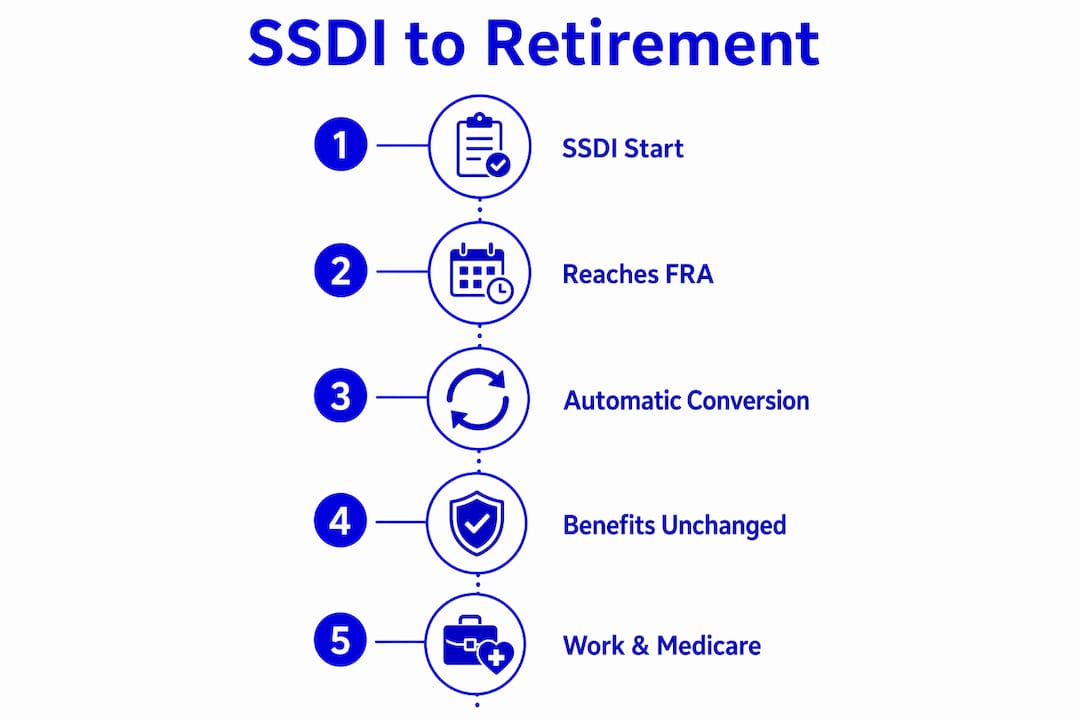
The earnings test also disappears at FRA. Before conversion, earning above the Substantial Gainful Activity (SGA) threshold could reduce or suspend your SSDI. After conversion, no earnings test applies.
| Feature | Before conversion (SSDI) | After conversion (retirement) |
|---|---|---|
| Benefit amount | Based on Primary Insurance Amount | Same amount, no change |
| Continuing Disability Reviews | Required periodically | Eliminated |
| SGA earnings limit | $1,690/month in 2026 | No limit |
| Medicare coverage | Continues after 24-month wait | Continues uninterrupted |
| Delayed retirement credits | Not applicable | Not applicable |
| Earnings test | Applies | Does not apply |
How does conversion affect your work and income options?
Before FRA, the SGA threshold controls how much you can earn while receiving SSDI. The 2026 SGA limit is $1,690 per month. Earning above that amount while still classified as disabled can trigger a suspension or termination of benefits. It can also create overpayment liability, which the SSA will pursue to recover.
After conversion at FRA, that limit disappears entirely. You can work full time, part time, or take on consulting work without any reduction in your monthly benefit. The Trial Work Period, which previously tracked months of substantial earnings, also ends at conversion because it only applies to disability recipients.
This creates a genuine planning opportunity. Recipients who want to return to work should consider timing that return to coincide with or follow their FRA. Returning to work before FRA while still on SSDI carries real risks of overpayments and benefit loss. Waiting until after conversion removes those risks entirely.
Key facts about work options after conversion:
- No SGA threshold applies after FRA conversion.
- Earnings from work do not reduce your monthly retirement benefit.
- The Trial Work Period tracking ends permanently.
- Self-employment income is also unrestricted after conversion.
- Social Security taxes on new earnings may increase your future benefit slightly through recalculation.
Pro Tip: If you plan to return to work, wait until the month after your FRA birthday to start. That one-month buffer confirms your conversion is complete and eliminates any risk of your earnings being evaluated under SSDI rules.
What should you do to prepare for the transition?
Preparation requires a few concrete steps, not a complicated process. The conversion is automatic, but verifying it and coordinating related decisions protects your household finances.
-
Check your SSA account after FRA. Log into My Social Security at ssa.gov in the month following your FRA birthday. Verify the conversion status by confirming your benefit type shows as retirement. Errors are infrequent but correcting one quickly prevents administrative delays.
-
Review SSA correspondence. The SSA typically sends a letter notifying you of the conversion. Keep that letter. It serves as documentation if questions arise later about your benefit classification.
-
Coordinate spousal and dependent benefits. Conversion can affect family members receiving benefits on your record. Spouses and dependents may see changes in their benefit amounts because the family maximum formula recalculates after conversion.
-
Avoid filing for early retirement. If you are already receiving SSDI, do not file a separate early retirement claim before FRA. Doing so could reduce your benefit permanently. The automatic conversion preserves your full Primary Insurance Amount.
-
Consult a legal or financial professional if your situation is complex. Households with multiple earners, spousal benefits, or dependent children on the record benefit from professional review before and after conversion. An attorney familiar with SSDI case strategy can identify issues before they become problems.
What are the lesser-known facts about SSDI retirement conversion?
Several details about this transition rarely appear in general financial advice, yet they carry real dollar value for recipients.
The family maximum benefit recalculates after conversion, and the result often favors the household. Retirement family maximums typically range from 150% to 188% of the Primary Insurance Amount, depending on bend points. SSDI family maximums are generally lower. That means spouses and dependents receiving auxiliary benefits on your record may see their payments increase after your conversion.
SSDI essentially functions as an early payment of full retirement benefits. The SSA calculates SSDI at the Primary Insurance Amount specifically to avoid penalizing recipients who became disabled before FRA. That design is intentional and protects your full benefit level.
Additional nuances worth knowing:
- You cannot voluntarily delay your SSDI conversion the way voluntary retirement claimants can delay filing to earn delayed credits.
- Medicare Part B premiums are income-tested through IRMAA surcharges, which may change if your income increases after you return to work post-conversion.
- Spousal benefits tied to your record may grow after conversion due to the more generous family maximum formula.
- Conversion errors, while rare, do occur. Monitoring your SSA account is the fastest way to catch and correct them.
Key Takeaways
SSDI converting to retirement benefits is automatic at Full Retirement Age, preserves your benefit amount, and removes earnings limits and medical review requirements permanently.
| Point | Details |
|---|---|
| Automatic conversion at FRA | The SSA reclassifies your benefit with no application or action required from you. |
| Benefit amount unchanged | Your monthly payment stays at the same Primary Insurance Amount before and after conversion. |
| CDRs and SGA limits end | Medical reviews and the $1,690/month earnings cap both disappear at FRA conversion. |
| Medicare continues uninterrupted | Part A and Part B coverage carry over with no gap or change in premiums. |
| Family maximum may increase | The retirement family maximum formula is more generous, potentially raising auxiliary benefits for your household. |
What I've learned from watching recipients approach this milestone
Most of the anxiety I see around this transition is unnecessary. Recipients spend months worrying about paperwork that does not exist and phone calls they do not need to make. The SSA designed this conversion to be invisible, and for the vast majority of recipients, it is.
What I find more useful to focus on is the month of conversion as a financial planning checkpoint. That is the moment when earnings restrictions lift, CDRs end, and the family maximum recalculates. Treating it as a passive event means missing real opportunities. Treating it as a planning trigger means you can time a return to work, review spousal benefit amounts, and confirm your Medicare coverage in one coordinated review.
The one area where I consistently see recipients make costly mistakes is returning to work too early. Earning above the SGA threshold while still classified as disabled creates overpayment liability that the SSA will pursue. Waiting until after FRA conversion costs nothing and eliminates that risk entirely. If your situation involves SSDI overpayment disputes or complex household benefit structures, professional guidance before conversion is worth the time.
The conversion is not a disruption. It is a reclassification that comes with fewer restrictions and more financial flexibility. Plan for it accordingly.
— Gerard
Legal support for your SSDI and retirement benefits questions
Approaching your FRA conversion with questions about your specific benefit amount, spousal coordination, or work plans is common. The rules are straightforward in general but can get complicated quickly when household finances, dependent benefits, or past work history are involved.
Ssdilawyer connects SSDI recipients with experienced disability attorneys who understand both the disability and retirement sides of Social Security law. Whether you need clarity on how conversion affects your household or want a professional review of your benefit record before FRA, qualified legal help is available. Ssdilawyer works with attorneys who handle SSDI matters at every stage, including the transition to retirement benefits.
FAQ
Does SSDI automatically convert to retirement benefits?
Yes. The SSA converts SSDI to Social Security retirement benefits automatically at your Full Retirement Age with no application required and no change in your monthly payment amount.
Will my benefit amount decrease after conversion?
No. Your benefit stays at the same Primary Insurance Amount. Delayed retirement credits do not apply, but your payment does not decrease either.
Does Medicare continue after SSDI converts to retirement?
Yes. Medicare Part A and Part B coverage continues without interruption after conversion, with the same premiums and coverage as before.
Can I work after my SSDI converts to retirement benefits?
Yes. After conversion at FRA, the SGA limit of $1,690 per month no longer applies. You can earn any amount from work without reducing your monthly benefit.
What is Full Retirement Age for SSDI recipients born in 1960 or later?
FRA is 67 for anyone born in 1960 or later. For those born in 1958 or 1959, FRA falls between 66 years and 8 months and 66 years and 10 months.