
What is the SSDI claimant file?
The SSDI claimant file is the official SSA case record for an individual's Social Security Disability Insurance claim. It consolidates every document, determination, and piece of evidence relevant to that claim in one place. The file exists in two formats: the Certified Electronic Folder (CEF) and the paper Modular Disability Folder (MDF). Every claimant has one, and its contents directly determine whether benefits are approved, denied, or modified.
The file is not a passive archive. SSA adjudicators, Disability Determination Services (DDS) staff, and hearing officers all rely on it at each stage of the SSDI claim process. Understanding what it contains and how it moves through SSA offices gives claimants a concrete advantage.
- The CEF is the current standard for most claims processed electronically.
- The MDF is the paper equivalent, used when electronic processing is not available.
- Both formats contain the same six organizational sections.
- The file serves as the authoritative record for all eligibility and benefits determinations.
What documents does your claimant file contain?
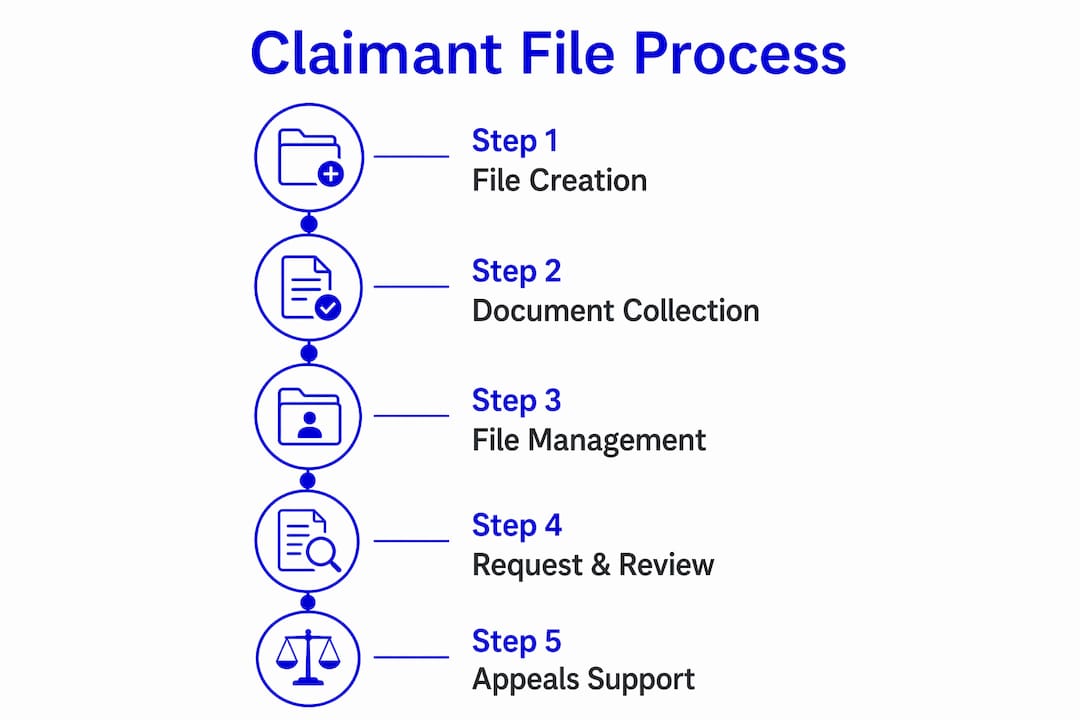
The claimant file holds far more than medical records. Per SSA's POMS DI 81001.005, the file includes applications, notices, personal statements, reports of contact, and all SSA determinations made throughout the life of the claim.
For CEF cases, documentation is tracked through SSA systems including the Electronic Disability Collect System (EDCS) and the Modernized Claims System (MCS). The file is organized into six sections regardless of whether it is electronic or paper, covering everything from initial applications to final adjudicator remarks.
- Applications and related intake forms
- Medical evidence of record (MER) and consultative examination reports
- Personal statements (SSA-795 and similar forms)
- Reports of contact and adjudicator remarks
- SSA notices and formal determinations
- Electronic collection forms submitted through EDCS
Which SSA office manages your file, and why does it matter?
File custody shifts as your claim moves through the SSA disability process. The Field Office (FO) handles initial nonmedical eligibility processing and establishes the file. Once nonmedical requirements are verified, the FO sends the case to the DDS for medical evaluation, and custody transfers accordingly.
Knowing which office holds your file at any given moment determines where you should send additional evidence or direct inquiries. Sending records to the wrong office causes delays.
- The FO verifies age, employment, marital status, and Social Security coverage.
- The DDS develops medical evidence and makes the initial disability determination.
- After an unfavorable decision, the file stays at the FO to support any appeal.
- Multiple offices, including the Office of Hearings Operations (OHO), may hold portions of the case at different stages.
- Coordination among the FO, DDS, and OHO is required to produce the complete, current file version.
How to request a copy of your claimant file
Claimants and their appointed representatives have the right to request a copy of the official file. Per POMS DI 81001.030, one free copy is available for program purposes. Additional copies or requests for non-program use may carry fees, and certified copies must be routed through the National Records Center.
Format matters: CEF cases are copied to CD, while MDF cases produce paper copies. The CEF does not automatically contain every document in the official folder, so a complete copy requires comprehensive inclusion of all case documents.
- Submit your request to the FO of jurisdiction for the full file.
- For certified copies without a subpoena, route the request to the National Records Center.
- Requests involving a subpoena or court order go to the LP PFDLaw Regional Disclosure office.
- If the DDS holds current jurisdiction, it can provide medical evidence copies faster than the full file process.
- CEF copies are provided on CD; MDF copies are paper.
Pro Tip: If you only need medical records and the DDS currently has jurisdiction, request just the medical evidence portion. That targeted request moves faster than asking for the entire official folder.

How the claimant file supports SSDI appeals and hearings
The claimant file is the evidentiary foundation for every level of the SSDI appeals process. Hearing officers and administrative law judges base their decisions on what the file contains. If evidence is missing or misfiled, the outcome can be affected directly.
The file remains accessible throughout appeals as a living record. Attorneys and representatives use it to build legal arguments, identify gaps, and challenge unfavorable determinations. An incomplete file is one of the most common obstacles claimants face at the hearing stage.
- The file must be complete and official for formal legal proceedings.
- Hearing officers rely on the file's six sections to evaluate all evidence.
- Missing consultative exam reports or medical records can weaken an appeal.
- Representatives should verify the file is current before any scheduled hearing.
- SSDI case development practices directly affect what ends up in the file before a hearing.
Expert guidance on managing your claimant file effectively
Jurisdictional awareness is the most practical skill a claimant can develop. Knowing which office controls your file at each phase tells you exactly where to send evidence and whom to contact. Sending records to an office that no longer has jurisdiction wastes time and risks missing deadlines.
Claimants should verify they have received the complete, current version of their file whenever it transitions between SSA offices. Gaps appear most often during transfers from DDS back to the FO after an unfavorable decision. A disability attorney who understands file procedures can catch these gaps before they become problems at a hearing.
- Confirm the file version you receive matches the current stage of your claim.
- Check that all six file sections are present and complete.
- Address document errors or omissions in writing, directed to the office with current jurisdiction.
- For psychiatric or complex medical evidence, a psychiatric record review can identify gaps before submission.
- Track all submission dates and confirmation receipts for documents you send to SSA.
Key takeaways for using your claimant file
Your SSDI claimant file is the official SSA record that controls every stage of your claim, from initial determination through final appeal.
- The file is the SSA's authoritative case record, existing as a CEF or MDF.
- It contains applications, medical evidence, personal statements, and all SSA determinations.
- File custody moves from the FO to DDS and potentially to OHO as the claim progresses.
- One free copy is available for program purposes; certified or additional copies may involve fees.
- Completeness of the file directly affects appeal outcomes.
How often does your claimant file get updated?
The claimant file is updated continuously throughout the SSDI claim process, not on a fixed schedule. Each time SSA receives new evidence, issues a notice, or makes a determination, that document is added to the file. During active development at the DDS, updates can occur frequently as medical records arrive and consultative exams are completed.
After a determination, updates slow unless the claimant files an appeal or submits new evidence. At the hearing stage, the file is updated again as the OHO adds correspondence, hearing notices, and the administrative law judge's decision. Claimants who submit evidence late in the process should confirm it was received and incorporated before any scheduled proceeding.
Privacy and security protections for your claimant file
The SSDI claimant file is protected under the Privacy Act of 1974, which restricts SSA from disclosing its contents without the claimant's written consent or a legal order. Access is limited to SSA staff with a need to know, authorized representatives, and parties with a valid subpoena or court order.
Electronic files stored in the CEF system follow federal information security standards. Paper MDF files are maintained in secured SSA facilities. Claimants have the right to review their file and request corrections to inaccurate information through formal SSA procedures. Any request for a certified copy without a court order must go through the National Records Center, which adds a procedural layer of verification before release.
How your claimant file affects the timeline for SSDI decisions
A complete, well-organized claimant file shortens decision timelines. When DDS receives a file with thorough medical evidence already in place, adjudicators spend less time chasing records and more time evaluating the claim. Gaps in the file, by contrast, trigger development requests that add weeks or months to the process.
At the hearing level, an incomplete file can force postponements while missing evidence is gathered. Claimants who work with an attorney to manage file completeness from the start tend to move through the process with fewer delays. The statutory five-month waiting period for SSDI benefits means every avoidable delay has a direct financial cost.
Key Takeaways
Your SSDI claimant file is the official SSA case record, and its completeness determines the outcome of your claim at every stage.
| Point | Details |
|---|---|
| File formats | The claimant file exists as a Certified Electronic Folder (CEF) or paper Modular Disability Folder (MDF). |
| File contents | It includes applications, medical records, personal statements, consultative exam reports, and all SSA determinations. |
| Custody and jurisdiction | File custody moves from the Field Office to DDS and then OHO; knowing who holds it guides where to send evidence. |
| Requesting a copy | One free copy is available for program purposes; certified copies require routing through the National Records Center. |
| Appeals impact | A complete file is the foundation of any successful appeal; missing evidence directly weakens the legal record. |
Navigating your claimant file is technical work. Ssdilawyer connects claimants with experienced disability attorneys who understand SSA file procedures, jurisdictional rules, and appeals strategy. If your claim has been denied or you need help managing your file, get legal help from an attorney who handles these cases every day.