
A disability attorney's role in an appeal is to manage your case from the moment of denial, file paperwork on time, gather medical evidence, and represent you at every stage until you get a decision. The Social Security Administration (SSA) denies the majority of initial applications, which means the appeal process is where most claims are actually won or lost. Represented claimants win hearings approximately 60% of the time, compared to about 30% for those without legal help. That gap is not accidental. It reflects what a skilled disability appeal lawyer does behind the scenes at every stage of the process.
What does a disability attorney do during reconsideration?
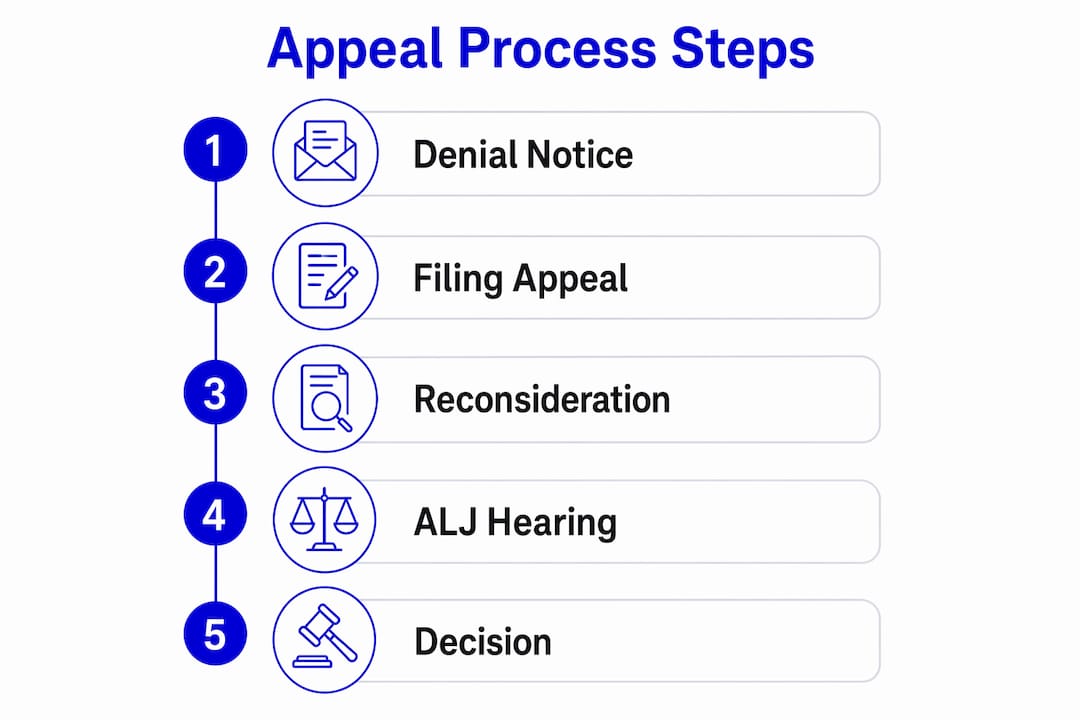
The role of a disability attorney appeal begins the moment you receive your denial letter. The SSA gives claimants 60 days plus 5 mailing days to file an appeal after a denial. Missing that window almost always ends the claim unless you can prove good cause for the delay. An attorney tracks this deadline and files the Request for Reconsideration before time runs out.
Reconsideration is the first formal appeal stage, and the approval rate is low. Reconsideration approvals sit between 15% and 16%. That number tells you reconsideration is rarely where cases are won, but it is a required step before you can request a hearing before an Administrative Law Judge (ALJ).
At this stage, a disability attorney does several things that a claimant filing alone typically misses:
- Reviews the original denial letter to identify the exact reasons SSA rejected the claim
- Contacts treating physicians to obtain updated medical records and functional assessments
- Corrects errors or gaps in the original application forms
- Communicates directly with the SSA on your behalf to clarify medical evidence
- Prepares a reconsideration stage strategy based on the specific denial reason
Pro Tip: Ask your attorney to request your complete SSA file at reconsideration. That file shows exactly what evidence the SSA reviewed and what was missing, which shapes the entire appeal strategy going forward.
The attorney's job at reconsideration is not just to resubmit the same paperwork. It is to build a stronger record for the hearing stage, where approval rates are significantly higher.
How does an attorney prepare you for an ALJ hearing?
The ALJ hearing is the most critical stage in the disability appeal process. Hearing stage approvals average around 50%, which is three to four times higher than reconsideration. An attorney's preparation work is the primary reason claimants reach that approval rate.

Organizing the medical record into a coherent case
Experienced disability attorneys act as case managers, organizing medical files into a clear narrative that focuses on functional limitations the ALJ can evaluate. A scattered file with hundreds of pages of raw medical records does not persuade a judge. A focused narrative that connects your diagnosis to your inability to work does. Attorneys identify the most relevant records, flag inconsistencies, and fill gaps by requesting additional documentation from your doctors.
Using Residual Functional Capacity assessments
A Residual Functional Capacity (RFC) assessment is a formal document that describes what work activities you can and cannot perform given your medical condition. Attorneys work with your treating physicians to produce RFC forms that align with SSA's evaluation criteria. A well-prepared RFC is often the single most persuasive document in a hearing file.
Cross-examining vocational experts
ALJ hearings frequently include testimony from a Vocational Expert (VE), a specialist the SSA uses to identify jobs a claimant could theoretically perform. Cross-examining vocational experts to link documented limitations to the impossibility of performing those jobs is one of the most technical skills a disability attorney brings to a hearing. Without an attorney, most claimants do not know how to challenge VE testimony, and that testimony can sink an otherwise strong case.
What if you arrive at a hearing without an attorney?
Claimants can request a pre-hearing conference to discuss legal representation before the hearing date. If you arrive at the hearing without a lawyer, the ALJ will typically offer to postpone the hearing so you can find representation. Taking that postponement is almost always the right choice. The benefits of hiring a disability attorney at this stage far outweigh the delay.
Pro Tip: Never waive your right to representation at an ALJ hearing just to avoid a delay. A postponement of a few weeks is a small cost compared to the difference in approval rates between represented and unrepresented claimants.
What happens after an ALJ hearing?
If the ALJ denies your claim, the appeal process does not end there. Two additional levels remain: the Appeals Council and federal district court. An attorney's role shifts at this stage from case building to legal analysis and rights preservation.
-
Request for Appeals Council Review. Your attorney files a written request asking the Appeals Council to review the ALJ's decision. The Council can affirm the decision, reverse it, or send the case back to the ALJ for a new hearing. The Appeals Council rarely overturns ALJ decisions, but filing this request is required before you can pursue federal court litigation.
-
Evaluating the legal merits. An attorney reviews the ALJ's written decision to identify legal errors, procedural mistakes, or evidence the judge improperly ignored. Not every denied case has grounds for further appeal. An attorney's honest evaluation at this point saves claimants from pursuing appeals with little chance of success.
-
Federal court litigation. If the Appeals Council denies review or upholds the ALJ's decision, your attorney can file a civil lawsuit in federal district court. Federal court appeals require formal legal briefs and knowledge of administrative law. This stage is where having an attorney is not just helpful. It is practically necessary.
-
Preserving your rights. Filing at each level on time preserves your right to move to the next level. Missing a deadline at the Appeals Council stage can permanently close the federal court option. Attorneys track these deadlines as a core part of their service.
The attorney's role after the hearing is to protect your legal options and give you an honest picture of where the case stands. That clarity matters as much as the legal work itself.
How do disability attorneys charge for their services?
Cost is one of the first concerns claimants raise when considering legal help. The answer is straightforward. Most disability attorneys work on contingency, meaning they charge no upfront fees and collect payment only if you win your case.
The key facts about disability attorney fees:
- No upfront payment. You do not pay anything to retain a disability attorney or to have them work your case through the appeal process.
- Contingency basis. The attorney's fee comes from your back pay award if you win. If you do not win, you owe no attorney fee.
- Legal fee caps. Federal law caps the attorney fee in Social Security disability cases. The attorney cannot charge more than the legal maximum, regardless of how long the case takes.
- Out-of-pocket costs. Some attorneys charge separately for case expenses such as obtaining medical records. Ask about this upfront so there are no surprises.
This payment model means that contingency fee arrangements align the attorney's financial interest with yours. They get paid when you win, which gives them a direct incentive to build the strongest possible case.
Key Takeaways
A disability attorney's most critical function is not just filing paperwork. It is building a medically and legally coherent case at every appeal stage, from reconsideration through federal court if necessary.
| Point | Details |
|---|---|
| Timely filing is non-negotiable | Claimants have 60 days plus 5 mailing days to appeal; missing this deadline typically ends the claim. |
| Hearing stage offers the best odds | ALJ hearing approvals average around 50%, far above the 15–16% reconsideration rate. |
| Representation doubles approval rates | Represented claimants win hearings approximately 60% of the time versus 30% for unrepresented claimants. |
| No upfront cost to hire an attorney | Disability attorneys work on contingency and collect fees only when you win, with amounts capped by federal law. |
| Appeals Council filing preserves rights | Filing at the Appeals Council level is required to keep the federal court option open after an ALJ denial. |
Why I think waiting to hire an attorney is the costliest mistake claimants make
Most people who contact an attorney after an ALJ denial ask the same question: "Can you still help me?" The honest answer is yes, but the case is harder to win at that point. The medical record is already built, the hearing testimony is already on the transcript, and the errors are already locked in.
The claimants I have seen succeed most consistently are the ones who brought an attorney in at reconsideration, before the hearing. Their medical files were organized early. Their RFC forms were completed correctly. Their treating physicians were contacted in time to provide supporting documentation. By the time they sat in front of an ALJ, the case was already strong on paper.
The contingency fee model removes the financial barrier entirely. You pay nothing unless you win. Given that represented claimants improve their approval odds so significantly, the question is not whether you can afford an attorney. It is whether you can afford to go without one.
The other thing most articles do not say plainly enough: the SSA process is designed to be navigated by professionals. The forms, the deadlines, the RFC criteria, the VE cross-examination protocols. None of these are intuitive. Claimants who treat the appeal as a paperwork exercise almost always underestimate what the hearing stage actually requires.
— Gerard
How Ssdilawyer connects you with experienced appeal attorneys
Ssdilawyer exists specifically to connect denied claimants with disability attorneys who handle appeals at every stage, from reconsideration through federal court. The attorneys in the Ssdilawyer network work on contingency, so there is no financial risk to getting started.
If your SSDI claim has been denied, the appeal clock is already running. Ssdilawyer makes it straightforward to get matched with a qualified disability appeal lawyer who can review your denial, assess your case, and take action before your deadline passes. Visit Ssdilawyer to request a free case review and find out what your appeal options look like with professional legal support behind you.
FAQ
What is the role of a disability attorney in an appeal?
A disability attorney manages your entire appeal, from filing on time and gathering medical evidence to representing you at ALJ hearings and, if needed, the Appeals Council or federal court.
When should I hire a disability attorney for my appeal?
Hiring an attorney at the reconsideration stage gives you the best outcome. The earlier an attorney builds your medical record and case file, the stronger your position at the hearing.
How much does a disability appeal attorney cost?
Most disability attorneys work on contingency with no upfront fees. Federal law caps the attorney fee, so you pay only if you win, and only up to the legal maximum.
What happens if I go to an ALJ hearing without an attorney?
Unrepresented claimants win hearings approximately 30% of the time, compared to 60% for represented claimants. If you arrive without an attorney, the ALJ will typically offer a postponement so you can find legal help.
What is the Appeals Council, and does it help denied claimants?
The Appeals Council reviews ALJ decisions but rarely overturns them. Filing a review request is still required to preserve your right to appeal in federal district court.