
A fully favorable SSDI decision means the Social Security Administration agreed you're disabled and accepted the exact date you said your disability began. That single detail unlocks the largest possible retroactive back payment the law allows and starts your Medicare clock as early as legally possible. Your monthly benefit amount doesn't change based on this label; only the timing and the size of your back pay do.
TL;DR:
- Fully favorable SSDI decisions match the alleged onset date exactly, allowing maximum back pay and earliest Medicare start, without affecting monthly benefit amounts.
- Clear, consistent medical records that align with the claimed onset date speed up approval and reduce the risk of a later EOD being assigned.
- Back pay is limited by a five-month waiting period and cannot be retroactive beyond 12 months before the application date, emphasizing early filing.
- If the agency shifts your onset date, the difference in back pay can be significant if the change is large, making an appeal worthwhile only in substantial cases.
- Responding promptly to requests for evidence and working with an attorney early can help secure a fully favorable decision and avoid avoidable delays.
Table of Contents
- What Fully Favorable SSDI Means: EOD vs. AOD Explained
- How SSA Decides a Claim Is Fully Favorable
- Back Pay, Payment Timing, and Medicare After Your Decision
- Fully Favorable vs. Partially Favorable: What Actually Changes
- Your Next Steps After a Fully Favorable Decision
- What Years of Case Patterns Reveal About Fully Favorable Outcomes
- Does a Fully Favorable Decision Affect Future Reviews?
- How a Fully Favorable Decision Affects Dependents' Benefits
- Can You Speed Up a Fully Favorable Decision?
- The Gap Between What the Rules Promise and What Claimants Actually Experience
- When to Bring in an SSDI Attorney
- Sources
What Fully Favorable SSDI Means: EOD vs. AOD Explained
Every SSDI application includes an Alleged Onset Date (AOD), the date you claim your disability began. When Social Security reviews your file, it assigns an Established Onset Date (EOD), the date it officially recognizes as when your disability started. A fully favorable decision happens when the EOD matches the AOD exactly. Social Security is agreeing with your own account of when you became unable to work, without shaving off a single month.
The SSA Handbook's definition confirms this is the standard the agency uses when explaining initial determinations to claimants.
If you're reading an Administrative Law Judge (ALJ) decision, you don't need to comb through 15 pages to find your answer. Look for these markers:
- The "Findings of Fact and Conclusions of Law" section near the end of the decision.
- A sentence resembling "I find that you have been disabled... since [date]," which almost always sits early in that section.
- A direct comparison between the date listed and the onset date you originally claimed on your application.
Pro Tip: Photograph or screenshot the exact paragraph containing your EOD the day you receive your decision. Award letters sometimes arrive weeks later, and having the ALJ's own language on hand speeds up any follow-up call to Social Security.
Your Primary Insurance Amount (PIA), the formula-based monthly benefit tied to your earnings record, stays identical whether your decision is fully or partially favorable. What changes is how far back Social Security pays you and when Medicare coverage kicks in.
How SSA Decides a Claim Is Fully Favorable
Adjudicators aren't required to build an exhaustive record before approving a claim. Under POMS DI 24515.020, examiners and judges can "curtail development," meaning they can stop gathering additional evidence once the file already proves disability, expected duration, and a fully favorable onset date. This policy exists specifically to speed up clear-cut cases rather than forcing every file through the same exhaustive review.
What tends to convince an adjudicator that your case qualifies for this shortcut? A few patterns show up repeatedly:
- Objective test results (imaging, lab work, functional capacity exams) that align with the date you claim your condition became disabling.
- Treating-source notes that describe consistent limitations over time, rather than sporadic complaints with gaps.
- A residual functional capacity (RFC) assessment showing you couldn't perform your past relevant work as of the alleged date.
- Vocational factors, like age, education, and transferable skills, that line up with a finding of disability rather than pointing toward other available jobs.
A clean, well-organized medical file that tells one consistent story from a single starting point often moves faster through review than a thick file stuffed with unrelated records spanning years. Adjudicators are looking for confirmation, not detective work.
The practical lesson here matters more than it sounds: volume isn't the goal. A tightly documented record covering the months immediately before and after your alleged onset date, with treating providers who write clearly and consistently, tends to outperform a disorganized stack of decades-old paperwork.
Back Pay, Payment Timing, and Medicare After Your Decision
Once an ALJ issues a fully favorable decision, your file moves through a predictable sequence:
- The hearing office finalizes the decision and forwards it to a payment center.
- The payment center calculates your back pay and monthly benefit amount.
- You receive an award letter confirming your benefit amount, EOD, and payment schedule.
- Social Security deposits your back pay, often separately from your first regular monthly payment.
This process commonly takes 60 to 90 days from decision to payment, though staffing backlogs, address changes, or verification issues can stretch that window.
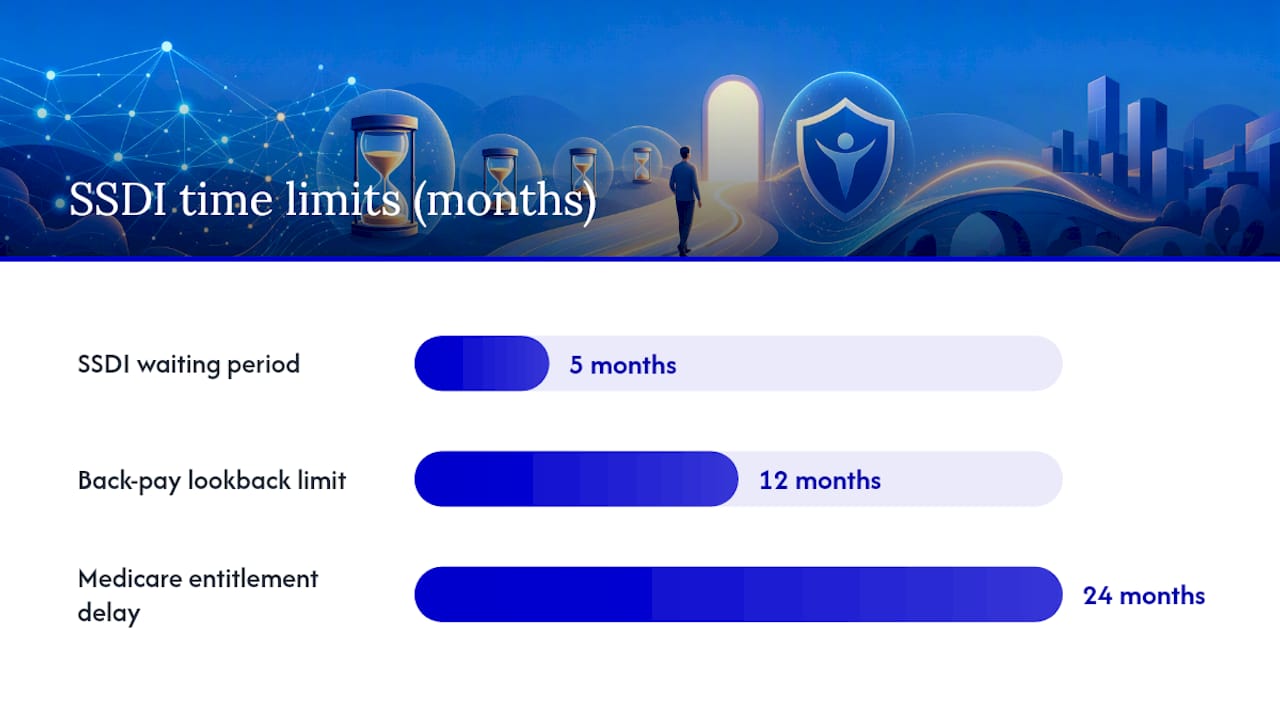
Two rules cap how far back your back pay can reach. First, SSDI includes a five-month waiting period after your established onset date before benefits start accruing. Second, back pay can't extend more than 12 months before your application date, even if your EOD falls earlier than that. Together, these rules mean an early filing date matters just as much as an early onset date.
Medicare entitlement for SSDI recipients begins 24 months after your disability entitlement date, tied directly to your EOD. Push your EOD earlier, and your Medicare start date moves earlier too. Our SSDI waiting period guide breaks down how these two clocks interact.
Common delays worth checking on: unresolved overpayments from a prior claim, Workers' Compensation offsets, and outstanding earnings verification. If your payment is late, calling Social Security with your EOD and decision date ready will save you a repeat call.
Fully Favorable vs. Partially Favorable: What Actually Changes
A partially favorable decision means Social Security agreed you're disabled, but moved your EOD later than the date you originally claimed. Your ongoing monthly benefit calculates the same way either outcome plays out. What shrinks is your back pay, and potentially your Medicare start date, because both are anchored to the EOD.
Some partially favorable decisions also involve a closed period, meaning Social Security finds you were disabled for a defined stretch of time but determines you medically improved enough to return to work afterward. That produces a lump sum for the closed window but no ongoing monthly benefit.
If Social Security moves your onset date and you disagree, you generally have three paths:
- Accept the decision. Reasonable when the shift is small (a few months) and appealing would cost more in time than it recovers in back pay.
- Appeal to the Appeals Council. You typically have 60 days from receiving the decision to file, and you'll need to show the medical evidence supports your original alleged date.
- Request reopening. Available in narrower circumstances, usually tied to new evidence or clear error, and subject to strict time limits.
Pro Tip: Before deciding whether to appeal, calculate the actual dollar difference between your current back pay and what you'd receive if your original AOD were reinstated. If that gap is a few hundred dollars, an appeal may not be worth the added wait. If it's several thousand, it usually is.
Our SSDI appeals process guide walks through deadlines and documentation requirements for each route in more detail.
Your Next Steps After a Fully Favorable Decision
- Confirm your EOD. Reread the Findings of Fact section of your ALJ decision, compare it to your original AOD, and keep a saved copy of that page.
- Watch for your award letter. It should arrive within roughly 60 to 90 days of the decision. If it doesn't, call your local Social Security office with your decision date on hand. Our award letter explainer covers what each section of that letter means.
- If your decision was partially favorable, request your Personalized Disability Explanation (PDE), which SSA requires DDS to send whenever an onset date changes. Note your appeal deadline immediately, and speak with an attorney before filing if the back-pay difference is significant.
- Track your Medicare entitlement date once your EOD is confirmed, and review the Medicare enrollment timeline to understand enrollment windows. File Form SSA-44 if you need to appeal an income-related Medicare premium adjustment.
What Years of Case Patterns Reveal About Fully Favorable Outcomes
Cases that land fully favorable almost always share one trait: a medical record that tells a single, coherent story starting at the claimed onset date. Files with gaps, undated notes, or treatment records that contradict the alleged onset date tend to push adjudicators toward a later EOD, even when the underlying disability isn't in dispute.
The most common mistake I see isn't a weak medical condition. It's continued work activity that overlaps with the alleged onset date, or a treating physician's notes that read as vague symptom lists rather than functional limitations tied to specific dates. Both create room for an adjudicator to question the timeline.
Claimants who work with counsel early on onset-date evidence, rather than after receiving a partially favorable decision, generally end up with cleaner files and fewer surprises. An attorney who understands how to document onset dates for SSDI claims can often prevent the exact gaps that push adjudicators toward a later date.
If you're unsure whether your current file supports your alleged date, that's precisely the moment to bring in experienced counsel, not after a partially favorable decision arrives.
Does a Fully Favorable Decision Affect Future Reviews?
A fully favorable decision doesn't exempt you from Continuing Disability Reviews (CDRs), the periodic checks Social Security conducts to confirm you remain disabled. What it can influence is the review schedule Social Security assigns you.
At the time of your decision, the agency classifies your case as "medical improvement expected," "possible," or "not expected," based on your diagnosis and prognosis. A fully favorable decision built on strong, consistent medical evidence, particularly for a condition SSA classifies as unlikely to improve, often supports a longer interval between reviews. That's a byproduct of the strength of your file at approval, not the fully favorable label itself.
CDRs aren't a reassessment of your onset date. They ask a single question: are you still disabled under current medical standards? Your original EOD and back pay remain unaffected. The practical implication is that the same well-documented, consistent medical record that helped you get a fully favorable decision will also help you sail through a future CDR, since reviewers are looking for the same kind of continuity and specificity your initial file already established.
Keep building your medical record even after approval. A file that goes quiet for years, with no ongoing treatment documentation, can create unnecessary friction at your next CDR, even if your condition genuinely hasn't improved.
How a Fully Favorable Decision Affects Dependents' Benefits
A fully favorable decision on your own SSDI claim can also open the door to benefits for eligible dependents, including a spouse caring for your child, or your children under 18 (or up to 19 if still in high school). These are calculated as a percentage of your PIA, subject to a family maximum that caps the total amount your household can receive.
Because dependents' benefits are tied to your EOD, an earlier established onset date can mean earlier retroactive payments for them too, not just for you. If your EOD is pushed later in a partially favorable decision, dependents' back pay shrinks along with yours, since their eligibility window follows the same onset date rules.
One detail that catches families off guard: dependents' benefits don't reduce your own monthly payment, but the family maximum can limit how much each dependent receives if multiple people qualify at once. If you have dependents who might qualify, raise it with Social Security as soon as your award letter arrives rather than waiting for a follow-up notice, since dependent benefit applications sometimes require separate paperwork.
Can You Speed Up a Fully Favorable Decision?
You can't force Social Security to rule in your favor, but you can remove the obstacles that typically slow a case down or push an EOD later than it should be.
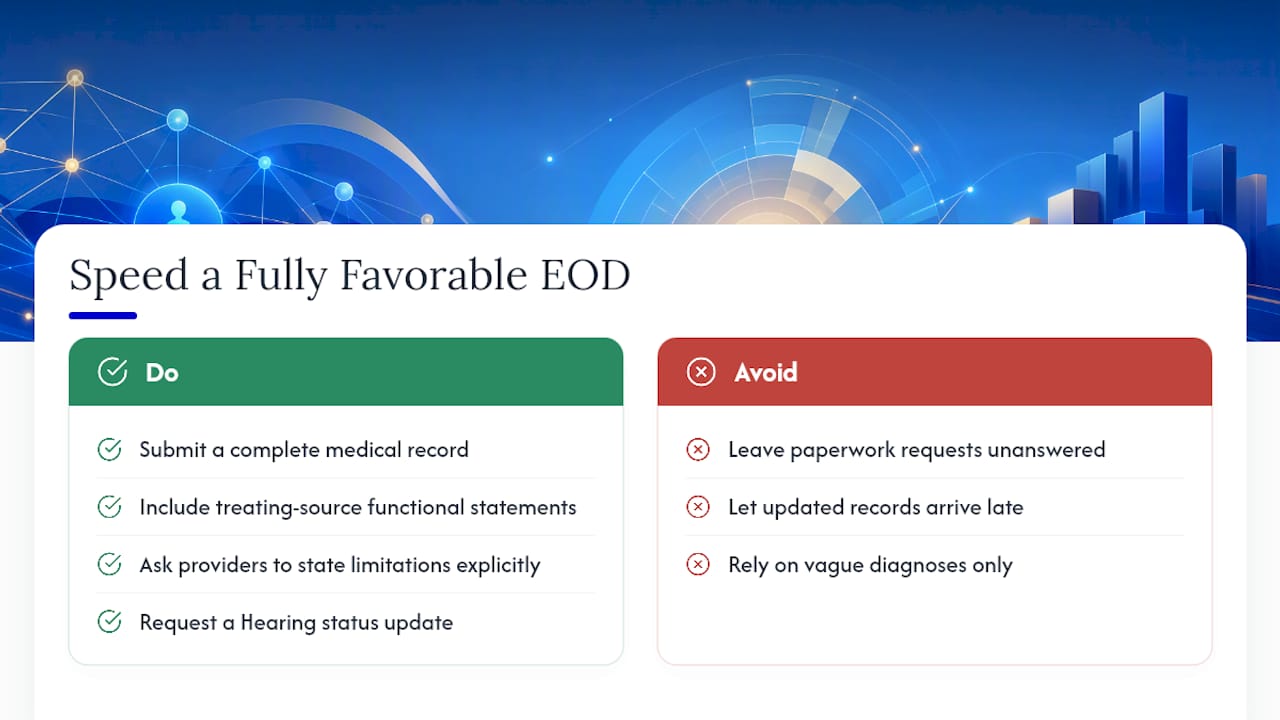
The single most effective step is submitting a medical record that already tells a complete story before your hearing. That means treating-source statements that describe specific functional limitations, dated consistently, rather than vague references to "chronic pain" or "ongoing symptoms" without functional detail. Since POMS DI 24515.020 allows adjudicators to curtail development once a file clearly supports a fully favorable finding, a complete file at the outset gives the adjudicator less reason to request more evidence or schedule additional exams.
Requesting a Request for Hearing status update, keeping your contact information current with Social Security, and responding immediately to any request for additional records also prevent avoidable delays. Cases stall most often not because the medical facts are weak, but because paperwork requests go unanswered or updated records arrive late.
If you're between filing and hearing, ask your treating providers to document functional limitations explicitly, not just diagnoses. "Diagnosed with degenerative disc disease" tells an adjudicator little. "Unable to sit longer than 20 minutes without repositioning due to lumbar radiculopathy" gives them something concrete to rule on.
The Gap Between What the Rules Promise and What Claimants Actually Experience
Most explainers on this topic stop at defining fully favorable and partially favorable, then move on. That's not where the real decision-making happens. The rules governing back pay caps, the five-month waiting period, and the 24-month Medicare clock are fixed. What isn't fixed is how much control you have over your own onset date evidence, and that's consistently underestimated.
The conventional advice to "just submit everything" is often counterproductive. Adjudicators respond to clarity, not volume. A record with genuine gaps or contradictions doesn't disappear because you buried it under years of unrelated paperwork; it just takes longer to sort through, and sometimes gets resolved against you by default.
If there's one priority worth acting on immediately, it's this: treat your onset date as a fact you have to prove, not a detail Social Security will simply take your word for. That mindset shift, applied early, prevents most of the partially favorable outcomes claimants later try to appeal.
— Gerard
When to Bring in an SSDI Attorney
If your decision came back partially favorable and the back-pay difference is significant, or Social Security shifted your onset date based on evidence you believe is incomplete, that's the moment to get an experienced SSDI attorney involved rather than navigating an Appeals Council filing alone. The same goes for complex situations involving Workers' Compensation offsets or disputed onset-date evidence.
There are services that connect claimants with experienced disability attorneys who handle exactly these situations: appeals, onset-date disputes, and questions that come up after a decision has already been issued.
Unlike trying to interpret POMS language or appeal deadlines on your own, working with matched counsel means someone who reads ALJ decisions daily is reviewing your specific onset-date evidence before you file anything. If your back pay took a hit you believe is wrong, or you're facing an Appeals Council deadline, start by requesting an attorney match through Ssdilawyer today.
This article is general information, not a substitute for advice from a qualified financial advisor. Consult a qualified financial professional about your own circumstances before acting on anything here.
Sources
- SSA Handbook § 527 — How to Read and Understand the Initial Determination
- SSA - POMS: DI 24515.020 Curtailing Development of Fully Favorable Claims
- SSA - POMS: DI 25501.280 Notifying Claimants of Partially Favorable Allowances