
What is an SSDI award letter?
The SSDI award letter, officially called a Notice of Award, is the formal written document from the Social Security Administration confirming that your disability claim has been approved. It is not a general update or status notice. It is the legal record establishing your rights as a beneficiary.
The letter specifies your monthly benefit amount, the dates that govern your payments, any back pay owed, and when Medicare coverage begins. Every financial detail of your SSDI case flows from this document.
Key elements the Notice of Award contains:
- Monthly benefit amount: The dollar figure you will receive each month
- Established Onset Date (EOD): The official date SSA determined your disability began
- Date of Entitlement: The date your benefit eligibility formally starts, calculated after the five-month waiting period
- Back pay amount and schedule: Any retroactive benefits owed and how they will be paid
- Medicare start date: When your Medicare coverage becomes active
- Five-month waiting period explanation: Why your first payment does not begin immediately after the EOD
Keep this document in a secure location. It governs your entire benefit relationship with SSA, including future Continuing Disability Reviews.

When you can expect to receive the award letter
Most claimants receive the Notice of Award 30 to 90 days after SSA issues a favorable decision, though some cases take up to four months. The delay is not an error. SSA must complete back pay calculations, coordinate payment schedules, and process administrative paperwork before the letter goes out.
The timing also depends on how your claim was approved:
- Initial approval by the Disability Determination Services (DDS): Generally the faster path; the letter typically arrives within 30 to 60 days of the decision
- Approval after an Administrative Law Judge (ALJ) hearing: Processing often takes longer because the hearing office must forward the decision to the payment center before the award letter is generated
- Back pay complexity: Large retroactive amounts require additional calculation time, which can push the letter toward the four-month end of the range
Pro Tip: Watch your mail carefully during this window. The appeal deadline is calculated from the date printed on the letter, not the date you receive it, so opening it promptly is critical.
What your SSDI award letter contains
The Notice of Award is a multi-page legal document. Reading it carefully the first time prevents costly misunderstandings later.
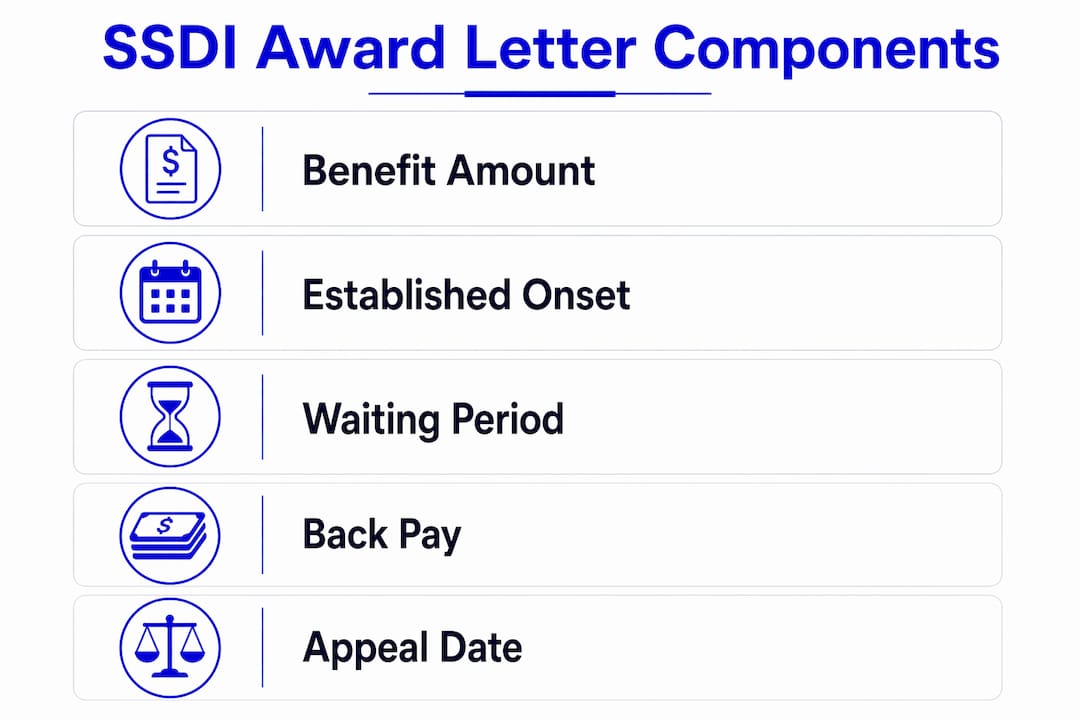
| Section | What it tells you |
|---|---|
| Monthly benefit amount | Your gross SSDI payment each month |
| Established Onset Date | The official start date of your disability per SSA |
| Date of Entitlement | First month you are eligible to receive payment |
| Back pay amount | Total retroactive benefits owed to you |
| Back pay payment schedule | Whether back pay arrives in one payment or installments |
| Medicare start date | When your Medicare Part A and Part B coverage begins |
| Five-month waiting period | Explanation of the mandatory delay before payments start |
The five-month waiting period is one of the most misunderstood elements. SSA pays the first benefit for the sixth full month after the EOD. For example, if your disability is established as beginning on january 15, your first payment covers july and arrives in august. One exception applies: claimants with amyotrophic lateral sclerosis (ALS) are exempt from this waiting period entirely.
Back pay is calculated from the Date of Entitlement, not the EOD. If your back pay is large, SSA may release it in installments rather than a single lump sum. The letter will specify the schedule.
How to get a copy of your award letter
The original Notice of Award is a one-time document. SSA cannot reissue it once it has been sent. If you lose your letter, SSA will not generate a duplicate of the original.
What you can do instead:
- Request a Benefit Verification Letter: SSA can issue this document at any time. It confirms your benefit amount and status but does not replicate the full legal detail of the original award notice.
- Call SSA directly: Reach the national line at 1-800-772-1213 to request a Benefit Verification Letter by mail or to schedule a local office appointment.
- Visit a local SSA office: Bring a government-issued photo ID. Staff can print a Benefit Verification Letter on the spot in most cases.
- Use your My Social Security account: At ssa.gov/myaccount, you can generate and download a Benefit Verification Letter instantly, any time of day.
The distinction between the two documents matters. The Benefit Verification Letter works for income verification purposes, such as applying for housing or a loan. It does not carry the legal weight of the original Notice of Award, which established your entitlement dates, back pay terms, and Medicare eligibility. For legal or appeals purposes, the original is the authoritative record.
Pro Tip: Scan your award letter and save a digital copy immediately after receiving it. Store it in a secure cloud folder alongside your medical records.

What to do if you disagree with your award letter
Errors in the Notice of Award do occur. SSA may set an Established Onset Date later than your medical evidence supports, or calculate back pay incorrectly. You have the right to appeal.
The deadline is strict: you have 60 days from the date printed on the letter to file an appeal, plus a five-day buffer that SSA allows for mailing time. Missing this window can forfeit your right to challenge the determination.
Steps to take if you believe the letter contains an error:
- Review all dates carefully: Compare the Established Onset Date in the letter against your medical records and the date you originally claimed
- Check back pay calculations: Verify that the amount reflects the correct Date of Entitlement and monthly benefit figure
- File a Request for Reconsideration: This is the first formal step in the SSA appeals process if you were approved but disagree with specific terms
- Request an ALJ hearing: If reconsideration does not resolve the dispute, you can escalate to a hearing before an Administrative Law Judge
- Respond in writing: Document every disagreement and submit supporting medical evidence with your appeal
Pro Tip: An experienced disability attorney can identify onset date errors and back pay miscalculations that most claimants miss. Legal representation at this stage often results in a more favorable outcome.
Ssdilawyer connects claimants with attorneys who specialize in exactly these disputes. Legal representation at the appeal stage is not a luxury; it is often the difference between recovering months of back pay and accepting a reduced award.
Understanding key dates and terminology in the award letter
The dates in your Notice of Award are not administrative formalities. They determine how much money you receive and when your Medicare coverage starts.
- Alleged Onset Date (AOD): The disability start date you claimed in your application
- Established Onset Date (EOD): The date SSA officially accepted as your disability start date, based on medical evidence. This is the date that controls your benefit calculation.
- Date of Entitlement: The first month you are entitled to payment, which falls five months after the EOD under standard rules
- Medicare start date: Medicare eligibility begins 24 months after the Date of Entitlement for most SSDI recipients
SSA does not always accept the Alleged Onset Date. If SSA sets the EOD later than you claimed, your back pay shrinks and your Medicare start date shifts forward. Even a one-month discrepancy in the EOD can reduce your total entitlement. Reviewing the EOD against your medical records before accepting the letter's terms is one of the most consequential steps a new beneficiary can take.
The role of an attorney in onset date disputes is well established. Attorneys familiar with SSA's medical evaluation standards can challenge an EOD that does not align with the clinical record, potentially recovering additional months of back pay and advancing your Medicare eligibility date.
Pro Tip: Note the exact date printed on your award letter the day it arrives. Your 60-day appeal window starts from that date, not from when you open the envelope.
Key Takeaways
The SSDI award letter is the single most important document in your disability case, establishing your benefit amount, onset dates, back pay, and Medicare eligibility in one legally binding record.
| Point | Details |
|---|---|
| Official document name | The SSDI award letter is formally called the Notice of Award. |
| Arrival timeline | Expect the letter 30 to 90 days after a favorable decision, sometimes up to four months. |
| Five-month waiting period | SSA pays the first benefit for the sixth full month after the Established Onset Date. |
| Lost letter options | SSA cannot reissue the original; request a Benefit Verification Letter or use My Social Security online. |
| Appeal deadline | You have 60 days from the date on the letter, plus a five-day mailing buffer, to file an appeal. |
Received your award letter and unsure whether the dates and amounts are correct? Ssdilawyer connects you with experienced disability attorneys who review Notice of Award documents, identify calculation errors, and file appeals before deadlines pass. Visit Ssdilawyer to get started.