
Qualifying for SSDI comes down to two separate tests, and you must pass both. First, you need enough Social Security work credits, typically 40 credits with 20 earned in the last 10 years. Second, you need a medical condition that stops you from substantial gainful activity for at least 12 months or is expected to result in death. The Social Security Administration checks both through a five-step evaluation, and monthly earnings above the substantial gainful activity (SGA) threshold generally signal you don't meet the disability definition.
TL;DR:
- Most SSDI applicants need at least 40 work credits, with 20 earned in the last 10 years, to qualify for benefits.
- Younger workers under 24 can qualify with fewer credits, but must meet the minimum of six credits, with special rules applying up to age 30.
- The 2026 substantial gainful activity limit is $1,690 per month for non-blind applicants and $2,830 for those who are blind; earning above these disqualifies most claims.
- SSDI considers work status, medical severity, listing match, past work capacity, and transferable skills, with vocational factors often causing denials even if medical evidence is strong.
- Applicants must meet insured status based on recent work credits and legal immigration status; benefits may convert to retirement once reaching full retirement age.
Table of Contents
- Work History and How Social Security Credits Work
- SSA's Medical Definition of Disability and the Five-Step Test
- Substantial Gainful Activity: 2026 Earnings Limits You Need to Know
- Special Situations: Blindness, Younger Workers, and Self-Employment
- How Claims Get Reviewed: Timeline, Waiting Period, and Retroactive Pay
- Evidence Checklist: What DDS Wants to See
- If Your Claim Is Denied: Appeals and When to Get an Attorney
- Income Limits Beyond SGA: Trial Work Periods and Continuing Reviews
- Other SSDI Criteria: Insured Status and Recent Work Requirements
- Non-Medical Eligibility: Citizenship and Lawful Presence
- What Actually Moves the Needle in a Claim
- How Ssdilawyer Matches You With an Experienced Disability Attorney
- Sources
Work History and How Social Security Credits Work
Social Security credits are the currency of SSDI eligibility. You earn up to four credits a year based on wages or self-employment income, and most adults need about 40 total, with 20 of them earned in the last 10 years before becoming disabled. That's the 20/40 rule: work roughly five of the last ten years, and you clear the bar.
Your Social Security Statement, available through your online account, shows exactly how many credits you've banked and where gaps exist. Check it before you assume you qualify.
Younger workers get a break, since they haven't had time to accumulate decades of work history. The credit-earning rules build in exceptions:
- Workers under 24 may qualify with fewer credits earned in the recent years before disability onset.
- Workers 24 to 30 generally need credits equal to half the time between age 21 and the onset of disability.
- Every applicant needs a minimum floor of 6 credits, regardless of age.
- Workers disabled before age 31 follow a separate, more forgiving calculation than the standard 20/40 rule.
SSA's Medical Definition of Disability and the Five-Step Test
The SSA's definition of disability is stricter than most people expect. It requires a medically determinable impairment that prevents substantial gainful activity for at least a continuous period of at least one year, or that is expected to end in death. A diagnosis alone doesn't clear that bar. What matters is how the condition limits your actual capacity to work.
Disability Determination Services applies a five-step sequence to every claim:
- Are you currently working above the SGA limit? If yes, the claim usually stops here.
- Is your condition severe? It must significantly limit basic work activities.
- Does it match or equal a Blue Book listing? SSA's listings describe impairments serious enough to qualify automatically.
- Can you still do your past work? DDS compares your residual functional capacity against your job history.
- Can you do any other work in the national economy? This step weighs age, education, and transferable skills.
Many denials occur at later steps involving vocational evaluations, not because the medical evidence is weak, but because vocational factors work against the claimant. An older worker in a physically demanding job with a back injury and no transferable desk skills has a very different outcome than a 35-year-old with the same diagnosis and an accounting degree.
Substantial Gainful Activity: 2026 Earnings Limits You Need to Know
In 2026, SGA is set at $1,690 per month for non-blind applicants and $2,830 per month for those who are legally blind. Earn above those thresholds, and SSA generally concludes you're capable of substantial work, which knocks out eligibility at step one regardless of your diagnosis.
SSA counts wages differently than self-employment income. For employees, it looks at gross earnings before taxes. For self-employed applicants, SSA applies the "Three Tests," measuring the value of your work to the business, comparing your work to that of a non-disabled owner, and calculating your actual worth to the business rather than take-home pay.
SGA also governs the Trial Work Period once you're already receiving benefits, letting you test employment without immediately losing SSDI.
Special Situations: Blindness, Younger Workers, and Self-Employment
Not every applicant follows the standard rulebook. SSA carves out separate paths for a few common circumstances, and knowing which one applies to you changes what evidence matters.
- Legally blind applicants get a higher SGA threshold ($2,830 versus $1,690) and different work-credit calculations under the Red Book's disability standards.
- Younger workers, as covered earlier, need fewer total credits, but the recency requirement still applies.
- Self-employed applicants face closer scrutiny of countable earnings versus gross revenue, since business income doesn't map cleanly onto a paycheck.
Pro Tip: If you're self-employed, keep separate records of hours worked versus revenue generated. SSA cares more about your functional contribution to the business than your bank balance.
How Claims Get Reviewed: Timeline, Waiting Period, and Retroactive Pay
Your application doesn't go straight to a judge. It lands with your state's Disability Determination Services office, which requests medical records, treatment notes, and functional assessments from your providers before making an initial decision.
Even after approval, benefits don't start immediately. SSA imposes a a waiting period of several months before benefits begin, meaning payments begin in the sixth full month after your disability onset date. In some cases, SSA pays retroactively for up to 12 months before you filed, provided you can document that your disability began that early.
Realistic timelines and common delays:
- Initial DDS decisions typically take several months, sometimes longer if records are incomplete.
- Missing treatment notes or unclear diagnostic dates are the most frequent cause of processing delays, highlighting the importance of knowing your rights under Disability Discrimination – Optimum Employment Lawyers.
- Cases requiring a vocational review at steps 4 and 5 tend to take longer than straightforward listing matches.
Evidence Checklist: What DDS Wants to See
Strong documentation is the single biggest lever you control in this process. DDS builds its decision almost entirely from paper, so gaps in your records become gaps in your case.
- Medical records: treatment notes, imaging and lab results, specialist reports, and a complete medication history.
- Employment records: W-2s, 1099s, recent pay stubs, and your Social Security earnings statement.
- Functional documentation: notes on daily activity limits, fatigue patterns, and cognitive difficulties that affect your ability to sustain work.
Request records directly from each provider's medical records department rather than waiting for DDS to chase them down. Building a case file before you apply, rather than after a denial, saves months.
Pro Tip: Ask your treating physician for a written residual functional capacity statement. SSA often orders a consultative exam when this is missing, which adds weeks to your timeline.
If Your Claim Is Denied: Appeals and When to Get an Attorney
A denial isn't the end of the process. It's step one of a longer four-stage appeals path: reconsideration, a hearing before an administrative law judge, Appeals Council review, and, rarely, federal court.
- Most initial denials stem from incomplete medical evidence or unclear functional limitations, not an actual absence of qualifying conditions.
- Reconsideration reviews the same file with fresh eyes, so submitting new evidence at this stage matters more than resubmitting the same paperwork.
- Hearings before an ALJ often involve vocational expert testimony, where representation with experience developing that testimony tends to improve outcomes.
Complex cases involving multiple conditions, unclear onset dates, or a need for vocational argument are exactly where legal representation earns its keep.
Income Limits Beyond SGA: Trial Work Periods and Continuing Reviews
Getting approved isn't the finish line. SSDI eligibility keeps getting tested after your first check arrives, and the two mechanisms that matter most are the Trial Work Period and Continuing Disability Reviews.
The Trial Work Period lets you test your ability to work without immediately losing benefits, even if your earnings exceed SGA during those months. You get several trial months within a rolling multi-year window to test work without losing benefits immediately, and SSA still pays full benefits during each one regardless of how much you earn, as long as you report the work. After the trial period ends, an Extended Period of Eligibility follows, during which any month you earn above SGA typically means no payment, but months below the threshold still pay out.
Continuing Disability Reviews are SSA's way of confirming your condition hasn't improved enough to return to substantial work. How often you get reviewed depends on your diagnosis: conditions expected to improve get reviewed roughly every 6 to 18 months, conditions that might improve get reviewed around every 3 years, and conditions unlikely to improve get reviewed every 5 to 7 years. Missing a CDR notice or failing to submit updated medical evidence is one of the more preventable ways people lose benefits they're still entitled to. Keep your address current with SSA and respond to review notices immediately, since a lapse in communication is treated very differently from a lapse in medical eligibility.
Other SSDI Criteria: Insured Status and Recent Work Requirements
Work credits alone don't guarantee eligibility. SSA also checks your "insured status," which is really two separate tests layered on top of the credit count.
Fully insured status requires the standard 40 credits (with age-based exceptions for younger workers), earned at any point across your working life. Currently insured status, sometimes called the "recent work test," requires that a portion of those credits, generally 20 out of the last 40 quarters, were earned close to your disability onset date. This second test exists because SSDI is designed to replace recent income, not reward decades-old employment with no recent connection to the workforce.
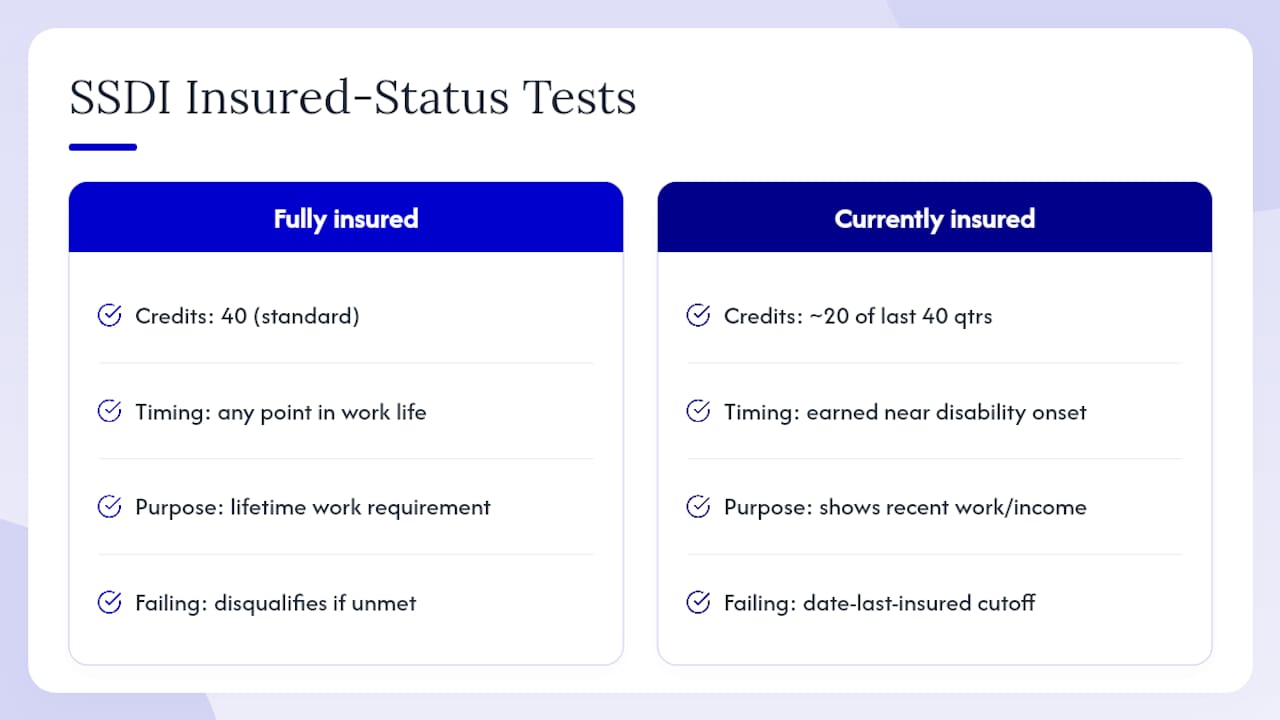
This is why someone who worked steadily for 25 years, then stopped working entirely for a decade before becoming disabled, can hit the 40-credit threshold on paper and still get denied. Their work simply isn't recent enough. The Red Book's insured-status framework treats "date last insured" as a hard cutoff. If your disability onset falls after that date, even a devastating diagnosis won't qualify you for SSDI, though it might still support an SSI claim under different rules.
Anyone with an irregular work history, extended caregiving gaps, or long stretches of self-employment with underreported income should check their date last insured before assuming eligibility.
Non-Medical Eligibility: Citizenship and Lawful Presence
Medical evidence and work credits get most of the attention, but SSDI also has non-medical requirements that trip up applicants who assume the process is purely health-based.
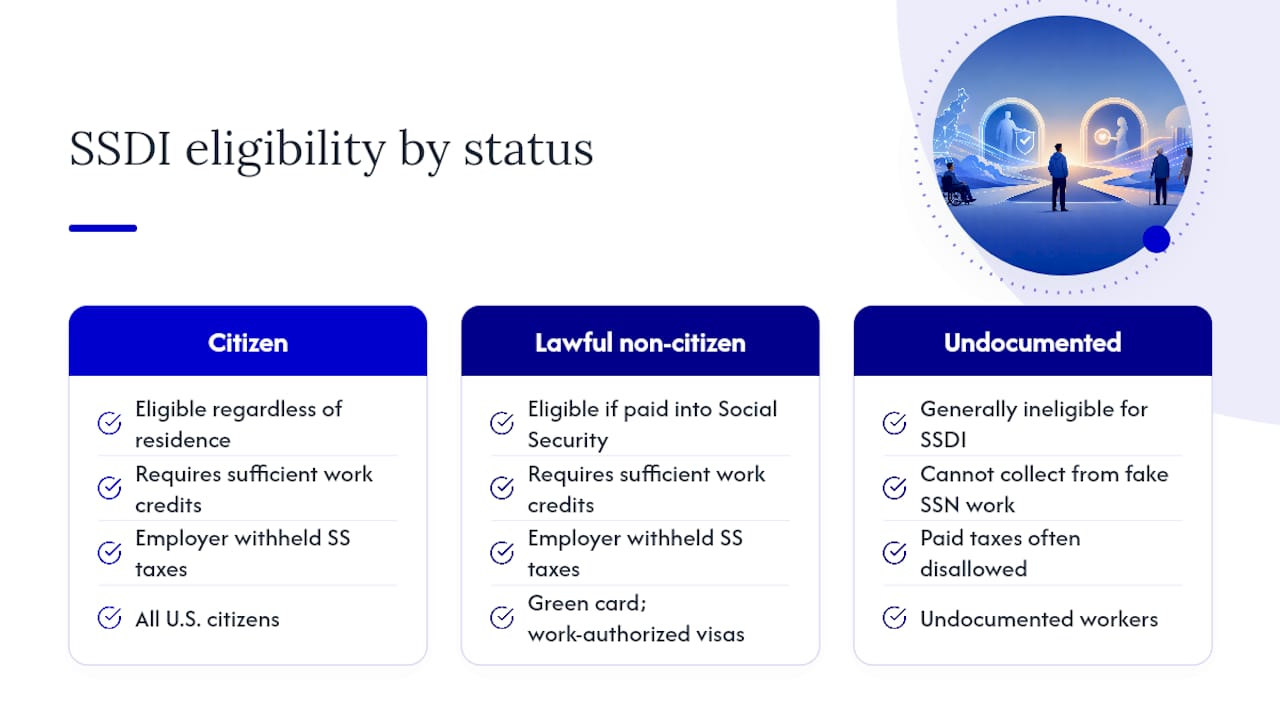
U.S. citizens qualify regardless of where they currently live, provided they meet the work-credit and disability tests. Lawfully present non-citizens can also qualify for SSDI, since eligibility is tied to having paid into the Social Security system through covered work, not to citizenship status itself. This distinguishes SSDI from Supplemental Security Income, which carries stricter immigration-status requirements because SSI is a needs-based program funded differently.
Green card holders, certain visa holders authorized to work, and some individuals with other lawful immigration statuses can accumulate work credits the same way citizens do, as long as their employer withheld Social Security taxes. Undocumented workers, even those who paid into the system under a fabricated Social Security number, generally cannot collect SSDI benefits tied to that work history.
Age also intersects with these non-medical rules in a practical way. SSDI has no minimum age beyond having earned sufficient credits, but applicants closer to retirement age often see their SSDI automatically convert to retirement benefits once they reach full retirement age, since SSA doesn't pay both simultaneously. Younger applicants, by contrast, face closer vocational scrutiny at steps 4 and 5 precisely because SSA assumes more remaining work capacity over a longer career horizon.
What Actually Moves the Needle in a Claim
Most guidance treats SSDI eligibility as a checklist: hit the credits, get a diagnosis, submit the form. That framing undersells where claims actually get won or lost. Organized, dated medical documentation, gathered proactively rather than assembled after a denial, does more to change outcomes than any single diagnosis code.
Vocational factors at steps 4 and 5 decide more claims than most applicants realize going in. Age, education, and transferable skills carry as much weight as the medical file itself, which is exactly why two people with identical conditions can get opposite decisions. Anyone with a complicated work history, a self-employment income stream, or a condition that doesn't map neatly onto a Blue Book listing benefits from getting a second set of eyes on their file before DDS ever sees it.
— Gerard
How Ssdilawyer Matches You With an Experienced Disability Attorney
Ssdilawyer is the alternative to guessing your way through DDS paperwork alone. Instead of piecing together medical records, vocational arguments, and appeal deadlines by yourself, you get matched with an attorney who handles this evidence gap every day.
The matching process starts with a consultation about your work history, diagnosis, and where your claim currently stands, whether you haven't filed yet, you're waiting on a decision, or you already received a denial. From there, an attorney can review your existing documentation, flag what's missing before DDS asks for it, and represent you at a hearing if vocational testimony becomes necessary.
This matters most if you're facing a denial, dealing with a self-employment income calculation, or simply don't have the bandwidth to chase down records from multiple providers. If any of that sounds like your situation, start your case review with Ssdilawyer and get connected with an attorney who can take the next step off your plate.
This article is general information, not a substitute for advice from a qualified financial advisor. Consult a qualified financial professional about your own circumstances before acting on anything here.