
The medical vocational guidelines, known as "the grids," are the official tables the Social Security Administration uses at Step 5 of its five-step disability review to decide whether a claimant can work. When your residual functional capacity (RFC), age, education, and work history match a "disabled" row in the tables, the decision is automatic. No guessing, no discretion. Four factors drive every grid outcome:
- RFC and exertional level: sedentary, light, medium, heavy, or very heavy
- Age: under 50, 50 to 54, 55 and older, and a special borderline-age rule
- Education: limited, high school and above, and whether it provides for direct entry into skilled work
- Past work: unskilled, semiskilled, or skilled, and whether any skills transfer to other jobs
Here's the practical reality most claimants never hear: Appendix 2 to Subpart P of Part 404 was built to favor older workers with limited RFC and few transferable skills. A 57-year-old with a sedentary RFC, a high school education, and 20 years in a single unskilled job often gets approved under the grids alone, even without a "listed" impairment. That is the entire logic of the medical-vocational guidelines: work capacity plus age plus skill fit, run through a formula instead of a subjective judgment call.
Key Takeaways
The medical-vocational guidelines decide disability claims through a fixed formula of RFC, age, education, and work history, and precise documentation of functional limits, not diagnosis alone, determines which grid row a claimant lands in.
| Point | Details |
|---|---|
| Grids apply at Step 5 | SSA uses Tables 1 through 3 and Rule 204.00 only after RFC is established and no Listing is met. |
| Age shifts outcomes sharply | Approval odds rise notably at 50 and again at 55, when transferability standards tighten. |
| RFC documentation is decisive | Specific physician RFC statements and FCE data map far more reliably to grid rows than general chart notes. |
| Non-exertional limits change everything | Mental health, pain, and environmental restrictions push cases from a directed grid outcome into individualized VE analysis. |
| Legal review catches gaps early | An attorney comparing your facts to the grid tables before a hearing can identify and close small evidentiary gaps that decide close cases. |
Table of Contents
- How the Medical Vocational Grid Rules Actually Work
- What Counts as Sedentary, Light, Medium, or Heavy Work?
- Why Turning 50 or 55 Changes Your SSDI Odds
- When Non-Exertional Limits Break the Grid Formula
- Building a Record That Maps to the Grid Rules
- Why Legal Help Changes Grid Outcomes
- Primary Sources and Further Reading
- What the Grid Rules Get Right, and Where They Fall Short
- Sources
How the Medical Vocational Grid Rules Actually Work
The grids live in Appendix 2 to Subpart P of Part 404, organized into Tables 1, 2, and 3, plus a separate rule for the top exertional tier. Table 1 covers sedentary work. Table 2 covers light work. Table 3 covers medium work. Heavy and very heavy work don't get their own table at all. Instead, Rule 204.00 handles that tier with a single line of text rather than a grid of outcomes.
Each row in Tables 1 through 3 lists a specific combination of age, education, and previous work experience, and points to a result: "disabled" or "not disabled." An administrative law judge or disability examiner takes a claimant's established facts and finds the row that matches. If the facts fit cleanly, the rule directs the outcome. That distinction between "directs" and "used as a framework" is where most confusion about the grid rules for SSDI comes from.
POMS DI 25025.005 spells out the difference:
A medical-vocational rule directs a conclusion of "disabled" or "not disabled" only when the claimant's specific age, education, and work experience coincide exactly with the criteria in a rule. When any factor doesn't fit a listed category, or when nonexertional limitations are present, adjudicators use the rule as a framework for decision-making instead of a binding result.
Rule 204.00 is a useful edge case. It applies to claimants whose RFC allows heavy or very heavy exertion, and it never directs a finding of disabled. SSA's own guidance confirms this: a person capable of heavy work is presumed to have access to a wide range of jobs, so the rule only ever serves as a framework, pointing toward "not disabled" without formally locking it in.
Here's how an adjudicator actually maps a real case onto the tables:
- Confirm the claimant doesn't meet or equal a Listing at Step 3, and establish the RFC at Step 4.
- Identify the exertional category the RFC falls into (sedentary, light, medium, heavy, or very heavy).
- Select the applicable table (or Rule 204.00 for heavy and very heavy RFCs).
- Place the claimant's age category, education level, and work experience classification into that table.
- Read the directed outcome, or, if any factor doesn't cleanly fit, use the closest rule as a framework and layer in vocational judgment.
This is why two claimants with nearly identical diagnoses can get opposite results. A 52-year-old former warehouse supervisor with a light RFC and transferable supervisory skills lands in a different cell than a 52-year-old former forklift operator with the same RFC but no transferable skills. Same medical picture on paper. Different grid rows, different outcomes. Grid rules for disability were never designed to grade the severity of an illness. They grade whether your body, age, and skill set still fit into the labor market.
What Counts as Sedentary, Light, Medium, or Heavy Work?
Your RFC decides which table applies, and the table decides everything else. Get the RFC wrong, and you're being measured against the wrong grid entirely.
The SSA's regulatory definitions break exertional capacity into four working tiers, with a fifth reserved for the most demanding jobs:
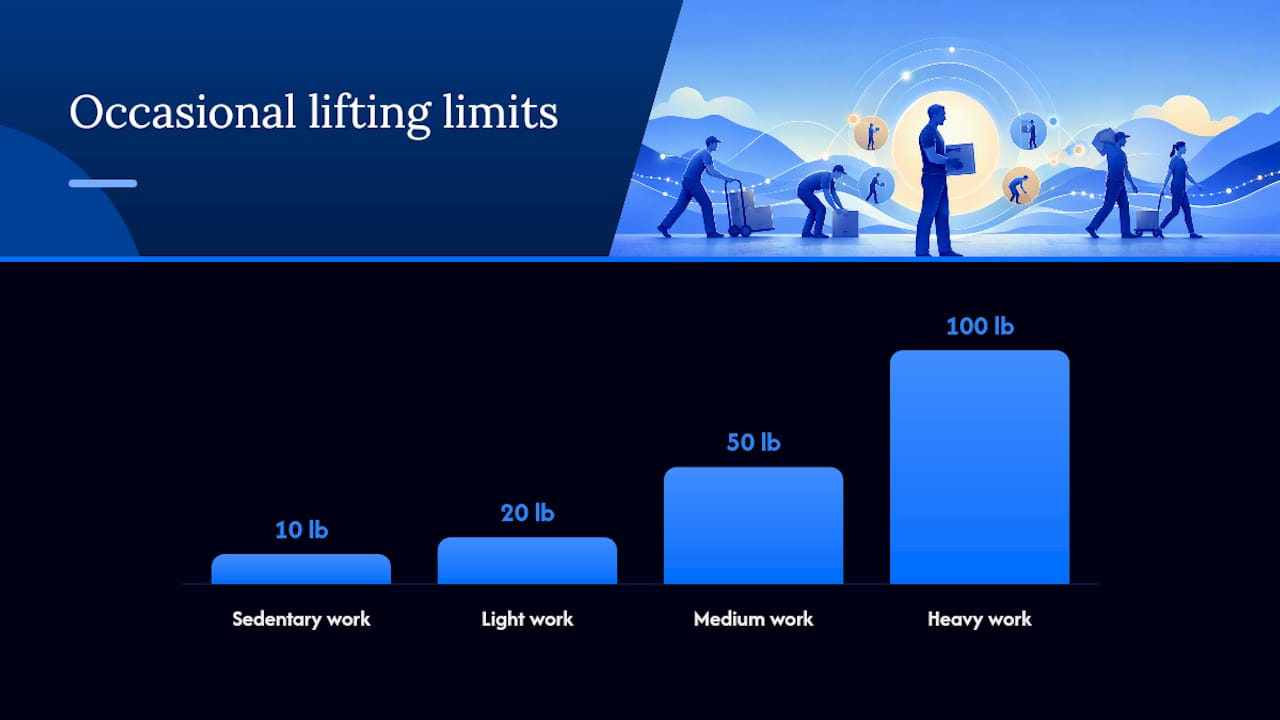
- Sedentary work: lifting no more than 10 pounds occasionally, mostly sitting, with occasional walking or standing. Think data entry, bench assembly, or ticket-taking.
- Light work: lifting up to 20 pounds occasionally and 10 pounds frequently, with a good deal of walking or standing. Retail cashier and light assembly-line roles fall here.
- Medium work: lifting up to 50 pounds occasionally and 25 pounds frequently. Stock clerk and certain nursing-aide duties fit this tier.
- Heavy work: lifting up to 100 pounds occasionally and 50 pounds frequently, plus very heavy work above that, which involves lifting objects over 100 pounds.
Most grid-favorable outcomes cluster in the sedentary and light categories, since Tables 1 and 2 contain far more "disabled" cells than Table 3, and Rule 204.00 essentially forecloses a directed disabled finding for heavy work.
RFC isn't a diagnosis. It's a functional translation of your medical file into what you can still physically and mentally do on a sustained, full-time basis. SSA builds it from several layers of evidence:
- Longitudinal treatment notes from your treating physicians, showing how your condition has behaved over months or years, not just on one bad day.
- Objective findings such as imaging, lab results, or nerve-conduction studies that corroborate reported symptoms.
- Physical or occupational therapy notes documenting measured limits: how far you can walk, how long you can stand, how much you can lift.
- Functional Capacity Evaluations (FCEs), a structured, hands-on assessment that measures strength, range of motion, and endurance against specific job demands.
- A treating or examining physician's written RFC statement, translating clinical findings into concrete work restrictions (lifting limits, sitting and standing tolerances, need for breaks).
- Consultative exam results when SSA orders its own evaluation to fill gaps in the existing record.
Here's the insight most claimants miss: the grids are strength-based, not diagnosis-based. Two people with the same MRI results can land in different exertional categories if one has a detailed physician RFC statement pinning down concrete lifting and sitting restrictions and the other has only a general chart note saying "chronic back pain, moderate." Precise functional documentation is often the single biggest lever a claimant controls in a grid-based case.
Pro Tip: Ask your treating physician directly for a written RFC opinion using specific numbers, "can lift 10 pounds occasionally, can stand for 15 minutes before needing to sit," rather than general language like "significant limitations." Adjudicators map numbers to tables. They can't map vague adjectives.
That documentation gap explains a lot of denials that otherwise look inexplicable on paper. The medical file said "disabled enough" to the patient and the treating doctor, but it never got translated into the functional vocabulary the grid rules actually run on.
Why Turning 50 or 55 Changes Your SSDI Odds
Age is the single most decisive nonmedical factor in the grid rules for disability, and its effect isn't gradual. It shifts at specific thresholds.
SSA sorts claimants into four age categories:
- Younger individual (under 50): the grids rarely direct a disabled finding here. SSA assumes younger claimants can adjust to new work even with reduced RFC and limited transferable skills.
- Closely approaching advanced age (50 to 54): several grid rows now direct "disabled" for claimants limited to sedentary work with limited education and no transferable skills, a threshold documented in Nolo's grid explainer.
- Advanced age (55 and older): transferability standards tighten sharply. Skills must transfer with very little vocational adjustment, meaning minimal retraining, for SSA to deny benefits based on those skills.
- Closely approaching retirement age (60 and older): the tightest transferability standard in the entire system applies, making a disabled finding more likely for claimants with reduced RFC.
Education interacts with age rather than standing alone. SSA categorizes education as illiterate or unable to communicate in English, marginal, limited (roughly 7th to 11th grade), and high school and above. That last category carries an important subcategory: "high school education or above that provides for direct entry into skilled work." If your education directly qualifies you for skilled work, the grid rows shift against you, even at advanced age, because SSA assumes you have a broader base of jobs to draw on.
Transferable skills often decide the case once age and education are fixed. A skill transfers when it applies to a different job that requires the same or a lesser degree of skill, uses the same tools, and involves the same industry or work process. A bookkeeper's proficiency with ledgers and spreadsheets generally transfers to other clerical roles. A roofer's ability to climb and balance on steep surfaces rarely transfers to sedentary work at all, since almost nothing in the sedentary job base uses that skill. After 55, the standard for transferability tightens further: skills must transfer with very little, if any, vocational adjustment, not just some plausible overlap, to support a "not disabled" finding.
One more mechanism deserves attention: the borderline age rule. If you're within a few days or months of the next age category, and using the higher category would change the outcome, SSA can apply the older, more favorable category instead of your chronological age. This isn't automatic. You generally have to raise it, point to your exact birth date relative to the hearing or decision date, and argue that the higher category more accurately reflects your vocational situation. Our guide on SSDI rules for older workers ages 55 to 65 walks through how this argument gets built in practice.
When Non-Exertional Limits Break the Grid Formula
The tables in Appendix 2 were built almost entirely around exertional limits, meaning how much weight you can lift and how long you can stand or sit. The moment a case involves non-exertional limitations, the tables stop being able to direct an outcome on their own.
Non-exertional limitations include:
- Mental health conditions affecting concentration, memory, or the ability to handle workplace stress
- Chronic pain severe enough to require unscheduled breaks or frequent position changes
- Environmental restrictions, such as an inability to tolerate dust, fumes, extreme temperatures, or loud noise
- Postural limits like difficulty stooping, crouching, or reaching overhead
- Manipulative limits affecting fine motor tasks such as typing or handling small objects
None of these show up as a row heading in Tables 1 through 3. When a claimant's RFC includes both an exertional limit and a significant non-exertional one, the rule shifts from directing an outcome to serving strictly as a framework, and the adjudicator has to determine how much the non-exertional restriction erodes the remaining job base beyond what the exertional limit alone would suggest.
That erosion analysis is exactly where a vocational expert (VE) tends to enter the case. A VE testifies at the hearing level about what jobs actually exist in the national economy given a specific combination of exertional and non-exertional limits, often responding to hypothetical questions posed by the administrative law judge.
Even when a claimant's RFC allows heavy work, meaning Rule 204.00 would normally point toward "not disabled," the presence of significant combined non-exertional limitations can require individualized vocational analysis rather than a flat presumption of work capacity.
VE testimony typically gets triggered by any of the following: a documented mental impairment layered on top of a physical one, chronic pain with objective medical support that limits sustained attention, environmental restrictions that eliminate large categories of jobs within an exertional level, or a combination of moderate limitations across multiple domains that no single grid rule addresses cleanly. If your case includes any of these, expect your hearing to hinge less on which grid row you land in and more on how convincingly a VE's testimony, and your attorney's cross-examination of it, describes the jobs you can and can't realistically perform.
Building a Record That Maps to the Grid Rules
A grid-favorable outcome depends on documentation built months, sometimes years, before the hearing ever happens. Waiting until a denial letter arrives to start assembling proof is the most common, and most costly, mistake claimants make.
Start with the medical file itself. Adjudicators need:
- Treatment notes spanning a meaningful period, not a single visit, showing a consistent pattern rather than an isolated flare-up.
- Diagnostic imaging and lab results that objectively support the reported limitations.
- Physical therapy or occupational therapy records with measured functional data (walking distance, standing tolerance, grip strength).
- A Functional Capacity Evaluation, when available, since it provides standardized, third-party-verified numbers rather than self-reported limits.
- A written RFC statement from a treating or examining physician that translates the diagnosis into specific work restrictions.
Past work needs its own precision. Vague job titles hurt claimants. "Manager" tells an adjudicator almost nothing about actual physical demands. Describe past relevant work in terms of the heaviest exertional level actually required, the specific tasks performed, and any supervisory or technical duties that might count as transferable skills. Our breakdown of how SSA evaluates past relevant work covers exactly how to frame job history so it maps cleanly to the grid categories instead of working against you.
Non-exertional limits require their own paper trail, separate from the exertional RFC. If depression or anxiety affects concentration, get that documented by a treating mental health provider, not just noted in passing by a primary care physician. If chronic pain requires unscheduled breaks, get a physician to state that explicitly and quantify it: "requires a 10-minute break every hour," not "experiences pain."

If your age is close to a category threshold, gather your exact birth date, the anticipated hearing or decision date, and any vocational facts (limited education, no transferable skills, sedentary RFC) that make the higher age category more appropriate. Raise the borderline age argument affirmatively. Don't assume the adjudicator will catch it.
Pro Tip: If your treating physician's records feel thin on functional detail, ask whether SSA can order a consultative examination, or have your attorney request one. A well-documented consultative exam can fill gaps that turn an ambiguous RFC into one that clearly maps to a grid row.
Attorneys use consultative exam requests strategically, timing them to arrive before a hearing so the resulting RFC opinion becomes part of the record the judge actually reviews, rather than something added after a decision has already been drafted.
Why Legal Help Changes Grid Outcomes
Counsel earns its value in a grid case by working backward from the tables, not forward from the diagnosis. An experienced disability attorney reviews your RFC evidence, age, education, and work history against Tables 1 through 3 before the hearing, identifies which specific row you're closest to, and then builds the record to close whatever gap remains. If you're 53 with a borderline RFC between light and sedentary, that gap between tables can be the entire case.
At hearing, an attorney's job is narrower and more technical than most claimants expect. Counsel ties your documented RFC and vocational factors directly to a grid rule, cross-examines any vocational expert on whether cited jobs actually match your real limitations, and argues, when appropriate, for borderline age treatment or for treating a "framework" rule as functionally directing a disabled finding given the combined severity of your impairments.
Before a consultation, gather:
- Your most recent RFC-related medical records and any physician statements
- A written description of your last 15 years of work, including physical demands
- Your exact birth date and the approximate timeline of your claim
- Any denial letters or hearing notices you've already received
SSDI claim allowance rates fall meaningfully once a case reaches Step 5, where grid and vocational analysis carries far more weight than the initial medical review alone. That's precisely where legal preparation matters most.
Ssdilawyer connects claimants with experienced SSDI attorneys who handle applications, denials, and hearings, matching you to counsel based on your specific case facts rather than a generic intake form. If your RFC, age, or work history sits anywhere near a grid line, talk to a matched attorney through Ssdilawyer before your hearing, not after a denial arrives.
Primary Sources and Further Reading
The full text of the medical-vocational guidelines and SSA's internal guidance on applying them are public and worth reading directly rather than relying solely on secondhand summaries.
- Appendix 2 to Subpart P of Part 404, Medical-Vocational Guidelines, the full regulatory text of Tables 1 through 3 and rules 200.00 through 204.00
- POMS DI 25025.005, Using the Medical-Vocational Guidelines, SSA's internal instructions on directed findings versus framework use
- POMS DI 25025.035, Tables No. 1, 2, 3, and Rule 204.00, a detailed breakdown of each table's structure and purpose
- 20 CFR Appendix 2 via Cornell Law's eCFR/LII reproduction, a clean, searchable version of the same regulatory text
- SSDI appeals process explained, for readers who need to challenge a grid rule that was misapplied at the initial decision
What the Grid Rules Get Right, and Where They Fall Short
The grids deserve more credit than they get for consistency. A formula that removes guesswork from Step 5 protects claimants from having their case decided by which adjudicator happened to review it that week. That's a real strength, not a bureaucratic footnote.
Where conventional advice falls short is treating the grids as a lookup table you check after the fact. The tables reward claimants who documented functional limits early and specifically. Vague chart notes and undocumented past work descriptions are the two most fixable failures I see repeated across denied claims, and both are entirely within a claimant's control months before a hearing.
If you take one thing from this guide, make it this: get a physician to write numbers, not adjectives, into your RFC record, and describe your past jobs by physical demand, not job title. Age works in your favor after 50. Documentation decides whether the grid ever gets the chance to help you.
This article is general information, not a substitute for advice from a qualified lawyer. Consult a qualified legal professional about your own circumstances before acting on anything here.