
At age 60, documented functional limitations carry more weight in an SSDI claim than at any earlier age. SSA treats advancing age as an increasingly limiting vocational factor, meaning the same RFC restrictions that might not qualify a 45-year-old can direct a finding of disabled for a 60-year-old under the medical-vocational rules. Three immediate steps apply:
- Document RFC function-by-function, tied to objective medical findings, not general statements of pain or fatigue.
- Request a consultative exam if the treating source record is thin or ambiguous.
- Raise a borderline-age argument in writing if the claimant is within days or months of turning 60 and the older category would change the outcome.
The governing authorities are 20 CFR §404.1563, Appendix 2 (the grids), Rule 204.00, and SSR 96-8p.
Key Takeaways
At age 60, functional limitations interact with SSA's vocational rules to direct allowances that the same RFC would not produce at a younger age, making documentation and borderline-age advocacy the two highest-leverage actions in any claim.
| Point | Details |
|---|---|
| Age 60 changes the vocational analysis | SSA treats age 60+ as closely approaching retirement age, raising the transferability bar and narrowing the job base. |
| RFC must be function-by-function | Each domain (lifting, standing, mental) needs objective medical support; vague notes do not establish RFC. |
| Borderline-age arguments are time-sensitive | If the claimant is within months of turning 60, raise the argument in writing before the hearing date. |
| Nonexertional limits can be decisive | Restrictions on concentration, handling, or posture can erode the occupational base even within a light or sedentary RFC. |
| Ssdilawyer matches claimants with attorneys | Submit a case inquiry at Ssdilawyer to connect with a disability attorney experienced in age-60 RFC and grid analysis. |
Table of Contents
- How does SSA use age 60 as a vocational factor?
- What RFC means and how SSA measures functional limitations
- Case profiles showing how functional limits resolve at age 60
- Evidence checklist for documenting functional limitations at age 60
- Attorney strategies for presenting functional limitations at age 60
- Common pitfalls that weaken an age-60 SSDI claim
- What to expect: timeline and next steps for a claimant age 60
- Ssdilawyer connects age-60 claimants with experienced disability attorneys
- Sources
How does SSA use age 60 as a vocational factor?
20 CFR §404.1563 places claimants into age categories: younger (under 50), closely approaching advanced age (50–54), advanced age (55–59), and closely approaching retirement age (60 and older). Each step up narrows the range of jobs SSA expects a claimant to adjust to.
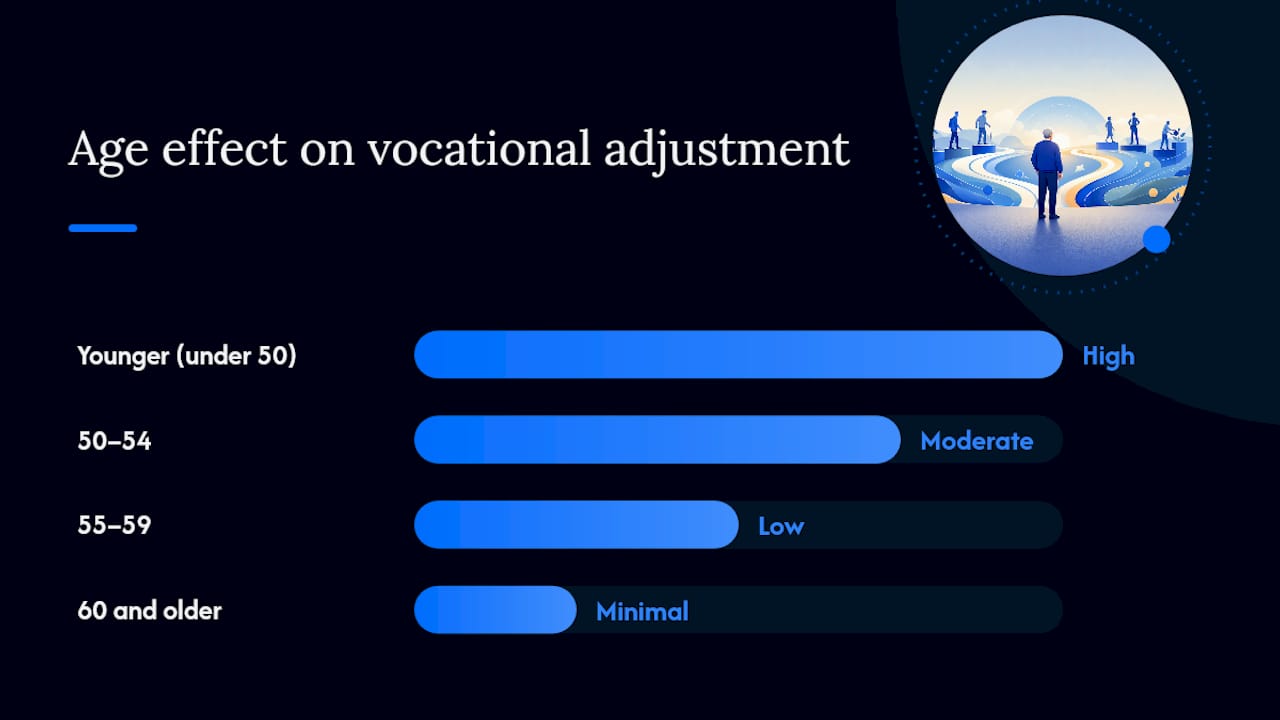
POMS DI 25015.005 directs adjudicators to treat advancing age as an increasingly limiting vocational factor and calls out special consideration for those "closely approaching retirement age (age 60 or older)." At this category, the transferability threshold rises sharply. For a claimant age 60 or older, skills transfer only when the new job requires very little, if any, vocational adjustment in tools, processes, setting, or industry. That standard is difficult to meet, and when it cannot be met, the grids often direct an allowance.
The medical-vocational rules in Appendix 2 combine RFC, age, education, and work history into numbered rules. When a claimant's profile matches a rule, the "Decision" column resolves the step-5 question. Rule 204.00 addresses combinations that include nonexertional limitations and guides adjudicators when the tables alone do not resolve the case.
- Age categories run from younger to closely approaching retirement age, each narrowing vocational adjustment expectations.
- Transferability at age 60 requires minimal vocational adjustment — a high bar that often cannot be met.
- The grids and Rule 204.00 are the primary framework adjudicators use at step 5.
Pro Tip: If a claimant is within a few months of turning 60, put the borderline-age argument in the written record explicitly. Cite 20 CFR §404.1563 and request that the adjudicator consider the older category. SSA does not apply age categories mechanically in borderline situations.
What RFC means and how SSA measures functional limitations
RFC, or residual functional capacity, is SSA's administrative statement of the most a claimant can do on a sustained basis despite medically determinable impairments. SSR 96-8p clarifies that RFC represents maximum sustained work capacity and that even impairments rated "not severe" must be included when their combined effect limits function.
POMS DI 24510.006 requires a function-by-function assessment grounded solely in medically determinable impairments. Age does not create RFC limits; it is considered separately at step 5. The RFC domains adjudicators assess:
- Lifting/carrying: maximum weight and frequency (occasional vs. frequent).
- Standing/walking: total hours in an 8-hour workday.
- Sitting: total hours, with or without positional change.
- Postural: climbing, balancing, stooping, crouching, kneeling, crawling.
- Manipulative: reaching, handling, fingering, feeling.
- Visual/communicative: near/far acuity, hearing, speaking.
- Mental: concentration, persistence, pace, social interaction, adaptation.
Exertional limits determine which grid table applies (sedentary, light, medium). Nonexertional limits, such as restricted concentration or limited handling, can erode the occupational base within that exertional level and often require vocational expert testimony to quantify. At age 60, even a modest nonexertional restriction combined with a light or sedentary RFC can eliminate the remaining job base entirely.
The SSA-3373 Adult Function Report, treating source RFC opinions, consultative exam reports, and work history documentation all feed the adjudicator's RFC finding. A claimant's own SSA-3373 responses that align with treating source limits strengthen the record; responses that contradict them create inconsistencies adjudicators use to discount the opinion.
Case profiles showing how functional limits resolve at age 60
RFC and age interact in ways that change outcomes quickly. The profiles below show how the same RFC can produce different results depending on vocational factors.
| Profile | RFC | Education / Past Work | Likely Result | Rationale |
|---|---|---|---|---|
| A | Sedentary, no nonexertional limits | Limited education, unskilled labor | Disabled (Grid Rule 204.00) | Grids direct allowance for sedentary RFC, age 60+, limited education, unskilled work |
| B | Light, no transferable skills | High school, semi-skilled labor | Disabled (Grid Rule 204.00) | Light RFC, age 60+, no transferable skills, limited education directs allowance |
| C | Light, significant nonexertional limits | High school, skilled past work | Likely disabled (Rule 204.00 + VE) | Nonexertional limits erode light occupational base; VE needed to quantify |
| D | Medium, transferable skills to light | College, professional past work | Depends on transferability analysis | Skills must require minimal vocational adjustment to transfer at age 60 |
One tactical scenario: a claimant is 59 years and 11 months old at the hearing date. Under a strict age-category reading, the adjudicator applies "advanced age" (55–59), and the grid rule does not direct disabled. Counsel argues borderline age under 20 CFR §404.1563, citing the claimant's proximity to 60 and the fact that the older category would direct an allowance. The adjudicator applies the older category. The claim is approved.
- Profile A and B show that sedentary and light RFCs with limited vocational factors direct allowances under the grids for age 60 claimants.
- Profile C shows that nonexertional limits require Rule 204.00 analysis and often vocational expert testimony.
- The borderline-age scenario shows that a few weeks can change the outcome when counsel raises the argument explicitly.
Evidence checklist for documenting functional limitations at age 60
The single most important evidence is clear, function-by-function medical documentation that ties specific symptoms to specific work limitations. Vague notes stating "patient has back pain" do not establish RFC. The record needs objective findings, functional limits, and a medical basis for each.
- Medical records with objective findings: imaging, lab results, examination findings that support the claimed impairment.
- Treating source RFC opinion: a completed RFC form from the treating physician specifying exact limits in each domain, with clinical support.
- SSA-3373 Adult Function Report: completed by the claimant to reinforce treating source limits; responses should mirror the RFC opinion without copying it verbatim.
- Consultative exam report: requested when the treating record is insufficient or when SSA's own examiner is needed to establish a baseline.
- Work history documentation: past relevant work described in detail to support a finding that skills do not transfer at age 60.
Sample physician RFC phrasing: "Patient can stand/walk no more than 2 hours in an 8-hour workday due to lumbar stenosis confirmed on MRI dated [date]. Lifting limited to 10 pounds occasionally based on documented radiculopathy."
Sample SSA-3373 response: "I can stand for about 20 minutes before pain forces me to sit. I cannot carry groceries heavier than a gallon of milk."

Pro Tip: For age-60 claimants, frame the transferable skills section of the work history to show that past work required tools, settings, or processes that differ from any available light or sedentary job. This directly supports a finding that skills do not transfer under the age-60 standard.
Attorney strategies for presenting functional limitations at age 60
The core strategy: build a function-by-function RFC supported by objective medical evidence, apply the grids and Rule 204.00 as the analytical framework, and develop transferability evidence that shows skills do not meet the minimal-adjustment standard. See the SSDI case strategy guide for a broader tactical framework.
Tactical checklist:
- Structure medical source statements to address each RFC domain with clinical support.
- Submit the SSA-3373 before the hearing so the record reflects the claimant's own functional account.
- Sequence consultative exams early; do not wait for SSA to schedule one that may understate limitations.
- Use a vocational expert to test whether the occupational base survives nonexertional restrictions.
Sample VE question sequence:
- "Assume a claimant age 60 with a light RFC, limited to occasional stooping, and no more than simple, routine tasks. What jobs exist in significant numbers in the national economy?"
- "If that claimant also requires a sit-stand option every 30 minutes, does the job base change?"
- "Are there any jobs that require the same tools, processes, and industry setting as [past work title] that this claimant could perform with no vocational adjustment?"
Pro Tip: On borderline-age cases, file a written pre-hearing brief citing 20 CFR §404.1563 and the POMS guidance. State the claimant's exact birth date, the hearing date, and the number of days separating them from the older category. Adjudicators are more likely to apply the older category when the argument is documented, not raised verbally for the first time at the hearing.
Common pitfalls that weaken an age-60 SSDI claim
Vague RFC opinions, inconsistent activity reports, and undocumented nonexertional limits are the most frequent reasons age-60 claims fail at the RFC stage.
- Vague physician notes: "Patient is disabled" without functional specifics. Fix: request a completed RFC form with domain-by-domain limits and clinical support.
- SSA-3373 inconsistencies: claimant reports activities (driving daily, caring for grandchildren) that contradict the RFC. Fix: review the SSA-3373 with the claimant before submission and reconcile any apparent conflicts with a clarifying note.
- Nonexertional limits underdocumented: mental RFC or manipulative limits not addressed in the treating record. Fix: obtain a separate mental RFC opinion when cognitive or psychological impairments exist.
- Noncompliance without explanation: missed appointments or discontinued treatment without documented medical reason. Fix: document the reason (cost, transportation, side effects) in the record before the hearing.
- Conceding a weaker RFC in writing: accepting SSA's RFC assessment without objection when the treating record supports greater restrictions. Fix: file a written objection and submit the treating source opinion as rebuttal.
Work history documentation is a separate vulnerability. If past work is described too broadly, SSA may find transferable skills that do not actually exist. Document each job's specific tools, physical demands, and setting to support a nontransferability finding. The past relevant work guide covers this in detail.
What to expect: timeline and next steps for a claimant age 60
Collect RFC evidence, complete the SSA-3373, and involve counsel before the initial application if the record is borderline. Early attorney involvement is particularly important for age-60 claimants because the borderline-age window closes at the hearing date.
Process milestones:
- Initial application: SSA typically issues an initial decision within 3–6 months.
- Consultative exam: SSA may schedule one during initial review; claimants can also request one independently.
- Reconsideration: if denied, a reconsideration request must be filed within 60 days of the denial notice.
- Hearing request: if denied at reconsideration, a hearing before an ALJ must be requested within 60 days. Hearing wait times vary by office but commonly run 12–24 months from request to decision.
- Appeals Council / federal court: available if the ALJ denies the claim.
For claimants in continuing disability reviews, POMS DI 80153.10 instructs adjudicators to account for the disadvantages of aging and prolonged workforce absence when reassessing RFC for older beneficiaries.
Pro Tip: If a claimant will turn 60 during the appeals process, flag the upcoming birthday in every filing. The borderline-age argument applies at any adjudicative level, not only at the initial application.
What the evidence shows about age-60 SSDI cases
Age-60 SSDI cases turn on documentation more than any other single variable. The regulatory framework, from the grids to Rule 204.00 to the transferability standard, is designed to favor allowances for older claimants with limited RFC. What defeats these cases is not the law; it is the record. Vague RFC opinions, SSA-3373 responses that undercut the medical evidence, and missed borderline-age arguments are all preventable failures.
The transferability standard at age 60 is genuinely strict. A claimant who spent 20 years as a welder does not transfer those skills to a sedentary clerical job. Documenting that gap precisely, with specific reference to tools, processes, and industry setting, is what converts a borderline case into a directed allowance under the grids. Attorneys who treat the SSA-3373 as a formality rather than a strategic document leave evidence on the table. Every response is an opportunity to reinforce the RFC or create a problem that takes hours to fix at the hearing.
Ssdilawyer connects age-60 claimants with experienced disability attorneys
Ssdilawyer connects claimants with disability attorneys who handle SSDI applications, denials, and hearings, including cases where RFC documentation and borderline-age arguments are central to the outcome.

Services relevant to age-60 cases:
- Case intake and initial record review to identify RFC gaps before filing.
- Support developing treating source RFC opinions and SSA-3373 responses.
- Attorney matching for hearing representation, including vocational expert preparation.
- Guidance on borderline-age arguments and transferability documentation.
Ssdilawyer operates as a matching and referral service; attorneys in the network handle representation. To connect with a disability attorney experienced in age-60 SSDI cases, submit a case inquiry through the Ssdilawyer intake form.
Sources
These are the primary rules adjudicators apply; counsel should cite them directly in written submissions and hearing briefs.
Adjudicators apply these rules at every level of review. Citing them by name and section in written submissions signals that the claim is legally grounded and reduces the risk of a decision that ignores the applicable framework.
This article provides general information about SSDI rules and is not legal advice. Consult a qualified disability attorney or review current SSA regulations to confirm how these rules apply to a specific claim.
This article is general information, not a substitute for advice from a qualified lawyer. Consult a qualified legal professional about your own circumstances before acting on anything here.