
Substantial gainful activity, or SGA, is the earnings test the Social Security Administration uses to decide whether you're too disabled to work or whether your work proves you're not. If you're a non-blind applicant or recipient earning more than $1,690 a month in 2026, the SSA generally considers you capable of substantial gainful activity, and that finding alone can sink an SSDI application or suspend benefits already in pay. For individuals who are statutorily blind, the threshold sits higher, at $2,830 a month. These figures aren't fixed. The SSA adjusts them almost every year, tracking national wage growth, so a number you memorized in 2023 or 2024 is already stale.
SGA is a two-part legal test, not a single number. Work has to be both substantial (real physical or mental effort) and gainful (done for pay or profit, or of a kind normally done for pay). Miss either half of that test and the earnings might not count against you at all. That distinction trips up more claimants than any other part of the disability process, and it's the reason this explainer exists.
Key Takeaways
Substantial gainful activity is a two-part earnings and activity test that determines SSDI eligibility, and understanding the current dollar thresholds is the first step to protecting your claim.
| Point | Details |
|---|---|
| Two-part legal test | Work must be both substantial (real effort) and gainful (for pay or profit) to count as SGA. |
| 2026 monthly limits | $1,690 for non-blind individuals and $2,830 for statutorily blind individuals. |
| Countable earnings matter most | SSA subtracts IRWEs and subsidy value from gross pay before testing against SGA. |
| Protections exist for setbacks | Unsuccessful work attempts and the Trial Work Period both shield short-term work from counting against you. |
| Get help early | Ssdilawyer connects claimants with attorneys who handle subsidy disputes, IRWE documentation, and SGA appeals. |
Table of Contents
- What Is Substantial Gainful Activity in Practice?
- How the SSA Calculates Your Countable Earnings
- Special Cases: Blind Limits, Self-Employment, and Unsuccessful Work Attempts
- Working After SSDI Approval: TWP and Extended Eligibility
- What to Do if Your Earnings Are Near or Over the SGA Limit
- When a Disability Attorney Helps With SGA Disputes
- How Ssdilawyer Can Help You Sort Out an SGA Question
- Sources
What Is Substantial Gainful Activity in Practice?
The two words in "substantial gainful activity" do separate legal work, and confusing them is where most claimants go wrong.
Substantial describes the nature of the activity itself, not how many hours it takes. Under 20 C.F.R. § 416.972, work involving significant physical or mental duties counts as substantial even if it's part-time. A claimant working 15 hours a week managing inventory, supervising staff, or handling customer complaints is performing substantial activity, because the tasks themselves demand real judgment and exertion. The SSA doesn't care that it's not a 40-hour week.
Gainful means the work is done for pay or profit, or is the type of work usually done for pay, whether or not the person actually turns a profit. A failing home business still counts if the tasks resemble what a paid employee would do. This is why a self-employed claimant who loses money on paper can still be found to have engaged in SGA. The Red Book's definition of disability makes this point directly: profit isn't the test, the nature of the activity is.
Here's how that plays out in real situations:
- Counts as SGA: Working part-time at a retail counter for wages, running a small landscaping business even at a loss, doing paid consulting from home.
- Doesn't count as SGA: Self-care, household chores, therapy attendance, and unpaid social or hobby activities are specifically excluded under SSA's regulations.
- Gray zone: Volunteer work can cross into SGA territory when it has real economic value or mirrors work someone would normally get paid for, according to SSA's own guidance.
That last point catches people off guard. A claimant volunteering 20 hours a week doing the same bookkeeping duties they once got paid for isn't automatically safe just because no check changes hands.
How the SSA Calculates Your Countable Earnings
The SSA doesn't just look at your gross paycheck and compare it to the monthly limit. It calculates countable earnings, which can be significantly lower than what you actually take home, and that gap is where most disputes over SGA get resolved.
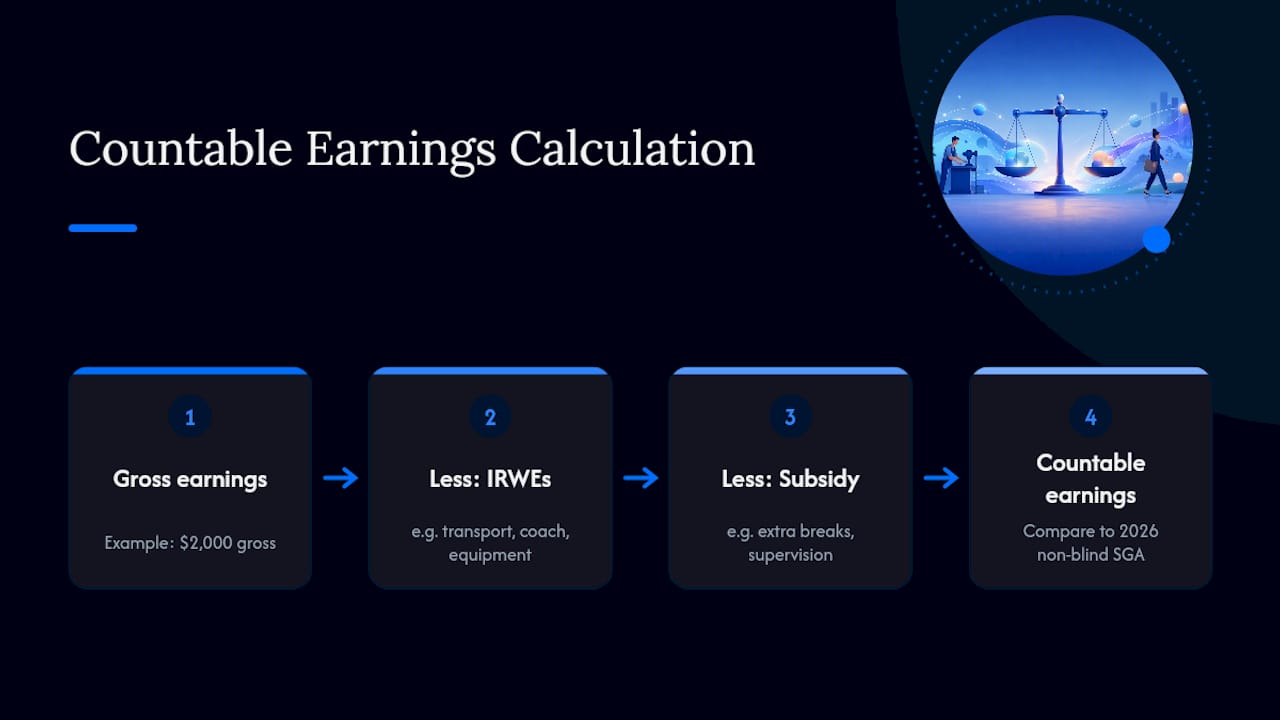
The agency starts with gross earnings, then subtracts two categories: impairment-related work expenses (IRWEs) and any subsidy value built into your wages. An IRWE is money you spend out of pocket on items or services you need because of your disability in order to work, things like specialized transportation, a job coach, or modified equipment. A subsidy is the portion of your pay that reflects your employer's support rather than your own productivity, like extra breaks, reduced output expectations, or additional supervision.
Here's a simplified 2026 example. Say you earn $2,000 a month gross.
In this example, countable earnings fall below the 2026 non-blind SGA threshold, even though the gross paycheck looked like it exceeded it. The SSA also applies averaging rules when earnings fluctuate month to month, and it factors in unsuccessful work attempts separately, both covered under 416.974.
Pro Tip: Keep every pay stub, mileage log, and receipt tied to disability-related work costs in one folder from day one. SSA determinations on subsidies and IRWEs almost always come down to paper trails, not verbal explanations, and reconstructing six months of expenses from memory rarely goes well.
Special Cases: Blind Limits, Self-Employment, and Unsuccessful Work Attempts
The general SGA rule doesn't apply the same way to every claimant, and the exceptions matter as much as the base rule.
Statutorily blind individuals get a higher monthly limit, $2,830 in 2026 versus $1,690 for everyone else. Congress built this gap into the law because blindness-related work limitations don't map cleanly onto the same earnings scale as other impairments. Both figures move annually, so checking SSA's current SGA amounts page before relying on any number is worth the two minutes it takes.
Unsuccessful work attempts (UWAs) protect claimants who try to return to work and fail because of their medical condition. If you stop working within six months due to your impairment, and you meet SSA's continuity conditions, such as a gap of at least 30 days before the attempt began, that period of earnings generally doesn't count as proof you can sustain SGA. This rule exists specifically because SSA recognizes that a short, failed comeback attempt shouldn't permanently disqualify someone who genuinely tried and couldn't manage it, a principle explained in SSA's POMS guidance.
Self-employment gets evaluated differently than wage work, since profit and loss statements don't reflect actual work effort the way a paycheck does. SSA instead looks at hours, duties, and whether the work is comparable to what a non-disabled person would do in that role.

Sheltered workshops and subsidized programs often involve pay that doesn't reflect real market value. When an employer or program pays above what the actual work is worth, SSA can subtract that subsidy before testing against the SGA limit, an approach detailed under 416.974. Certain federally supported volunteer programs also get excluded from counting altogether in specific circumstances, per related SSA regulations.
Working After SSDI Approval: TWP and Extended Eligibility
Getting approved for SSDI doesn't mean you're locked out of ever working again. The SSA built a structured path for testing your ability to return to work, and understanding its timeline prevents a lot of avoidable panic.
The Trial Work Period (TWP) lets you work and keep full SSDI benefits for up to nine months, regardless of how much you earn, as long as you report the work. Those nine months don't need to be consecutive. They accumulate within a rolling 60-month window, and any month where earnings exceed a separate, lower "trial work" threshold counts toward that total.
Once you've used all nine TWP months, you enter the Extended Period of Eligibility (EPE), a 36-month window where SSA checks your earnings against the standard SGA limit each month. Earn above $1,690 (non-blind) in any month during the EPE, and that month's benefit gets suspended. Drop back below the limit, and benefits typically resume without a new application.
Here's the practical order of events:
- Months 1 through 9 (TWP): Full benefits continue no matter your earnings, as long as you report income to SSA.
- Months 10 through 45 (EPE): Benefits are paid in any month you're below SGA and suspended in any month you're above it.
- After the EPE ends: If you're still working above SGA, benefits terminate, but expedited reinstatement rules exist if your condition worsens again within five years.
Pro Tip: Report every change in earnings to SSA the same month it happens, not at your next scheduled review. Recipients who wait to report often end up facing overpayment notices for benefits paid during months they were technically over the limit, and clawing that money back from SSA is far harder than reporting it up front.
What to Do if Your Earnings Are Near or Over the SGA Limit
If your monthly paycheck is creeping close to $1,690, don't wait for SSA to flag it during a continuing disability review. Take these steps now.
Report the earnings immediately. Call or use SSA's wage reporting tools the moment your income changes. Silence doesn't protect you. It just delays a correction that will eventually happen anyway, often with an overpayment bill attached.
Gather your documentation before SSA asks for it. Pull together pay stubs, any receipts for IRWEs like medical equipment or accessible transportation, and a written statement from your employer describing any accommodations, reduced productivity expectations, or extra supervision you receive. If your job involves any subsidy, get that confirmed in writing.

Request a countable earnings review. You have the right to ask SSA to recalculate your countable earnings if you believe subsidies or IRWEs were left out. This isn't automatic. SSA works from what you submit, so incomplete paperwork usually means a higher, less favorable countable earnings figure.
Track dates obsessively. The date your impairment forced you to stop a job, the date you started an accommodation, the date a subsidy began, all of it matters if you ever need to argue an unsuccessful work attempt or dispute a countable earnings determination on appeal.
When a Disability Attorney Helps With SGA Disputes
SGA disputes are rarely about whether you worked. They're about whether the SSA calculated your countable earnings correctly, and that's where legal representation earns its keep.
A disability attorney or accredited representative typically handles several tasks in an SGA-related case:
- Gathering and organizing documentation proving IRWEs, from medical equipment receipts to specialized transportation costs.
- Building the factual record for an unsuccessful work attempt, including employer statements about why the job ended.
- Arguing subsidy and subtraction claims when SSA's initial countable earnings calculation looks too high.
- Representing you at hearings where a judge, not just a claims examiner, will decide whether your work history supports or undermines your disability claim.
Representation tends to matter most in a few recurring scenarios: appeals after an SGA-based denial, self-employment cases where profit and loss don't reflect actual effort, and situations involving repeated short-term jobs that might qualify as unsuccessful work attempts. Claimants managing complex subsidy arrangements, like sheltered workshop pay, also benefit from someone who can translate SSA's subtraction rules into a coherent argument. Reviewing how legal representation affects claim outcomes gives a fuller picture of what a representative actually contributes at each stage.
Expect an initial consultation to focus heavily on paperwork. Most attorneys will ask for recent pay stubs, any SSA correspondence you've received, medical records tied to the relevant time period, and a list of any work-related expenses connected to your condition.
Pro Tip: Bring your documentation to the first consultation even if it feels incomplete. An attorney can often identify what's missing faster than you can guess at it, and starting that conversation early gives more time to gather evidence before a deadline forces the issue.
A Practical Note on Where Claimants Go Wrong
The mistakes that sink SGA cases are rarely dramatic. They're small, avoidable, and repeat constantly across claims. Underreporting earnings tops the list, usually not out of dishonesty but because claimants assume a slow month won't matter or that SSA already has the numbers from tax filings. It doesn't work that way, and the gap between assumption and reality is where overpayment notices come from.
The second recurring error is failing to track impairment-related work expenses as they happen. Claimants remember the big medical bills but forget the $40 a week spent on accessible transportation, and by the time SSA asks for proof, six months of receipts are gone. The third is misclassifying volunteer work, treating it as automatically safe because no paycheck is involved, when the actual test is whether the activity has economic value, not whether money changed hands.
None of these mistakes require a lawyer to avoid. They require a habit: write things down the week they happen, not the month before a review. If your earnings are approaching the SGA threshold, that habit becomes the difference between a smooth continuation of benefits and a drawn-out dispute.
How Ssdilawyer Can Help You Sort Out an SGA Question
Untangling countable earnings, subsidies, and unsuccessful work attempts on your own is possible, but it's the kind of paperwork fight where a wrong calculation costs you benefits you're actually entitled to keep. Ssdilawyer connects you directly with disability attorneys who handle SGA disputes regularly, instead of leaving you to interpret SSA's subtraction formulas from a government worksheet.
Before reaching out, pull together a few things: recent pay stubs, any letters SSA has sent you, medical records covering the period in question, and a running list of impairment-related expenses like transportation or equipment costs. Having this ready shortens the intake conversation considerably. If you're also weighing how SGA affects a mixed SSDI and SSI household, understanding the differences between SSDI and SSI beforehand helps you ask sharper questions. The intake process through Ssdilawyer's site takes just a few minutes, and it matches you with an attorney suited to your specific situation rather than a general referral list.
Sources
These are the primary sources behind the rules covered in this guide, useful if you want to verify a figure or read the regulatory language directly.
The SGA amounts page publishes the current and historical monthly thresholds. 20 C.F.R. § 416.972 contains the legal definition of substantial gainful activity, including the list of non-SGA activities. 416.974 explains how SSA calculates countable earnings, subsidies, and averaging. The Red Book offers a plain-language overview of how SGA fits into the broader disability determination process, and SSA's overview pamphlet summarizes the disability determination steps for a general audience.
- Substantial Gainful Activity (SGA) amounts (SSA)
- 416.972 What we mean by substantial gainful activity. (CFR via Cornell LII)
- POMS: DI 10501.001 - Meaning of SGA and Scope of Subchapter (SSA POMS)
- How Do We Define Disability? | The Red Book (SSA)
This article provides general information about Social Security Disability rules and isn't a substitute for professional legal advice. Confirm current SGA thresholds and how they apply to your case with the SSA directly or a qualified disability attorney.
This article is general information, not a substitute for advice from a qualified lawyer. Consult a qualified legal professional about your own circumstances before acting on anything here.