
Fill every job entry for the five years before you became unable to work. That is the single most important action on the SSA Work History Report (Form SSA-3369-BK). Each entry must include specific dates, hours per day, days per week, rate of pay, and a task-level description of physical demands. Adjudicators use this information to determine whether you can return to past work and what your residual functional capacity (RFC) is.
Three actions to take right now:
- Download the official PDF from the SSA forms page and print or save it before you write anything.
- Gather supporting documents: W-2s, paystubs, employer contact information, and any job descriptions you still have.
- Draft one complete job entry as a test run before filling the full form, using the field-by-field guidance below.
Review POMS DI 22515.030 for the processing rules adjudicators follow when they receive your completed form.
Key Takeaways
The SSA Work History Report (Form SSA-3369-BK) requires specific, task-level job descriptions for every job in the five years before you became unable to work, and vague entries are the most common reason claims stall or are denied.
| Point | Details |
|---|---|
| Five-year window | List all jobs from the five years before you became unable to work, in MM/YYYY format. |
| Answer every field | Blank fields signal omission; write "don't know" when a detail is genuinely unavailable. |
| Task-level descriptions | Name specific tasks, lifting weights, postures, and environmental conditions for each job. |
| Verify your earnings record | Use your my Social Security account to confirm wages before submitting; correct errors early. |
| Ssdilawyer | Connects claimants with disability attorneys who draft, review, and submit Work History Reports. |
Table of Contents
- What is the SSA Work History Report and where do you get it?
- Who fills the form, which jobs to include, and the five-year rule
- How to fill out each section of SSA-3369-BK
- What details does SSA expect for each job?
- Common mistakes that cause problems with your SSA Work History Report
- Documents and evidence to gather before you submit
- How to submit SSA-3369-BK and what happens after
- When should you get legal help with the Work History Report?
- What completing the SSA-3369 taught me about specificity
- Ssdilawyer connects you with attorneys who handle the Work History Report
- Sources
What is the SSA Work History Report and where do you get it?
Form SSA-3369-BK is a structured questionnaire that supplements the initial disability application (Form SSA-3368-BK). Its purpose is to give adjudicators granular, job-level detail about the physical and functional demands of your past work so they can assess whether you retain the capacity to perform it.
The authoritative source is the SSA forms page, where the SSA-3369-BK is listed among commonly used forms with a direct link to the official PDF. Do not use a third-party version of this form. The SSA PDF is the only version that reflects current field labels and instructions.
The front page of the form states:
That instruction is not a suggestion. Blank fields signal to adjudicators that a job was light or sedentary, which can be used to conclude you retain RFC for that type of work.
Who fills the form, which jobs to include, and the five-year rule
Who completes it: The claimant fills the form. If someone else assists, that person identifies themselves in Section 4. Section 4 must be completed regardless of who writes the answers.
Which jobs to include:
- All jobs held in the five years immediately before you became unable to work, listed with start and end dates in MM/YYYY format.
- Self-employment counts. Foreign work counts. Both must be listed.
- Do not list any job held for fewer than 30 calendar days.
The five-year window is defined by the date you became unable to work, not the date you filed your claim. If you stopped working in March 2023, your relevant period runs back to March 2018. POMS DI 22515.030 provides adjudicators with specific guidance on how to define this relevant period for Title II claims.
Omitting self-employment or foreign work is a common error. When those jobs are missing, adjudicators may conduct an incomplete vocational assessment and conclude you can perform other work you are not actually capable of doing.
How to fill out each section of SSA-3369-BK
Fill the sections in order. Section 2 and the job subsections require the most detail and carry the most weight in adjudication.
- Section 1 — Applicant identification. Enter your full name, Social Security number, and date of birth exactly as they appear on your SSA records.
- Section 2 — Work history list. List each qualifying job with job title, employer name, and dates (MM/YYYY). One row per job. If you held the same job title at different employers, list each separately.
- Job subsections — Detailed duties and demands. For each job listed in Section 2, complete the corresponding subsection with hours per day, days per week, rate of pay, task descriptions, and physical/environmental demands.
- Section 3 — Remarks. Use this space to continue any job description that does not fit in the subsection, to clarify unusual circumstances, or to note that you are attaching additional pages. Write your name and Social Security number on every supplementary page.
- Section 4 — Who completed the form. The claimant or the person assisting must sign and date here.
Sample job entry
Job title: Retail cashier Type of business: Grocery store Dates worked: 06/2019 to 02/2023 Hours per day: 7 Days per week: 5 Rate of pay: $13.50/hour
Tasks and physical demands: Operated cash register, scanned and bagged groceries, handled cash and card transactions, and stocked shelves during slow periods. Stood for 6 of 7 hours per shift. Lifted and carried bags and boxes weighing up to 30 lbs. Reached overhead to stock shelves. Bent and stooped repeatedly throughout the shift. Used both hands for scanning, bagging, and keypad entry.
Form field reference
| Form field | What to write | Why it matters |
|---|---|---|
| Hours per day | Your actual average, not a full-time assumption | Adjudicators use this to gauge exertional level |
| Days per week | Actual schedule, including part-time | Affects whether the job qualifies as substantial gainful activity |
| Rate of pay | Dollar amount and frequency (hourly, weekly) | Corroborates earnings records and SGA determination |
| Task description | Specific verbs: lifted, carried, stood, bent, reached | Vague verbs allow RFC assumptions that hurt your claim |
| Lifting/carrying | Maximum weight and frequency | Maps directly to SSA's exertional categories (sedentary to very heavy) |
| Supervisory duties | Yes/no; if yes, how many people | Affects skill level classification |
Pro Tip: If you genuinely do not remember a detail, write "don't know" rather than leaving the field blank. A blank field is treated as an omission; "don't know" signals an honest attempt to comply with the instruction to answer every question.
What details does SSA expect for each job?
POMS DI 11005.025 specifies the items adjudicators expect for each job: job title, type of business, dates in MM/YYYY format, hours per day, days per week, rate of pay and frequency, writing or report duties, and physical and environmental requirements.
Required fields per job:
- Job title (as you actually performed it, not the HR title)
- Type of business or industry
- Start and end dates (MM/YYYY)
- Hours per day and days per week
- Rate of pay and pay frequency
- Whether you wrote reports or performed supervisory duties
- Physical demands: sitting, standing, walking, lifting, carrying, use of hands, bending, stooping, reaching, climbing
- Environmental conditions: exposure to heat, cold, fumes, noise, heights, or vibration
Three sample job descriptions
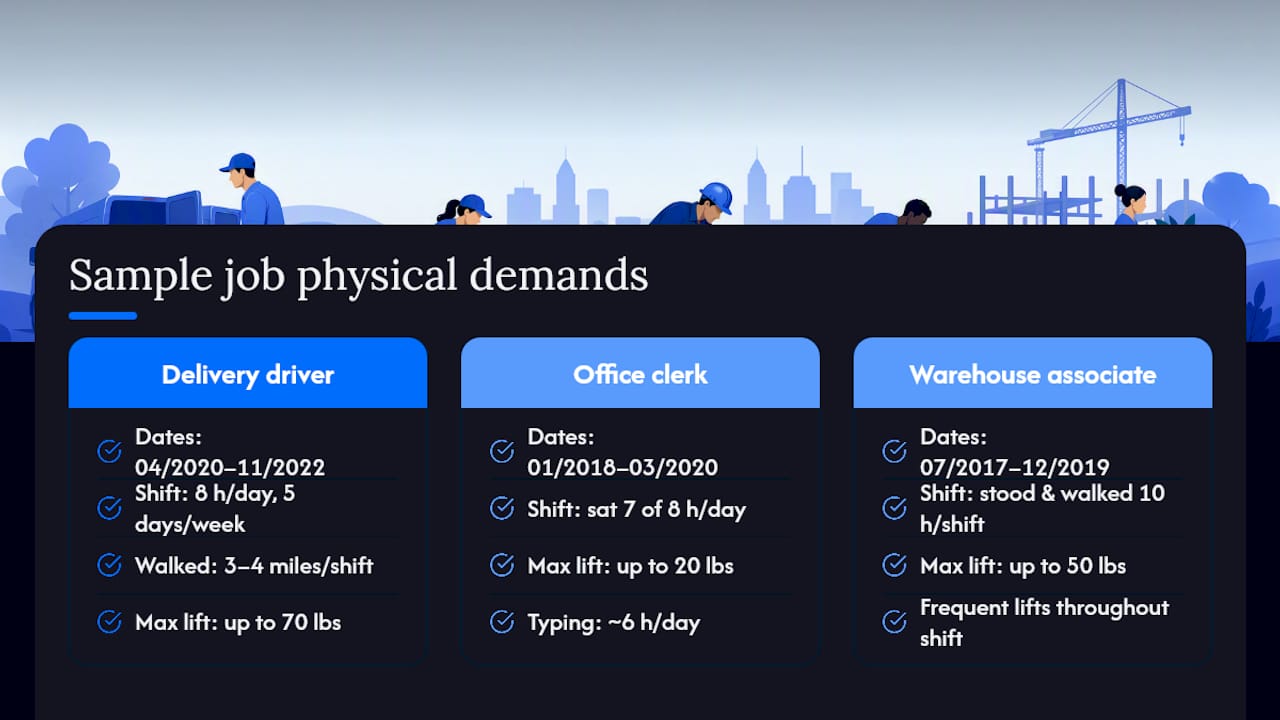
Delivery driver (package delivery company, 04/2020 to 11/2022): Loaded and unloaded packages weighing up to 70 lbs. Drove a cargo van on a fixed route for 8 hours per day, 5 days per week. Walked 3–4 miles per shift carrying packages. Climbed in and out of the van approximately 80 times per day. Used a handheld scanner for deliveries.
Office clerk (insurance company, 01/2018 to 03/2020): Processed paper and electronic files, answered phones, and entered data into a claims management system. Sat for 7 of 8 hours per day. Lifted file boxes weighing up to 20 lbs. Reached into overhead cabinets and bent to access lower drawers. Typed for approximately 6 hours per day.
Warehouse associate (distribution center, 07/2017 to 12/2019): Pulled orders from shelves, packed boxes, and moved pallets using a hand truck. Stood and walked for the full 10-hour shift. Lifted items weighing up to 50 lbs repeatedly throughout the shift. Worked in a refrigerated section at approximately 35°F for 4 hours per day.
Sample physical-demands sentence you can adapt:
"I stood for [X] hours per shift, walked approximately [X] miles per day, and lifted items weighing up to [X] lbs frequently and up to [X] lbs occasionally. I used both hands for [specific tasks] and bent or stooped [frequency] throughout the shift."
Pro Tip: Describing physical demands for jobs with heavy exertion is especially important. SSA's exertional categories hinge on maximum lifting and carrying weights, so an imprecise number can shift your classification from "heavy" to "medium" work, which changes the vocational analysis entirely.
Common mistakes that cause problems with your SSA Work History Report
The single biggest risk is a vague or minimal duty description. When adjudicators cannot determine the actual physical demands of a job, they apply assumptions that typically favor lighter work classifications.
Frequent errors:
- Vague verbs: Writing "helped customers" instead of "lifted and carried merchandise weighing up to 40 lbs, stood for 8 hours, and operated a cash register."
- Relying on W-2s alone: Tax records confirm earnings but provide no functional job detail. As POMS DI 11005.025 makes clear, the form requires task-level, environmental, and exertional details, not earnings summaries.
- Omitting self-employment or foreign work: Both count toward the five-year window and must be listed.
- Leaving fields blank: Blank fields are treated as omissions, not as "not applicable."
- Inconsistent dates: Dates that conflict with your SSA earnings record create credibility problems during adjudication.
- Understating exertion: Claimants sometimes minimize physical demands out of habit or modesty. Write what the job actually required at its most demanding, not what you could tolerate on a good day.
Before and after example:
Weak: "Worked in a warehouse doing general labor."
Strong: "Pulled and packed orders in a distribution warehouse for 10 hours per day, 5 days per week. Lifted boxes weighing up to 50 lbs repeatedly. Stood and walked for the entire shift. Worked in a refrigerated area at approximately 35°F for 4 hours per day."
The strong version maps directly to SSA's exertional and environmental categories. The weak version gives adjudicators nothing to work with.
Documents and evidence to gather before you submit
Corroborating documents reduce the risk that your self-reported job details will be questioned during adjudication.
| Document | What it confirms | Where to get it |
|---|---|---|
| W-2 | Employer name, dates, and earnings | IRS transcript or personal records |
| Paystubs | Hours, pay rate, and job title | Personal records or employer HR |
| Official job description | Duties and physical requirements | Employer HR department |
| Performance reviews | Duties, attendance, and job demands | Employer HR department |
| Supervisor contact info | Verification of dates and duties | Employer HR or personal contacts |
| Medical records tied to work incidents | Physical limitations during employment | Treating physician or hospital |
Employer letter template (adapt as needed):
"To Whom It May Concern: I am writing to request written confirmation of my employment with [Employer Name] from [MM/YYYY] to [MM/YYYY], including my job title, primary duties, physical requirements of the position (lifting, standing, walking, etc.), and hours worked per week. This information is needed to support a Social Security disability claim. Please respond to [your name, address, phone, or email]. Thank you."
Use your my Social Security account to view your full earnings record before submitting the form. If an employer's wages are missing or incorrect, request a correction through SSA before the form reaches adjudication. Correcting earnings early prevents contradictory records from surfacing later. Note that in 2026, one Social Security credit equals $1,890 in earnings, so missing wage entries can affect both your eligibility and your benefit calculation.
Pro Tip: Print your SSA earnings statement from your my Social Security account and compare it line by line against your W-2s. Any year where the figures differ is a year worth correcting before you submit the Work History Report.
How to submit SSA-3369-BK and what happens after
You can return the completed form in four ways:
- Mail: Send to the SSA office address on the cover letter that accompanied the form. Keep a dated copy for your records.
- Fax: Use the fax number on the cover letter. Confirm receipt with the office.
- In person: Deliver to your local Social Security office. Request a receipt or date stamp.
- Upload via my Social Security: When SSA instructs you to attach documents through your online account, you can upload the completed PDF directly.
Follow any specific instructions in the cover letter SSA sends with the form. POMS DI 22515.030 allows adjudicators to send a partially completed SSA-3369 to claimants for completion, so read the cover letter carefully before assuming the form is blank.
After submission, the Disability Determination Services (DDS) office:
- Reviews your job descriptions against medical evidence to assess your RFC.
- Determines whether you can perform your past relevant work as actually or generally performed.
- May contact you for clarification if descriptions are incomplete or inconsistent with other records.
- Uses the information in combination with vocational expert testimony at hearings when the claim advances to that stage.
Keep a complete copy of everything you submit. The Work History Report becomes part of your permanent claimant file and will be referenced at every stage of adjudication.
When should you get legal help with the Work History Report?
Get legal help when your work history is complex, when your medical limitations are not clearly reflected in standard job descriptions, or when you have already received a denial.
Signs you need a disability attorney:
- Your employment record includes multiple short-term jobs, gaps, or overlapping positions.
- You were self-employed and your duties and income are difficult to document.
- A prior employer is unavailable, out of business, or unresponsive to requests for records.
- Your medical condition affected your job performance in ways that standard duty descriptions do not capture.
- You have received a denial and are preparing for reconsideration or a hearing.
- Your work history spans foreign employment or unusual occupational categories.
An experienced disability attorney will draft precise job descriptions, collect corroborating evidence, coordinate with vocational experts, and represent you at hearings. The benefits of SSDI legal representation extend well beyond form completion. Attorneys understand how adjudicators interpret RFC findings and can frame your work history to reflect the actual functional demands of each job.
Pro Tip: If you are also completing the Adult Function Report (Form SSA-3373), make sure your physical-demand descriptions are consistent across both forms. Inconsistencies between the SSA-3373 and the SSA-3369-BK are a common basis for credibility challenges during adjudication.
What completing the SSA-3369 taught me about specificity
Gathering records for the Work History Report takes longer than most claimants expect. Tracking down an employer letter from a company that changed ownership, locating paystubs from five years prior, and reconciling dates against an SSA earnings statement are each time-consuming tasks. The step that made the clearest difference was requesting a written letter from a former supervisor confirming not just dates of employment but the specific physical requirements of the job, including maximum lifting weights and the percentage of the shift spent standing. That letter gave the job description a corroborated, third-party basis that self-reported entries alone cannot provide.
The practical takeaway: write every task description as if the adjudicator has never seen your type of job before. Assume nothing is obvious. Name the tools you used, the weights you lifted, the postures you held, and the environmental conditions you worked in. Precision in those details is what separates a claim that moves forward from one that stalls.
Ssdilawyer connects you with attorneys who handle the Work History Report
Completing the SSA-3369-BK accurately requires more than reading instructions. It requires knowing how adjudicators interpret each field and how your job descriptions interact with your medical evidence.
Ssdilawyer connects SSDI claimants with experienced disability attorneys who handle exactly this work: drafting precise job descriptions, gathering corroborating evidence, reviewing forms for completeness, and representing claimants at hearings. The intake process is straightforward. You submit your information through Ssdilawyer, and the service matches you with an attorney suited to your claim. Initial intake is confidential. Attorneys who work through Ssdilawyer handle applications, denials, appeals, and hearings. If your work history is complex or your claim has already been denied, connecting with a qualified attorney before submitting the Work History Report is the most direct way to protect your claim.
Sources
SSA publishes all forms and processing guidance through official channels. Third-party versions of the SSA-3369-BK may be outdated or incorrectly formatted. Use only the sources below.
Key official sources:
This article provides general information about the SSA Work History Report process. It is not legal advice. Confirm current form versions and processing rules directly with SSA or a qualified disability attorney before submitting your claim.
This article is general information, not a substitute for advice from a qualified financial advisor. Consult a qualified financial professional about your own circumstances before acting on anything here.