
Form SSA-3373, the Adult Function Report, is the single most important non-medical document in your SSDI or SSI file. How you answer its 22 questions across 10 pages directly shapes whether a Disability Determination Services (DDS) examiner can build a Residual Functional Capacity (RFC) that supports your claim. Vague answers, inconsistencies, or an overstatement of what you can do on a good day are among the most common reasons close cases go the wrong way.
Immediate steps:
- Download the official SSA-3373 PDF (form version 02-2024) before you do anything else.
- Note your return deadline. DDS typically expects the form back within about 10 days of receipt. Missing that window without notice can result in a "failure to cooperate" denial.
- Make a dated photocopy or scan before you mail or submit anything.
- Identify a reliable third party (spouse, adult child, caregiver) who can complete Form SSA-3380, the Third-Party Function Report, to corroborate your answers.
- List every medication and its side effects before you start writing.
| Form detail | Value |
|---|---|
| Form name | Function Report — Adult |
| Form number | SSA-3373-BK |
| Form version | 02-2024 |
| Total pages | 10 |
| Total questions | 22 |
Table of Contents
- What does the Adult Function Report actually test?
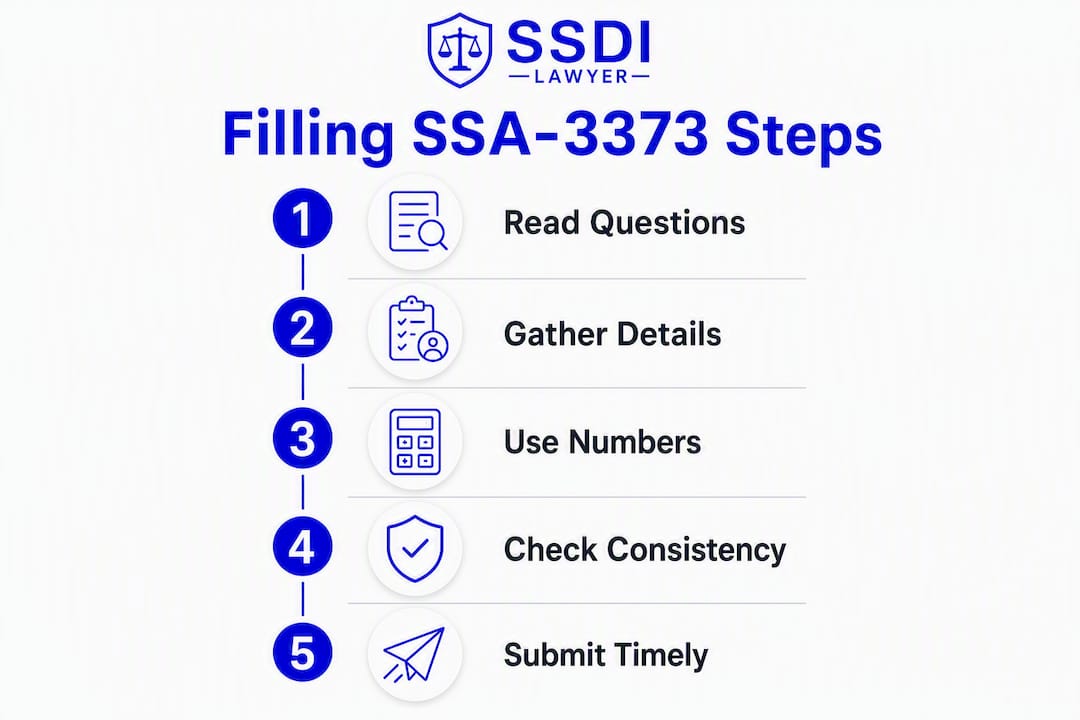
- How to complete each section of Form SSA-3373
- How SSA cross-checks your answers and what contradictions hurt claims
- Sample answers: weak vs. strong phrasing you can adapt
- What happens after you submit, and when is it due?
- When should you get an attorney, and how do you choose one?
- Key Takeaways
- Why precise answers matter more than most claimants realize
- Ssdilawyer can review your Function Report before it costs you
- Official SSA form and reputable resources
What does the Adult Function Report actually test?
DDS examiners are not reading your answers to understand your life. They are reading them to measure specific work-related functions: how long you can sustain attention, whether you can maintain pace across an 8-hour shift, how far you can walk before stopping, how much you can lift and carry, whether you can follow multi-step instructions, and how reliably you can interact with supervisors and coworkers.
The SSA five-step disability evaluation process uses functional information to determine whether a claimant can perform past work or any other work in the national economy. The Function Report fills gaps that medical records alone cannot show, such as how often pain forces you to lie down, or whether fatigue prevents you from concentrating for more than 20 minutes at a stretch. DDS builds your RFC from medical records, your Work History Report, any third-party statements, and your Function Report. When the medical record is thin or ambiguous, the Function Report carries more weight.
The translation principle: If you write "I need to stop and rest twice while getting dressed in the morning," a DDS examiner reads: "This claimant cannot sustain the physical demands of even sedentary work without unscheduled breaks." That single sentence, placed in the right section, can support a finding that you cannot maintain an 8-hour workday. A vague answer like "getting dressed is hard" gives the examiner nothing to work with.
Overlapping questions on the form are intentional. SSA cross-checks your answer about walking distance in Section C against your answer about physical abilities in Section D. If those numbers conflict, credibility drops. Write your answers with that cross-check in mind from the start.
How to complete each section of Form SSA-3373

The section-by-section approach that reduces denial risk follows a consistent principle: answer with numbers, not adjectives. "I can walk half a block before stopping to rest for 10 minutes" is evidence. "I can't walk very far" is not.
Section A: Administrative information (questions 1–4)
Provide your correct Social Security number and contact details. The living-arrangement question matters more than it looks. If you report living alone, an examiner may infer you perform all household tasks independently. If you receive help, state it explicitly: "My daughter does the grocery shopping and laundry. I cannot carry bags or stand at the stove for more than 5 minutes."
Section B: Your illnesses, injuries, or conditions (question 5)
List every diagnosis. For each one, write a brief note connecting it to a work limitation. Include medication side effects here, not just the condition itself. "Gabapentin causes dizziness and drowsiness that last 2–3 hours after each dose, taken three times daily" is the kind of detail that supports an RFC limitation for off-task time.
Section C: Daily activities (questions 6–19)
This is the largest section and the one where most claims are damaged. A few rules:
- Describe your average or worst day, not your best. SSA wants to know what you can sustain across a five-day workweek, not what you managed once last month.
- Use time and frequency. "I sleep 10–12 hours but wake 3–4 times due to pain" is stronger than "I don't sleep well."
- Personal care: If bathing takes 30 minutes because you must sit and rest, say so. If someone helps you, name them and describe the help.
- Household tasks: State what you cannot do and why. "I cannot vacuum because pushing the vacuum for more than 2 minutes causes lower back pain rated 8/10."
- Mobility and shopping: Give distances and durations. "I can drive 10 minutes before leg pain requires me to stop."
- Social activities: If you avoid crowds or have difficulty with conflict, note frequency and triggers.
Pro Tip: Draft Section C answers in a separate document first. Read them aloud and ask: does every answer include a time, distance, frequency, or physical threshold? If not, add one before transferring to the form.
Section D: Abilities checklist (questions 20–22)
Complete this section with the same quantifiers you used in Section C. If you wrote in Section C that you can walk half a block, do not check "1 mile" in Section D's walking question. For cognitive limits, be specific: "I can follow written instructions for simple tasks but lose track after 3–4 steps due to medication fog." For social limitations, note whether the problem is initiating contact, sustaining conversation, or handling criticism.
How SSA cross-checks your answers and what contradictions hurt claims
DDS compares your Function Report to your SSA-3368 (Disability Report), your Work History Report, the Third-Party Function Report (SSA-3380), and your medical records. Any mismatch becomes a credibility issue.
Common contradictions that damage claims:
- Reporting you can lift 20 pounds in Section D but describing carrying groceries without difficulty in Section C.
- Stating you have no social difficulties but listing regular attendance at group activities.
- Claiming you cannot stand more than 10 minutes but reporting you cook full meals daily without noting seated preparation or frequent breaks.
- Describing a limitation in the Function Report that your treating physician has never documented.
Self-audit checklist before you submit:
- Compare every distance and weight figure across Sections C and D. They must match.
- Check that your medication side effects appear in both Section B and Section D (where relevant to concentration, pace, or attendance).
- Confirm your Third-Party Function Report (SSA-3380) uses the same distances, frequencies, and help descriptions as your own report.
- Pull your most recent physician notes and verify your described limitations are consistent with documented findings.
- Review your SSA-3368 Disability Report and confirm the conditions listed there match what you wrote in Section B.
If you already submitted a form with inconsistencies, call DDS promptly. Explain the discrepancy and ask whether you can submit a written addendum. Many examiners will accept a clarifying statement when it arrives before a determination is made. Understanding how your SSDI claimant file is assembled can help you anticipate where these conflicts are most likely to surface.
Sample answers: weak vs. strong phrasing you can adapt
The difference between a denied claim and an approved one often comes down to a single sentence. The following paired examples show the contrast between answers that give examiners nothing to work with and answers that build a concrete RFC picture.
1. Mobility
Weak: "I have trouble walking long distances."
Strong: "I can walk approximately half a block (about 150 feet) before I must stop and rest for 5–10 minutes due to left knee pain. I repeat this pattern no more than twice before I must sit or lie down."
2. Personal care
Weak: "Bathing is difficult for me."
Strong: "I shower seated using a shower chair. The process takes 30–40 minutes. My spouse assists with washing my lower legs and feet because bending causes severe lower back pain rated 7/10."
3. Concentration and memory
Weak: "I have trouble concentrating."
Strong: "I can focus on a simple task (reading, watching television) for 10–15 minutes before I lose my train of thought. I cannot follow a conversation with more than two people. I forget appointments and must use written reminders for daily tasks."
4. Medication side effects
Weak: "My medication makes me tired."
Strong: "Hydrocodone causes drowsiness within 30–45 minutes of each dose. I take it twice daily. The drowsiness lasts approximately 2 hours per dose, during which I cannot drive, read, or hold a conversation."
5. Describing a typical day
Weak: "I mostly stay home and rest."
Strong: "I wake at 8 AM after 9 hours of broken sleep (waking 2–3 times due to pain). I spend 45 minutes getting dressed and eating breakfast, then rest for 1–2 hours. I can manage one short task (a 10-minute phone call or brief walk to the mailbox) before needing to lie down again. By 3 PM I am usually in bed for the remainder of the day."
6. Need for rest periods
Weak: "I need to rest during the day."
Strong: "I lie down 2–3 times per day for 45–60 minutes each time due to fatigue and pain. These rest periods are unscheduled and cannot be predicted. I cannot complete a task that requires sustained standing or sitting for more than 20 minutes without a break."
Adapt these templates to your actual experience. If your worst days are significantly worse than your average days, note that explicitly: "On my worst days, which occur 3–4 times per week, I cannot leave my bedroom." Examiners are trained to assess sustainable functioning, not isolated performance. The National Academies' functional assessment framework confirms that linking daily activity descriptions to work demands is the standard method for translating limitations into RFC findings.
What happens after you submit, and when is it due?
The Function Report typically arrives 4–6 weeks after you file your application, and DDS generally expects it back within about 10 days. That window is shorter than most claimants expect.
| Timeframe | Action required |
|---|---|
| Day 1 (form received) | Date-stamp your copy; read all 22 questions before writing a single answer |
| Days 1–3 | Draft answers in a separate document; run the self-audit checklist |
| Days 4–7 | Transfer final answers to the form; have your third party complete SSA-3380 |
| Day 8–10 | Submit by the deadline; keep a dated photocopy or scan |
| If you need more time | Call DDS before the deadline and request an extension; note the name of the person you spoke with and the date |
| After submission | Expect possible DDS phone contact within 2–4 weeks; a consultative exam (CE) may be scheduled if medical evidence is insufficient |
If you miss the deadline: Return the form anyway, with a dated cover note explaining the delay. Call DDS to confirm the file is still open. Many examiners will accept a late form when they receive prior or prompt notification. A form returned late with an explanation is far better than no form at all.
Record-keeping after submission:
- Keep a copy of every page you submitted, dated.
- Log the name of any DDS contact, the date, and what was discussed.
- If a consultative exam is scheduled, bring a written summary of your limitations and your medication list.
- Attach supporting medical notes to the form only when they directly clarify a specific answer.
When should you get an attorney, and how do you choose one?
Not every claimant needs an attorney at the Function Report stage. The decision depends on the complexity of your file.
Hire an attorney now if:
- You have already received one or more denials.
- Your medical records are incomplete, conflicting, or from multiple providers who have not coordinated.
- You have a hearing scheduled before an Administrative Law Judge (ALJ).
- Your RFC is genuinely ambiguous (for example, you have both physical and mental impairments that interact).
- You are unsure whether your answers are consistent with your medical records.
Consider waiting if:
- Your claim is straightforward, your medical evidence is strong and consistent, and you have no prior denials.
Handle it yourself only if:
- Your condition is well-documented, your limitations are clear and consistent, and you have no history of denials or appeals.
Red flags that justify immediate attorney involvement:
- Multiple denials on file.
- A treating physician's opinion that conflicts with your described limitations.
- Significant gaps in your medical treatment history.
- A consultative exam result that understates your limitations.
Questions to ask during a free consultation:
- Have you handled claims involving my specific impairment (e.g., fibromyalgia, degenerative disc disease, bipolar disorder)?
- How do you review a completed Function Report before submission or on appeal?
- What is your contingency fee, and what costs am I responsible for if the claim is denied?
- How will you communicate with me during the process?
Ssdilawyer connects claimants with experienced SSDI attorneys through a free intake process. You describe your situation, and the service matches you with an attorney who handles cases like yours. There is no upfront cost. SSDI attorneys work on contingency, meaning they are paid only if your claim succeeds. For older claimants, understanding SSDI older worker rules can also clarify how functional limitations interact with vocational considerations at steps 4 and 5 of the evaluation.
Key Takeaways
Completing the Adult Function Report with specific, consistent, work-capacity language is the single most effective step a claimant can take to protect an SSDI or SSI claim before DDS makes a determination.
| Point | Details |
|---|---|
| Download the official form | Use the SSA-3373-BK (version 02-2024) directly from SSA.gov before starting. |
| Answer for average or worst days | Describe what you can sustain across a workweek, not your best single performance. |
| Use numbers throughout | Include time, distance, frequency, and weight in every relevant answer. |
| Run the self-audit | Cross-check all figures between Sections C and D and against your medical records before submitting. |
| Get a third-party report | Ask someone who sees your daily limitations to complete Form SSA-3380 with matching specifics. |
| Ssdilawyer matching service | Connect with an experienced SSDI attorney through a free intake if red flags are present in your file. |
Why precise answers matter more than most claimants realize
The Function Report is where claimants most often undermine their own cases, and the mechanism is almost always the same: they answer the way they wish things were, or the way they were on a good day, rather than the way things actually are most of the time.
An examiner reviewing a file where the claimant reports cooking full meals, driving regularly, and attending church weekly will build an RFC that reflects those activities, regardless of what the medical records say about pain levels. The form is not asking what you are capable of in theory. It is asking what you actually do, how long it takes, and what happens afterward.
One pattern that appears repeatedly in appealed cases involves a small inconsistency that compounds. A claimant writes in Section C that a family member does the laundry, but in Section D checks that they can carry 20 pounds. The examiner notes the contradiction. At the hearing, the ALJ asks about it. The claimant cannot explain it clearly. That single mismatch shifts the credibility assessment for the entire file. On appeal, once the inconsistency was identified and a clarifying addendum submitted alongside updated physician notes, the RFC was revised to reflect the actual limitation. The lesson is not that one mistake is fatal. It is that one mistake, left unaddressed, can define how every other answer in the file is read.
If you are uncertain whether your answers are consistent, or if you have already submitted a form you now question, the time to act is before DDS issues a determination. A written disability report review by an experienced attorney can identify problems that are still correctable at this stage.
Ssdilawyer can review your Function Report before it costs you
Completing the SSA-3373 accurately is one thing. Knowing whether your answers will hold up against your medical records, your Work History Report, and a DDS examiner's RFC analysis is another. Ssdilawyer connects you with experienced SSDI disability attorneys who review Function Reports as part of the intake process, identify red flags before they become denial reasons, and represent claimants through hearings when needed.
The intake is free. Attorneys in the network work on contingency, so there is no fee unless your claim succeeds. To get started, submit your information at Ssdilawyer.co. Have your diagnosis list, medication list, and any prior denial notices ready. A matched attorney will contact you to review your file, assess your Function Report answers, and outline the next steps for your specific situation.
Official SSA form and reputable resources
- Form SSA-3373-BK (Function Report — Adult, version 02-2024): The official 10-page, 22-question form from SSA.gov. Download directly from this link. Keep a printed copy of every page you submit and note the date you mailed or uploaded it.
- DisabilityExchange: SSA-3373 How-To Guide: Practical section-by-section guidance including deadline information and the cross-check explanation. Useful for claimants who want additional sample phrasing.
- National Academies Functional Assessment for Adults with Disabilities: The authoritative research framework linking daily activity descriptions to work demands and RFC development. Relevant if you want to understand the evidentiary basis for how SSA uses functional information.
Verify receipt of your submitted form by calling DDS directly and asking them to confirm it is in your file. Do not assume receipt because you mailed it.
This article provides general information about the SSA Adult Function Report process and is not legal advice. Confirm current SSA requirements and deadlines with DDS or a qualified disability attorney for your specific situation.