
A disability lawyer's written disability report is a detailed medical-legal document that translates your diagnosed conditions into specific, measurable work-related limitations the Social Security Administration requires to approve a claim. This document, formally known as a Physician's Statement of Disability or an Attending Physician Statement, sits at the center of every strong SSDI application. Understanding the disability lawyer written disability report explained in full gives you a clear picture of what your attorney builds, why each section matters, and how you can help make it stronger. The SSA evaluates every report against two core standards: supportability and consistency with the overall medical file.
What does a disability lawyer's written disability report contain?
A well-structured disability report covers six distinct categories of information. Each category serves a specific function in the SSA's review process, and missing even one weakens the entire claim.
- Diagnosis summary. The report lists every diagnosed condition using formal medical terminology, ICD codes, and the dates each condition was first documented. Vague descriptions like "back pain" carry less weight than "lumbar disc herniation at L4-L5 confirmed by MRI dated march 2024."
- Symptom description and progression. The report documents how symptoms have changed over time. A condition that has worsened over 18 months tells a different story than one that appeared last month.
- Objective clinical findings. MRIs, nerve studies, cognitive tests, and laboratory results form the factual backbone of the report. These findings give adjudicators concrete data rather than subjective accounts.
- Daily functional limitations. The report specifies what you cannot do: how long you can sit, stand, or walk; how much weight you can lift; how often you need breaks. These details map directly to SSA's Residual Functional Capacity categories.
- Treatment history and response. Every medication, therapy, and procedure is listed alongside your response to it. A treatment that failed to improve function strengthens the argument that the condition is severe and persistent.
- Legal framing of impairments. Your attorney frames each limitation against SSA's definition of disability, showing that no combination of your restrictions allows you to perform any substantial gainful activity.
Pro Tip: Ask your attorney to confirm that every diagnosis in the report is backed by a dated clinical record. An unsupported diagnosis gives the SSA grounds to discount the entire opinion.
The importance of disability reports comes down to this: the SSA does not take your word for how sick you are. Every claim in the report must be anchored to a document in your medical file.

How does a lawyer ensure the report meets SSA standards?
SSA adjudicators prioritize medical opinions that demonstrate strong supportability and consistency with the overall medical file. A report that contradicts your treatment records, or that makes claims unsupported by test results, will be dismissed. Lawyers use a structured process to prevent both problems.
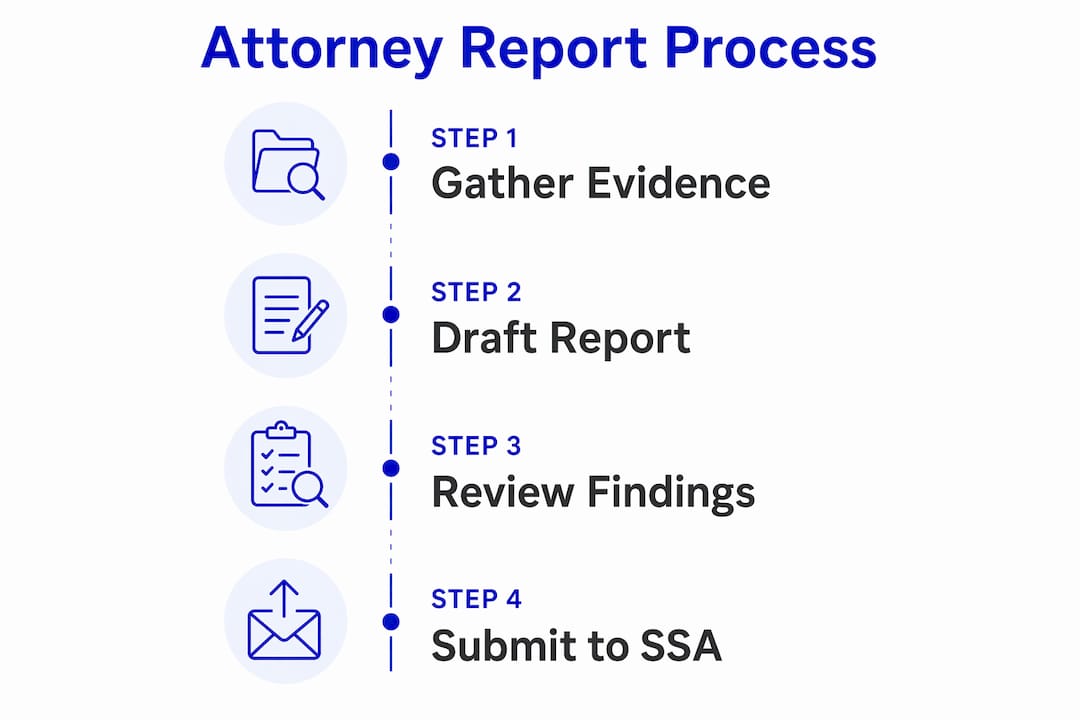
The four-step approach attorneys use
- Audit the full medical file first. Before drafting anything, your attorney reviews every record, every imaging result, and every treatment note. This audit identifies gaps and inconsistencies before the SSA finds them.
- Use customized RFC questionnaires. The SSA does not mandate a specific physician form, so lawyers use tailored questionnaires aligned with SSA's Residual Functional Capacity categories. These forms prompt treating physicians to provide the exact data adjudicators need.
- Require measurable restrictions. An attending physician statement must provide measurable restrictions such as weight limits, time limits, and frequency of breaks rather than vague statements like "patient cannot work." Specific numbers give adjudicators actionable data.
- Cross-check for internal consistency. The attorney compares the completed report against every other document in the file. If a treating doctor states you cannot lift more than 10 pounds, but a physical therapy note from the same month describes you lifting 25 pounds during a session, that conflict must be resolved before submission.
Pro Tip: If your treating physician is reluctant to complete a detailed questionnaire, your attorney can provide a pre-filled draft based on your records for the physician to review, correct, and sign. This reduces the physician's time burden and improves accuracy.
The SSA also accepts statements from multiple licensed providers, not just physicians. Nurse practitioners, psychologists, and licensed clinical social workers can all contribute supporting opinions. A skilled attorney coordinates these sources so they reinforce rather than contradict each other.
Why is the report critical for disability claims and appeals?
A thorough written disability report directly affects whether your claim is approved, denied, or sent back for more information. Incomplete or vague reports often trigger denials or delays in disability benefits. A complete report reduces requests for additional information and lowers denial rates.
The report's impact changes depending on where you are in the claims process:
- Initial application. At this stage, the report establishes the medical foundation. A strong report submitted with the initial application reduces the chance of an automatic denial based on insufficient evidence.
- Reconsideration. If your first application is denied, the reconsideration review gives you one chance to add new evidence. An updated report that addresses the specific reason for denial is the most direct way to reverse that decision.
- Administrative Law Judge hearing. At a hearing, the ALJ weighs your report against any independent medical expert the SSA brings in. Disability lawyers improve approval odds by ensuring reports meet SSA's high evidentiary standards and anticipate the questions an ALJ is likely to raise.
- Appeals Council and federal court. At these levels, the written record is everything. A well-documented report from earlier in the process becomes the foundation of any legal argument.
"The written disability report is not a formality. It is the primary tool an attorney uses to translate your medical reality into the legal language the SSA requires."
Legal representation for disability claims matters most at the hearing stage, where the report is tested directly against SSA scrutiny. Claimants without legal representation often submit reports that are medically accurate but legally incomplete, meaning they describe the condition but fail to connect it to specific work restrictions the SSA recognizes.
How can you help your lawyer build a stronger report?
Your attorney drafts the report, but the quality of that report depends heavily on what you provide. Claimants who prepare thorough documentation in collaboration with their lawyers increase their chances of a successful disability claim.
Five steps to prepare effectively
- Gather every medical record before your first meeting. Collect records from all treating providers, not just your primary doctor. Specialist notes, hospital discharge summaries, and pharmacy records all contribute to the picture.
- Write a detailed daily function account. Describe a typical day in specific terms: how long you can sit before pain forces you to stand, how many hours you sleep, whether you can prepare meals or drive. Concrete details give your attorney material to work with.
- Document every treatment and its result. List every medication, its dosage, and whether it helped. Note side effects that affect your ability to concentrate or stay awake. These details support the argument that your condition is not controlled by treatment.
- Report changes immediately. If your condition worsens, or if you start a new treatment, tell your attorney right away. A report submitted with outdated information can be undermined by newer records the SSA pulls independently.
- Review the draft before submission. Read the completed report carefully. You know your limitations better than anyone. If something is understated or missing, flag it before the report goes to the SSA.
Pro Tip: Keep a symptom journal for at least 30 days before your attorney begins drafting. Daily entries that record pain levels, activity limits, and medication effects give your lawyer specific, dated evidence that strengthens every section of the report.
Preparing for your attorney consultation with organized records and a written symptom history cuts preparation time and improves the final product. The more specific your input, the more specific the report.
Key Takeaways
A disability lawyer's written disability report is the single most important document in an SSDI claim because it connects your medical diagnoses to the specific work restrictions the SSA requires to approve benefits.
| Point | Details |
|---|---|
| Report structure matters | The report must cover diagnosis, symptoms, clinical findings, functional limits, treatment history, and legal framing. |
| Measurable restrictions win claims | Vague statements like "cannot work" are dismissed; specific limits like "cannot lift over 10 pounds" give adjudicators usable data. |
| SSA standards are non-negotiable | Every claim in the report must be supported by objective evidence and consistent with the full medical file. |
| Your input shapes the outcome | Detailed daily function accounts and organized medical records directly improve the quality of the report your attorney drafts. |
| Legal coordination reduces denials | Attorneys who cross-check reports against the full medical file and use RFC-aligned questionnaires reduce the risk of denial or delay. |
What I've learned from watching reports succeed and fail
After reviewing hundreds of SSDI cases, the pattern is clear. The reports that succeed are not necessarily the longest or the most medically complex. They are the ones where every single limitation is tied to a specific, dated piece of objective evidence.
The most common weakness I see is a report that accurately describes a claimant's condition but stops short of connecting that condition to work restrictions. A physician might document severe rheumatoid arthritis in both hands and then write "patient has difficulty with daily activities." That statement is true but legally useless. What the SSA needs is: "patient cannot grip objects weighing more than two pounds for more than five minutes without a 20-minute rest period." One statement describes a condition. The other describes a work limitation. Only the second one moves a claim forward.
Choosing an attorney with specific experience in report preparation quality matters more than most claimants realize. Ask any attorney you consider hiring how they structure physician questionnaires and how they handle inconsistencies between treating source opinions. The answer tells you immediately whether they understand the evidentiary requirements or are simply filing paperwork.
The other thing I consistently observe is that claimants underestimate their own role. Your attorney cannot invent limitations you have not described. The more precisely you communicate your daily reality, the stronger the report becomes.
— Gerard
Ssdilawyer connects you with attorneys who know how to build these reports
Ssdilawyer exists to connect claimants with experienced disability attorneys who specialize in exactly this kind of evidence-based claim preparation. A well-crafted disability report requires legal knowledge, medical coordination, and a clear understanding of SSA evidentiary standards. That combination is what the attorneys in the Ssdilawyer network provide.
Whether you are filing an initial application, responding to a denial, or preparing for an ALJ hearing, the right attorney makes a measurable difference in how your claim is documented and presented. Visit Ssdilawyer to request a free case evaluation and connect with an attorney who can assess your medical records and begin building a report that meets SSA standards from the start.
FAQ
What is a disability lawyer's written disability report?
A disability lawyer's written disability report is a medical-legal document that connects your diagnosed conditions to specific work-related limitations the SSA requires to approve a disability claim. It typically includes clinical findings, treatment history, and measurable functional restrictions.
What should a disability report include to be persuasive?
A persuasive disability report includes objective clinical evidence such as MRIs and test results, measurable restrictions on sitting, standing, and lifting, and a clear link between those restrictions and SSA's Residual Functional Capacity categories.
Why do vague disability reports get denied?
Vague statements like "patient cannot work" give adjudicators no actionable data to evaluate. The SSA requires specific, measurable limitations supported by objective medical evidence to approve a claim.
Can providers other than physicians contribute to the report?
Yes. The SSA accepts opinions from multiple licensed providers including nurse practitioners, psychologists, and licensed clinical social workers, as long as each provider operates within their licensed scope.
How does hiring a disability attorney improve my report?
Disability lawyers coordinate evidence from multiple sources, use RFC-aligned questionnaires, and cross-check the report against the full medical file to eliminate inconsistencies that trigger denials or delays.