
Your SSDI (Title II) benefit is generally protected from garnishment under 42 U.S.C. § 407, but narrow statutory exceptions allow the Social Security Administration, the Internal Revenue Service, and certain courts to withhold part of those payments. Private creditors and debt collectors generally cannot reach SSDI. The exceptions that can are:
- Child support and alimony orders under 42 U.S.C. § 659
- IRS tax levies authorized by the Taxpayer Relief Act of 1997, capped at 15% of each payment per the SSA FAQ
- Victim restitution and certain other federal agency orders
If you receive a garnishment notice, the first step is to identify who issued the order: a state court (child support), the IRS (tax levy), or another federal agency. That identification determines your next move and your appeal rights.
Key Takeaways
SSDI (Title II) is protected from most garnishments under 42 U.S.C. § 407, but child support, IRS levies, and victim restitution orders are statutory exceptions that SSA must process when properly served.
| Point | Details |
|---|---|
| § 407 is the core protection | Future SSDI payments cannot be garnished by private creditors or debt collectors under federal law. |
| Three statutory exceptions exist | Child support (§ 659), IRS levies (up to 15% per payment), and victim restitution orders can reach SSDI. |
| Withholding is calculated from MBC | SSA deducts Medicare premiums and overpayment recovery first; garnishment applies to the remaining monthly benefit credited. |
| Challenge the order, not SSA | SSA processes orders it receives without questioning their correctness; disputes must go to the issuing court or IRS. |
| Ssdilawyer can help | Ssdilawyer matches recipients facing garnishment with SSDI attorneys who can file motions, negotiate IRS alternatives, and assert § 407 protections. |
Table of Contents
- What are the SSDI garnishment rules under federal law?
- When can someone legally garnish your SSDI payments?
- How does SSA calculate and process a garnishment order?
- Why private creditors generally cannot garnish your SSDI
- What to do if you receive a garnishment notice affecting your SSDI
- Three scenarios that show how these rules work in practice
- When should you contact an SSDI attorney?
- Why documentation and timing matter more than most recipients realize
- Facing a garnishment order? Ssdilawyer can connect you with an attorney
- Sources
What are the SSDI garnishment rules under federal law?
42 U.S.C. § 407 is the foundation. It states that the right to future Title II payments is not transferable or subject to execution, levy, attachment, garnishment, or other legal process — except where another federal statute expressly provides otherwise. That phrase, "except as expressly provided by statute," is the operative limit. Any exception must point to a separate, specific statute. A creditor's state-court judgment alone is not enough.
The SSA FAQ and SSA POMS implement this statute at the operational level. SSA will not withhold from a Title II benefit unless it receives a proper court or agency order that falls within one of the recognized statutory exceptions. A letter from a collection agency or a state-court judgment against you personally does not qualify.
For a broader look at how § 407 protections interact with your overall financial picture, see why SSDI protects retirement savings.
When can someone legally garnish your SSDI payments?
Three statutory categories override § 407. Each has a different legal basis, a different cap, and different appeal rights.
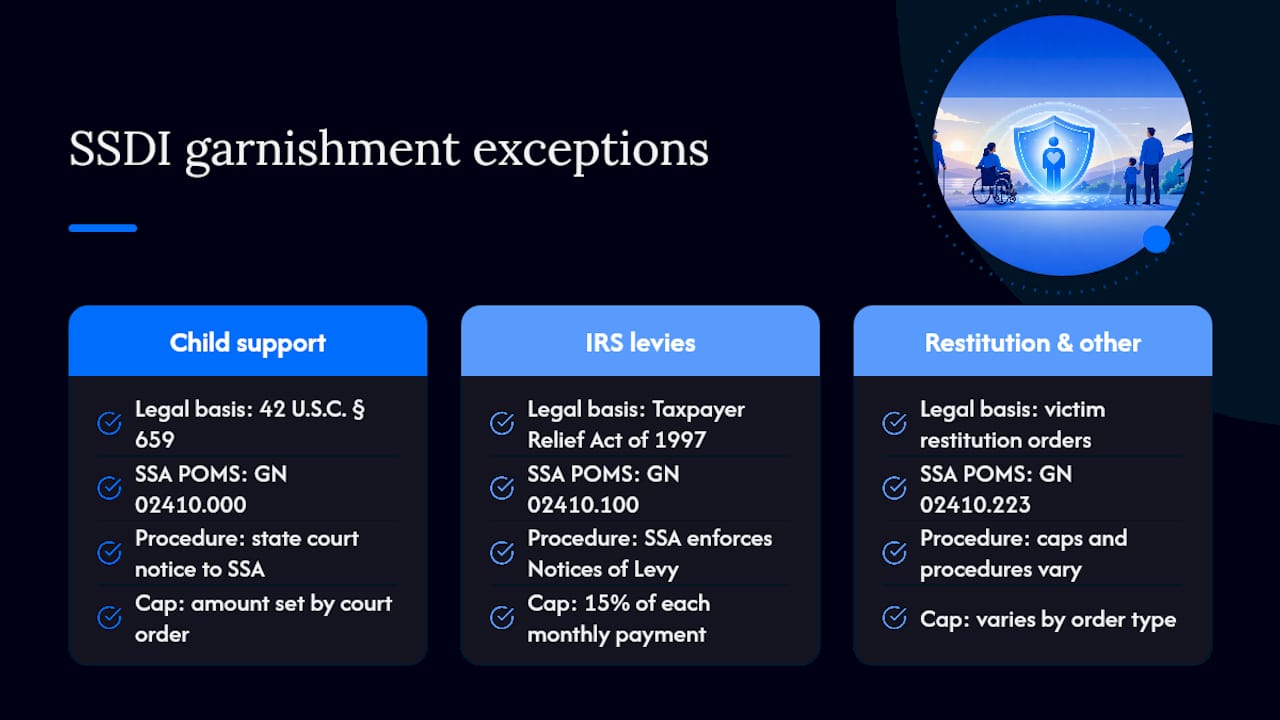
Child support and alimony. 42 U.S.C. § 659 gives the federal government's consent to income withholding for child support and alimony enforcement. A state court issues an income-withholding notice, which is then served on SSA. SSA POMS GN 02410.000 documents the procedures SSA follows when processing these orders. The amount withheld depends on the court order, not a fixed federal cap.
IRS tax levies. The Taxpayer Relief Act of 1997 authorizes the IRS to levy Title II benefits for overdue federal tax debts. SSA POMS GN 02410.100 confirms that properly served IRS Notices of Levy are enforceable against SSDI, that SSA processes the levy until the IRS issues a Release of Levy, and that SSA does not have authority to question the levy's correctness. The statutory cap is 15% of each monthly payment.
Victim restitution and other federal orders. SSA POMS GN 02410.223 covers victim restitution orders and similar garnishments. Caps and procedures vary by order type. SSA's appeal authority is limited for these orders — recipients generally must challenge them at the issuing court.
Pro Tip: Each exception category has different priority rules. An IRS levy received before a child support order may take precedence depending on receipt dates. Identify the order type before taking any action.
How does SSA calculate and process a garnishment order?
SSA does not withhold from your gross benefit amount. POMS GN 02410.215 states that withholding is calculated from the Monthly Benefit Credited (MBC) — the amount remaining after other deductions are applied first.
Deductions applied before garnishment:
- Medicare Part B (SMI) premiums
- Overpayment recovery amounts
- Representative payee fees (where applicable)
The garnishment then applies to the net MBC. Two recipients with the same gross SSDI benefit can end up with different garnishment amounts because their prior deductions differ.
| Withholding Authority | Statutory Basis | Typical Cap |
|---|---|---|
| IRS tax levy | Taxpayer Relief Act of 1997 | 15% of each payment |
| Child support / alimony | 42 U.S.C. § 659 | Per court order |
| Victim restitution | POMS GN 02410.223 | Per court order / POMS limits |
SSA generally does not make retroactive adjustments when a court later changes or cancels a garnishment order. Timing matters: once SSA processes an order, the financial effect is immediate and prospective only.
Why private creditors generally cannot garnish your SSDI
A credit card company, medical debt collector, or personal loan lender cannot garnish SSDI directly. § 407 blocks that path. CFPB guidance confirms that debt collectors generally cannot take Social Security benefits, though government agencies can collect for taxes or support.
The complication arises at the bank level. If a creditor obtains a state-court judgment and serves your bank with a garnishment order, the bank may freeze the account temporarily. Federal rules require banks to protect two months' worth of directly deposited Social Security benefits automatically. However, if you commingle SSDI deposits with other funds, proving which money is protected becomes harder.
Steps to assert your protection:
- Notify the bank in writing that the account contains SSDI direct deposits
- Provide your SSA award letter or recent bank statements showing the deposit source
- Cite § 407 in any written response to the court or collector
- Contact the court that issued the order and file a claim of exemption
Pro Tip: Keep SSDI deposits in a dedicated account. Mixed funds complicate the paper trail and can delay the bank's release of protected funds.
What to do if you receive a garnishment notice affecting your SSDI
Act within the first 48–72 hours. The order type determines every subsequent step.
- Read the order. Identify the issuing entity: state court, IRS, or federal agency. Note any response deadline printed on the document.
- Contact the issuing entity. For a child support order, call the state court or child support enforcement agency. For an IRS levy, call the IRS directly and ask about levy release or collection alternatives. For a victim restitution order, contact the issuing court.
- Call SSA. Confirm whether SSA has received the order and when processing will begin. SSA's main number is 1-800-772-1213.
- Gather documents. Collect your SSA award letter, recent bank statements showing SSDI direct deposits, the garnishment order itself, and any prior correspondence.
- Notify your bank in writing. State that the account holds SSDI funds protected under 42 U.S.C. § 407 and request that the freeze be lifted or limited to non-SSDI funds.
- Consult an attorney if the order is disputed, the deadline is short, or the withholding amount appears incorrect.
For help preparing the documents an attorney will need, see the SSDI attorney authorization form guide.
Pro Tip: SSA follows orders it receives. Your leverage is at the court or IRS level — not at SSA. Disputing the order with SSA directly rarely changes the outcome.
Three scenarios that show how these rules work in practice
Child support order. A state court issues an income-withholding notice and serves it on SSA. SSA begins withholding the court-ordered amount from the MBC on the next payment cycle. The recipient cannot stop withholding by contacting SSA — the order must be modified or terminated by the state court. Next step: contact the family court that issued the order.
IRS tax levy. The IRS serves SSA with a Notice of Levy for unpaid federal taxes. SSA withholds 15% of each monthly payment until the IRS issues a Release of Levy. SSA does not evaluate whether the underlying tax debt is correct. Next step: contact the IRS to request a levy release, an installment agreement, or an offer in compromise.
Private creditor judgment. A creditor wins a state-court judgment and serves the bank. The bank freezes the account. The SSDI deposits in the account are protected under § 407, but the recipient must file a claim of exemption with the court and provide proof of deposit source. Next step: file the exemption claim promptly and notify the bank in writing.
When should you contact an SSDI attorney?
Some garnishment situations are straightforward. Others require legal intervention.
Contact an attorney when:
- The withholding amount appears to exceed the statutory cap (e.g., more than 15% for an IRS levy)
- You have concurrent garnishments from multiple sources and need priority clarified
- SSA is also recovering an overpayment at the same time, reducing your MBC further
- A bank freeze is blocking access to funds you need for basic expenses
- You need to file a motion with a court to challenge or modify the underlying order
An SSDI-focused attorney can file motions with the issuing court, negotiate IRS collection alternatives such as installment agreements or levy release requests, and assert § 407 protections in state proceedings. For readers concerned about cost, finding an SSDI attorney with no upfront cost explains how contingency-based representation works in disability cases.
Pro Tip: For IRS levies, ask specifically about a "levy release" under IRC § 6343. The IRS can release a levy if it creates economic hardship — a standard that applies to many SSDI recipients living on fixed income.
Why documentation and timing matter more than most recipients realize
Most recipients focus on the wrong target. SSA is not the decision-maker once it receives an enforceable order. The statute is clear: SSA processes what it receives. The practical leverage is always upstream — at the court that issued the order or at the IRS that served the levy. Disputing the amount or validity with SSA directly rarely produces a different result, because SSA does not have authority to question the levy's correctness.
The recipients who limit financial harm are the ones who act fast, keep clean records, and contact the right entity within the first few days. A dedicated SSDI deposit account, a current SSA award letter on file, and a clear understanding of which exception applies — those three things reduce the time it takes to assert protection and get funds released.
Facing a garnishment order? Ssdilawyer can connect you with an attorney
Ssdilawyer connects SSDI recipients with experienced disability attorneys who handle garnishment disputes, IRS levy challenges, and court motions. The matching service is free to use: submit a brief case inquiry, and the service screens your situation and puts you in contact with a qualified attorney quickly.
Most matched attorneys work on a contingency basis, meaning no upfront legal fees. When you contact a matched attorney, have your SSA award letter, the garnishment or levy notice, and recent bank statements ready. Those three documents let an attorney assess your situation immediately.
Submit a case inquiry at Ssdilawyer to get connected with an SSDI attorney who can review your garnishment situation and advise on next steps.
Sources
- Can my Social Security benefits be garnished or levied? | Frequently Asked Questions | SSA
- 42 U.S.C. § 407: Assignment of benefits (USCODE PDF)
- POMS GN 02410.000 — Garnishment of Title II benefits for support/alimony (SSA POMS)
- 42 USC 659: Consent by United States to income withholding, garnishment, and similar proceedings for enforcement of child support and alimony obligations (USCODE House)
- Can a debt collector take my Social Security or VA benefits? | CFPB
SSA POMS entries reflect SSA's internal administrative policy implementing the statutes above. For questions about your specific situation, consult a qualified SSDI attorney or contact SSA directly at 1-800-772-1213.
This article provides general legal information, not legal advice. Confirm current rules with SSA, the IRS, or a qualified attorney before taking action on a specific garnishment or levy.
This article is general information, not a substitute for advice from a qualified lawyer. Consult a qualified legal professional about your own circumstances before acting on anything here.