
An SSDI favorable settlement is defined as a Social Security Administration decision that approves your disability claim and accepts your claimed onset date, securing your full entitlement to back pay and monthly benefits. The term "favorable settlement" is informal. The official SSA terminology is a "fully favorable decision," and understanding the difference between that and a "partially favorable decision" directly determines how much money you receive. This guide covers both outcomes, explains how lump-sum settlements interact with SSDI, and tells you exactly what to do after a decision arrives.
What is a fully favorable SSDI decision?
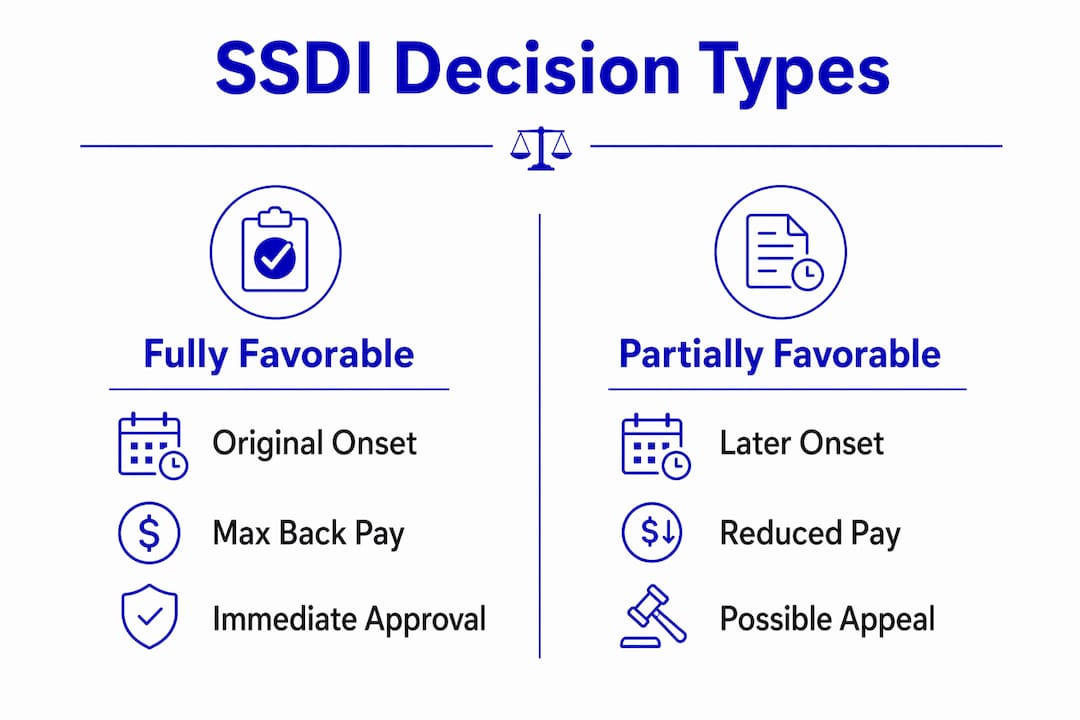
A fully favorable decision means the SSA accepts your disability and your original onset date. That combination produces the largest possible back pay award. The SSA calculates back pay from your onset date, minus a mandatory five-month waiting period. Every month the onset date moves forward costs you one month of back pay.
After a fully favorable ruling, payments follow a predictable sequence:
- Award letter: Arrives by mail within weeks of the decision.
- Back pay deposit: Typically processed within 1–3 months of the decision.
- Monthly benefits: Begin the month after back pay clears.
- Medicare eligibility: Starts 24 months after your established onset date.
- Attorney fees: Deducted directly from back pay if you have legal representation.
The typical timeline from decision to payment runs 4–6 months. That delay is not an error. It reflects SSA's internal processing queue, not a problem with your claim.
What is an SSDI fully favorable bench decision?

A bench decision is a fully favorable ruling delivered orally by an Administrative Law Judge at the hearing itself. The ALJ announces approval before the written notice is prepared. This is rare. It requires the evidence to be overwhelmingly clear, and the SSA never issues bench decisions in cases where drug or alcohol addiction is a contributing factor. The formal written notice follows the oral ruling, but the approval is immediate and binding.
Pro Tip: If an ALJ issues a bench decision in your case, confirm the onset date stated orally matches the date in the written notice when it arrives. Discrepancies do occur and must be corrected quickly.
How does a partially favorable decision differ from a fully favorable one?
A partially favorable decision approves your disability but rejects your original onset date. The ALJ sets a later onset date instead. That shift directly reduces your back pay, sometimes by thousands of dollars, depending on your monthly benefit amount and how far the date moved.
The financial consequences extend beyond back pay:
- Reduced back pay: Each month lost from the onset date is one month of benefits gone.
- Program eligibility shift: A later onset date can move a claimant from SSDI to SSI, which carries stricter asset rules.
- Medicare delay: Your 24-month Medicare clock restarts from the new onset date.
- Appeal rights: You retain the right to appeal the onset date determination even after a partially favorable ruling.
Distinguishing fully favorable from partially favorable decisions is critical. A partially favorable decision often represents a significant financial loss despite the word "favorable" appearing in the notice. Claimants should verify back pay calculations immediately and consult an attorney before accepting the outcome.
The onset date is the single most consequential number in your SSDI case. A shift of six months in the wrong direction can eliminate a substantial portion of your back pay. Legal professionals advise that partially favorable decisions are appealable, and that appealing the onset date determination can recover lost back pay.
How do lump-sum settlements affect SSDI benefits?
SSDI is not means-tested, so most lump-sum personal injury settlements do not reduce your monthly benefits. Receiving a personal injury settlement while collecting SSDI does not trigger any SSA offset. That is a critical distinction most claimants do not know.
Workers' compensation settlements work differently. The SSA applies a federal offset rule when combined disability income exceeds a set threshold.
| Settlement type | Effect on SSDI | Key rule |
|---|---|---|
| Personal injury (lump sum) | No reduction | SSDI is not means-tested |
| Workers' compensation | Potential reduction | SSA 80% cap on combined income |
| SSI with lump sum | Asset limit triggered | SSI has strict resource limits |
| Special needs trust | Protected | Funds excluded from SSI asset count |
Workers' compensation settlements can reduce or suspend SSDI benefits when combined income from SSDI and workers' comp exceeds 80% of your average pre-disability earnings. That 80% cap is a federal rule. Exceeding it causes SSA to reduce your monthly SSDI payment dollar for dollar until the combined total falls back under the threshold.
SSI operates under entirely different rules. SSI has strict asset limits, and a lump-sum settlement can push a recipient over those limits immediately. Special needs trusts exist specifically to hold settlement funds without counting them as SSI resources. Clarifying whether you receive SSDI or SSI before any settlement is finalized is not optional. It determines your entire financial strategy.
Pro Tip: Never sign a workers' compensation settlement without first calculating the SSA offset impact. A settlement that looks favorable on paper can reduce your monthly SSDI check for years.
What legal nuances should claimants know about SSDI settlements?
The language inside a settlement agreement directly affects how SSA calculates your offset. Most claimants do not realize that the way a workers' comp settlement is written can legally reduce the SSA's offset calculation.
Three specific drafting strategies matter:
- Proration by life expectancy: Spreading the lump sum over your projected lifespan reduces the monthly equivalent amount SSA uses to calculate the offset. A smaller monthly equivalent means a smaller reduction in SSDI benefits.
- Medical expense itemization: Settlement agreements that separately identify past and future medical expenses allow those amounts to be excluded from the offset calculation. SSA does not count medical expense reimbursements as income for offset purposes.
- Attorney fee allocation: Fees paid to your attorney from the settlement can also be excluded from the offset base, further reducing the monthly equivalent.
Tax implications add another layer of complexity. SSDI benefits become partially taxable when your total income exceeds IRS thresholds. A large workers' comp settlement in the same tax year as a back pay award can push you into a higher bracket. An attorney who understands both SSA offset rules and federal tax law protects you from surprises that arrive at tax time.
Proper legal drafting of workers' comp settlements, including specifying proration rates and excluding medical expenses, can significantly minimize the offset impact on your long-term SSDI payments. This is not a minor technical detail. It can mean hundreds of dollars per month in protected income.
How do you navigate the SSDI settlement process after a decision?
Receiving a favorable decision is not the end of the process. The steps you take in the weeks following the decision determine whether you receive every dollar you are owed.
- Read the award letter carefully: Confirm the onset date, the monthly benefit amount, and the back pay total. Errors in SSA paperwork are not uncommon.
- Verify the back pay calculation: Multiply your monthly benefit by the number of eligible months, subtract the five-month waiting period, and compare that figure to the SSA's stated amount.
- Check Medicare eligibility dates: Confirm the 24-month clock starts from the correct onset date.
- File an appeal if the onset date is wrong: The SSDI appeals process allows you to challenge onset date determinations even after a partially favorable ruling. Deadlines are strict, typically 60 days from the notice date.
- Contact SSA if payment is delayed: If back pay has not arrived within 6 months of the decision, contact your local SSA office directly.
Working with an attorney at this stage matters. Legal representation improves outcomes not just at the hearing stage but during post-decision review. Attorneys catch calculation errors, identify appeal opportunities, and handle SSA correspondence on your behalf. The case strategy you build with an attorney after a decision can recover money that a claimant acting alone would never know to pursue.
Key Takeaways
A fully favorable SSDI decision accepts your original onset date and produces the maximum back pay, while a partially favorable decision shifts that date forward and reduces what you receive.
| Point | Details |
|---|---|
| Fully favorable decision | SSA accepts your onset date, maximizing back pay after the five-month waiting period. |
| Partially favorable decision | SSA sets a later onset date, reducing back pay and potentially shifting you from SSDI to SSI. |
| Workers' comp offset rule | Combined SSDI and workers' comp income cannot exceed 80% of pre-disability earnings without triggering a reduction. |
| Settlement language matters | Proration rates and medical expense itemization in workers' comp agreements can legally reduce SSA offsets. |
| Appeal the onset date | Partially favorable decisions are appealable, and a successful appeal can recover significant lost back pay. |
Why the onset date deserves your full attention
Most claimants focus on the approval itself and stop reading after the word "favorable." That is the most expensive mistake in the SSDI process. The onset date is where the real money lives, and I have seen claimants lose years of back pay because they accepted a partially favorable decision without questioning the date.
My consistent observation is this: the SSA does not always get the onset date right on the first attempt. Medical records, work history, and treating physician statements all feed into that determination, and ALJs sometimes set conservative dates when the evidence is not perfectly organized. That is exactly why you should verify the onset date in your award letter against your medical records before the appeal window closes.
The 60-day appeal deadline moves fast. Claimants who wait to "see how things go" often find themselves outside the appeal window with no recourse. The partially favorable decision that felt like a win in the moment becomes a permanent financial loss. Quick action after the award letter arrives is not optional. It is the difference between collecting what you are owed and accepting less than you deserve.
If you have a workers' comp settlement in the picture, the stakes are even higher. The drafting of that agreement should happen before you sign, not after. Retroactive changes to settlement language are rarely possible once SSA has processed the offset calculation.
— Gerard
Ssdilawyer can help you secure the right outcome
Navigating SSDI decisions and settlement terms requires precise knowledge of SSA rules, offset calculations, and appeal deadlines. Ssdilawyer connects claimants with experienced disability attorneys who review award letters, identify onset date errors, and handle appeals for partially favorable decisions.
Whether you received a fully favorable decision and want to confirm your back pay is correct, or a partially favorable ruling that may be worth appealing, Ssdilawyer provides the legal guidance to protect your benefits. Attorneys in the Ssdilawyer network also assist with workers' compensation settlement drafting to minimize SSA offsets. Get a case review and know exactly where you stand.
FAQ
What does a fully favorable SSDI decision mean?
A fully favorable decision means the SSA approves your disability claim and accepts your original onset date. This produces the maximum back pay after the mandatory five-month waiting period.
What is the difference between fully favorable and partially favorable SSDI?
A fully favorable ruling accepts your claimed onset date, while a partially favorable ruling sets a later date, reducing back pay and potentially changing your program eligibility from SSDI to SSI.
What is an SSDI fully favorable bench decision?
A bench decision is an oral, fully favorable ruling issued by an ALJ at the hearing itself. It is rare, requires overwhelming evidence, and is never issued in cases involving substance abuse as a contributing factor.
Does a lump-sum settlement reduce SSDI benefits?
Personal injury lump-sum settlements do not reduce SSDI benefits because SSDI is not means-tested. Workers' compensation settlements can trigger an SSA offset if combined income exceeds 80% of pre-disability earnings.
Can you appeal a partially favorable SSDI decision?
Yes. Partially favorable decisions are appealable, particularly the onset date determination. Filing within the 60-day deadline can recover significant lost back pay if the SSA set an incorrect onset date.