
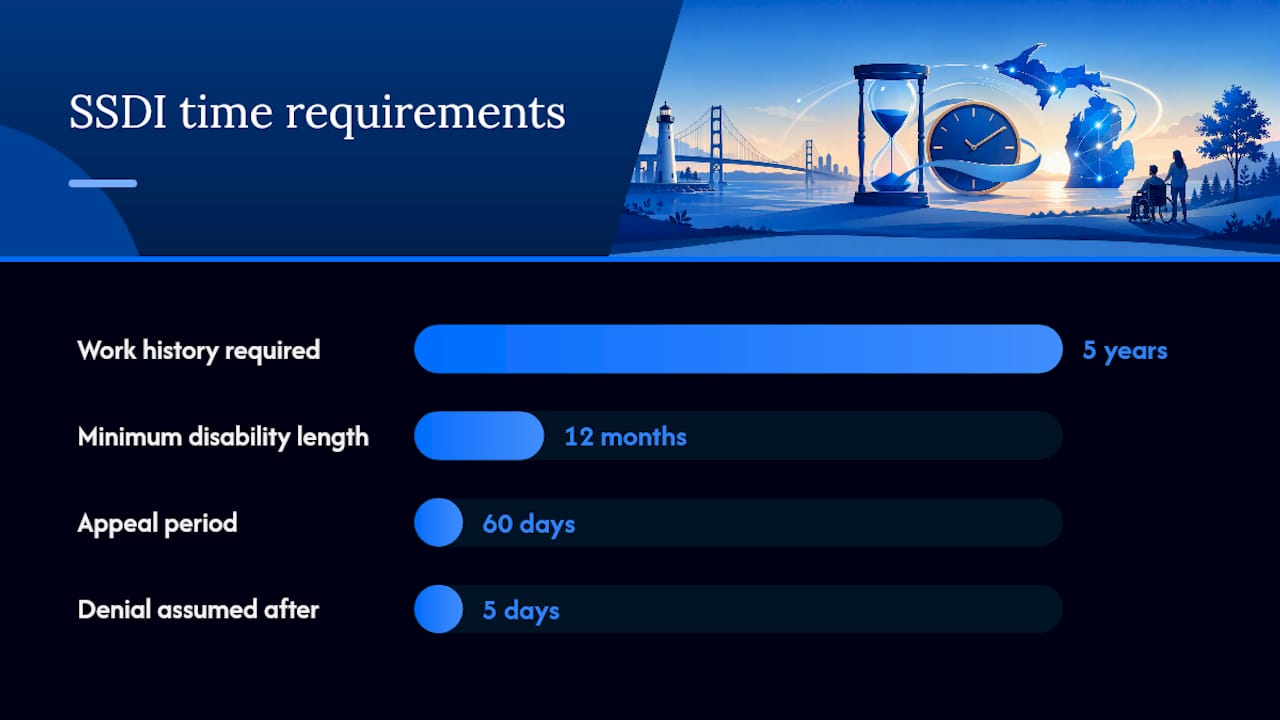
Michigan residents who have a disabling condition expected to last at least 12 months and enough recent work history qualify for Social Security Disability Insurance (Life Settlements in Michigan). Note: SSDI is a federal insurance program tied to your work record, distinct from Supplemental Security Income (SSI), which is needs-based. If you meet SSDI criteria, three steps apply now:
- Start your online application or call SSA at 1-800-772-1213.
- Gather five years of job history and all treating medical records before your interview.
- Contact Ssdilawyer to match with a Michigan disability attorney, particularly before any hearing.
Pro Tip: SSA assumes you received a denial letter five days after the date on the notice. Your 60-day appeal clock starts from that presumed date, not when you actually open the envelope.
Key Takeaways
Michigan SSDI claimants who gather complete medical records, track appeal deadlines precisely, and secure experienced legal counsel before an ALJ hearing give their claims the strongest foundation.
| Point | Details |
|---|---|
| SSDI eligibility | Requires a 12-month disabling condition plus sufficient recent work credits. |
| Five-month waiting period | Benefits begin the sixth full month after onset; Medicare follows 24 months later. |
| PRW rules matter | POMS DI 25005.015 requires past work within five years, 30+ days, and at SGA level. |
| Appeal deadline | 60-day clock starts five days after the date on the denial notice; act immediately. |
| Ssdilawyer | Connects Michigan claimants with matched disability attorneys at no cost to the claimant. |
Table of Contents
- How long does the SSDI process take in Michigan?
- How to document medical evidence and functional limits
- Why legal help changes outcomes in Michigan
- Ssdilawyer connects Michigan claimants with experienced attorneys
- Sources
How long does the SSDI process take in Michigan?
Initial decisions typically take several months. Michigan's Disability Determination Service (DDS) handles medical reviews on SSA's behalf, and Michigan Legal Help notes that gathering complete records up front shortens that window.
Even after approval, SSDI benefits do not begin until a waiting period of several months after your established disability onset date. Medicare coverage generally follows after an extended period of receiving benefits. Plan accordingly: a claimant approved with a January 2025 onset date receives first payment in July 2025 and Medicare eligibility in July 2027.
How to document medical evidence and functional limits
The SSA evaluates your Residual Functional Capacity (RFC), a formal assessment of what you can still do despite your condition. RFC framing determines whether you pass steps 4 and 5 of the five-step sequential evaluation.
Useful documentation includes:
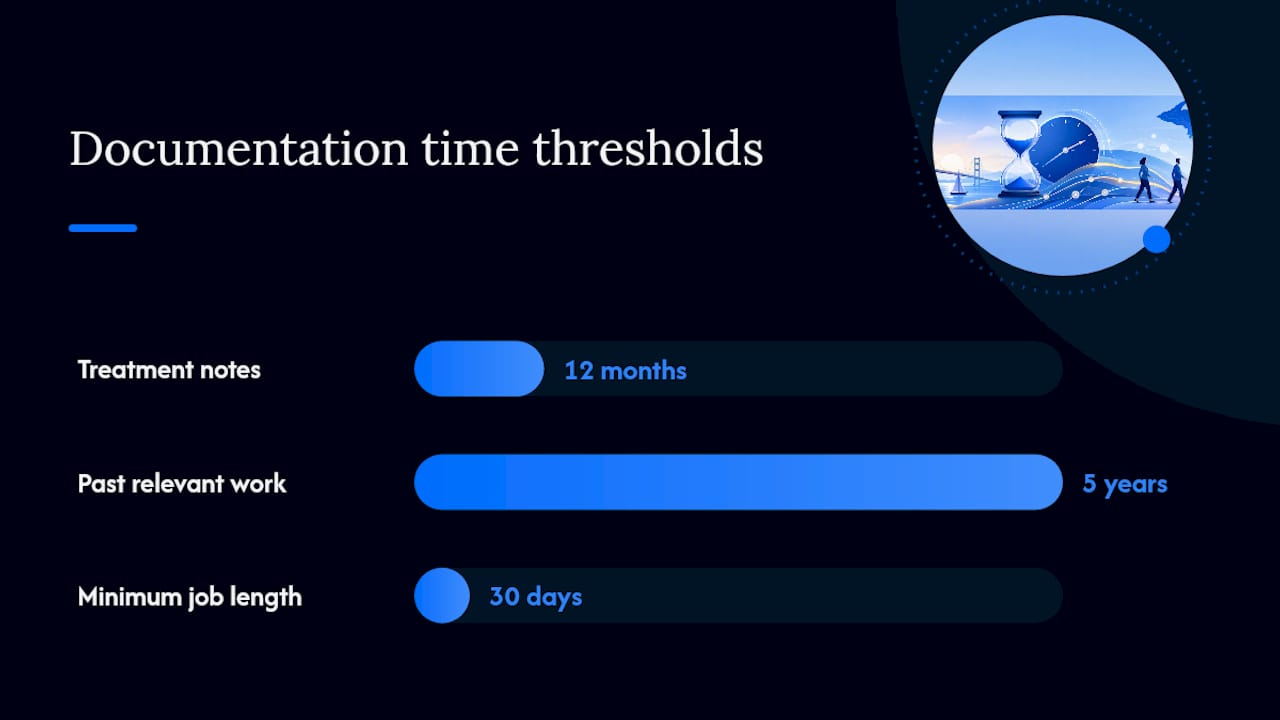
- Treatment notes from every physician, specialist, and therapist who has seen you in the past 12 months.
- Functional assessments showing specific limits: how far you can walk, how long you can sit, how much you can lift.
- Mental health records if cognitive or psychological conditions contribute to your disability.
Per POMS DI 25005.015, past work must generally fall within the last five years, last at least 30 consecutive calendar days, and meet Substantial Gainful Activity (SGA) standards to count as Past Relevant Work (PRW) at step four. Short jobs or work below SGA may drop out of the analysis entirely, which can help or hurt your claim depending on the job's demands versus your RFC.
Why legal help changes outcomes in Michigan
Attorneys who handle SSDI cases regularly know how to frame RFC evidence in SSA's own language, identify which past jobs qualify as PRW under POMS rules, and prepare vocational arguments for ALJ hearings. SSA's own appeals guidance acknowledges that representation at the hearing stage materially affects how a record is developed and presented.
Most claimants who reach an ALJ hearing do so after one or two prior denials. At that stage, the technical PRW and SGA rules under POMS DI 25005.015 become decisive. An attorney who understands Michigan DDS practices and ALJ preferences gives a claimant a structurally stronger record.
Ssdilawyer connects Michigan claimants with experienced attorneys
Ssdilawyer matches Michigan claimants with disability attorneys who handle application prep, hearing representation, and appeals. The intake process is straightforward: submit your case details, confirm eligibility, and receive a matched attorney referral. Matching is free for claimants; attorneys pay referral fees. Matched attorneys can assist with limited-scope representation if full representation is not needed. Start your attorney match now.
Sources
Key references for verifying rules, forms, and local contacts:
- SSA - POMS: DI 25005.015 - Determination of Capacity for Past Work-- Relevance Issues - 03/04/2026
- How We Decide If You Are Disabled (Step 4 and Step 5) | Disability | SSA
- An Overview of Social Security Disability Insurance (SSDI) | Michigan Legal Help
This article provides general information about SSDI in Michigan and is not a substitute for legal advice. Confirm current rules with SSA or a qualified disability attorney.