
As of mid-2026, the national average for an initial SSDI decision is approximately 6 to 6.5 months, or roughly 180 to 193 days. That figure comes from the Social Security Administration's own performance reporting and marks a meaningful improvement from 2025 averages that ran above 230 days. The Disability Determination Services (DDS) office in your state handles the medical review; the Social Security Administration (SSA) manages the overall process. If the DDS denies your claim, you can appeal to reconsideration, then to an Administrative Law Judge (ALJ), then to the Appeals Council, and finally to federal court — each stage adding months.
Three immediate expectations:
- Initial decision range: Most applicants wait 5 to 8 months for a first decision, depending on their state DDS office and how complete their medical file is at submission.
- Appeals extend the timeline significantly: Reconsideration typically adds several months; an ALJ hearing can add 8–14 months on top of that.
- Check your case status now: The my Social Security portal shows real-time milestones — examiner assigned, records requested, consultative exam scheduled — and is the fastest way to spot a stall.
Table of Contents
- What does SSA's 2026 performance data actually show?
- How long does each stage of the SSDI process take in 2026?
- Why does your state change how long you wait?
- Can expedited processing shorten your wait?
- What can you do right now to reduce delays?
- If your claim is denied, how much more time should you plan for?
- When does hiring an SSDI attorney actually help?
- What happens after approval: payments, backpay, and the five-month wait
- Key Takeaways
- The part of SSDI timing most applicants underestimate
- How Ssdilawyer can help you move your claim forward
- Sources and methodology
What does SSA's 2026 performance data actually show?
The SSA's performance reporting puts the national average initial decision time at approximately 180–193 days as of mid-2026. That number covers the full elapsed time from filing through payment or denial notice, including transit, technical determinations, medical review by DDS, and SSA quality review. It excludes technical denials.
The backlog picture has improved substantially. DDS pending initial claims dropped from a peak of 1.26 million in June 2024 to roughly 831,000 as of February 2026, a reduction of about 33–34%. That decline is the primary reason average decision times fell. Phone access also improved: SSA's National 800 Number average speed of answer dropped from 11 minutes in May 2025 to 5 minutes in May 2026, which matters when you need to follow up on a stalled development request.
| Metric | 2024 Peak / Prior Period | 2026 Figure |
|---|---|---|
| National avg. initial decision (days) | 230+ days (2025 avg.) | ~180–193 days |
| DDS pending initial claims | 1.26 million (June 2024) | ~831,000 (February 2026) |
| 800-number avg. speed of answer | 11 minutes (May 2025) | 5 minutes (May 2026) |
One important caveat: the national average is a useful trend indicator, but it can mislead individual claimants. A state-level DDS average is a far better predictor of your actual wait, because DDS offices are state-run and vary widely in staffing and caseload. The national figure also reflects the combined Title II (SSDI) and Title XVI (SSI) initial claims requiring a medical determination, as defined by SSA's open data methodology.
How long does each stage of the SSDI process take in 2026?
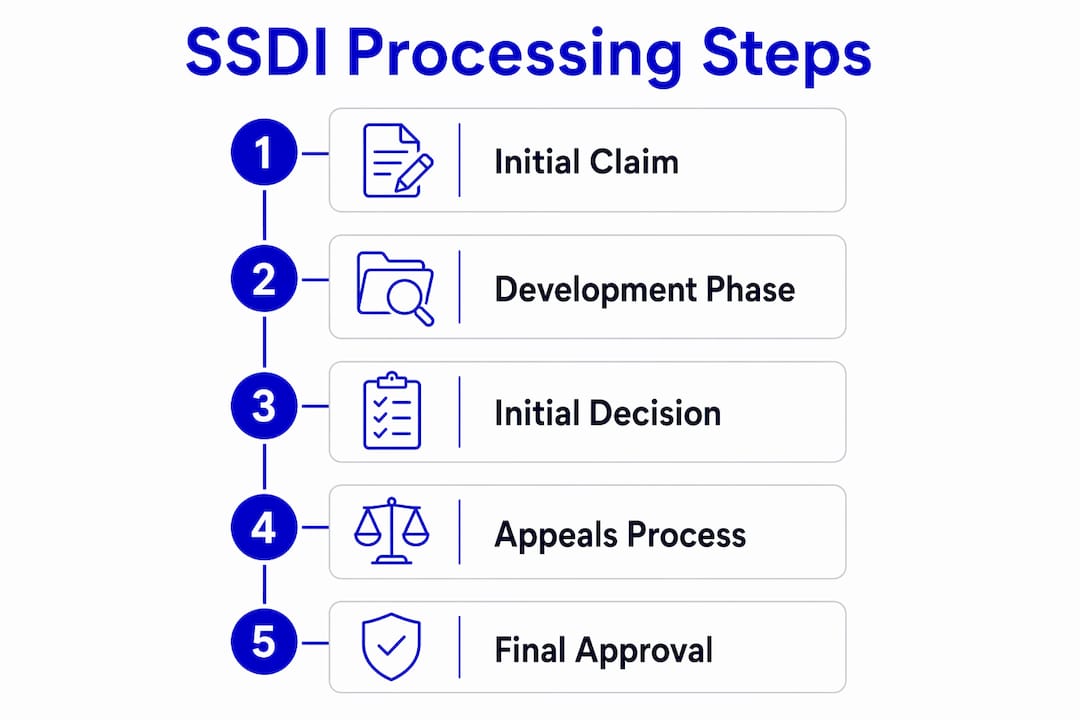
The SSDI timeline has five distinct stages. Each one has its own typical range, and the cumulative time grows fast if your case reaches a hearing.
-
Initial application — DDS review (180–193 days as of mid-2026). After you file, SSA routes your case to your state DDS office. DDS assigns an examiner who requests medical records, may schedule a consultative exam, and then makes a medical determination. This stage accounts for the 180–193 day national average. The single biggest delay here is the development phase: DDS waiting for providers to return records. Claimants who submit complete, organized records at filing routinely see faster decisions.
-
Reconsideration (3–5 months). If DDS denies your initial claim, you have 60 days to request reconsideration. A different DDS examiner reviews the file. Most reconsiderations are also denied, but the stage is required in most states before you can request a hearing.
-
ALJ hearing — ODAR (8–14 months from request to decision). This is where wait times lengthen most. An Administrative Law Judge reviews your case at a formal hearing. Scheduling depends heavily on your local hearing office's caseload. Approval rates at the hearing stage are notably higher than at initial review.
-
Appeals Council (6–12 months). If the ALJ denies your claim, you can request Appeals Council review. The Council may affirm, reverse, or remand the case. Most requests are denied review, but the stage preserves your right to federal court.
-
Federal court (12–24+ months). A U.S. District Court reviews whether SSA followed proper legal standards. This stage is uncommon and adds substantial time. Cumulative timeline if you reach federal court: 3 to 5 years from initial filing is realistic.
Pro Tip: The development phase — DDS waiting for medical providers to return records — is the main driver of initial-stage delays. Submit your own complete, chronologically organized records at the time of filing. This often prevents DDS from issuing multiple record-request holds that each add weeks.
Why does your state change how long you wait?
DDS offices are state-run agencies, and that structure explains most of the variation in wait times. Each state sets its own examiner pay scales, hiring rates, and workload policies. When examiner attrition is high or a state DDS falls behind on continuing disability reviews, initial claim processing slows. Software adoption and electronic records infrastructure also differ by state.

The practical range in 2026 is wide. State-level data shows the fastest states processing initial claims in roughly 108–140 days, while the slowest exceed 400 days.
| State (Example) | Approximate Average Initial Decision Time (2026) |
|---|---|
| Idaho | ~108 days |
| Several mid-range states | 180–193 days |
| South Carolina | ~452 days |
The national average of 180–193 days sits between those extremes, but if you live in a high-caseload state, planning around the national figure will leave you underprepared. The SSA performance page publishes state-level data periodically; checking your state DDS average before filing gives you a more accurate planning baseline than the national number.
Can expedited processing shorten your wait?
Two SSA programs can cut processing time from months to weeks for qualifying applicants.
Compassionate Allowances (CAL) covers more than 200 conditions — primarily certain cancers, rare disorders, and advanced neurological diseases — that SSA has determined are so severe they virtually always meet the disability standard. CAL cases are flagged automatically when the condition appears in the application, and SSA often processes them in weeks rather than months.
Terminal Illness (TERI) designations apply when a claimant has a condition that is likely to result in death. TERI cases receive priority handling at both the DDS and SSA levels.
Steps to request expedited handling:
- Name the condition precisely on the application. SSA's automated system flags CAL conditions by diagnosis code and terminology. Vague descriptions can miss the trigger.
- Submit complete medical documentation at filing. For CAL and TERI, a biopsy report, imaging, or specialist letter confirming the diagnosis is the most important piece of evidence.
- Call SSA directly if you believe your condition qualifies. The 800-number average answer time is now 5 minutes as of May 2026, making a direct call practical.
- Ask your attorney or representative to flag the case. Representatives familiar with CAL criteria can ensure the correct codes appear in the file.
Realistic limits: not every severe condition qualifies for CAL, and expedited processing is not the same as automatic approval. SSA still reviews whether the medical evidence meets the standard. TERI designation speeds scheduling but does not guarantee a favorable outcome.
What can you do right now to reduce delays?
The biggest controllable delay in an SSDI claim is waiting for medical records. DDS sends requests to providers, and providers often take four to eight weeks to respond. Each outstanding request can hold the entire file. Submitting your own records at the time of filing short-circuits that cycle entirely.

A complete submission should include: recent provider notes (within the past 12 months), imaging and lab reports, a current medications list, a work history covering the past 15 years, and completed function reports. A Medical Source Statement from your treating physician — explaining how your condition limits your functional capacity — carries particular weight with DDS examiners. Organize everything chronologically and label each document with the provider name and date before uploading.
Filing online saves one to four weeks compared to paper filing by creating an electronic file from day one and eliminating the clerical scanning step. After filing, use the my Social Security portal to monitor case milestones. The portal shows when an examiner is assigned, when records are requested, and when a consultative exam is scheduled. If a milestone stalls for more than three to four weeks, contact DDS directly or through your representative.
Pro Tip: Label every uploaded document with the provider name, date of service, and record type in the file name (e.g., "DrSmith_CardioNotes_March2026.pdf"). Examiners work faster through organized files, and a well-labeled packet reduces the chance of a record being overlooked.
If your claim is denied, how much more time should you plan for?
Denial at the initial stage is common. Roughly 32–35% of initial SSDI applications are approved; the rest are denied and must appeal if the claimant wants to continue. Each appeal stage adds time, and the cumulative wait grows quickly.
Reconsideration typically adds 3–5 months. An ALJ hearing adds 8–14 months from the date of the hearing request to a written decision. Appeals Council review can add another 6–12 months. Federal court, if reached, adds 12–24 months or more. A claimant who files today and reaches a federal court decision could be looking at 4–5 years total.
Actions to preserve and strengthen your appeal:
- Keep treatment records current. New medical evidence submitted after the initial denial can change the outcome at reconsideration or hearing.
- Submit new evidence promptly. There are deadlines for submitting evidence at each stage; missing them can result in exclusion.
- Attend all consultative exam appointments. Missing a scheduled exam is one of the most common reasons claims are denied or dismissed on appeal.
- Preserve your work history and function reports. These documents establish onset date and functional limitations and are reviewed at every stage.
On hearing format: in 2026, ALJ hearings are available by video or in person. Video hearings generally schedule faster because they are not limited by hearing-office room availability. If your local hearing office has a long in-person wait, requesting video can meaningfully shorten the scheduling delay. Ask your representative about current wait times at your specific hearing office before choosing.
For a detailed breakdown of each appeal stage, the SSDI appeals process guide covers reconsideration through federal court with current 2026 timelines.
When does hiring an SSDI attorney actually help?
Attorney involvement is most likely to shorten the overall timeline or improve outcomes in three specific situations: when the onset date is disputed, when the medical record is incomplete or poorly organized, and when the case reaches the ALJ hearing stage.
At the hearing stage, approval rates are notably higher than at initial review, often in the 45–55% range compared to roughly 32–35% at the DDS level. An attorney who knows the local hearing office, the specific ALJ's decision patterns, and the evidentiary standards can prepare a stronger exhibit file and a more targeted pre-hearing brief. That preparation directly affects both the quality of the hearing and the speed of the post-hearing decision.
Attorneys who regularly practice before a specific hearing office know which ALJs require detailed function-by-function assessments and which focus on vocational evidence. Matching the exhibit file to the judge's known priorities is one of the clearest ways representation affects outcomes — and it is something an unrepresented claimant has no practical way to replicate.
Most SSDI attorneys work on a contingency basis: no upfront fee, with payment capped by federal regulation at 25% of back pay, up to a statutory maximum. That structure means cost is not a barrier to representation at any stage.
Questions to ask a prospective attorney before hiring:
- How many cases have you handled before my local hearing office?
- What is your approval rate at the ALJ hearing stage?
- How do you handle medical record development — do you request records directly from providers?
- What is your fee structure, and what costs (if any) am I responsible for if the claim is denied?
Pro Tip: Ask specifically about the attorney's experience with your state DDS office and your local hearing office. Local knowledge of scheduling patterns and examiner tendencies is more predictive of outcomes than general SSDI experience.
For more on how attorneys develop cases and manage timelines, the SSDI case strategy guide covers the practical steps in detail.
What happens after approval: payments, backpay, and the five-month wait
Approval is not the same as immediate payment. SSA imposes a five-month waiting period before SSDI benefits begin, starting from your established onset date. If your onset date is January 1, 2025, your first month of eligibility is June 2025. Benefits paid from that point forward are current monthly payments; amounts owed from June 2025 through your approval date are paid as a lump-sum backpay.
A short example: onset date January 1, 2025; approval date July 1, 2026. The five-month waiting period runs through May 2025. Backpay covers June 2025 through June 2026 — 13 months of benefits paid as a single payment. The exact amount depends on your primary insurance amount (PIA), which SSA calculates from your earnings record.
Common reasons payment is delayed after approval:
- Employer record verification: SSA may need to confirm recent earnings before finalizing your benefit amount.
- Continuing disability review (CDR): In some cases, SSA initiates a CDR close to approval, which can hold payment.
- Missing direct deposit information: Payment cannot be issued without a verified bank routing and account number on file.
Documents to have ready when approval comes: your SSA award letter, bank routing and account numbers for direct deposit, your Social Security card, and any SSA forms requesting additional information. Responding to SSA requests within the stated deadline prevents payment holds. For a full explanation of the five-month waiting period and backpay rules, SSA's own guidance and the Ssdilawyer resource cover the calculation in detail.
Key Takeaways
The national average SSDI initial decision time in 2026 is approximately 180–193 days, but state-level variation, appeals, and record completeness determine your actual wait far more than the national figure does.
| Point | Details |
|---|---|
| 2026 national average | Initial decisions average 180–193 days; an improvement from 230+ days in 2025. |
| State variation is wide | Fastest states average ~108 days; slowest exceed 400 days — check your state DDS figure. |
| Appeals add significant time | ALJ hearings add 8–14 months; plan for 12–24 months total if you need a hearing. |
| Submit records at filing | Providing complete, organized medical records at submission is the single most effective way to shorten DDS review. |
| Ssdilawyer | Connects claimants with experienced disability attorneys for applications, appeals, and hearing preparation at no upfront cost. |
The part of SSDI timing most applicants underestimate
The national average gets most of the attention, and the improvement from 230+ days to roughly 180–193 days is real progress. But the number that actually governs your experience is your state DDS average, and that figure can be more than four times the national average depending on where you live.
What most guides do not say plainly: the development phase is where most controllable delays live, and it is almost entirely within the applicant's power to shorten it. DDS is not slow because examiners are inefficient. DDS is slow because it is waiting for providers who have no particular incentive to respond quickly to a government records request. Submitting your own records removes that dependency entirely.
The other underappreciated point is the hearing stage. Approval rates at the ALJ level are meaningfully higher than at initial review. Claimants who give up after an initial denial — which is the majority — are walking away from a stage where their odds improve. The additional 8–14 months is a real cost, but so is leaving a valid claim on the table.
Representation matters most at the hearing stage, not because attorneys have special access, but because hearing preparation is genuinely technical. Matching the exhibit file to the specific ALJ's evidentiary preferences, preparing a vocational analysis, and knowing when to request a medical expert are skills that take years to develop. For claimants at the hearing stage, the contingency fee structure means there is no financial reason to go unrepresented.
How Ssdilawyer can help you move your claim forward
Waiting 6 months for an initial decision is one thing. Waiting 18 months for a hearing while managing a disabling condition is another. Ssdilawyer connects claimants with experienced disability attorneys who handle the record development, filing, and hearing preparation that most applicants find difficult to manage alone.
Services cover the full process: initial application assistance, reconsideration appeals, ALJ hearing preparation, and Appeals Council review. Attorneys work on a contingency basis in most cases, meaning no upfront fee. Payment comes only from back pay if the claim is approved, capped by federal regulation. Outcomes cannot be guaranteed, but representation at the hearing stage is associated with meaningfully higher approval rates.
To request a consultation, visit Ssdilawyer and submit your contact information. An attorney will review your situation and explain what representation would involve for your specific case and stage. If you want to understand the benefits of legal representation before reaching out, that resource covers what attorneys do at each stage and what to expect from the process.
This article provides general information about SSDI processing times and is not legal advice. Processing times, approval rates, and fee structures vary by case and jurisdiction. Consult a qualified disability attorney or SSA directly to confirm current rules for your situation.
Sources and methodology
The processing time figures in this article draw from SSA's official performance reporting and open data, supplemented by practitioner analysis of state-level DDS data.
| Source | Description | Last Updated |
|---|---|---|
| SSA Open Data — Combined Disability Processing Time | Monthly average processing days for combined Title II/XVI initial claims requiring medical determination | June 1, 2026 |
| SSA Performance Page | National metrics including pending claims, 800-number answer times, and processing improvements | Updated monthly |
| Disability Exchange — SSDI Backlog Update May 2026 | Practitioner analysis of backlog trends, ALJ hearing timelines, and approval rates | May 2026 |
| Disability Exchange — DDS State Wait Times 2026 | State-by-state DDS average processing times with Idaho and South Carolina examples | 2026 |
| SSA Blue Book — Evidentiary Guidance | SSA guidance on medical evidence standards and Medical Source Statements | SSA standing guidance |
| my Social Security Portal | Claimant case status monitoring tool showing procedural milestones | Ongoing |
Methodology note: The "2026 national average" of 180–193 days is derived from SSA monthly performance figures through approximately February–June 2026 as reported on the SSA performance page and open data portal. State averages cited (Idaho ~108 days, South Carolina ~452 days) come from Disability Exchange's 2026 state DDS analysis. State averages vary month to month; check the SSA performance dashboard for the most current figures. The ALJ hearing range of 8–14 months reflects practitioner-reported 2026 data from Disability Exchange and may differ by hearing office.