
Deadline tracking is a core responsibility every disability attorney carries to protect a claimant's legal rights throughout the Social Security disability process. The Social Security Administration (SSA) sets strict procedural deadlines at every stage of a claim, from initial application to Administrative Law Judge (ALJ) hearings. Miss one, and the SSA can dismiss a case outright. Attorneys who understand why disability attorney tracks deadlines use structured systems to prevent that outcome. This guide explains the key deadlines, how attorneys manage them, and what claimants can do to help.
What are the key deadlines in Social Security disability claims?
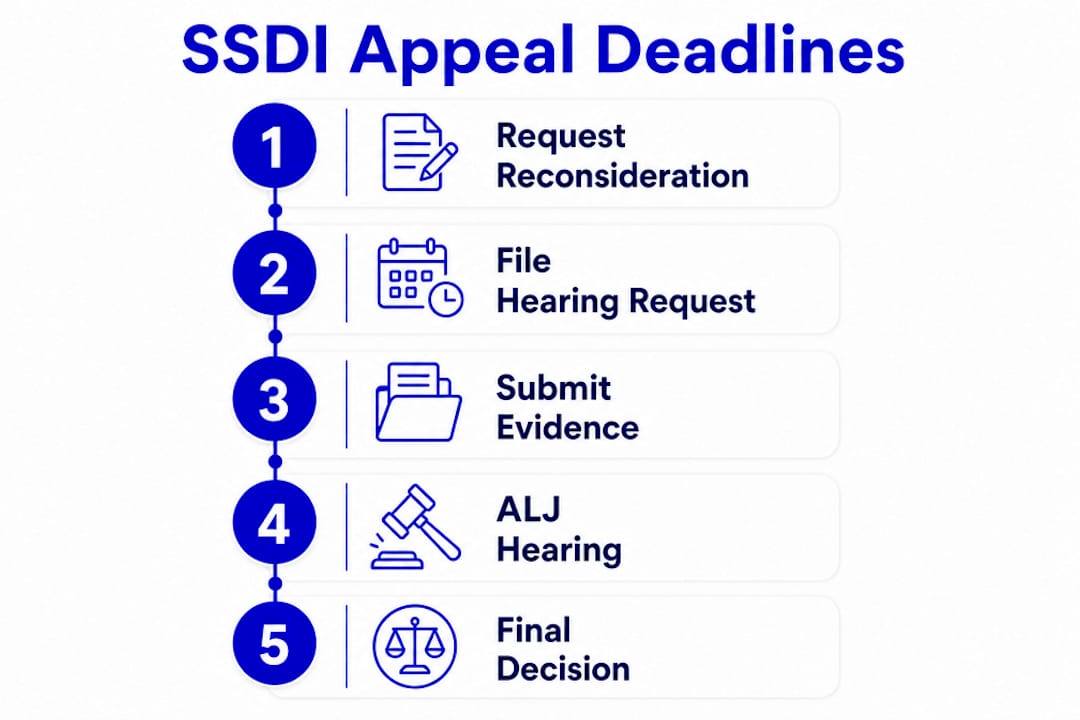
The SSA imposes firm deadlines at each stage of the disability process. Attorneys monitor these dates because a single missed filing can end a claim without any review of its medical merits.
The most critical deadline is the 60-day appeal window. After the SSA issues a reconsideration denial, claimants have 60 days to file a request for an ALJ hearing using Form HA-501. The SSA applies a 5-day mailing presumption, meaning the agency assumes the claimant received the denial letter 5 days after its printed date. In practice, this gives claimants 65 days from the notice date, but attorneys track from the printed date to avoid any ambiguity.

Evidence submission carries its own hard cutoff. New evidence must be submitted or formally identified at least 5 business days before the scheduled ALJ hearing. Evidence submitted after that point may be excluded entirely. Exclusion limits the attorney's ability to build the strongest possible case with current medical records.
The table below summarizes the main deadlines attorneys track in a standard SSDI appeal.
| Deadline type | Timeframe | Consequence if missed |
|---|---|---|
| Request for reconsideration | 60 days from initial denial | Claim closed; must restart |
| Request for ALJ hearing | 60 days from reconsideration denial | Case dismissed without hearing |
| Evidence submission before ALJ hearing | 5 business days before hearing | Evidence excluded from record |
| Response to SSA development letters | Varies; typically 10–30 days | Claim delayed or denied |
| Appeals Council review request | 60 days from ALJ decision | Federal court appeal only option |
Each of these deadlines operates independently. Missing the evidence cutoff does not restart the appeal clock, but it can weaken a case that was otherwise on track to succeed.
How disability attorneys effectively manage these timelines
Disability attorney deadline management relies on layered systems, not single reminders. Successful firms track deadlines using multiple notification channels rather than relying solely on physical mail. Physical mail can be delayed, misdirected, or simply overlooked during a busy week.
The most effective attorneys monitor the SSA's Electronic Records Express (ERE) system daily. ERE daily monitoring allows firms to catch new notices, updated decisions, and scheduling changes the day they appear, not days later when a paper letter arrives. That real-time awareness triggers immediate task creation and internal deadline setting.
Attorneys also set internal buffer deadlines. Internal due dates are set 5–10 business days before the official SSA deadline to allow time for collecting medical records, drafting documents, and completing administrative tasks. This buffer removes the pressure of last-minute filings and reduces the risk of incomplete submissions.
A well-run disability law practice uses all of the following to manage timelines:
- ERE daily monitoring to catch SSA updates in real time
- Automated calendar alerts tied to each case file
- Internal buffer deadlines set 5–10 days before official SSA dates
- Manual case reviews at regular intervals to catch anything automation misses
- Team coverage protocols so absences or high caseloads do not create gaps
Pro Tip: Treat deadline awareness as an information-flow problem. The question is not just "when is the deadline?" but "how quickly does the right person learn about it?" Attorneys who answer that second question build systems that rarely fail.
The SSDI case strategy behind effective deadline management is not about working harder close to due dates. It is about building a process that makes late filings structurally unlikely.
Why missing deadlines puts claimants at serious risk
A missed deadline in an SSDI case is rarely a minor setback. Delayed submissions can force claimants to restart the entire application process, losing months or years of potential back pay and delaying monthly benefits they may urgently need.
The SSA's policy on late filings is strict. The agency almost never allows late filings once an official deadline passes unless the claimant can prove "good cause." Good cause is a narrow legal standard. Serious illness, hospitalization, or documented agency error may qualify. Forgetting the deadline, being busy, or not understanding the process does not.
Common deadline-related mistakes and their direct consequences include:
- Filing the ALJ hearing request after 65 days: The SSA dismisses the case. The claimant must file a new application and lose all prior procedural history.
- Submitting medical evidence after the 5-business-day cutoff: The ALJ may exclude the records, leaving the case without its most current and relevant documentation.
- Ignoring SSA development letters: The SSA closes the claim for failure to cooperate, even when the underlying disability is well-documented.
- Waiting for a second notice before acting: The SSA does not always send reminders. The first notice is the only official communication.
- Assuming the attorney received the same mail: Claimants sometimes receive SSA letters that their attorney does not, especially if address records are not updated.
Consistent deadline management prevents the anxiety-avoidance cycle that causes panic, rushed filings, and incomplete applications. Attorneys who build organized systems protect clients from these outcomes before they occur.
What claimants can do to support deadline compliance
Attorneys carry the primary responsibility for tracking deadlines, but claimants play a direct role in keeping cases on schedule. The most common source of missed deadlines is not attorney error. Failing to open SSA mail promptly causes missed deadlines because the SSA counts the receipt date even if the claimant reads the notice days later.
Claimants who stay actively involved make their attorney's job more effective. The following steps reduce deadline risk significantly:
- Open all SSA mail immediately. Do not set it aside. The appeal clock starts from the date on the letter, not the date you read it.
- Forward SSA correspondence to your attorney the same day. A photo or scan sent by text or email is sufficient.
- Notify your attorney of any medical updates. New diagnoses, hospitalizations, or treatment changes affect evidence strategy and timing.
- Submit requested documents early. When your attorney asks for records or signatures, respond within 24–48 hours, not at the last minute.
- Confirm your address with both the SSA and your attorney. Address mismatches cause notices to go missing without anyone realizing it.
Pro Tip: Set a phone reminder for the date 30 days after any SSA decision letter. If you have not heard from your attorney about next steps by then, call and ask. Staying informed is not micromanaging. It is protecting your claim.
Understanding how attorneys handle disability timelines helps claimants see their own role more clearly. The attorney manages the legal process. The claimant manages the information flow from their side of the case.
Key Takeaways
Disability attorneys track deadlines because a single missed filing date can end a claim permanently, regardless of how strong the underlying medical evidence is.
| Point | Details |
|---|---|
| 60-day appeal window | File Form HA-501 within 65 days of a reconsideration denial to avoid case dismissal. |
| 5-business-day evidence rule | Submit or identify all new evidence at least 5 business days before the ALJ hearing. |
| Layered tracking systems | Attorneys use ERE monitoring, automated alerts, and internal buffer deadlines to prevent missed filings. |
| Good cause exceptions are rare | The SSA almost never accepts late filings without documented illness, hospitalization, or agency error. |
| Claimant involvement matters | Opening SSA mail immediately and forwarding it to your attorney reduces deadline risk on your end. |
Deadlines are where disability cases are won or lost
After years of watching disability cases move through the SSA system, one pattern stands out clearly. Cases do not fail because the claimant was not disabled. They fail because a procedural step was missed at the wrong moment. That is a different problem entirely, and it is one that proper legal representation solves.
What surprises most claimants is how little margin for error the SSA actually allows. The 60-day appeal window sounds generous until you factor in mail delays, gathering records, and scheduling time with your attorney. The 5-business-day evidence rule sounds simple until a treating physician takes two weeks to return a call. These are not edge cases. They are routine obstacles that experienced attorneys build their systems around.
The attorneys who consistently achieve good outcomes at ALJ hearings are not necessarily the most persuasive speakers in the room. They are the ones who showed up with complete, timely, and well-organized evidence. That outcome starts weeks before the hearing date, not the night before. Proper deadline management transforms the process from reactive scrambling to organized preparation, and that shift directly improves approval odds.
The claimants I see struggle most are the ones who assumed their attorney had everything under control and never checked in. A good attorney does have it under control. But the claimant who stays informed, opens their mail, and responds quickly makes that attorney's job significantly easier. The best outcomes come from both sides of the relationship doing their part.
— Gerard
Ssdilawyer connects you with attorneys who track every deadline
Missing a single SSA deadline can close a disability case that took months to build. Ssdilawyer specializes in connecting claimants with experienced disability attorneys who use structured deadline management to protect every stage of the SSDI process.
From the initial application through ALJ hearings and appeals, the attorneys in the Ssdilawyer network monitor SSA systems, set internal buffers, and keep cases moving on schedule. If you have received a denial or are approaching an appeal deadline, the time to act is now. Visit Ssdilawyer to connect with a disability attorney who will track every deadline in your case from day one.
FAQ
What is the appeal deadline after an SSDI reconsideration denial?
The SSA gives claimants 60 days to file a hearing request after a reconsideration denial, plus 5 days for mail delivery, making the effective window 65 days from the notice date. Missing this deadline typically results in case dismissal.
Why does a disability attorney track deadlines instead of the claimant?
Attorneys use layered systems including ERE monitoring, automated alerts, and internal buffer deadlines that most claimants cannot replicate on their own. A single missed deadline can end a claim permanently, making professional tracking a core part of legal representation.
What happens if evidence is submitted late before an ALJ hearing?
Evidence submitted after the 5-business-day cutoff before an ALJ hearing may be excluded from the record entirely. Exclusion limits the case to older documentation and weakens the attorney's ability to present a current, complete medical picture.
Can the SSA make exceptions for missed deadlines?
The SSA rarely grants exceptions to missed deadlines. Good cause exceptions apply only in narrow circumstances such as serious illness, hospitalization, or documented agency error. Ordinary delays or misunderstandings do not qualify.
How can claimants help their attorney meet SSA deadlines?
Claimants should open all SSA mail immediately, forward it to their attorney the same day, and respond to document requests within 24–48 hours. Prompt communication on the claimant's side directly reduces the risk of missed filings.