You can win an SSDI appeal without a lawyer. The path requires three things: filing within the strict 60-day deadline, submitting new medical evidence that was not part of your original claim, and preparing thoroughly for your Administrative Law Judge (ALJ) hearing. Most denials are not final. The Social Security Administration (SSA) offers four levels of appeal, and claimants who persist through those levels improve their odds considerably.
The critical success factors for self-represented appellants:
- File your appeal within 60 days of the denial notice. The SSA allows a 5-day grace period for mail, but do not rely on it.
- Submit updated medical records, specialist evaluations, and objective test results from the past 3–6 months.
- Obtain a completed Medical Source Statement or Residual Functional Capacity (RFC) form from your treating physician.
- Maintain consistent medical treatment with no unexplained gaps in your records.
- Understand each appeal stage: reconsideration, ALJ hearing, Appeals Council review, and federal district court.
- Prepare organized, specific testimony for your hearing that ties your limitations directly to your medical conditions.
- Never resubmit the same evidence that was already denied. New evidence is not optional at reconsideration; it is the difference between approval and near-certain denial.
Understanding the SSDI appeals process and its four stages
The SSA structures its appeal process in four sequential levels. You do not have to exhaust all four, but knowing what each stage involves helps you decide when to push forward and when to reassess your strategy.
Reconsideration is the first step. A different SSA examiner reviews your original file plus any new evidence you submit. Approval rates at reconsideration are typically low, which discourages many claimants from continuing. That is a mistake. Reconsideration is still worth pursuing because skipping it forfeits your right to advance.
ALJ hearing is where approval rates rise sharply, to between 45% and 62%. An Administrative Law Judge reviews your full record, hears your testimony, and may question a vocational expert about your ability to work. This stage is where most successful unrepresented claimants win their cases. Preparation here matters more than at any other level.
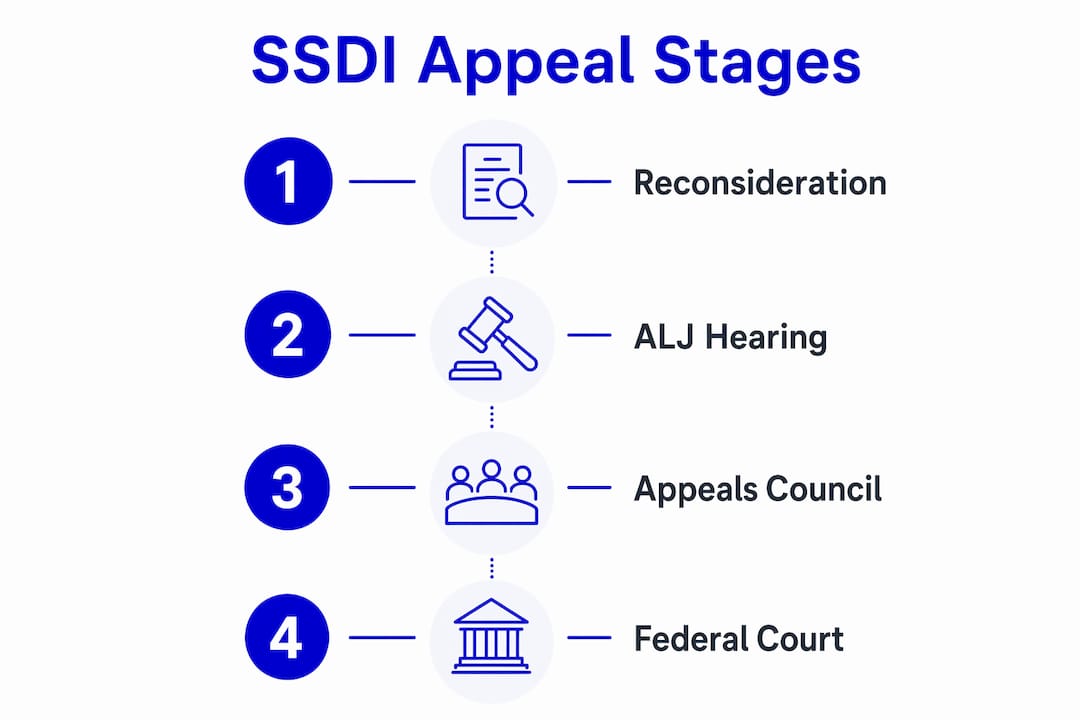
Appeals Council review follows if the ALJ denies your claim. The Council can affirm the decision, send it back to an ALJ for a new hearing, or reverse it outright. Approval rates at this level are lower than at the ALJ stage, and the process can take a year or more.
Federal district court is the final option. You file a civil action against the SSA in U.S. District Court. This stage almost always benefits from legal representation, as it involves formal legal pleadings and procedural rules that go well beyond standard SSA forms.
Persistence through multiple levels is the single most consistent factor separating claimants who eventually receive benefits from those who do not. ALJ approval rates vary by judge and by state, which means your outcome at the hearing stage is not uniform across the country.
How to file your SSDI appeal and what paperwork to submit
Filing correctly is as procedural as it is substantive. Missing a form or a deadline can end your claim regardless of how strong your medical evidence is.
Step-by-step filing for reconsideration
- Obtain Form SSA-561 (Request for Reconsideration) from your local SSA office or download it from ssa.gov.
- Complete the Disability Report (Form SSA-3441), which updates the SSA on any changes to your condition, treatment, or work activity since your original application.
- File online at secure.ssa.gov or mail your forms to your local SSA office. Online filing is faster and creates a timestamped record.
- Attach all new medical records, test results, and physician statements gathered since your initial claim.
- Keep a copy of everything you submit, including the date and method of submission.
Filing for an ALJ hearing
- If reconsideration is denied, you have 60 days from that denial notice to request a hearing before an ALJ.
- Submit your hearing request in writing or online through the SSA's iAppeals portal.
- Include a brief written statement explaining why you disagree with the reconsideration decision.
- Continue gathering medical records and submit them to your SSA eFolder as they become available, even after filing.
Key administrative tips
- The 60-day deadline applies at every stage. Missing it forfeits your claim and your original onset date, which affects backpay.
- File a protective appeal as soon as you receive a denial, even if your medical records are not yet complete. You can supplement the file before the decision is made.
- Confirm receipt of your submission with the SSA. Request a written acknowledgment or use the online portal's confirmation screen.
- Request your complete SSA file before your hearing. You are entitled to review every document the SSA has on record, and reviewing it often reveals missing records or errors.
Pro Tip: File your appeal online at ssa.gov the same day you receive a denial notice. This locks in your filing date and gives you the full remaining time to gather and submit supporting evidence before the SSA examiner makes a decision.
Preparing strong medical evidence to win your appeal
Medical evidence is the foundation of every successful SSDI appeal. The SSA's examiners and ALJs base their decisions primarily on what your medical records show, not on your verbal description of your symptoms alone.
The most persuasive evidence combines recent treatment records with detailed functional assessments. SSA gives significant weight to updated, comprehensive functional assessments from treating physicians, particularly when those assessments describe specific limitations rather than general diagnoses. A record that says "patient has chronic back pain" carries far less weight than one that says "patient cannot sit for more than 20 minutes, cannot lift more than 5 pounds, and requires rest periods every hour."
Types of evidence that strengthen your appeal
- Recent treatment records: Ideally from the past 3–6 months, showing ongoing treatment and current functional status.
- Specialist evaluations: A rheumatologist, neurologist, psychiatrist, or other specialist carries more weight than a general practitioner alone.
- Objective testing: MRI results, X-rays, pulmonary function tests, psychological evaluations, and lab work all provide measurable data the SSA can evaluate against its Listing of Impairments (the SSA Blue Book).
- Medical Source Statement or RFC form: This is a form your treating doctor completes that describes, in specific functional terms, what you can and cannot do. It is the single most valuable document you can submit.
How to get a Medical Source Statement from your doctor
Ask your treating physician directly. Explain that you are appealing an SSDI denial and that you need a written statement describing your functional limitations in detail. Many physicians are unfamiliar with SSA's RFC format, so bring a blank RFC form to the appointment. The SSA's own RFC regulations define exactly what the form should address, including physical demands like sitting, standing, walking, lifting, and carrying, as well as mental demands like concentration, persistence, and pace.
Gaps in treatment history are a serious problem. If you stopped seeing a doctor for several months, the SSA may interpret that gap as evidence that your condition is not as severe as claimed. Document every reason for any gap, whether it was cost, lack of transportation, or a change in providers.
Pro Tip: After filing your appeal, keep submitting new medical records to your SSA eFolder as they arrive. SSA examiners review all evidence in your file up to their decision date, so records submitted after your initial filing can still influence the outcome.
How to prepare for your SSDI hearing and present your case
The ALJ hearing is your best opportunity to win your SSDI appeal without a lawyer. Approval rates at this stage are substantially higher than at reconsideration, and the hearing format gives you a direct chance to present your case, respond to questions, and clarify your medical record.

What to expect at the hearing
ALJ hearings are typically held in a small conference room or by video. The judge, a hearing reporter, and sometimes a vocational expert or medical expert will be present. The proceeding is recorded. You will be placed under oath and asked questions about your work history, daily activities, and medical conditions. The vocational expert, if present, will testify about what jobs someone with your limitations could perform. You have the right to question that expert.
How to describe your limitations effectively
ALJs expect specific, detailed testimony tied directly to your medical conditions. General statements like "I feel bad most days" do not move the needle. Instead, describe concrete limitations: how far you can walk before pain stops you, how long you can sit or stand, how often you need to lie down, and how your medications affect your concentration or alertness. Connect every limitation to a specific diagnosis in your medical record.
Explain clearly why you cannot perform any substantial gainful activity (SGA). The SSA's standard is not whether you are in pain; it is whether your limitations prevent you from doing any work that exists in significant numbers in the national economy. Your testimony needs to address that standard directly.
Organizing your evidence and witness statements
Before the hearing, organize your medical records chronologically and flag the most important documents with tabs or sticky notes. Prepare a one-page summary of your medical history, key diagnoses, treating physicians, and functional limitations. Bring multiple copies.
Witness statements from family members, caregivers, or friends who observe your daily limitations can support your testimony. These statements should be written, signed, and specific. A statement that says "I help her get dressed every morning because she cannot raise her arms above her shoulders" is useful. A statement that says "she seems to be in a lot of pain" is not.
Prepare answers to the questions ALJs commonly ask:
- What is your highest level of education and past work experience?
- What conditions prevent you from working?
- How do your conditions affect your ability to sit, stand, walk, lift, and concentrate?
- What does a typical day look like for you?
- Have your conditions worsened since your original application?
Practice your answers out loud before the hearing. Specific, calm, and consistent responses carry more weight than emotional or vague ones.
Common mistakes to avoid when appealing SSDI without a lawyer
The most preventable losses in SSDI appeals come from procedural errors and evidence gaps, not from the underlying medical conditions. These are the mistakes that most often end claims before they reach the hearing stage.
- Missing the 60-day deadline. This is the most common and most permanent error. Failing to file on time forfeits your claim, your onset date, and all potential backpay. There is no standard extension.
- Resubmitting the same evidence. Sending the SSA the same records that were already reviewed and denied gives the examiner no reason to change the decision. New evidence is required at reconsideration; without it, denial is nearly certain.
- Ignoring SSA requests for consultative exams. If the SSA schedules a consultative examination (CE) with one of its contracted physicians, you must attend. Missing a CE without good cause can result in a denial based on insufficient evidence.
- Gaps or inconsistencies in medical records. Unexplained treatment gaps, symptom descriptions that contradict your records, or statements that conflict with your physician's notes all undermine credibility with the ALJ.
- Vague or unprepared hearing testimony. Walking into an ALJ hearing without rehearsed, specific answers to standard questions is one of the most avoidable ways to lose a winnable case.
- Not requesting your SSA file before the hearing. Your file may contain errors, missing records, or unfavorable reports you are unaware of. Reviewing it in advance gives you time to correct problems.
- Failing to understand SSA's disability criteria. The SSA does not evaluate whether you are sick or in pain. It evaluates whether your limitations prevent you from performing any work in the national economy. Testimony that does not address that standard directly misses the point.
Do you need a lawyer to win your SSDI appeal?
Self-representation is possible, but the statistics are clear about the tradeoffs. Claimants with attorneys win at the hearing stage at rates roughly 15–20 percentage points higher than unrepresented claimants. That gap reflects the practical advantages attorneys bring, not a bias in the system.
What a disability attorney actually does for your case
Legal representation offers specific, concrete benefits beyond general legal knowledge. Attorneys identify evidence gaps, prepare you for ALJ testimony, submit pre-hearing briefs that frame your case according to SSA criteria, and cross-examine vocational experts who might otherwise testify that you can perform jobs you realistically cannot do. These are skills that take time to develop, and unrepresented claimants often do not know what they are missing until after an unfavorable decision.
When self-representation is feasible
Cases with strong, continuous treatment records, detailed physician statements, and no contradictory evidence have the best chance of succeeding without legal help. If your medical record is clean, your RFC form is complete, and your condition clearly meets or equals an SSA Listing of Impairments, you may not need an attorney at the reconsideration or even the hearing stage.
Self-representation is harder when your case involves complex vocational issues, mental health conditions with inconsistent records, or a vocational expert who identifies jobs you allegedly can perform. Those scenarios benefit most from legal counsel.
Cost considerations
SSDI attorneys work on contingency. They collect a fee only if you win, and that fee is capped by federal law at 25% of your back pay, up to a maximum set by the SSA. You pay nothing upfront. That structure means cost is rarely a genuine barrier to getting legal representation for your appeal.
Legal aid organizations and law school clinics also provide free or low-cost representation to claimants who qualify based on income. If you are considering self-representation primarily because of cost, explore those options before deciding to proceed alone. You can also find an SSDI attorney with no upfront cost through several national referral networks.
When to seek legal help
- Your claim involves a mental health condition with inconsistent treatment records.
- A vocational expert has testified that you can perform other work.
- You have already been denied at the ALJ level.
- Your medical records contain contradictions or gaps you cannot explain.
- You are approaching the federal court stage.
2026 best practices for winning SSDI appeals without a lawyer
The SSA's procedural requirements have not changed fundamentally in recent years, but the practical landscape for self-represented claimants in 2026 reflects a few specific patterns worth knowing.
Approval rates by stage remain the sharpest predictor of where to focus your effort. Reconsideration approvals remain low at 2%–13%, while ALJ hearing approvals hold at 45%–62%. The data consistently supports pushing through reconsideration to reach the hearing stage rather than abandoning the appeal after an initial reconsideration denial.
The Medical Source Statement is the most underused tool in self-represented appeals. Most claimants submit treatment records but never ask their physician to complete an RFC form. That form, when completed with specific functional limitations, gives the ALJ a concrete framework for evaluating your claim against SSA's vocational grid rules. Without it, the ALJ relies on SSA's own medical consultants, whose assessments tend to favor the agency.
Pro Tip: File your protective appeal online at ssa.gov immediately after receiving a denial, even if your medical records are not yet complete. You can submit additional records to your SSA eFolder as they become available before the examiner issues a decision. This preserves your filing date and your onset date without forcing you to wait.
ALJ approval rates vary significantly by judge and by state. Researching your assigned judge's approval rate through publicly available SSA data can help you calibrate how thoroughly you need to prepare and whether the complexity of your case warrants legal assistance.
The two errors that most consistently end appeals before they should are missing the 60-day deadline and submitting no new evidence at reconsideration. Both are entirely preventable. Filing promptly and updating your medical record before each decision point are the two highest-return actions available to any self-represented claimant.
For claimants whose cases involve complex vocational testimony or multiple denied stages, the SSDI appeals process has enough procedural complexity that a single procedural misstep can cost years of backpay. Knowing where your case falls on that spectrum is itself a form of preparation.
Ready to strengthen your SSDI appeal?
Ssdilawyer connects denied claimants with experienced disability attorneys who work on contingency, meaning no upfront cost to you. Whether you want to review your options or get professional help before your ALJ hearing, Ssdilawyer can match you with legal counsel who knows the SSA process. Visit Ssdilawyer to get started.
Key Takeaways
Filing on time, submitting new medical evidence, and preparing specific hearing testimony are the three factors that most determine whether you can win an SSDI appeal without a lawyer.
| Point | Details |
|---|---|
| File within 60 days | Missing the deadline forfeits your claim, your onset date, and all potential backpay. |
| New evidence is required | Submitting the same records at reconsideration results in near-certain denial; updated records are not optional. |
| ALJ hearing has the best odds | Approval rates at the hearing stage are between 45% and 62%, substantially higher than at reconsideration. |
| RFC form from your doctor | A completed Medical Source Statement gives the ALJ specific functional limits to evaluate your case against SSA's vocational rules. |
| Attorneys improve hearing outcomes | Legal representation increases ALJ hearing success by 15–20 percentage points, though contingency fees mean no upfront cost. |