
Yes, disabled widows can qualify for SSDI on their own work record, provided they meet the same three tests every applicant faces: enough work credits to be insured, earnings under the Substantial Gainful Activity limit, and a five-month waiting period before payments start. If you're unsure where you stand on any of these, start pulling your work and medical records now, since appeal deadlines run fast once a decision arrives.
TL;DR:
- Disabled widows with sufficient work credits can qualify for SSDI even if their earnings are below the 2026 SGA threshold of $1,690 for non-blind individuals or $2,830 for the blind.
- Filing promptly after disability onset is crucial, as SSDI payments start in the sixth month, and delays can risk missing appeal deadlines and losing benefits.
- Medical evidence should be current and detailed, including objective test results and functional assessments, with third-party statements strengthening the case at hearings.
- Most initial SSDI applications are denied, but appeals through reconsideration, hearings, Appeals Council review, and federal court have strict 60-day deadlines that require timely action.
- Remarriage does not impact SSDI benefits based on a disabled widow’s own work record, but it's important to verify eligibility before applying and during the process.
Table of Contents
- What Qualifies a Disabled Widow for SSDI Benefits?
- How Do You Apply for SSDI Step by Step?
- What Happens If Your SSDI Claim Is Denied?
- What Medical Evidence Strengthens an SSDI Claim?
- When Should You Contact a Disability Attorney?
- Do Disabled Widows Face Different Age or Marriage Rules?
- Can You Receive SSDI and Survivor Benefits at the Same Time?
- Does Remarriage Affect Your Own SSDI Eligibility?
- Is There a Separate Disability Program Just for Widows?
- When Do Disabled Widow Benefits End or Change?
- What Should You Do Right Now?
- Get Matched With an SSDI Attorney at No Cost to You
- Sources
- FAQ
What Qualifies a Disabled Widow for SSDI Benefits?
Three checks decide almost everything. Get these right before you file, and you'll avoid the most common reasons SSA denies a claim.
Work credits. SSA generally requires that you worked in Social Security-covered jobs for at least 5 of the last 10 years before becoming disabled. Younger applicants may qualify with fewer credits, since the requirement scales with age. If your work history is spotty because you spent years caregiving or working part-time, this is the first thing to verify with SSA directly.
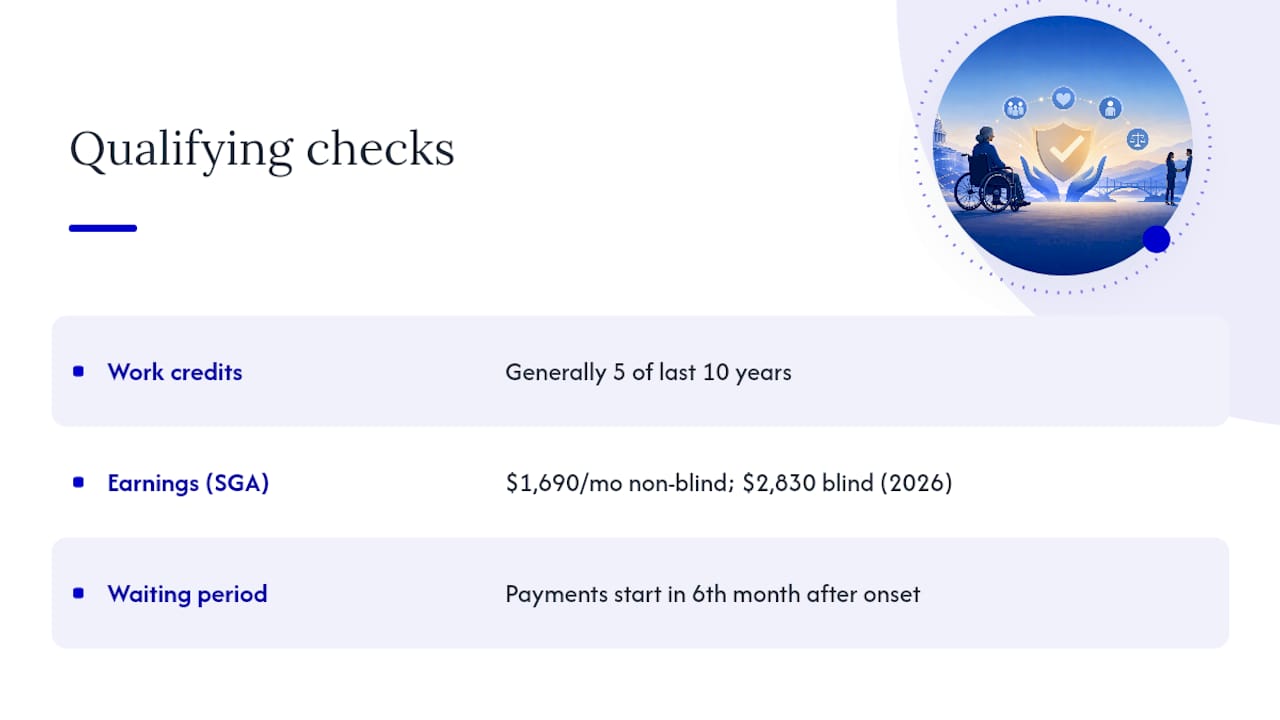
Earnings versus SGA. For 2026, the Substantial Gainful Activity threshold sits at $1,690 per month for non-blind individuals and $2,830 per month for those who are legally blind. Earn above that amount from work, and SSA will typically consider you not disabled for SSDI purposes, regardless of your medical condition.
The five-month waiting period. Once SSA establishes your disability onset date, payments begin in the sixth full month after that date. There's no way around this clock, so applying the moment your disability begins matters more than most people realize. Our SSDI waiting period guide breaks down how that timeline actually plays out month by month.
Quick check: $1,690/month (non-blind) or $2,830/month (blind) is the 2026 earnings ceiling. Cross it, and SSA generally stops the clock on your claim.
Timing also matters if your disability began close to your spouse's death. SSA can confirm exactly how the onset date interacts with survivor records, so a quick call to a local field office is worth the ten minutes it takes.
How Do You Apply for SSDI Step by Step?
Filing correctly the first time saves months. Here's the order that works.
- Apply as soon as disability begins. SSA recommends filing immediately rather than waiting, since the five-month clock starts from your onset date, not your filing date.
- Choose a filing method. Online applications work for most adults meeting basic criteria; phone and in-person appointments exist for those who need extra assistance or have complications SSA's online system doesn't handle well.
- Complete the Adult Disability Report. This form asks about your conditions, treatment, and work history in detail. Save your work often. The online system allows you to pause and resume.
- Gather your documents before you start. Having everything on hand prevents the frustrating stop-and-start that stretches applications out for weeks.
Documents SSA typically expects:
- Social Security numbers for you and your family members
- Marriage, death, and divorce dates and certificates
- Employment records, including W-2s or self-employment tax returns
- Medical records, doctors' names, and contact information
- Test results and current medication lists
- Any workers' compensation or settlement paperwork
Confirm submission before you close the browser tab or hang up the phone. SSA should give you a receipt or confirmation number. Keep it somewhere you won't lose it, because you'll need it if you ever call to check status.
What Happens If Your SSDI Claim Is Denied?
Most first-time applications get denied. That's not a dead end, it's step one of a four-stage process with strict deadlines that punish hesitation.
The four levels of appeal run in this order:
- Reconsideration — a fresh review by someone who didn't touch your original claim
- Hearing before an Administrative Law Judge (ALJ) — where most successful appeals turn the case around
- Appeals Council review — a check on whether the judge applied the rules correctly
- Federal district court — the final option if administrative appeals fail
Each stage carries a 60-day deadline from the date you receive a decision. Miss it, and you risk losing your right to administrative review entirely, which can force you to restart the whole application from scratch. SSA generally assumes you received a mailed notice five days after the date printed on it, so don't count from when you actually opened the envelope.
At the hearing stage, the ALJ leans heavily on your medical record and testimony from medical or vocational experts. New written evidence must reach the file at least 5 business days before your scheduled hearing, or the judge can exclude it. Our ALJ hearing overview covers what actually happens in that room.
Pro Tip: Mark your 60-day deadline on a calendar the day you receive any decision letter, not the day you plan to deal with it. Deadlines don't bend for a rough week.
What Medical Evidence Strengthens an SSDI Claim?
Judges weigh contemporaneous records over anything written after the fact. A treating doctor's note from the week your symptoms flared carries more weight than a summary letter written six months later for your hearing.
Start by requesting your full treatment history through record release forms sent to each provider's billing office. Ask specifically for objective test results (imaging, lab work, functional capacity evaluations) alongside your doctor's own statements about what you can and can't do physically or mentally.
Useful functional details to request from providers:
- Ability to stand, walk, or sit for defined periods
- Lifting and carrying limits
- Concentration, memory, and attention limitations
- Side effects from medication that affect daily function
Third-party statements from family members or former coworkers can back up what the medical record shows, particularly around day-to-day limitations a doctor's visit doesn't always capture. If you were self-employed, document your prior job tasks in detail. Comparing what you used to do against what you can do now is often central to a vocational argument at hearing, and self-employment records rarely spell that out clearly on their own.
When Should You Contact a Disability Attorney?
Representation matters most when your claim has already hit friction. Denials, complex medical records, and upcoming ALJ hearings are the three situations where a qualified representative tends to change outcomes.
A representative typically handles:
- Gathering and organizing medical evidence before deadlines hit
- Preparing you for hearing testimony and questioning medical or vocational experts
- Filing procedural paperwork correctly and on time
- Managing the appeal from one stage to the next without missing a step
SSA formally recognizes this relationship through the Appointment of Representative form, which makes your attorney's involvement official in your file. Ssdilawyer connects claimants with experienced disability attorneys who handle applications, denials, appeals, and hearings. You can start that process at Ssdilawyer.
Pro Tip: When evaluating a potential attorney, ask directly about their hearing experience, how they handle fee arrangements, and how often they communicate with clients during a case. Vague answers to any of those three are a red flag.
Our piece on the role of a disability attorney in your appeal walks through what representation actually looks like at each stage.
Do Disabled Widows Face Different Age or Marriage Rules?
This article focuses on SSDI eligibility based on your own work record, which is the path most disabled widows pursue when they've built sufficient work history. The standard SSDI rules apply the same way to widows as to any other applicant: insured status through work credits, medical severity meeting SSA's disability definition, and earnings under the SGA threshold.
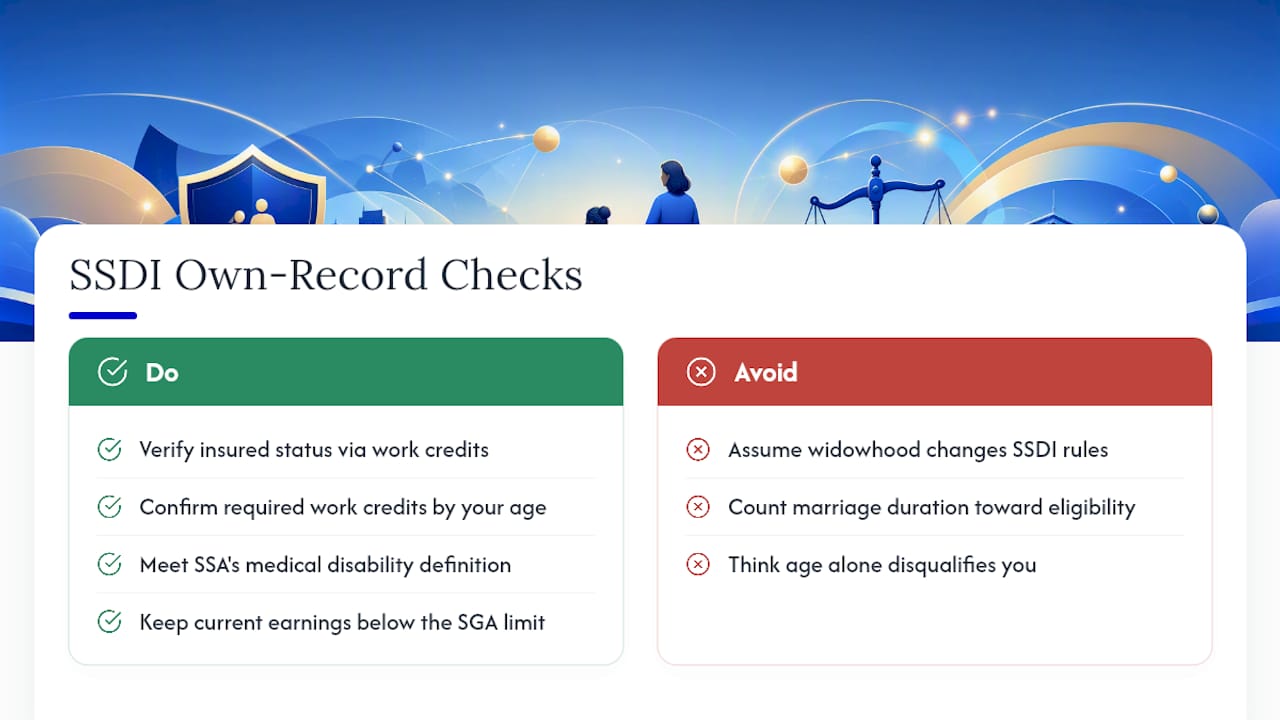
Age plays a role only in how many work credits you need. Younger workers can qualify with fewer years of covered employment, while someone who becomes disabled later in life generally needs the fuller 5-of-10-years history. There's no separate age cutoff that disqualifies a widow from filing on her own record, and marriage duration doesn't factor into this particular eligibility path at all.
Where confusion often creeps in is when people assume that widowhood itself changes SSDI's rules. It doesn't. Your work history, medical condition, and current earnings drive the decision. If you've worked and paid into Social Security long enough, your marital status is beside the point. A fuller overview of SSDI eligibility covers how these pieces fit together for any applicant, widowed or not.
If you're uncertain how your specific work history stacks up, SSA's field offices can help verify your earnings record and eligibility before you file anything.
Can You Receive SSDI and Survivor Benefits at the Same Time?
SSDI and survivor benefits both draw on Social Security's broader benefit system, but they're calculated and paid through separate processes. Your SSDI benefit comes from your own earnings record. It exists independently of anything tied to a deceased spouse's work history.
In practice, SSA looks at benefits you might be eligible for under multiple categories and generally pays whichever calculation results in the higher amount, without stacking full payments from every category simultaneously. If you're already receiving one type of benefit and believe you might also qualify under a different category based on your own work record, that's worth raising directly with SSA rather than assuming one path excludes the other.
The safest move is to apply for SSDI based on your own work record if you meet the eligibility tests outlined earlier, then let SSA determine how your full benefit picture fits together. Don't skip applying because you assume another benefit disqualifies you. SSA's own systems are built to sort out overlapping claims, and guessing at the outcome ahead of time usually costs applicants time they didn't need to lose.
Does Remarriage Affect Your Own SSDI Eligibility?
Remarriage does not affect SSDI benefits paid on your own work record. Since your disability benefit is tied to your earnings history and your insured status, getting remarried has no bearing on whether SSA continues to pay you based on that record.
This distinction trips people up because remarriage rules do affect certain benefits tied to a former spouse's record. SSDI paid on your own work history isn't one of them. If you worked enough years, paid into Social Security, and meet SSA's disability definition, your marital status going forward doesn't change the calculation.
Where this gets more complicated is if you're also exploring benefits that stem from a spouse's record rather than your own. Those categories carry their own separate rules, and remarriage can factor into that math differently. If your situation involves multiple potential benefit types, it's worth a direct conversation with SSA to confirm exactly how each piece applies before you make assumptions based on what you've read elsewhere.
Is There a Separate Disability Program Just for Widows?
Social Security does maintain benefit categories specifically for widowed individuals who are disabled, run through survivor benefit rules rather than the standard SSDI framework covered throughout this article. That program uses its own eligibility criteria, separate from the work-credit and SGA tests that govern SSDI on your own record.
This article's focus stays on SSDI eligibility through your own earnings history, since that's the path most disabled widows with a solid work record actually pursue, and it's the process where an experienced disability attorney typically adds the most value during applications and appeals.
If you're not sure which category fits your situation, SSA representatives can walk you through both options based on your specific work history and circumstances. There's no penalty for asking, and getting the right category identified early saves you from filing under the wrong framework and having to start over.
When Do Disabled Widow Benefits End or Change?
SSDI benefits paid on your own work record continue as long as you remain medically disabled under SSA's standards and your earnings stay under the SGA threshold. SSA periodically conducts continuing disability reviews to confirm your condition hasn't improved to the point where you no longer meet the disability definition.
A few events commonly trigger a change:
- Medical improvement found during a continuing disability review
- Earnings that exceed the SGA threshold ($1,690 non-blind or $2,830 blind in 2026) for a sustained period
- Reaching full retirement age, at which point SSDI typically converts to retirement benefits at the same amount
- Return to substantial work through SSA's trial work period provisions, which allow testing your ability to work without immediately losing benefits
None of these changes happen without notice. SSA sends written correspondence before making adjustments, and each one comes with its own appeal rights if you disagree with the determination. If you receive a notice that your benefits are changing or ending, treat it the same way you'd treat a denial: check the deadline, and don't let it pass without a response.
What Should You Do Right Now?
Check your work credits and your earnings against the 2026 SGA limits first. Those two numbers tell you more about your odds than anything else. While you're at it, start collecting medical records today, not after a denial letter arrives.
If your claim gets denied or a hearing is approaching, don't wait to bring in help. The procedural traps in this process, like the 60-day deadline and the 5-day evidence rule, catch people who had a strong medical case but ran out of time. Services exist to connect you with legal representatives who can assist with deadlines and appeals.
— Gerard
Get Matched With an SSDI Attorney at No Cost to You
There are services designed to help individuals unsure about their claim strength or facing denial letters with tight deadlines by connecting them with experienced SSDI attorneys who handle applications, denials, appeals, and hearings.
Submitting an inquiry to a matching service may cost nothing. You describe your situation to be matched with an attorney suited to your case type, whether that's a first-time application, reconsideration, or an upcoming ALJ hearing. Many attorneys who work through matching services operate on contingency, so getting a professional opinion early can be beneficial.
If you're ready to find out where you stand, Ssdilawyer and get matched with an attorney who can tell you exactly what your claim needs.
This article is general information, not a substitute for advice from a qualified financial advisor. Consult a qualified financial professional about your own circumstances before acting on anything here.
Sources
- Disability evaluation under Social Security (Red Book)
- How to apply for Social Security disability benefits
- POMS: DI 42010.001 - Appeals at and Above the Hearing Level - 11/28/2023
FAQ
Can a widow apply for SSDI on her own work record?
Yes, if she has enough work credits (generally 5 of the last 10 years), earns under the 2026 SGA limit, and meets SSA's disability definition.
What happens if I miss the 60-day appeal deadline?
You risk losing your right to administrative review and may have to restart your application from the beginning.
How long before SSDI payments actually start?
Payments generally begin in the sixth full month after your established disability onset date, following the mandatory five-month waiting period.
When should I hire an SSDI attorney?
Consider representation as soon as you face a denial, complex medical evidence, or an upcoming ALJ hearing. Ssdilawyer can match you with an experienced disability attorney for any of these stages.
Does remarriage affect SSDI paid on my own work record?
No. SSDI based on your own earnings history is unaffected by remarriage, since it depends on your work credits and disability status, not your marital status.