
You can ask the Appeals Council to review an unfavorable ALJ hearing decision, but the request must be in writing within the prescribed deadline of about two months after receiving that decision, and SSA presumes you received it a few days after the date on the notice. File through iAppeal or Form HA-520 immediately, keep proof of delivery, and request an extension right away if you're already past the deadline. Miss this window without good cause, and the ALJ's denial becomes final.
TL;DR:
- Filing an Appeals Council request must be done in writing within about 60 days of receiving the ALJ decision, with proof of mailing crucial if past deadline.
- The request should clearly identify legal or procedural errors, such as ignored medical evidence or procedural unfairness, rather than vague disagreements.
- Submitting new evidence is only effective if it is material and relates to the case up to the ALJ's decision date, focusing on errors rather than rearguing the entire case.
- An Appeals Council remand directs the ALJ to fix specific issues, but it does not guarantee case approval, and the process can take several months to over a year.
- Enlisting an experienced attorney can significantly improve the chances of success by effectively framing errors, building strategic briefs, and navigating procedural nuances.
Table of Contents
- How to file an appeals council SSDI request without getting dismissed
- What the Appeals Council actually reviews
- Appeals council deadlines, mailing rules, and how long review takes
- Adding new evidence and writing a focused legal brief
- What an appeals council remand means for your case
- When an attorney makes the difference at this stage
- A note on urgency and next steps
- Get matched with an attorney who knows appeals council cases
- Primary sources worth bookmarking
- Sources
How to file an appeals council SSDI request without getting dismissed
Most dismissed Appeals Council requests fail for procedural reasons, not weak arguments. Get the paperwork right first.
Start by pulling together your claim number, the exact date printed on your ALJ decision, and your representative's contact information if you have one. You'll need all three whether you file online or on paper.
- Choose your filing method. Use iAppeal for the fastest online submission, or complete Form HA-520 and mail or fax it to SSA.
- Sign it correctly. A representative can sign on your behalf in most cases, but check the form's instructions since SSA enforces signature rules strictly.
- Send it to the right place. Mail or fax your request to the hearing office listed on your denial notice, or drop it off at your local SSA field office in person.
- Keep proof. Save your certified mail receipt, fax confirmation page, or a dated stamp from the SSA office. This documentation matters enormously if your timing is ever questioned.
- Ask for more time if you need it. If you're past 60 days, submit your request anyway with a written explanation. SSA accepts "good cause" reasons like serious illness, a death in the family, or never receiving the notice because it went to the wrong address.
Only the Appeals Council can grant that extension, according to SSA's own policy manual, so don't assume silence means approval. Follow up if you don't get written confirmation.
What the Appeals Council actually reviews
The Appeals Council isn't a second hearing. It won't re-listen to your testimony or reassess your credibility the way the ALJ did. Instead, it functions as a quality control check, looking for legal or procedural mistakes in how the ALJ handled your case, according to SSA's hearing procedures.
That distinction changes how you should frame your request. Vague complaints like "the judge got it wrong" carry no weight here. Specific, documented errors do.
The most common reversible mistakes include:
- Medical evidence the ALJ ignored or never addressed in the decision.
- A residual functional capacity (RFC) finding with no clear explanation connecting the evidence to the conclusion.
- Step 5 vocational testimony that conflicts with the Dictionary of Occupational Titles without explanation.
- Failure to consider the combined effect of multiple impairments.
- Procedural unfairness, such as being denied a fair chance to present evidence.
The Appeals Council has four possible actions: deny your request (the ALJ decision stands), grant review and issue its own decision, modify or reverse the ALJ's ruling outright, or remand the case back to an ALJ with specific instructions.
Appeals council deadlines, mailing rules, and how long review takes
The 60-day clock starts the day you receive your ALJ decision, not the day it was signed. Since SSA can't know exactly when your mail arrived, the agency presumes you received it five days after the date printed on the notice. That means your real deadline is often closer to 65 days from the decision date, though you shouldn't count on that buffer if you can file sooner.
Documentation matters here more than almost anywhere else in the process. Save:
- The envelope your decision arrived in, postmarked, if you kept it.
- Any certified mail or fax confirmation showing when you submitted your request.
- A dated receipt if you dropped your filing off at a local SSA office.
If you need more time, write to the Appeals Council explaining why, citing a specific reason SSA recognizes as good cause to request an extension. Once filed, timelines vary widely. Some cases get resolved through an own-motion review notice within a few months. Others, especially those requiring detailed record review, stretch well beyond a year. Check your case status periodically by phone through your hearing office or by contacting your representative, since the Appeals Council doesn't always send progress updates on its own.
Adding new evidence and writing a focused legal brief
New evidence is considered only if it is material and relates to the time period up to your ALJ decision date. Material means it could reasonably change the outcome, not just add more detail to something the judge already considered. A new diagnosis dated after your hearing usually won't qualify unless it sheds light on a condition that existed earlier.
To submit evidence and arguments effectively:
- Identify one or two specific legal errors in the ALJ's decision rather than reargue your whole case.
- Attach labeled exhibits that directly demonstrate each error.
- Write a short brief connecting the evidence to a specific policy, ruling, or regulation.
- Submit within any deadline noted on a recommended decision, typically 20 days, or request an extension in writing before that window closes.
Pro Tip: Build what practitioners call a "logical bridge" argument, showing exactly where the ALJ's reasoning breaks down between the evidence and the conclusion. The Appeals Council responds to that kind of precision far more than to a restated version of your testimony.
What an appeals council remand means for your case
A remand sends your case back to an ALJ, often the same one, with instructions to fix a specific problem. That might mean developing more evidence, holding a supplemental hearing, rewriting the RFC explanation, or resolving a conflict with vocational testimony.
Remand is a second chance, not a finish line. The Appeals Council's remand order can vacate the entire decision or, in some cases, affirm part of it while remanding only the disputed portion. Either way, the ALJ has to follow those specific instructions on remand under federal regulations.
Here's the part claimants often miss: a remand doesn't guarantee approval. The new proceeding can still end in another denial if the underlying medical case is weak.
- If the Appeals Council denies your request instead, the ALJ decision becomes SSA's final decision.
- At that point, your remaining option is filing a civil action in U.S. Federal District Court.
- That court review looks at whether SSA applied the law correctly, not whether you're disabled in a fresh sense.
When an attorney makes the difference at this stage
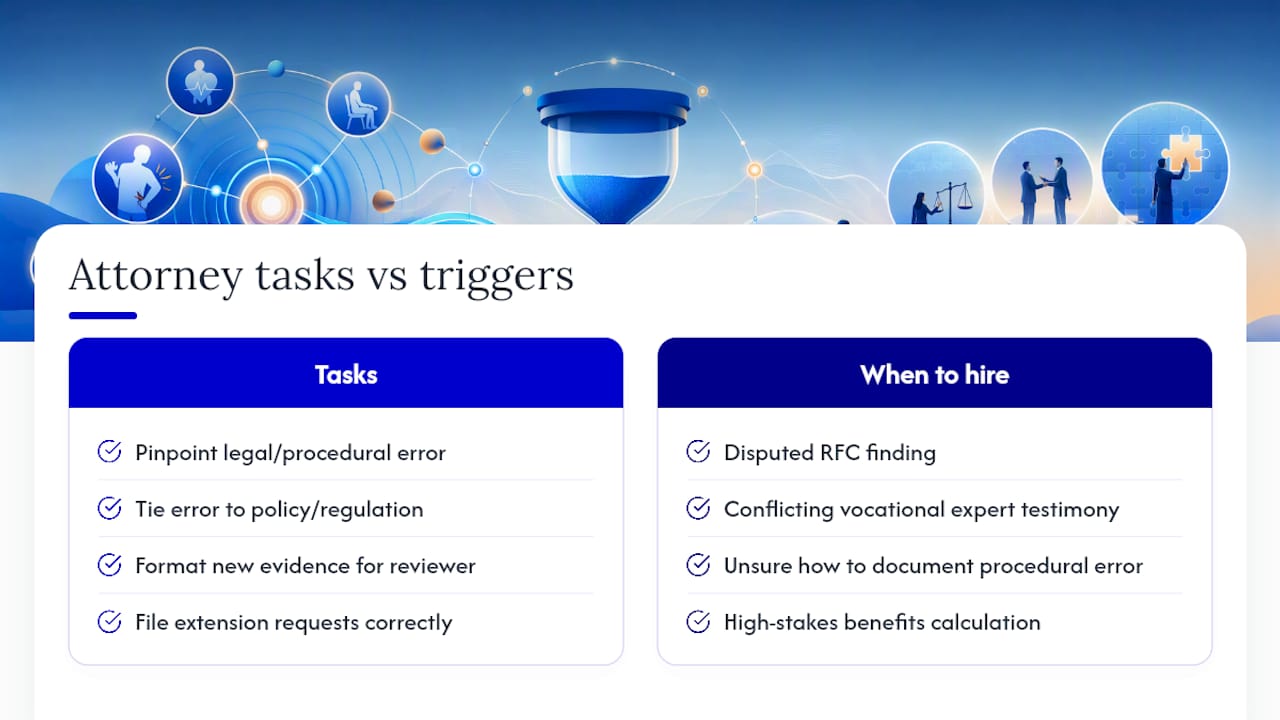
Appeals Council work is legal argument, not storytelling. An attorney experienced with this stage typically handles several concrete tasks: pinpointing the specific legal or procedural error in your ALJ decision, building a brief that ties that error to policy or regulation, formatting new evidence so it's easy for a reviewer to connect to the argument, filing extension requests correctly, and mapping out what a remand would realistically mean for your specific case.
Consider hiring counsel if your case involves a disputed RFC finding, conflicting vocational expert testimony, a procedural error you're not sure how to document, or benefits calculations significant enough that a mistake would be costly. Read more about what attorneys actually do during an appeal and how to evaluate a lawyer's track record before you commit.
A note on urgency and next steps
Sixty days moves faster than it sounds when you're also managing a medical condition. Write down the date you received your decision today, save every piece of mailing proof, and file before you feel "ready." If your case involves a complicated RFC dispute or a vocational conflict, don't wait to seek help sorting out which errors are worth arguing. Getting a second set of eyes early costs you nothing and can save the entire appeal.
— Gerard
Get matched with an attorney who knows appeals council cases
Ssdilawyer is the alternative to spending weeks searching for a disability attorney on your own, especially with a 60-day clock already running. Instead of cold-calling firms or guessing which lawyer has real Appeals Council experience, you submit your case details once and get matched with an attorney who handles this exact stage of the process, from spotting reversible errors to building the brief that supports a remand.
This fits if your denial involves a technical issue like an RFC dispute, a vocational conflict, or a procedural error you can't quite pin down yourself. It's not a guarantee of a different outcome. What it does offer is someone who reads ALJ decisions for a living helping you decide whether remand is realistic and what evidence actually moves the needle. Learn more about how attorneys build appeal strategy, then start a free case review at Ssdilawyer to see if an Appeals Council attorney is available in your area.
Primary sources worth bookmarking
- SSA: Appeals Council review process
- SSA: Form HA-520
- SSA: SSI appeals deadlines and mailing presumption
- What happens if an ALJ hearing decision is final
This article is general information, not a substitute for advice from a qualified lawyer. Consult a qualified legal professional about your own circumstances before acting on anything here.