
If your SSDI claim gets denied and you appeal all the way to an Administrative Law Judge, expect a total timeline of roughly a year to two years from your initial denial to a hearing decision. Most approvals after a denial happen at the ALJ hearing stage, not reconsideration, so this middle stage carries the most weight in your case.
The number that matters most right now isn't the wait time. It's a deadline.
- 60 days. That's how long you have to file any appeal after receiving a denial notice.
- 5 days. SSA adds this to your deadline, assuming you received the notice five days after it was mailed unless you can show otherwise.
- Miss it, and you may have to start your claim over from scratch, losing your place in line and potentially months of back pay.
Quick stat: ALJ hearings resolve more favorably for claimants than reconsideration does, which is why understanding this stage's timing matters more than any other part of your appeal.
Key Takeaways
The SSDI appeal timeline runs 12 to 24 months when a case reaches the ALJ level, and missing the 60-day filing deadline is the single most preventable cause of a claim restarting from zero.
| Point | Details |
|---|---|
| Mark your 65-day deadline | Count 60 days from the denial notice plus SSA's 5-day mail assumption, and file before that date. |
| ALJ hearing decides most cases | Most post-denial approvals happen at the ALJ hearing stage, which typically takes 9 to 18+ months to schedule. |
| Check your local hearing office | Wait times vary widely by office, so look up your specific office's average before planning around a national figure. |
| Submit evidence early, every stage | Send updated medical records as soon as you have them rather than waiting for a hearing notice. |
| Get representation before you refile | SSDILawyer.co matches claimants with attorneys who track deadlines and prepare hearing-ready files to reduce avoidable delay. |
This article is general information, not a substitute for advice from a qualified financial advisor. Consult a qualified financial professional about your own circumstances before acting on anything here.
Table of Contents
- What Is the SSDI Appeal Timeline, Stage by Stage?
- How Long Does Each Stage of an SSDI Appeal Take?
- How Do You Calculate Your 60-Day SSDI Appeal Deadline?
- What Causes SSDI Appeal Delays and How Long Do They Add?
- How Can You Speed Up an SSDI Appeal?
- What Happens After SSDI Approval: Waiting Period and First Payment
- What Should You Do Immediately After an SSDI Denial?
- How Do You Prepare Evidence for Each SSDI Appeal Stage?
- What Are the Most Common Reasons for SSDI Appeal Delays?
- Can You Get an Expedited SSDI Appeal for Severe Hardship?
- Sources
What Is the SSDI Appeal Timeline, Stage by Stage?
Every SSDI appeal moves through up to four levels, and each one serves a different function. Knowing which stage you're in, and what it actually reviews, tells you what to expect next.
- Reconsideration. A different SSA claims examiner reviews your entire file again, including any new evidence. No hearing happens here. It's a paper review that either overturns the original denial or upholds it.
- ALJ hearing. If reconsideration fails, you request a hearing before an Administrative Law Judge. This is your first chance to testify in person (or virtually) and have a judge weigh your credibility alongside the medical record. For most denied claimants, this is where the case is actually decided.
- Appeals Council. If the ALJ denies you, the Appeals Council reviews the judge's decision for legal or procedural errors. You have 60 days from the hearing decision to request this review. The Council typically does one of three things: deny your request, remand the case back to an ALJ, or (rarely) reverse the decision outright.
- Federal court. If the Appeals Council denies review or upholds the ALJ's decision, your final option is filing a civil action in U.S. District Court. This is a judicial review, not a new hearing, and it moves at the pace of the federal court system rather than SSA's internal process.
Reconsideration is mandatory in most states before you can request a hearing. A handful of "prototype" states skip it, sending denied initial claims straight to the ALJ level. Check your state's rules before assuming you know which stage comes next.
How Long Does Each Stage of an SSDI Appeal Take?
National averages give you a baseline, but your actual wait depends heavily on where you live and which hearing office handles your case. Here's what SSA data and current industry reporting show for 2026.
| Appeal Stage | Typical Time Range | What Drives the Variance |
|---|---|---|
| Reconsideration | several months | Volume of medical evidence needed and quality review backlog |
| ALJ hearing (scheduling to decision) | typically many months, varying by location | Local hearing office caseload and judge availability |
| Appeals Council | several months up to more than a year | Complexity of the legal issue raised and current AC backlog |
| Federal court | approximately one to two years or more | District court docket and complexity of the record |
SSA's own reconsideration processing time dataset calculates the average using transit time, the medical determination itself, and quality review, and the agency has published this methodology since fiscal year 2014. The wider ranges reported by legal industry analyses reflect real state-by-state and office-by-office differences, not inconsistent measurement.
Statistic to remember: the ALJ hearing stage is both the longest wait and the stage where most reversals happen. That combination is exactly why preparation before your hearing date matters more than preparation at any earlier stage.
Federal court is the outlier, and understanding Social Security benefits rules relevant for claimants after complex cases such as divorce can help you navigate entitlement issues more smoothly. Very few SSDI cases reach this level, and the ones that do involve genuine legal disputes rather than factual disagreements about disability status.
How Do You Calculate Your 60-Day SSDI Appeal Deadline?
Start counting from the date on your denial notice, not the date you opened the envelope. SSA assumes you received that notice five calendar days after the postmark date unless you can prove a later delivery date, so your real deadline is 65 days from the notice date in most cases.
Filing itself doesn't require a specific form. SSA provides Form HA-501-U5 for hearing requests, but POMS guidance confirms that any written statement clearly expressing your intent to appeal satisfies the requirement. You can also file online through your SSA account or in person at your local field office.
If you're going to miss the deadline:
- Contact your local SSA office immediately, before the deadline passes if possible.
- Document the reason in writing. "Good cause" for a late filing includes serious illness, a death in the family, or never receiving the notice at all.
- Submit a written request for an extension along with your late appeal. SSA has discretion to accept it, but discretion isn't a guarantee.
- Keep copies of everything, including the envelope or any digital timestamp showing when you actually received the notice.
Read your denial letter carefully the day it arrives. The clock is already running whether you open it that day or three weeks later.
What Causes SSDI Appeal Delays and How Long Do They Add?
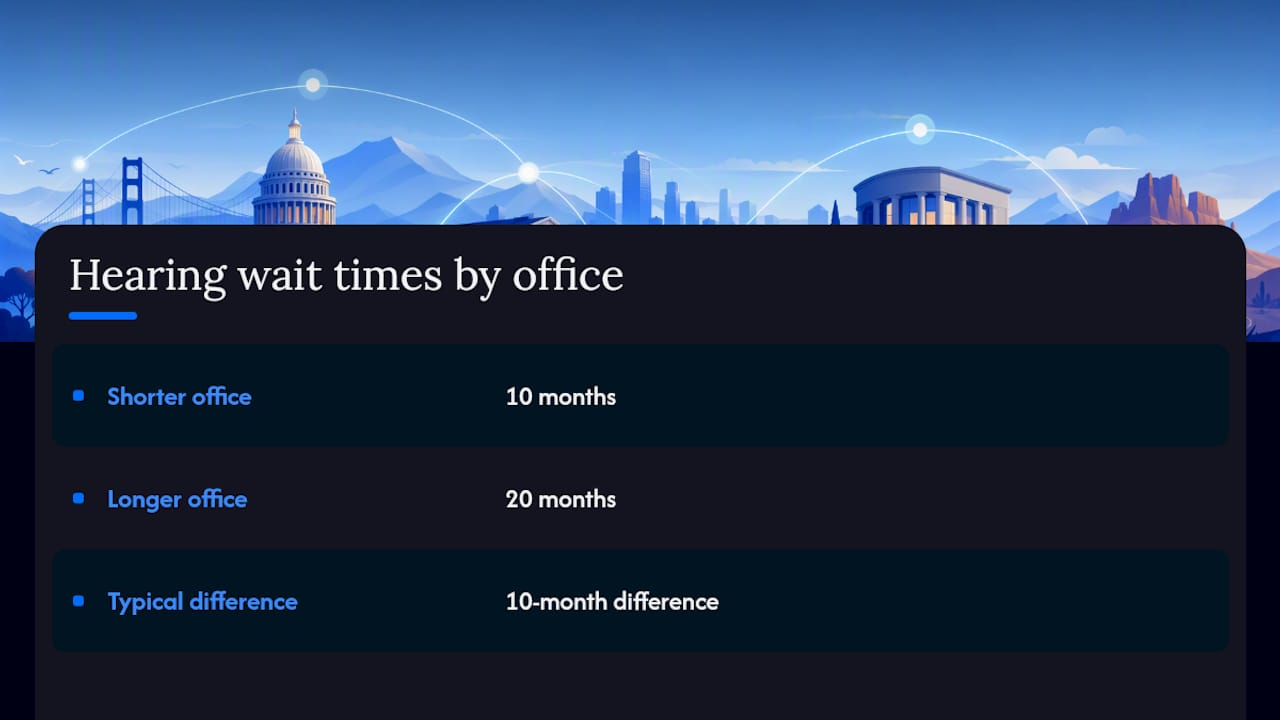
Hearing office backlog is the single biggest driver of how long your appeal takes, and it varies enormously by location. SSA publishes an Average Wait Time Until Hearing Held report for every hearing office in the country, updated monthly. A claimant in one office might wait ten months for a hearing date while someone in another region waits twenty.
Incomplete medical records cause the second-biggest category of delay. If your file is missing recent treatment notes or the judge orders a consultative exam to fill a gap, that adds weeks or months before a decision can even be scheduled. Remands from the Appeals Council back to an ALJ restart much of the clock, too.
Hearing format has shifted the landscape somewhat. SSA's performance data shows a steady rise in virtual and telephonic hearings since 2019, and offices offering video hearings often schedule them faster than in-person slots.
Pro Tip: Look up your specific hearing office's average wait time before assuming a national figure applies to you. A ten-month difference between offices is common, and knowing your number helps you plan financially instead of guessing.
How Can You Speed Up an SSDI Appeal?
You can't control hearing office backlog, but you control how complete and organized your file is, and that affects scheduling more than most claimants realize.
- Submit all medical evidence early. Don't wait for a hearing notice to send updated records. Every treatment note, test result, and specialist letter should reach SSA as soon as you have it.
- Ask about an on-the-record (OTR) decision. If your medical evidence is strong enough to leave no real question about disability, a representative can request that a judge decide your case without a hearing at all, potentially cutting months off your wait.
- Request a virtual hearing where offered. Video and telephonic formats often get scheduled faster than in-person hearings simply because there's more judge availability for them.
- Work with a representative who tracks deadlines and files exhibits proactively. Attorneys who handle appeals regularly know which records a judge will ask for before the judge asks.
Pro Tip: Requesting an in-person hearing instead of a virtual one can sometimes lengthen your wait, but if your case depends heavily on the judge assessing your credibility in person, that trade-off may be worth it. Talk it through with your representative rather than defaulting to whichever option sounds faster.
What Happens After SSDI Approval: Waiting Period and First Payment
Approval isn't the finish line. SSDI carries a mandatory five-month waiting period, calculated from your established disability onset date, before benefits begin. If your onset date was determined to be eight months before your approval, you've likely already satisfied part or all of that waiting period.
- First payments typically arrive within a few months after your decision, once SSA finalizes back pay calculations and payment processing.
- Back pay covers the period from your onset date (plus the five-month wait) through your approval, often arriving as a lump sum separate from your ongoing monthly payment.
- If a remand pushed your case back through the system, your timeline resets to whatever new decision date results.
- Check your online SSA account or call your local office if a payment doesn't arrive when expected. Delays happen, and following up matters more than waiting quietly.
What Should You Do Immediately After an SSDI Denial?
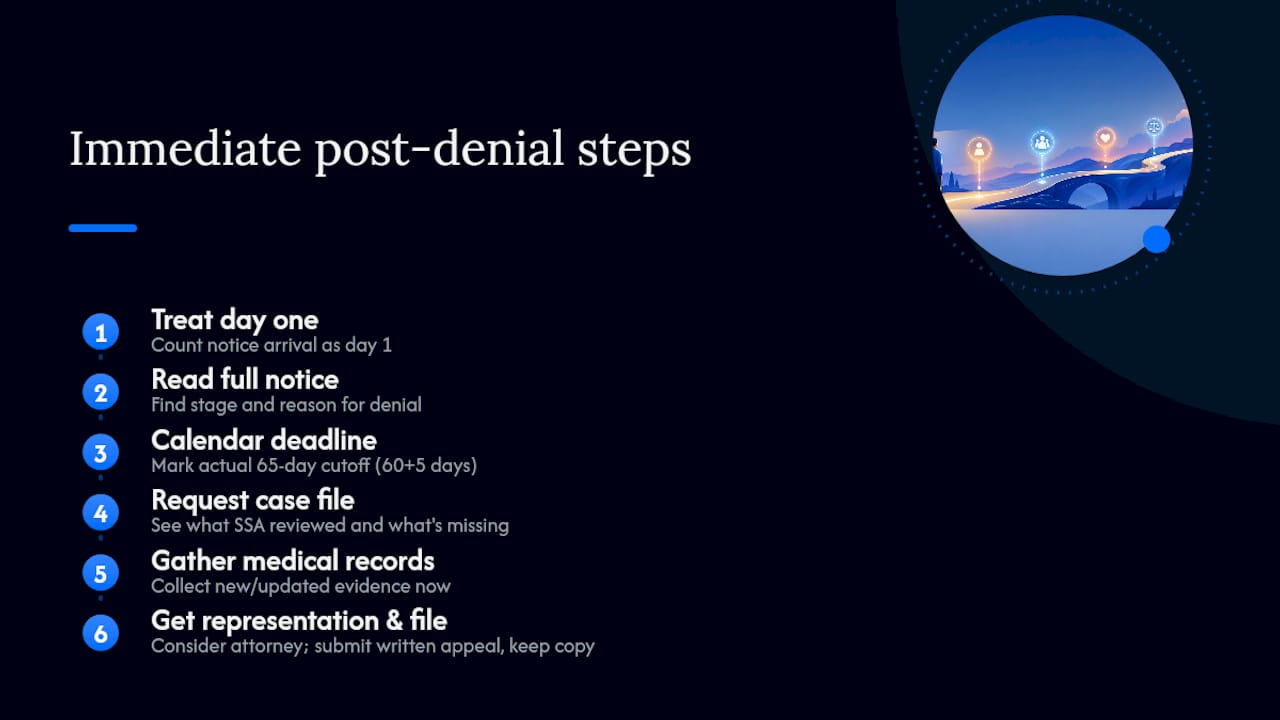
The first 60 days after a denial determine whether you keep your place in the process or start over. Treat the day the notice arrives as day one, not the day you feel ready to deal with it.
First, read the entire notice, not just the decision line. It explains which stage denied you and why, whether that's insufficient medical evidence, a finding that you can still work, or a technical eligibility issue. That reasoning shapes your entire appeal strategy.
Second, calendar your deadline immediately. Mark the actual 65-day cutoff (60 days plus SSA's 5-day mail assumption), not a vague "couple months" estimate. Missing this date because you lost track of time is one of the most preventable mistakes claimants make.
Third, request your case file if you haven't already. Knowing exactly what evidence SSA reviewed, and what's missing, tells you what to gather before the next stage.
Fourth, start collecting new and updated medical records now rather than waiting for a hearing notice. Reconsideration and ALJ review both benefit from a thicker, more current file.
Fifth, consider getting representation before you file the next appeal, not after. A disability attorney can review your denial reasoning and file the appeal correctly the first time, which avoids the kind of procedural delays that add months to an already long process.
Finally, submit your appeal request in writing, keep a copy, and note the submission date. Whether you file online, by mail, or in person, proof of timely filing protects you if a dispute ever arises about your deadline.
How Do You Prepare Evidence for Each SSDI Appeal Stage?
Evidence requirements shift as your case moves up the appeals ladder, and submitting the right documentation at the right stage prevents avoidable delays.
At reconsideration, focus on filling gaps the initial denial identified. If SSA said your evidence didn't establish severity or duration, submit updated treatment records, imaging, and specialist opinions that directly address that finding. This stage is a paper review, so everything must be in writing.
At the ALJ hearing stage, evidence submission has a hard cutoff: generally five business days before your hearing date under SSA's rules. Beyond medical records, this is where a treating physician's statement about your functional limitations carries real weight, since the judge will also hear your live testimony. Prepare a clear, honest account of your daily limitations, not a rehearsed script, because judges notice inconsistency between testimony and the written record.
At the Appeals Council, you're not submitting new medical evidence in most cases. You're arguing that the ALJ made a legal or procedural error, misapplied a regulation, ignored evidence, or reached a conclusion the record doesn't support. This requires a written brief, and it's a fundamentally different task than assembling medical records.
At federal court, the record is closed. The court reviews what's already there rather than accepting new evidence, which makes the ALJ hearing stage your last real opportunity to shape the file.
What Are the Most Common Reasons for SSDI Appeal Delays?
At reconsideration, the top delay driver is incomplete initial submissions. If your first application lacked recent treatment records, the examiner often has to request them independently, adding weeks. Submit everything upfront rather than assuming SSA will chase down what's missing.
At the ALJ hearing stage, delays mostly come from hearing office backlog, which is why checking your local office's average wait time matters so much. A secondary cause: consultative exams. If your medical record doesn't clearly establish the severity of your condition, SSA may order an exam with its own doctor, and scheduling that exam alone can add months.
At the Appeals Council, delays often stem from case complexity rather than backlog alone. A straightforward request for review moves faster than one alleging multiple legal errors, since each argument requires its own analysis.
At federal court, delays follow the same pattern as any civil litigation: docket congestion, briefing schedules, and the sheer procedural formality of federal cases. There's no shortcut here beyond having competent legal representation.
The single most avoidable delay across every stage is a disorganized or incomplete file. Requesting your own case file early and reviewing it for gaps before you submit new evidence at any stage prevents the back-and-forth that eats months.
Can You Get an Expedited SSDI Appeal for Severe Hardship?
SSA offers expedited handling for specific hardship situations, and if you qualify, it changes your timeline dramatically. The most well-known pathway is Compassionate Allowances, reserved for conditions SSA has pre-identified as clearly meeting disability standards, certain aggressive cancers, rare disorders, and specific terminal illnesses. These cases can be decided in days or weeks rather than months.
A related option, the Terminal Illness (TERI) designation, flags a case for expedited processing at any stage, including during an appeal, when medical evidence indicates a terminal prognosis. Your representative or the treating physician typically needs to alert SSA directly that TERI processing applies, since it isn't always applied automatically.
For severe financial hardship that doesn't meet Compassionate Allowances or TERI criteria, you or your representative can request dire-need processing, citing risk of homelessness, inability to afford medication, or similar circumstances. This request should be made in writing, addressed to your servicing field office or hearing office directly, and should include documentation supporting the hardship claim.
None of these expedited pathways skip the appeal levels themselves. They compress the time within each level. If you believe your case qualifies, raise it immediately after your denial rather than waiting until you're deep into the standard timeline, since expedited flags are far more useful early than late.
What Timing Surprises Come Up Most Often in SSDI Appeals?
The biggest surprise clients run into isn't the wait itself. It's discovering, mid-hearing, that a single missing set of treatment records from two years ago is what stalled everything. That gap often traces back to a claimant assuming a doctor's office would send records automatically. It rarely happens without someone following up directly.
Organization is the difference between a 12-month appeal and an 18-month one. SSDILawyer.co connects claimants with attorneys who track filing deadlines and chase down records before a judge ever asks for them.
— Gerard
How Can SSDILawyer.co Help With Your SSDI Appeal?
You've just read how much a complete file and a tracked deadline matter at every stage of an SSDI appeal. That's precisely the gap SSDILawyer.co closes for claimants navigating this process alone.
SSDILawyer.co connects you with experienced disability attorneys who handle the procedural work that most often causes avoidable delay: filing your appeal within the 60-day window, requesting records before a hearing notice forces the issue, and preparing exhibits so your ALJ hearing doesn't get bogged down waiting on missing documentation. A representative can also evaluate whether an on-the-record decision, a virtual hearing, or expedited processing fits your situation, options that are easy to miss without someone who works these cases regularly.
If you've received a denial or you're heading into a hearing without representation, Ssdilawyer now and get your case reviewed before your next deadline arrives.