Receiving a denial letter from Social Security means one thing above all else: you have 60 days from the date you receive the notice to file a written appeal, or you lose your right to contest that decision. This deadline applies to each level of the SSA appeal process: initial reconsideration, hearing before an Administrative Law Judge, Appeals Council review, and federal district court. Begin with reconsideration after most denials. Ssa — the SSA identifies this as the fastest method. Do not wait for a second opinion or more records before acting. The deadline runs regardless.
Your initial checklist to start promptly after receiving the denial letter:
- Photograph or scan the SSA denial letter and note the exact date you received it.
- Locate the decision date printed on the notice and identify the reason code(s) listed.
- Contact your treating providers and request that your medical records be prepared for release.
- Consider contacting a disability attorney or qualified representative immediately, before filing.
- File your appeal (reconsideration is the standard first step) within 60 days of receipt.
Deadline note: It is generally presumed that the denial letter was received within 5 days of the date printed on the notice. If you received it later, you must prove it with tracking records, certified mail receipts, or a dated photograph of the envelope. Missing the 60-day window typically requires starting your application over.
Key Takeaways
Filing your appeal within 60 days of receiving the SSA denial letter is the single most critical action — missing that deadline typically requires starting the entire application over.
| Point | Details |
|---|---|
| 60-day filing deadline | File your written appeal within 60 days of receiving the denial letter, or you lose that appeal right. |
| Four appeal levels | Reconsideration, ALJ hearing, Appeals Council, and federal court — start at reconsideration in nearly every case. |
| Treating-source evidence | RFC forms and signed statements from your treating physician are the most persuasive evidence on appeal. |
| 5-business-day hearing rule | Submit new evidence at least 5 business days before your ALJ hearing or it may be excluded from the record. |
| Ssdilawyer | Connects claimants with disability attorneys for denials, appeals, and hearings — have your denial letter and medical list ready before contact. |
Table of Contents
- What does an SSA denial letter actually say?
- How do the four SSA appeal levels compare?
- How to file your SSA appeal step by step
- What evidence does the SSA need for your appeal?
- Should you hire a disability attorney or representative?
- What happens at an ALJ hearing?
- Common denial reasons and how to address them on appeal
- What to do if your appeal is denied again
- What the denial rate tells you about persistence
- Ssdilawyer connects you with disability attorneys who handle denials
- Official SSA resources to use right now
- Sources
What does an SSA denial letter actually say?
Every SSA denial letter follows a standard structure. Reading it correctly determines which appeal you file and what evidence you need.
Key fields to locate:
- Decision date: Printed near the top. This is the date the SSA made its determination, not the date you received the letter.
- Reason codes: The letter states whether the denial is based on medical grounds (insufficient objective evidence, residual functional capacity conclusions, consultative exam findings) or non-medical grounds (excess income or resources for SSI claimants).
- Appeal deadline language: The letter explicitly states your right to appeal and the 60-day window. Find the page or URL the SSA lists for online filing — typically the Disability Appeal online application.
- Notice type: Confirm whether the document is an initial denial, a reconsideration determination, or a medical review notice. Each triggers a different next appeal level.
Pro Tip: If your envelope is missing or you cannot confirm the receipt date, photograph the letter next to a dated newspaper or your phone's date display immediately. USPS tracking numbers and certified mail receipts are the strongest proof if the SSA questions your timeline.
How do the four SSA appeal levels compare?
The SSA appeal process has four distinct levels. Most claimants start at reconsideration and do not need to reach federal court.
| Appeal Level | What It Is | Typical Wait | Best Used When |
|---|---|---|---|
| Reconsideration | A different SSA examiner reviews the full file | Several months | First step after any initial denial |
| ALJ Hearing | Hearing before an Administrative Law Judge | Over a year | Reconsideration denied; new evidence available |
| Appeals Council | Reviews ALJ decision for legal error | Over a year | ALJ ruling contains procedural or legal error |
| Federal District Court | Civil action in U.S. District Court | Variable | Appeals Council denies or refuses review |
Decision path guidance:
- Proceed to reconsideration first in virtually every case. Skipping it forfeits that level.
- Move to an ALJ hearing when reconsideration is denied and you have updated medical evidence or a treating-source statement not previously in the record.
- Request Appeals Council review when the ALJ made a legal error or ignored material evidence, not simply because you disagree with the outcome.
- Federal court is a last resort and typically requires an attorney familiar with federal disability litigation.
How to file your SSA appeal step by step
Online filing (recommended)
The Disability Appeal online application lets you request a medical appeal, update medical information, and sign the medical release form electronically. Online submission creates a timestamped record of what you filed and when.
- Go to ssa.gov/disability/appeal and log in or create a my Social Security account.
- Select the appeal type that matches your denial level (reconsideration for an initial denial).
- Enter the decision date from your denial letter exactly as printed.
- Upload supporting documents. The SSA accepts .doc, .docx, .tif, .tiff, and .pdf formats; PDF is the most reliable.
- Complete and sign the medical release electronically (replaces paper Form SSA-827).
- Save or print the confirmation page as your submission receipt.
Paper filing
Form SSA-561 (Request for Reconsideration) is the standard paper form for reconsideration. For medical appeals, attach Form SSA-827 (Authorization to Disclose Information to SSA) to authorize release of your medical records.
Document checklist for paper submission:
- Completed Form SSA-561 with the decision date from your denial letter
- Form SSA-827 signed and dated
- Copies (not originals) of any new supporting medical records
- A cover sheet listing every document enclosed, with page counts
Deliver to your local SSA office in person and request a date-stamped receipt, or mail via USPS certified mail with return receipt requested.
Pro Tip: Name uploaded files descriptively before submitting: "Smith_MRI_Lumbar_2025-11.pdf" rather than "scan001.pdf." Adjudicators reviewing large files locate specific records faster, and a clear file name signals an organized, credible submission.
What evidence does the SSA need for your appeal?
The SSA's evidence checklist prioritizes recent treating records, objective test results, and signed medical source statements when re-evaluating claims.
Evidence to gather:
- Treating physician records from the past 12 months, including office notes and progress reports
- Objective test results: imaging (MRI, X-ray, CT), lab work, pulmonary function tests, or cardiac studies
- Hospital admission and discharge summaries
- Medication lists with dosages and prescribing providers
- Therapy notes (physical, occupational, mental health)
- Medical source statements (treating-source RFC forms) completed and signed by your primary treating provider
- Specialist records relevant to the conditions listed in the denial
Requesting records from providers:
Ask each provider in writing for "all records related to treatment of [condition] from [date] to present, including office notes, test results, imaging reports, and any functional assessments." Reference Form SSA-827 as the authorization already on file, or attach a signed copy directly to your request.
Pro Tip: A treating-source RFC form completed by your physician carries more weight than a consultative exam arranged by the SSA. Ask your doctor to document specific functional limits — how long you can sit, stand, or lift — rather than a general statement about your diagnosis. Specific numbers tied to work-related functions are what adjudicators need.
Should you hire a disability attorney or representative?
The SSA explicitly allows claimants to appoint an attorney or qualified representative at any point in the appeal process. Early involvement tends to improve evidence collection and procedural compliance.
When representation materially helps:
- Complex or voluminous medical records requiring organization and summary
- Preparing for an ALJ hearing, including cross-examining vocational experts
- Identifying and correcting procedural errors from earlier appeal levels
- Drafting targeted treating-source statements and hearing briefs
When self-representation may be reasonable:
- A straightforward reconsideration with a clear, correctable record gap
- Non-medical SSI denials based on a single, documentable income or resource issue
Appointing a representative:
Form SSA-1696 (Appointment of Representative) is the standard authorization form. The SSA requires it to communicate directly with your attorney and to release file information to them.
Questions to ask a potential attorney:
- How many SSDI and SSI cases have you handled at the ALJ hearing level?
- Who in your office will manage my file day to day?
- What is your fee structure, and is it contingency-based?
- What is your estimated timeline for my appeal level?
- What records do you need from me before you can assess the case?
For claimants who want to connect with an experienced disability attorney, Ssdilawyer explains the practical benefits of legal representation at each appeal stage. Have your denial letter, medical provider list, and most recent test results ready before making contact.
What happens at an ALJ hearing?
An ALJ hearing is a formal proceeding, usually lasting under an hour, held in person or by video. Form HA-501 is required to request the hearing.
Hearing checklist:
- Original denial letter and any prior reconsideration determination
- A complete list of all medical evidence submitted to the record
- Contact information for any treating providers who may submit written statements
- A brief summary of your work history and functional limitations
Who testifies:
- The claimant (you) answers questions from the ALJ and your representative.
- A vocational expert (VE) testifies in most hearings about available jobs given your limitations.
- Treating or examining doctors may submit written statements or appear by phone.
The 5-business-day evidence rule: New evidence must generally be submitted at least 5 business days before the scheduled hearing. Evidence submitted late may be excluded, which weakens your procedural posture if the case later goes to the Appeals Council. Plan all submissions well in advance.
Sample questions to prepare for:
- Describe a typical day from waking to bedtime.
- What activities can you no longer do that you could do before your condition worsened?
- How often do you see your doctors, and what treatments have you tried?
- Have you attempted any work or volunteer activity since your alleged onset date?
Common denial reasons and how to address them on appeal
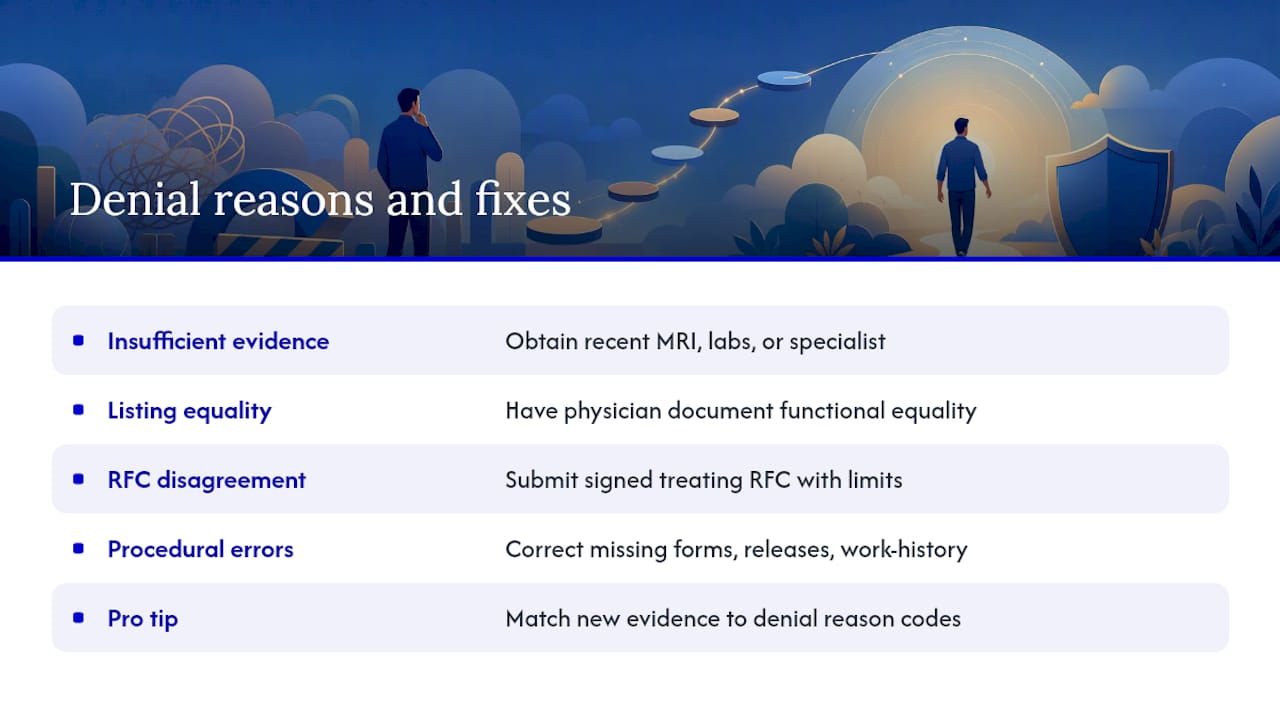
Insufficient objective medical evidence. Obtain recent imaging, lab work, or specialist evaluations. A single updated MRI or functional capacity evaluation can change the RFC conclusion.
Failure to meet or equal a Listing. If the SSA found you do not meet a listed impairment, ask your treating physician to document how your combined conditions functionally equal the Listing's criteria. Treating-source statements that map symptoms directly to Listing requirements are the most direct fix.
Residual functional capacity (RFC) disagreement. The SSA's RFC may overstate what you can do. A completed RFC form from your treating provider, with specific limits on sitting, standing, walking, and lifting, directly counters the SSA's assessment.
Procedural errors. Missing forms, unsigned releases, or incomplete work history reports can trigger denials unrelated to your medical condition. Review the denial letter's reason codes carefully and correct any administrative gap before resubmitting.
Pro Tip: Match your new evidence directly to the reason codes in the denial letter. If the letter cites "lack of treating source opinion," your next submission should lead with a signed RFC from your physician. Generic record dumps without a cover letter explaining relevance are easy for adjudicators to overlook.
What to do if your appeal is denied again
Next steps in order
- Request Appeals Council review. File within 60 days of the ALJ's unfavorable decision. The Appeals Council considers whether the ALJ made a legal or procedural error, not simply whether it agrees with the outcome.
- File in federal district court. If the Appeals Council denies or refuses review, you have 60 days to file a civil action in U.S. District Court. This step almost always requires an attorney with federal litigation experience.
Checking your case status:
- Log in to your my Social Security account at ssa.gov for current status updates.
- Contact your local SSA office directly by phone or in person.
- Ask your representative to request a copy of the administrative file and any pending notices.
If you missed the 60-day deadline:
Request a good-cause extension in writing as soon as possible. Explain the reason for the delay and attach supporting documentation: a hospital record showing you were incapacitated, a postal tracking printout showing delayed delivery, or a signed statement from a treating provider. The SSA evaluates extension requests case by case, and approval is not guaranteed. Missing the window without an approved extension typically requires filing a new application.
What the denial rate tells you about persistence
Most initial SSDI applications are denied. The appeal process exists precisely because the SSA's initial review is limited in scope, and the ALJ hearing level historically produces more favorable outcomes than reconsideration alone. The 60-day deadline is the single point of failure that ends more valid claims than any medical finding. Meeting it, then building a focused record around the specific reason codes in the denial letter, is the pattern that gives an appeal its best chance.
Treating-source evidence is the lever most claimants underuse. A denial that cites "insufficient objective evidence" is not a final verdict on your condition. It is a specific instruction about what the record is missing. Experienced attorneys know which RFC details and provider language carry weight with adjudicators, and that targeted approach to evidence is what separates a successful appeal from a repeat denial.
Ssdilawyer connects you with disability attorneys who handle denials
Facing a denial without legal guidance means navigating forms, deadlines, and evidence rules on your own. Ssdilawyer connects claimants directly with experienced disability attorneys who handle SSDI and SSI denials, appeals, and ALJ hearings.
Before submitting a request, have these documents ready: your SSA denial letter (with the decision date visible), a list of your treating providers and their contact information, your most recent medical records or test results, and your Social Security number. Having this information prepared speeds the intake process and allows an attorney to assess your case quickly.
Connect with a disability attorney through Ssdilawyer to get matched with representation suited to your appeal level and medical situation.
Official SSA resources to use right now
These are the primary sources for forms and filing referenced throughout this article:
- Ssa: Overview of all four appeal levels and how to start the process.
- Disability Appeal online application: File a medical appeal, update medical information, and sign the release form electronically.
- Form SSA-561 (Request for Reconsideration): Standard paper form to request reconsideration; attach SSA-827 for medical appeals.
- Form SSA-827 (Authorization to Disclose Information to SSA): Authorizes your providers to release medical records to the SSA.
- Form HA-501 (Request for Hearing by ALJ): Required to request an ALJ hearing; contains the 5-business-day evidence submission rule.
- Information You Need to Complete Your Disability Appeal: SSA checklist of required information and accepted file formats for electronic submissions.
- SSA local office locator: Available at ssa.gov/locator for in-person filing and certified mail delivery addresses.
- Publication No. 05-10058 ("Your Right to Question the Decision Made on Your Claim"): Ssa — explains appeals rights and next steps in plain language.
This article provides general information about the SSA appeals process and is not a substitute for legal advice. Consult a qualified disability attorney or contact the SSA directly to confirm current rules and deadlines that apply to your specific case.
Sources
- Appeal a decision we made | SSA
- Form HA-501 | Request For Hearing By Administrative Law Judge | SSA
- Information You Need To Complete Your Disability Appeal | SSA
- What You Need to Know When You Get Social Security Disability Benefits | SSA (EN-05-10153)
- Form SSA-561 | Request for Reconsideration | SSA
- Social Security Express: Appeal a decision | SSA